RETHINKING CARBON 14 DATING; AGE OF EARTH

 email this
 share this
 tweet this

Evolutionists have long used the carbon-14, or radiocarbon, dating technique as a “hammer” to bludgeon Bible-believing Christians. A straightforward reading of the Bible describes a 6,000-year-old universe, and because some carbon-14 (14C) age estimates are multiple tens of thousands of years, many think that the radiocarbon method has soundly refuted the Bible’s historical accuracy.

However, these excessively long ages are easily explained within the biblical worldview, and 14C actually presents a serious problem for believers in an old earth. 14C has been detected in organic specimens (coal, wood, seashells, etc., containing carbon from formerly living organisms) that are supposedly hundreds of millions of years old—but no detectable 14C should be present in specimens that are even a little more than 100,000 years old! Nearly anyone can verify this for themselves using basic multiplication and division.

Radiocarbon Basics

Carbon comes in three “varieties” or isotopes: 12C, 13C, and 14C. Any carbon atom has six protons within its nucleus, but the different isotopes have different numbers of neutrons. In today’s world, only about one in a trillion carbon atoms is a 14C atom.

Cosmic rays (mainly high-energy protons) trigger a process in the atmosphere that changes atmospheric nitrogen into 14C. However, unlike the other two carbon isotopes,14C is unstable and eventually decays back into nitrogen. The decay rate can be measured for a large number of these 14C atoms. Since this decay process slows as the number of 14C atoms decreases, it may be expressed best in terms of a half-life, which is the amount of time for half of any given sample of 14C to decay back into nitrogen. Thus, after one half-life, 50 percent of the original 14C atoms will remain. After two half-lives, 25 percent of the original 14C will remain, and so on. Today’s measured half-life of 14C is 5,730 years.

Because carbon is expected to be thoroughly mixed throughout the biosphere, atmosphere, and oceans, living organisms (which continually “take in” carbon throughout their lifetimes) are expected to have the same 14C/C ratio as the environment, or about one 14C atom per trillion carbon atoms. Once they die, however, organisms no longer take in new carbon, and the amount of 14C in their bodies begins to decrease.

In principle, this decay rate may be used to “date” the time since an organism’s death. But the calculated dates will only be accurate if the assumptions behind the method are correct.

Smallest Detectable Amount of Radiocarbon

Sensitive instruments called acceleration mass spectrometers (AMS) are used to count the 14C atoms within a sample of material. However, even the most sensitive AMS machines cannot detect fewer than one 14C atom per 100,000 trillion carbon atoms.1Since the amount of 14C in a sample decreases with time, no radiocarbon at all should be detectable if the sample is sufficiently old.

The concentration of 14C (the number of 14C atoms per total number of carbon atoms) within a sample is indicated using a “percent of the 14C/C ratio in modern carbon,” or pMC notation. If a sample has one 14C atom per trillion carbon atoms, we would say that its concentration of 14C is 100 pMC, since this is 100 percent of the modern 14C/C ratio (one 14C atom per trillion carbon atoms). Likewise, one 14C atom per two trillion carbon atoms would be equivalent to 50 pMC.

Since one 14C atom per trillion carbon atoms is equivalent to 100 pMC, then one 14C atom per 100,000 trillion carbon atoms is equivalent to 100 pMC/100,000 = 0.001 pMC. No instrument on earth can detect 14C in a sample whose 14C/C ratio is less than 0.001 pMC.2

Assuming the initial value was 100 pMC, how much time will have transpired before the14C/C ratio in a sample drops below 0.001 pMC?

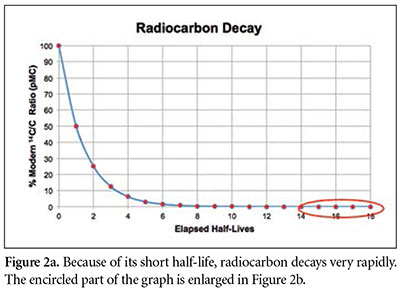
One can estimate this time by dividing 100 pMC by 2 repeatedly until the resulting number drops below 0.001 pMC. We find that about 18 such halvings are required for the pMC value to drop below 0.001 (Figures 1 and 2). (We could “round up” the value of 0.0007 pMC at 17 half-lives to 0.001 pMC, but the 0.00038 pMC at 18 half-lives is definitely below the detection threshold.) Since each half-life is 5,730 years, this means that no 14C at all would be detectable in a specimen that is older than about 18 × 5,730 years = 103,140 years.

Dating Methods in Conflict

But researchers consistently detect 14C in samples thought to be tens of millions of years old. 14C has even been detected in diamonds, which some scientists claim are billions of years old! Radioisotope dating methods involving the heavier, longer-lived isotopes (methods such as uranium-lead, potassium-argon, etc.) are one of the main justifications that evolutionists use to argue for such vast ages. Because these radioisotope methods yield age estimates of many millions of years for igneous rocks, it is thought that sedimentary rocks are also millions of years old, as well as the organic remains found within them. Yet this assumption leads to a contradiction: If these organic samples really are many millions of years old, then they should be radiocarbon “dead.” But they aren’t!

Contamination?
Evolutionists have attempted to blame these surprising results on a number of mechanisms.3They often invoke “contamination” that occurred either in situ (on site in the earth) or during the radiocarbon testing process itself. However, the consistency with which 14C is found in these samples makes it difficult to argue that such results are all the result of in situ contamination. Moreover, diamond is extremely resistant to “natural” contamination by external 14C atoms.

Furthermore, laboratories take great pains to keep contamination to a minimum, and researchers have found that, provided a sufficiently large testing sample is used (in the ballpark of 100 milligrams or so), the amount of such possible lab contamination is negligible compared to the 14C already present within the specimen.

Finally, although contamination can sometimes occur, it should not be assumed in a particular instance unless there are good reasons to believe that it has. And a radiocarbon result that contradicts old-earth dogma is not a good enough reason by itself to invoke contamination!

Assumptions…Assumptions

Instead of arbitrarily blaming these anomalous results on contamination, a far better (and more scientific) approach would be to question the correctness of the assumptions behind radioisotope dating methods.

One of these assumptions is that nuclear decay rates have always been constant. Although 14C decays fairly quickly, heavier isotopes (such as uranium-238) decay much more slowly. Because the present decay rates of these heavier isotopes are so small, the assumption that these rates have always been constant naturally leads to age estimates of millions and even billions of years.

Interestingly, however, some radioisotope methods tend to consistently yield younger age estimates than others, even when the techniques are used on the same rock units.4Could this be a clue that radioisotope “clocks” might have “ticked” at different rates in the past, and that this variation in “ticking” is different for different radioisotopes?

If so, this would explain the discrepancy between the radiocarbon method and other radioisotope techniques. When today’s rates are used to calculate ages from certain radioisotope ratios, the results indicate that billions of years’ worth of nuclear decay of the heavier radioisotopes has occurred. But there is evidence that this decay occurred in accelerated “spurts,”5 which means the assumption that decay rates were always constant leads to age estimates that are much too high. This is the reason that 14C is still detectable in these “ancient” organic specimens—the specimens simply aren’t millions of years old! Furthermore, because the past variations in “ticking” were different for different radioisotopes, 14C did not experience as much accelerated decay as did the heavier radioisotopes. This is why the past episodes of accelerated decay did not completely eliminate the world’s 14C that existed before these episodes occurred.

Thus, although this is still an ongoing area of research,6 the presence of 14C within supposedly extremely “old” specimens is just one of several indicators of past accelerated nuclear decay.7

Why the High Radiocarbon Age Estimates?

Virtually all fossils found within sedimentary rocks are the remains of creatures that perished during the Genesis Flood about 4,500 years ago. Yet a skeptic might point out that the amounts of 14C found in these organic samples are smaller than what one might expect if they are only about 4,500 years old. And 4,500 years is less than one radiocarbon half-life, so from Figure 2 we might expect 4,500-year-old samples to have14C/C concentrations greater than 50 pMC. Yet the 14C found within organic samples thought to date from the time of the Flood is generally only about 0.1 to 0.5 pMC. From Figure 1, a value of 0.098 ≈ 0.1 pMC corresponds to 10 half-lives, or about 57,000 years. Are these high radiocarbon “ages” a problem for the biblical worldview?

No. First, remember that no detectable 14C at all should be present within these samples if they really are millions of years old. Despite this apparent difficulty for the recent-creation view, this is, in fact, a much more serious problem for the old-earth view!

Second, such large calculated ages are based on the assumption that the 14C/C ratio has remained unchanged for tens of thousands of years.

A global flood like the one described in the Bible would invalidate this assumption. Creation scientists have estimated (based upon the amounts of organic matter thought to be contained within the sedimentary layers) that the carbon in the pre-Flood biosphere may have been 300 to 700 times greater than what is present in today’s world.8 Thus, the 14C/C ratio in the pre-Flood biosphere was hundreds of times smaller than today’s value.

A simple “thought experiment” illustrates why assuming a constant 14C/C ratio yields inflated radiocarbon ages. Suppose a time-traveling scientist journeys to the day before the Flood started (don’t worry; he’ll return before the Flood begins!) and radiocarbon-tests the remains of an animal that has just died. If the pre-Flood 14C/C ratio was 500 times smaller than today’s value, this would be equivalent to 100 pMC/500 = 0.2 pMC. This value of 0.2 pMC is very close to the value of 0.195 pMC found within Figure 1. About nine half-lives would have to elapse for a starting value of 100 pMC to decrease to 0.2 pMC. If the scientist did not realize that the pre-Flood 14C/C ratio was hundreds of times smaller than today’s value, he would calculate the animal’s age to be approximately 9 × 5,730 years = 51,570 years old—even though it had just died! Of course, he would realize that this age was nonsense, because he saw the fresh carcass. But if a scientist in the present did not have this firsthand knowledge and attempted to date the fossil remains of this very same animal (assuming it was fossilized during the Flood), he would conclude that the animal was 52,000—not 4,500—years old.

Thus, these “inflated” ages are not a problem for the biblical creationist, but the presence of detectable 14C in supposedly ancient organic specimens is a substantial problem for those who believe in an old earth. (JH,ICR)

*** Will Myers

Posted in Uncategorized | Leave a comment

Equipping Message; Reason To Believe

I must admit I lacked enthusiasm for last month’s debate between Bill Nye and Ken Ham. In fact, I dreaded it. In terms of advancing people’s trust in the reliability of God’s Word, I doubted this encounter would prove helpful.

However, God has a way of working all things together for His good purposes. While many people tuned in just for the spectacle, the amount of attention the debate received indicates a significant level of interest in the ongoing creation-evolution conversation. Thus, it brought some collateral attention to Reasons to Believe, including a burst of social media activity and a number of radio interviews. For that I’m grateful.

The debate and the flurry of discussion around it also brought me this observation: People seem more confused than polarized on the topic of creation and evolution.Although the media and certain organizations tend to play up the polarization for their own purposes, most people are left with only a vague notion of what or how to think about life’s origins, especially humanity’s origin and development.

Does this widespread confusion bother you as much as it does me? Who we are, how we got here, and why we are here—these are some of life’s biggest and most important questions. The answers have everything to do with our everyday existence, our decisions and actions, values and relationships, and with what we live for.

The significance of these questions is what prompted me to add one more book, Navigating Genesis, to the plethora of books on Genesis. Additional motivation came from a growing consensus among Christians that Genesis chapters 1–11 simply cannot be read and interpreted as a historical account of actual events in the natural realm.

The more I learn from both science and Scripture, the more convinced I am that it is possible to read the text as a truthful account, both scientifically and theologically. That’s not to say my view of the text is the one reliable interpretation. My principal objective in writing this book is to show that a scientifically plausible, literal reading of Genesis is possible.

Who could have known when I was working on the book over the past two years that it would be released almost simultaneously with a major Hollywood production on Noah? Whether or not it follows the biblical text, the film holds potential to open up a wide-ranging discussion of a spiritually significant story. My hope is that the four chapters in Navigating Genesis devoted to the flood account will equip you and all who read the book to discuss the movie in a spiritually productive way.

The Reasons to Believe team has built a web page reasons.org/theflood and assembled an array of resources to assist you in taking advantage of the opportunities the movie offers us, not just to defend but also to advance people’s trust in the God who loves us enough to rescue us from the deadly grip of rampant evil. As my friend and colleague Kenneth Samples loves to remind people, the Noah story foreshadows the Good News of Jesus Christ. We have a merciful Savior who invites us to “come aboard” and ride out the drowning storm of sin safely in Him.

I’m sure you’ve heard me say many times that our demeanor is as important as our content when addressing people’s questions and comments and skepticism. Perhaps you’ve discovered, as I have, that preparation makes a world of difference in our ability to maintain a gentle, respectful demeanor. By preparation, I mean spiritual as well as intellectual.

The core of RTB’s mission is to support you in your preparation for kingdom-advancing conversations. It’s what we’ve been about for 28 years and what we’ll continue to be about until the moment the Lord says, “Mission accomplished!”

*** Will Myers

Romans 1:20

For the invisible things of him from the creation of the world are clearly seen, being understood by the things that are made, even his eternal power and Godhead; so that they are without excuse:

Featured Resources

Guest Writer, Dr. H. Ross

The Great Debate on Science and the Bible Ken Ham and Dr. Jason Lisle (representing the young-earth view), and Dr. Hugh Ross and Dr. Walter Kaiser (representing the day-age view) debate various creation questions on The John Ankerberg Show.

Posted in Uncategorized | Leave a comment

New Research Suggests Two Overlooked Functions of Junk DNA

Life scientists continue to identify new functions for so-called junk DNA. Recently, a researcher from the US Centers for Disease Control and Prevention pointed out two overlooked “junk DNA” functions: (1) serving as a nucleoskeleton that establishes the volume of the cell’s nucleus; and (2) acting as a mutational buffer that protects the genome from mutations resulting from transposon and retroviral DNA insertion activity. Such results help undermine the argument that junk DNA must be leftovers of evolutionary processes, not the creation of an intentional Designer.

If you cannot be open-minded, then you do not possess your ideas, your ideas possess you.

Bryant McGill

DNA is a remarkable molecule—its double helix design displays a certain beauty and, in biochemical terms, its structure and function are no less pleasing to behold. As I discuss in my book The Cell’s Design, DNA is structurally optimized to carry out its chief function: storage of information used by the cell’s machinery to generate life’s building blocks and direct the cell’s operation. (For an example of the optimized structure-function relationships found in DNA, see “DNA Soaks Up Sun’s Rays.”)

Yet there is more to DNA’s purpose than information storage. Recently, biologist Claudiu Bandea of the US Centers for Disease Control and Prevention argued that DNA sequences assume noninformational roles that biologists have often overlooked.1 These noninformational functions help account for the existence of abundant junk DNA in the genomes of humans and other organisms.

Nucleoskeletal Support

First, Bandea shows that DNA plays a skeletal role by helping to establish and maintain the size of the cell’s nucleus. This function is called the nucleoskeletal hypothesis. According to this idea, the amount of DNA in a cell dictates the nuclear volume. The size of the nucleus is not arbitrary, however, but must be maintained within tight limits. The cell will die if the ratio of the nuclear volume relative to overall cell volume deviates too much. Presumably, the nucleoskeletal role of DNA can account for the vast amount of junk DNA within genomes and helps explain the C-value paradox. Larger cells require a larger nucleus and, consequently, a greater amount of junk DNA in their genomes to maintain an adequate nuclear volume. (For more, see “TNRTB Classic: Junk DNA and the Nucleoskeletal Hypothesis.”)

Mutation Shield

Bandea also asserts that junk DNA may serve as a mutational buffer. He notes that the human genome (and the genomes of other organisms) consists of a significant fraction of mobile DNA pieces called transposons. These pieces of DNA move around the genome and, presumably, insert at random into different locations. (Some transposons also possess the capacity to duplicate in the process.) If insertions occur in coding or regulatory regions of the genome, mutations result.

Retroviruses pose a similar problem. When viruses invade a cell, retroviral DNA inserts into the host’s genome. Again, these insertion events can be disruptive if they occur within functional sequences.

But Bandea posits that high levels of junk DNA can make genomes more resistant to the deleterious effects of insertion events. If insertion events are random, then the offending DNA is much more likely to insert itself into “junk DNA” regions instead of coding and regulatory sequences—thus, protecting information-harboring regions of the genome. To say it another way, junk DNA sequences could serve as buffers against mutations that arise from transposon and retroviral DNA insertion events.

Solving the C-Value Paradox

If junk DNA functions as a mutational buffer, then it could also help account for the C-value paradox (which observes “that genome size does not correlate with organismal complexity”).2 It could be that the varying genome sizes are not arbitrary, but instead correlate with the amount of protective DNA. Genomes with higher transposon activity could require a greater buffering capacity and, consequently, more junk DNA.

When it comes to understanding genomes (human or otherwise), the evolutionary paradigm has continuously restricted the view of many people in the scientific community by compelling them to classify, noncoding DNA as the leftover vestiges of evolution. But, as Bandea’s research shows, a narrow focus on DNA’s informational role has interfered with the acknowledgment of junk DNA’s important noninformational functions. Such discoveries help open up the possibility for nonevolutionary interpretations of genome content, including the notion that these tiny pieces of DNA stem from an intelligent Mind. (FR,RTB)

*** Will Myers

Please “Donate a penny” or any amount to support the ministry’s research and development. Just click the link below:

https://www.paypal.com/cgi-bin/webscr?cmd=_s-xclick&hosted_button_id=DKCQUR7YG7W5U

Share this:

Posted in Uncategorized | Leave a comment

Junk Science Will Become Science In Future

Metaphysics is not considered a science at present, but with the research and development of interfacing humans to machines and computers metaphysics shall become a true science. Optimum metaphysics become religion. ” Without science religion is lame; without religion science is blind”; Albert Einstein.

Meta-physician shall evolve as devices which enhance the healing progress when they are interfaced with our brains. The mind has a latent ability of healing the body as most people know; it just need help in most cases. Neuroscience has developed to the degree of knowing brain activity and the thoughts associated. Quantum’s of energy with varying intensity can actually destroy diseases. Using Magnetic Resonance  Imaginary research scientist are rapidly progressing to developing a computerized, universal psychiatrist and physical healer.

Astrology has been practiced for centuries, and by all means has never been considered a legit science. Although, more people today believe in the gypsy science than ever. Under lying concepts shall be discovered with the aid of science. Global Positioning Satellites alone with new theories in astronomy plus new developments in neuroscience has posed new fundamental hypothesizes and  concepts which gives a more rigid relationship between mind and the celestial bodies and immediate environment.

Power of meditation, becoming one with nature, is going to be realized on a higher state of conscience; once again, aided by devices interfaced with out brain. Meditation shall become a true science. As a matter of fact, the concept of mental telepathy shall become  a fact in the not so far future whether by transplants of communication chips or simply by attaining the correct brain frequencies through faith.

Colossians 1:16

For by him were all things created, that are in heaven, and that are in earth, visible and invisible, whether they be thrones, or dominions, or principalities, or powers: all things were created by him, and for him:

Romans 1:20

For the invisible things of him from the creation of the world are clearly seen, being understood by the things that are made, even his eternal power and Godhead; so that they are without excuse:

*** Will Myers

Please “Donate a penny” or any amount to support the ministry’s research and development. Just click the link below:

https://www.paypal.com/cgi-bin/webscr?cmd=_s-xclick&hosted_button_id=DKCQUR7YG7W5U

Share this:

Posted in Uncategorized | Leave a comment

GOD DOES IT AGAIN

The humanist say that we don’t need God even if he did exist. The attitude is that we have only one life, and we must live it to the hilt because it’s all that we have. On the contrary, believers in God who love God believe that we have a better life awaiting those who are faithful. The scales tilted in favor of God and the Word of God for me when I thought that God can certainly do it again…create life in another place as he has done in this world because even I can repeat what I have done. Even animals once learned to do a task can do it again.

Many famed scientist now believe that the universe is cyclic . They predict that the universe at some time in the future shall begin contracting to the size of a golf ball; some say even smaller as that of a nuclei.  At some time, God may do it again by creating again. God put our souls here from where no one knows, but for sure He did; proving that He could do it once.

We have limitations, but God has none. He is all-powerful, all-knowing, and present everywhere. The scriptures say that our place in the solar system is going to suddenly change. The book of Revelations symbolically treats the ongoing process of the end of time, but the book defers us to the genuine spirit of man as being what man shall experience during those tribulations; the book is spiritually correct and an exact symbolic description.

God continually call us unto Himself. He gives us toys as scientist engineer them. He even came into this world in the flesh as His own Son, Jesus. God set the stage for us to do things again as did Jesus; raising the dead and controlling matter with our minds. The purpose of our lives is to live in God’s Kingdom with God in the Spirit. The toys that God gives us teaches us something about God. If one only see the enjoyment experienced when playing with the toy, than they have missed the eternal life lesson; the Life after we are transformed in the spirit or the universe contracts unto infinite density and inertia, leaving no room for any soul.

God has promised to return embodied as Jesus to set up His permanent Kingdom on Earth. This would be a thousand years before the final judgement of God. Now, I am teetering near reincarnation. Does God throw any soul into the eternal lake of fire forever, and they shall suffer excruciating pain of the burning fire forever? My feelings are that God is not cruel, but is a God of Love. Yes, since God is the only One Who can destroy a soul, than a quick destruction in the eternal lake of fire maybe for Hitler. Although, my spirit feelings are that God is Love, and shall always give a second change. But, with that belief will men begin to not care about sinning and killing because they believe that they have a second chance from God? Jesus did say that there are meats in which we can not eat at present. Maybe those of us that feel in our spirit that God is going to give a second change should keep our mouths shut. Or, teach that God can do anything if He so want including “doing it again.” I do know that the cyclic nature of the universe is God’s reminder; He constantly reminds us of things.

The Word of God is unfathomable without the Son of God. We should lean not on our own understanding for He is infinitely beyond our understanding.

Mark 14:62

And Jesus said, I am: and ye shall see the Son of man sitting on the right hand of power, and coming in the clouds of heaven.
Matthew 26:64

Jesus saith unto him, Thou hast said: nevertheless I say unto you, Hereafter shall ye see the Son of man sitting on the right hand of power, and coming in the clouds of heaven.

*** Will Myers

Please “Donate a penny” or any amount to support the ministry’s research and development. Just click the link below:

https://www.paypal.com/cgi-bin/webscr?cmd=_s-xclick&hosted_button_id=DKCQUR7YG7W5U

Share this:

Posted in Uncategorized | Leave a comment

Research Rules Out Rogue Planets


A high-sensitivity search for very distant planets in the solar system reveals a lack of rogue planets and other features common in other planetary systems. This remarkable circumstance allows our solar system to manifest a benign environment for enduring advanced life and suggests the involvement of an intentional Designer.

A rogue planet on a collision course with Earth is something science-fiction stories have in common with doomsday theories (such as the 2012 Mayan calendar prophecies). Astronomy, however, has revealed nothing to lend credence to these fantastical scenarios. Researchers had used powerful telescopes to rule out the existence of any planet the size of Mars or greater within 7 billion miles of Earth and any planet the size of Jupiter or greater within 100 billion miles.1 (For comparison, Neptune orbits the Sun at a mean distance of 2.8 billion miles.)

While these findings may provide reassurance for those developing investment strategies for their grandchildren, it is quite another matter when attempting to use very distant planets to understand the stability of advanced life over the past several million years. Some astronomers have hypothesized that an extremely distant planet in the solar system may be responsible for causing the mass extinction events noted in the fossil record (such events took place at regular intervals throughout a 27-million-year period).2 To address these considerations, astronomer Kevin Luhman analyzed the database from the Wide-Field Infrared Survey Explorer satellite to search for possible thermal emission signals from gas giant planets and brown dwarfs that may be lurking in the outer limits of the solar system.3 (Brown dwarfs are bodies ranging in size from 12–75 Jupiter masses.)

Luhman determined that no planet the size of Saturn or greater exists within 2.6 trillion miles (0.44 light-years) of the Sun and no planet the size of Jupiter or greater exists within 7.6 trillion miles (1.30 light-years).4 Such a stringent limit on distant solar system bodies effectively rules out the possibility that a distant planet could be responsible for the mass extinction events noted in the fossil record.

This limit also implies that, over the past several million years, advanced animals on Earth have been relatively undisturbed by events in the extreme outer realms of the solar system. One can only hope this limit will also put an end to speculations that a hypothesized Planet X will bring about the end of civilization or usher in the apocalyptic events prophesied in Scripture.

A Unique Planetary System

Such a lack of large planets and brown dwarfs may be an exceptional feature for planetary systems. In spite of the fact that planets orbiting at great distances from their stars are extremely difficult to detect, astronomers have found a substantial number.5 Researchers have also discovered several free-floating planets and brown dwarfs (bodies unattached to any star).6

Large planets cannot form at great distances from their stars because the circumstellar disks from which they form do not extend far enough. However, the nearly ubiquitous high-eccentricity orbits observed for exoplanets located more than a 100 million miles from their host stars (Earth’s distance from the Sun = 92.8 million miles; see the exoplanet catalog) implies that many planets will be ejected from their planetary systems. Given the expected large population of ejected planets, there exists a high likelihood that many stars will capture these free-floating bodies into very wide orbits.7

Our solar system’s lack of planets with high-eccentricity orbits, lack of wide orbit planets, and lack of any large body within a light-year of the Sun all suggests that our planetary neighborhood is special. At RTB, we propose that the uniqueness of our solar system indicates that it was designed intentionally, in order to make possible the existence of enduring advanced life on Earth. We can thank God that the closest we’ll be to a rogue planet is the pages of a sci-fi novel. (RTB)

*** Will Myers

Posted in Uncategorized | Leave a comment

Jesus is Necessary as Our Savior

It’s easier to convince one that God created the world including us humans and all other life, than to make Jesus known to one.  I acknowledge that Jesus walked the face of Earth as a man, and most people see Him only as another man who is good and wise beyond His years. The fact that His life has been documented and scrutinized more than any other life that has ever existed in this world, people seem to ignore what makes Him uniquely our Savior. Jesus was born a virgin birth, worked many miracles such as raising the dead, and Himself was raised from the dead, and accented into the heavens after walking around for 42 days after His resurrection witnessing to many people.

I am going to regress to historical man who seeks what is the standard; who is our standard. A group of people by necessity seek a leader. This can be reduced to only two persons. If they are to live together, than one must be the head. Sharing decisions of course is much easier with two persons, but sharing is almost impossible for the masses. By necessity, there must be one leader.

Now lets leap into the problem of actually perceiving reality. Can anyone grasp reality? So far, most intellectuals agree that even if one experienced absolute reality they wouldn’t know it, and if they strongly sensed that they had experienced it, than proving it  would be impossible.

Adam and Eve faced this when they ate from the tree of knowledge of what is right or wrong to become gods themselves. The only problem is that we depend on our Creator Who is the only absolute. This means that God is the only One Who determined what is right or wrong at each instant of our life in an absolute sense, and not in a relative sense as man must make his determinations. After Adam and Eve disobeyed God they were sent on a long journey that would never end because they would never be able to decide what is right or wrong absolutely in any instant nor  in any eon of time because only God has the power to absolutely decide what is right or wrong. This is our first sign that man necessarily need a Savior from God; a Savior from God’s Kingdom Who is perfect.

Two imperfect persons can only compromise with the results being imperfect; a group can only negotiate a temporary, imperfect solution. Man can only thrive for perfection without an end. By the Grace of God, man is given enough rewards in life to survive and make a living by his thriving for perfection. Who is the Messiah who will bring perfection, and solve all of man’s problems?

One live by codes, social norms, and many precepts after precepts unto concepts which under scrutiny fall short and a need for other concepts are realized which in time become a precept of a higher concept. The culmination of all guides to one’s life remain fragmented and lack perfect continuity; lack perfection. Who is perfect? If we knew who is perfect than that One could be a substitute for each of our mind, and become each person’s guide into a perfect utopia.

Separation from God is death. There is a death sentence on all the world because it is temporary. All things die. All things end. Can man ever regain eternal life? Yes, because God sent His Son to give His life as a ransom to redeem us from the death sentence. Being in the presence of God there is no death.

High headed men say arrogantly why don’t Almighty God just give us eternal life since he is all-powerful and smart. It very simply; God don’t want robots as children; God want you to choose Him and love Him only above all the temptation in existence. This existence came when God gave a part of His Life to each human; the same life to each; but our brains and minds which interface us with creation are very different, and usually rebellious to God. Who can bring us peace between man and God?

Jesus said that “Heaven is at hand.” The inspired Word of God says the Son of God Who is God among us in the flesh, 100% man and 100% Divine, has brought the gift of eternal life. God is the only entity that can give eternal life.

There will always be strife between men, and between man and God unless a perfect life become a substitute for our imperfect interfacing with God and nature. Our minds are like mosaic window panes in which we look through a veil dimly and perceive distorted thoughts.

Science, technology, and all the conventions of men can not solve the heart problem of man which has self at the center, neither can man achieve perfection without God.

God has only one Son. Jesus is necessary to save and return us unto God’s Kingdom. God in the flesh shed His blood because He desires that we choose Him. Let the Lord have His way. If one’s old self die while receiving the Lord in its place a wonderful thing happen; the new self in Christ Jesus gains life 10 times more than what one had in the first place.

Mark 10:18

“Why do you call me good?” Jesus asked. “Only God is truly good.
Matthew 4:4

But Jesus told him, “No! The Scriptures say, ‘People do not live by bread alone, but by every word that comes from the mouth of God.’”
Acts 5:32

And we are his witnesses of these things; and so is also the Holy Ghost, whom God hath given to them that obey him.
Hebrews 3:7

Exposition of Psalm 95: Hearing God’s Word in Faith ] Therefore, as the Holy Spirit says, “Ohthat today you would listen as he speaks!
ECCLESIASTICS 12:13
 Let us hear the conclusion of the whole matter: Fear God, and keep his commandments: for this is the whole duty of man.
Revelation 21:5

The one sitting on the throne said, “I am making everything new.” He said, “Write this: ‘These words are faithful and true.’”

*** Will Myers

Please “Donate a penny” or any amount to support the ministry’s research and development. Just click the link below:

https://www.paypal.com/cgi-bin/webscr?cmd=_s-xclick&hosted_button_id=DKCQUR7YG7W5U

Share this:

Posted in Uncategorized | Leave a comment

Deuterium Measurements Double-Check Cosmological Parameters

A report in a recent Astrophysical Journal issue reveals that astronomers have used measurements of unprecedented accuracy for the primordial deuterium abundance to double check the values of the cosmic expansion rate and the fraction of the universe made up of ordinary matter. Knowledge of these parameters’ values enables astronomers to build a detailed cosmic origins model that can be compared with the Bible’s claims about the universe’s beginning and history.

In 1994, I wrote an article for Christianity Today describing how astronomers had found “the Holy Grail of cosmology.”1 That is, they had determined the proportion of the universe comprised of ordinary matter (protons, neutrons, and electrons) by analyzing high-sensitivity maps of the temperature fluctuations in the cosmic microwave background radiation (CMBR). This determination yielded the best scientific evidence to date that the universe arose from a big bang event, a scenario that aligns with ancient biblical descriptions of the origin of the cosmos.2

In light of the fact that scientists have values for the cosmic expansion rate and the fraction of ordinary matter in the universe (and that improved CMBR maps have produced improved calculations), recent attempts to obtain these same values from measurements of primordial helium and deuterium may seem unnecessary. However, primordial abundance measurements provide astronomers with a much-needed second set of calculations, based on different physical principles and using different detection instruments, with which they can independently check the values of these cosmological parameters and eliminate possible instrumental biases.

Deuterium, a nucleus comprised of one proton and one neutron, especially interests cosmologists. Unlike helium, deuterium was produced only during the first few minutes of cosmic history when hydrogen (the one existing element) was partly fused into helium-4, helium-3, deuterium, and a trace amount of lithium-7. The mass fraction of helium-4 produced depends on how rapidly the universe expanded from the cosmic creation event, while the mass fraction of deuterium depends on the proportion of ordinary matter in the universe.

Observing the primordial deuterium abundance has proven to be a very tricky business. Deuterium spectral lines are much weaker than helium spectral lines—plus, stellar burning has consumed a substantial amount of primordial deuterium. Astronomers must observe gas clouds far enough away that the look-back times predate any significant stellar burning—yet such great distances mean that deuterium spectral lines will be extremely weak. But now, by using the world’s largest telescopes, a dedicated group of astronomers has overcome the hurdles.

Challenges to Observing Deuterium

The primordial abundances refer to the quantities of helium and deuterium extant before any significant stellar burning occurred. Once stars start burning nuclear fuel, they produce helium and consume deuterium. Thus, measurements of the primordial abundances yield the values of important cosmological parameters while measurements at various epochs since star formation onset give astronomers a detailed picture of the history and locations of star formation and stellar burning for the universe in general and the Milky Way Galaxy in particular. Such a picture has important ramifications for establishing the degree of galactic fine-tuning needed for the existence of advanced life.

Initially, astronomers attempted to measure the primordial deuterium abundance in distant quasars. It became clear, however, that even in distant quasars stellar burning was not a trivial factor. Astronomers then turned to damped Lyman-alpha (DLA) systems, huge clouds of dense gas in the earliest stages of collapsing to form galaxies. Such systems typically contain only a small number of newly formed stars and thus consumption of deuterium by stellar burning is close to zero. The problem here is that DLA systems emit undetectable light levels, which limits astronomers to observing DLA systems in absorption (that is, observing the degree to which a DLA system absorbs light from a background quasar).

First Observation Attempts

The first serious attempt to measure the primordial deuterium abundance was made in 2001. Using the Hubble Space Telescope, astronomers Max Pettini and David Bowen observed a DLA system 10.60 billion light-years away, which yielded Ωbh2 = 0.025±0.001,3 Ωb where is the fraction of the universe comprised of ordinary matter and h = 100 divided by the value of Hubble’s constant (the cosmic expansion rate) in kilometers per second per megaparsec (1 megaparsec = 3,258,000 light-years). However, Pettini and Bowen faced uncertainties in determining the abundance of elements in the system heavier than lithium (a measure of the amount of stellar burning that has occurred).

A decade later, Pettini and astronomer Ryan Cooke used the Very Large Telescope(the world’s largest optical telescope) to measure deuterium in a DLA system 11.61 billion light-years away in which the density of elements heavier than lithium was just one percent of the solar value,4 putting the loss of deuterium by stellar burning at an insignificant level. Pettini and Cooke’s observations produced a value for Ωbh2 = 0.0223±0.0009.5

Success at Last

Now, in 2014, Cooke and Pettini, together with three other colleagues, have published results of their observations of deuterium in a DLA system 11.70 billion light-years away in which the density of elements heavier than lithium is a scant 0.13 percent of the solar value.6 Their derived value for Ωbh2 = 0.02202±0.00046.7 This is the first time that a measurement of Ωbh2 based on deuterium has delivered comparable precision to those based on CMBR maps.

The best measures of Ωbh2 from maps of the CMBR are 0.02205±0.00028 from the Planck Collaboration8 and 0.02243±0.00055 from the WMAP team.9 Using the best-determined value of h = 68.30±0.81,10 these measures translate into the following estimates of the proportion of ordinary matter in the universe: 4.72 (Cooke et al.), 4.73 (Planck), and 4.81 (WMAP) percent.

The remarkable consistency in these measurements delivers yet another evidence for big bang cosmology, which, in turn, strengthens the case for the biblical account of creation. The Bible describes several key characteristics of a big bang universe, including a singular beginning of matter, energy, space, and time, ongoing cosmic expansion, and constant laws of physics including a pervasive law of decay, but leaves many other details, such as the rate of cosmic expansion and the mass of the universe, for us to measure. Once again, research continues to affirm the correspondence between the biblical description of the universe and the best scientific understanding of the universe. (RTB)


*** Will Myers

Posted in Uncategorized | Leave a comment

Q&A: How Do You Envision the Big Bang?

Guest Writer, Dr. Hugh Ross, RTB

From Calvin Staats in British Columbia (submitted via Facebook):

As far as I know the big bang has only been defined or thought of as an expansion or explosion of all matter from a singularity. Do you envision this as all matter compressed into a tiny space with a huge mass? For some reason I’ve been inclined (the thought keeps popping into my mind) to also accept…that all matter started from a singularity as large as all things combined.…I imagine dark matter or dark energy imposing itself into the equilibrium of this huge mass, setting and controlling the rate and order of movement of what we see today throughout the cosmos. I guess this could apply to a tiny space as well. What law would dictate further regression implying matter to compress further to a tiny area?

I wonder if you could put me out of my misery on this issue with a short answer or any comment(s) you may have. Thank you and may God continue to bless you.

****

Calvin, one of the tenets of the standard inflationary hot big bang model is that at the beginning of the universe all matter, energy, space, and time was compressed into an infinitely, or near infinitely, small volume. However, at this high compression point, matter, energy, space, and time are not separate entities. The basic picture is that the universe begins with nine highly compressed space dimensions that all expand from the cosmic creation event. At 10-43 seconds after the creation event, six of the nine dimensions stop expanding. Shortly thereafter, the continuing release of space curvature, as a result of cosmic expansion, leads to the production of photons (electromagnetic energy). Subsequent to photon production, an ongoing cosmic expansion leads to the production of massive particles. By the time the universe is a billionth of a second old, space, time, matter, and energy become separate entities that continue to influence one another.

Dr. Hugh Ross

Reasons to Believe emerged from my passion to research, develop, and proclaim the most powerful new reasons to believe in Christ as Creator, Lord, and Savior and to use those new reasons to reach people for Christ. Read more about Dr. Hugh Ross.

“Let the Truth be Told.” Radical Darwin Evolutionist believe that the universe has no beginning. They also believe that everything came into being by a series of random events. Of course, Creationist (belief that God created the universe, Genesis) believe that the universe including all life has a beginning with purpose.

*** Will Myers

Posted in Uncategorized | Leave a comment

Rovers Report on Mars’s Past Potential Habitability

Data from rovers continue to build strong evidence for transient periods of liquid water in local regions early in Mars’s history. Furthermore, those water environments likely contained the chemical ingredients and conditions that could provide a habitat for certain types of life. However, the transient, local nature of Mars’s “habitable” environments serves to highlight the unexpectedly long and global nature of Earth’s habitability. Such results comport well with the idea that an intelligent Designer fashioned Earth to host life.

The year was 1996. Scientists announced the results of an investigation that led to claims of past life on Mars. But in the discussions following this exciting announcement researchers concluded that the evidence did not support the claim.

Nearly 20 years later the conversation continues with increased data gathered by instruments driving across the surface of the Red Planet. Given the difficulty of finding ancient microbial life here on Earth, scientists seeking evidence of life-friendly conditions on Mars look for signs of liquid water, the basic chemical components required for life (C, H, N, O, P, S), and chemical energy gradients necessary for metabolism. Definitive evidence for or against extraterrestrial life remains elusive—but a body of data affirms that liquid water (and other ingredients required for life) existed early in Mars’s history.

Rover Reports

In January 2004, two rovers, Spirit and Opportunity, landed on Mars for a three-month exploration mission. Although communications with Spirit ceased in 2011, Opportunitycontinues exploring the Martian surface and reporting back to NASA to this day. Since August 2011, those explorations have focused on the Endeavour Crater, an impact basin 14 miles across. The impact that created it excavated Mars’s surface layers during the Noachian period approximately 3.7 to 4.1 billion years ago, which corresponds to the time of the Late Heavy Bombardment.

A recent paper published by the Spirit and Opportunity team shows evidence of liquid water existing on Mars during the Noachian period. The evidence includes fine-grained layered rock, calcium sulfate veins cutting through the rock layers, and aluminum-rich clay materials in rock fractures.1 All three observations indicate flowing, liquid water before and after the crater’s formation. Furthermore, in contrast to studies of younger rock formations that show much higher acidity, recent analysis of Mars’s past aqueous environment indicates only a slightly acidic to neutral pH—a more favorable environment for prebiotic chemistry.

The larger and more capable Curiosity rover (which landed on Mars in August 2012) found corroborating evidence from the other side of Mars in the Gale Crater (formed approximately 3.5 to 3.8 billion years ago). According to a paper by the Curiosityteam, the Yellowknife Bay region of the Gale Crater consisted of a “fluvio-lacustrine environment.” “Lacustrine” describes a lake environment and the term “fluvial” refers to rivers and streams and the deposits they form. Curiosity found rock layering in the Gale Crater, similar to what Opportunity discovered in the Endeavour Crater but with layers extending to a depth of over five meters. The composition of sediment in the Yellowknife Bay layers matches that of the surrounding lava-based rock. Measurements revealed the presence of carbon, hydrogen, oxygen, sulfur, nitrogen, and phosphorus—all chemical elements required by life. The chemical composition also revealed the chemical gradients necessary for chemoautotroph metabolism.2

Potentially Habitable but Transient

These data imply the existence of a river-fed lake with depth ranging from meters to a few tens-of-meters. The thickness of the sedimentary layers means the lake persisted for hundreds to tens-of-thousands of years. Analysis also indicates a neutral pH and low salinity environment. All these conditions led the authors to argue for the plausibility of habitable environments early in Mars’s history (before 3.5 billion years ago).

These results highlight the strong (and growing) body of evidence that Mars hosted liquid water environments for sustained periods early in its history—but this conclusion is not very surprising to astronomers. Water is the third most abundant molecule in the universe (behind H2 and H3+), thus we expect rocky planets to start with plenty of water. Furthermore, Mars’s distant location from the Sun (compared to Earth’s) means that the active and violent conditions during its early history would provide transient, local environments where liquid water might flourish. However, the potentially habitable conditions on Mars clearly ended within a few hundred million years—a result that shows sustainable life requires more than just the basic chemical ingredients.

Studies of neighboring planets continue to demonstrate the uniqueness of Earth’s remarkable capacity to host a diverse, sustained, and thriving system of life. The types of life that have existed throughout Earth’s history played a major role in maintaining and advancing that habitable character—even in the midst of significant astronomical, geological, and atmospheric change. The complex interplay between such different influences to sustain Earth’s habitability across the planet for billions of years continues to point to the work of a divine Designer. (JZ,RTB)

*** Will Myers

Posted in Uncategorized | Leave a comment