Resolving the Super-Earth Paradox


BY HUGH ROSS – JANUARY 8, 2018

Researchers looking to solve the super-Earth paradox finally have found what very likely is the resolution. Their resolution also has revealed more evidence for the fine-tuning of the solar system to support advanced life.

Super-Earths are planets possessing a mass between 1.2 and 13 times the mass of Earth. For comparison, Uranus and Neptune weigh in at 14.54 and 17.15 Earth masses, respectively. Another term for a super-Earth is a mini-Neptune. The diameters of known super-Earth planets range from about 120 to 220 percent of Earth’s diameter (about 30 to 54 percent of Neptune’s diameter). The featured image shows a comparison of the sizes of super-Earths (middle of the image) relative to Earth (left of the image) and relative to Uranus (lower left) and Neptune (upper right).

So far, astronomers have discovered 3,721 planets orbiting nuclear burning stars.1 Of these 3,721 planets with known masses, 16.2 percent are in the super-Earth category, making it the second most populous of all planet categories. The most populous category are hot Jupiters at 20.9 percent, which are planets greater or equal to Jupiter’s mass that orbit their host stars closer than Earth orbits the Sun.

The super-Earth paradox is that, according to our best understanding of how planets form, there should not be any super-Earth planets at all. Observed super-Earths are all in the critical mass range—that is, they possess enough mass to accrete gas very efficiently. Nothing should stop them from becoming planets dominated by massive gaseous atmospheres like Jupiter, Saturn, Uranus, and Neptune.

The Kepler spacecraft clearly has proven that super-Earths do exist and that they exist in large numbers. In an effort to resolve the super-Earth paradox, in 2014, UC Berkeley astronomers Eve Lee, Eugene Chiang, and Chris Ormel proposed a metallicity gradient in the proto-planetary disks of planet-forming stars.2 That is, they suggested that for proto-planetary disks, the ratio of heavy elements to light elements declines in proportion to the distance from the host star. Therefore, planets forming in close proximity to their host stars will lack the abundance of gas to accrete that exists farther out from the host stars.

There are two problems for this metallicity gradient scenario. One is that most models for the formation of super-Earths have the super-Earth planets forming far from their host stars and subsequently migrating inward toward the host stars. A second problem is that it is very difficult in proto-planetary disk models to get the necessary steep metallicity gradient.

In 2016, Lee and Chiang proposed another way to resolve the super-Earth paradox. They speculated that, while gas giant planets form early, super-Earth planets form late.3 They pointed out that, as proto-planetary disks age, the abundance of gas in the disk falls and that the gas abundance can drop by several orders of magnitude. Therefore, if super-Earth planets form late enough, they will be gas-poor compared to gas giant planets.

The gas abundance in old proto-planetary disks indeed drops precipitously. However, the abundance of dust and rocks in such disks also drops precipitously. Thus, planet formation is much less productive and efficient in older proto-planetary disks. Such low productivity and efficiency are contradicted by the very large population of super-Earth planets.

In an open access paper (yes, you can read the entire paper for free) published in the December 1, 2017 issue of the Astrophysical Journal, astronomer Cong Yu of Sun Yet-Sen University in Guangzhou, China, proposed4 a solution to the super-Earth paradox that avoids the problems in the scenarios developed by Lee, Chiang, and Ormel. In Yu’s model, super-Earth planets form as a result of tidally forced turbulent diffusion.

Yu notes that if a planet forms close enough to its host star, tidal interactions between the host star and the planet can periodically perturb the planet. Heating by tidal dissipation can so inhibit gas cooling in primordial super-Earth atmospheres as to dramatically limit the amount of gas that the planet can accrete. Specifically, Yu’s calculations established that “the thermal feedback associated with the externally forced turbulent stirring may greatly alter the accretion history of super-Earths.”5 Thus, he demonstrated that “tidally forced turbulent diffusion effectively helps super-Earths evade growing into gas giants.”6

Yu’s model also explains planetary systems that possess both super-Earth and gas giant planets. His calculations show that “the condition for turbulence-induced formation of super-Earths is more readily satisfied in the inner disk region but is harder to satisfy in the outer disk region.”7 The deductions from Yu’s calculations are consistent with observations. In planetary systems with both super-Earth and gas giant planets, the super-Earths orbit nearby their host stars while the gas giants orbit much farther away.

Yu ends his paper by admitting that not all the details are worked out. How and when the turbulence is initiated during planet formation remains to be modeled in detail. Yu used a simple opacity model for his planet atmospheres. More realistic opacities need to be invoked. Nevertheless, Yu’s model already goes a long way toward resolving the super-Earth paradox.

While the super-Earth paradox apparently is very close to being fully resolved, the solar system paradox remains. Our solar system is like no other known planetary system. It contains none of the most common planets. Neither super-Earths nor hot Jupiters exist in the solar system. Furthermore, the sizes and the orbital locations of the Sun’s four gas giant planets are unique.

As I explain in my book, Improbable Planet,8 there are excellent reasons for the unique features of the solar system. All eight of the Sun’s planets must possess exquisitely fine-tuned physical and orbital characteristics for advanced life to be possible on Earth. The reason why the solar system is so different compared to the other 2,792 planetary systems that have been discovered so far, is that apparently, it alone has been fashioned by the Creator of the universe to be a fit home for humans and human civilization.

Endnotes
  1. Exoplanet TEAM, The Extrasolar Planet Encyclopedia, The Catalog (December 27, 2017), http://exoplanet.eu/catalog/.
  2. Eve J. Lee, Eugene Chiang, and Chris W. Ormel, “Make Super-Earths, Not Jupiters: Accreting Nebular Gas onto Solid Cores at 0.1 AU and Beyond,” Astrophysical Journal 797 (December 20, 2014): id. 95, doi:10.1088/0004-637X/797/2/95.
  3. Eve J. Lee and Eugene Chiang, “Breeding Super-Earths and Birthing Super-Puffs in Transitional Disks,” Astrophysical Journal 817 (January 22, 2016): id. 90, doi:10.3847/0004-637X/817/2/90.
  4. Cong Yu, “The Formation of Super-Earths by Tidally Forced Turbulence,” Astrophysical Journal 850 (December 4, 2017), id. 198, doi:10.3847/1538-4357/aa9849.
  5. Yu, “Formation of Super-Earths,” id. 198, p. 2.
  6. Yu, “Formation of Super-Earths,” id. 198, p. 2.
  7. Yu, “Formation of Super-Earths,” id. 198, p. 10.
  8. Hugh Ross, Improbable Planet: How Earth Became Humanity’s Home (Grand Rapids: Baker, 2016): 43–93.

About Reasons to Believe

RTB’s mission is to spread the Christian Gospel by demonstrating that sound reason and scientific research—including the very latest discoveries—consistently support, rather than erode, confidence in the truth of the Bible and faith in the personal, transcendent God revealed in both Scripture and nature. Learn More »

Support Reasons to Believe

Your support helps more people find Christ through sharing how the latest scientific discoveries affirm our faith in the God of the Bible.

DONATE NOW


U.S. Mailing Address
818 S. Oak Park Rd.
Covina, CA 91724
  • P (855) 732-7667
  • P (626) 335-1480
  • Fax (626) 852-0178

Reasons to Believe logo

Posted in Uncategorized | Leave a comment

Take Up and Read: Institutes of the Christian Religion

BY KENNETH R. SAMPLES – MAY 1, 2018

MORE

This current blog series on Reflections is intended to encourage Christians to read more vigorously by providing a beginner’s guide to some of the Christian classics in such fields as theology, philosophy, and apologetics. Hopefully, a brief introduction to these important Christian texts will motivate today’s believers—as St. Augustine was called to in his dramatic conversion to Christianity—to “take up and read” (Latin: Tolle lege) these classic books.

blog__inline--take-up-and-read-institutes-of-christian-religion

This week’s book, Institutes of the Christian Religion, is by Protestant Reformer John Calvin and is considered one of the masterpieces of Protestant theology as well as one of the most influential works of Western civilization. According to distinguished church historian Philip Schaff, Calvin’s classic theological work is on the level of such masterworks as Augustine’s City of God and Thomas Aquinas’s Summa Theologica.1

Why Is This Author Notable?

French theologian John Calvin (1509–1564) is, after Martin Luther, the second most recognizable person of the Protestant Reformation of the sixteenth century. Calvin is not only the most influential scholar within the broad Reformed theological tradition, but many historians consider him one of the most influential persons in the history of Western civilization itself. Because he affirmed that man’s ultimate allegiance lies only with the sovereign God and not with kings or bishops, some have argued that Calvin successfully laid the theological groundwork for democracy to flourish in the Western world.

What Is This Book About?

The first edition of Institutes of the Christian Religion was published in 1536 when Calvin was only 27 years old. Originally written in Latin, it was later translated into French and then into other European languages. The book represents a full systematic theology of the Reformed tradition within Protestantism. Calvin revised and expanded the work multiple times over the course of his career, with the full-scale work being completed in 1559 (Latin) and 1560 (French).

Intended as a basic introduction or catechism to Christian theology, the starting point of Institutes of the Christian Religion is the Apostles’ Creed. Calvin surveys the work of the Father, Son, and Holy Spirit in creation, revelation, and redemption.

The four divisions within the book reflect the following broad creedal order:

  • Part 1 explores the knowledge of God the Father, who is the sovereign creator, sustainer, and director of all things.
  • Part 2 addresses the work of the Son through redemption coming in the life, death, and resurrection of Jesus Christ.
  • Part 3 focuses on the Holy Spirit as the one who brings about regeneration and sanctification in the life of the believer.
  • Part 4 examines the critical role that the holy catholic church plays in administering Word (Scripture) and sacrament to God’s people.

John Calvin was not a philosopher but rather a literary scholar and biblical exegete. Therefore, his contemplation of the triune God is not speculative or theoretical but instead deeply personal.

Below, Calvin describes what has been called in Latin the sensus divinitatis—humankind’s inner sense of the divine (reflecting the apostle Paul’s statements in Romans 1):

There is within the human mind, and indeed by natural instinct, an awareness of divinity. This we take to be beyond controversy. To prevent anyone from taking refuge in the pretense of ignorance, God himself has implanted in all men a certain understanding of his divine majesty.2

Why Is This Book Worth Reading?

Institutes of the Christian Religion is arguably not only the most influential theological text of the Protestant Reformation but possibly of all Western Christendom. Whether adored or abhorred, John Calvin and his interpretation of historic Christianity have deeply influenced Western civilization. Every Christian and student of history should have a familiarity with this amazing work of theology.

Therefore, take up and read Calvin’s Institutes of the Christian Religion!

Resources

For more about the life and accomplishments of John Calvin, see “Christian Thinkers 101: A Crash Course on John Calvin.”

Endnotes
  1. See “Calvin’s Place in History” (Philip Schaff, “John Calvin and His Work,” chap. 8 in History of the Christian Church, Volume VIII: Modern Christianity. The Swiss Reformation).
  2. John Calvin, Institutes of the Christian Religion Vol. 1, Library of Christian Classics, ed. John T. McNeill, trans. Ford Lewis Battles (Philadelphia: Westminster Press, 1960), 1:43.

About Reasons to Believe

RTB’s mission is to spread the Christian Gospel by demonstrating that sound reason and scientific research—including the very latest discoveries—consistently support, rather than erode, confidence in the truth of the Bible and faith in the personal, transcendent God revealed in both Scripture and nature. Learn More »

Support Reasons to Believe

Your support helps more people find Christ through sharing how the latest scientific discoveries affirm our faith in the God of the Bible.

DONATE NOW


U.S. Mailing Address
818 S. Oak Park Rd.
Covina, CA 91724
  • P (855) 732-7667
  • P (626) 335-1480
  • Fax (626) 852-0178

Reasons to Believe logo

Posted in Uncategorized | Leave a comment

How Whales Increase Fish Stocks and Help Control Global Warming

BY HUGH ROSS – FEBRUARY 25, 2019

One of the most popular blogs I wrote in 2010 discussed how the recovery of the sperm whale population from near extinction to 12,000 individuals in the Southern Ocean had greatly increased that ocean’s biomass and had helped to mitigate global warming.1 Now, studies on blue whales, fin whales, and humpback whales establish that they, too, are making an enormous contribution to increasing the marine biomass and in helping to mitigate global warming.

Environmental Benefits of Sperm Whales 
In the June 2010 issue of Proceedings of the Royal Society B, a team of eight marine biologists (seven Australian, one German) published their results of a multiyear study of sperm whales.2Sperm whales dive thousands of feet below the ocean surface to feed on giant squid. Their squid diet is very rich in iron. The eight marine biologists determined that sperm whales defecate only on the ocean surface, and noted that the whales’ feces are rich in soluble iron compounds.

Sperm whale feces fertilize the oceans’ phytoplankton with the nutrients they most need—soluble iron compounds. Thanks to sperm whales, the Southern Ocean sustains a much higher biomass (amount of living matter) of phytoplankton. This higher phytoplankton biomass permits a higher biomass of zooplankton, which in turn, makes possible a higher biomass of fish. The cascade of increased living matter explains why the return of the only predator species of giant squid has actually increased the population and body sizes of giant squid as a whole.

As a byproduct, the eight marine biologists calculated that the higher biomass of phytoplankton removes an extra 440,000 tons per year of carbon from the atmosphere through their photosynthesis. Since the 12,000 sperm whales respire 176,000 tons of carbon per year into the atmosphere, that means sperm whales are responsible for removing a net of 264,000 tons per year of carbon from the atmosphere. Thus, sperm whales are certainly doing their bit to remove carbon dioxide, a powerful greenhouse gas, from the atmosphere and, therefore, they play a significant role in mitigating global warming.

Environmental Benefits of Other Whales
New research achieved by seven marine biologists at the University of Tasmania led by Lavenia Ratnarajah extends the findings of the team of eight.3 Ratnarajah’s team focused on baleen whales and three species in particular: blue whales, fin whales, and humpback whales. Baleen whales differ from sperm whales in that they feed on krill instead of giant squid.

Krill are small marine crustaceans. They feed on phytoplankton and, to a lesser extent, on zooplankton. The diet of the whales studied by Ratnarajah’s team consists of Antarctic krill (see figure 1). Antarctic krill, in terms of total biomass, rank as Earth’s most abundant animal species. Their total biomass is approximately 500 million tonnes (550 million tons), comprised of 300–400 trillion individuals.4

blog__inline--how-whales-increase-fish-stocks-1

Figure 1: Antarctic Krill. Body length = 1–6 centimeters. Image credit: Uwe Kils, Creative Commons Attribution

Ratnarajah’s team determined that the iron concentrations in Antarctic krill are a million times higher than typical Southern Ocean seawater concentrations. For the fecal matter of Southern Ocean baleen whales, the iron concentration is almost 10 million times higher. Thus, like the sperm whales, baleen whales enhance the marine biomass of phytoplankton, zooplankton, fish, marine mammals, and the removal of greenhouse gases from the atmosphere by fertilizing marine phytoplankton.

Blue whales (see figure 2) were even more impacted by the whaling industry than sperm whales. I was taught in my public school education that blue whales were extinct since a decade had gone by where not a single blue whale had been sighted. Since that time, I have had the pleasure of seeing blue whales. It is estimated that 10,000–12,000 blue whales exist in the world’s oceans today.

blog__inline--how-whales-increase-fish-stocks-2

Figure 2: Blue Whale. The largest animal known to have ever existed, blue whales can attain a length of 98 feet and a weight of 190 tons. Image credit: NOAA

Before the proliferation of the whaling industry in the eighteenth and nineteenth centuries, the population of blue whales in the Antarctic Ocean alone was between 202,000 and 311,000.5 Blues whales were just as abundant in the rest of the world’s oceans.

Fin whales and humpback whales did not suffer the same impact from the whaling industry as did the blue whales. Nevertheless, the 2018 world population of fin whales, at an estimated100,000 individuals6, is less than half what it was before the eighteenth century. The pre-whaling industry population of humpback whales was an estimated 125,000 individuals and is less than half that number today.

Ratnarajah’s team calculated to what degree the pre-whaling industry populations of blue, fin, and humpback whales enhanced phytoplankton productivity compared to present-day levels. The enhanced phytoplankton productivity was up to 26 percent for blue whales, 16 percent for fin whales, and 3 percent for humpback whales, respectively (a total of 45 percent). However, uncertainties in the iron concentrations in krill are large. Based on the reported uncertainties,7 the enhanced phytoplankton productivity, if the whale populations were restored to pre-eighteenth-century levels, could be as low as 1.4 percent for blue whales, 0.8 percent for fin whales, and 0.2 percent for humpback whales, respectively (a total of 2.4 percent).

Population Restoration Produces Benefits
That is, the enhanced phytoplankton productivity for blue, fin, and humpback whales combined would range from 2.4 to 45 percent, if whale populations were restored to pre-eighteenth-century levels. The contribution from sperm whales and other species of whales would likely double (to 4.8 percent) these percentages.

Even the lower range percentage of 4.8 percent should give us humans a powerful incentive to restore the whale populations as quickly as possible. That 4.8 percent means the marine fish stocks would be increased by about 4.8 percent. It would also mean that the amount of carbon dioxide removed from the atmosphere by phytoplankton would increase by 4.8 percent. Since phytoplankton comprise about two-thirds of all the photosynthetic activity occurring on Earth, that 4.8 percent would count as a substantial step in mitigating global warming. It is also a substantial step that would augment, rather than subtract, from the global economy. The minimum benefit levels from restoring the whale populations alone give humans several more reasons to be grateful for these majestic creatures that bring us joy and appreciation for their pivotal ecological role.

Endnotes
  1. Hugh Ross, “Thank God for Whales,” Today’s New Reason to Believe (blog), Reasons to Believe, August 23, 2010, https://www.reasons.org/explore/blogs/todays-new-reason-to-believe/read/tnrtb/2010/08/23/thank-god-for-whales.
  2. Trish J. Lavery et al., “Iron Defecation by Sperm Whales Stimulates Carbon Export in the Southern Ocean,” Proceedings of the Royal Society B, Biological Sciences 277, no. 1699 (June, 2010): 3527–31, doi:10.1098/rspb.2010.0863.
  3. Lavenia Ratnarajah, “The Biogeochemical Role of Antarctic Krill and Baleen Whales in Southern Ocean Nutrient Cycling.” Abstract. American Geophysical Union, Fall Meeting 2015 (December 2015): abstract id:OS13A-2019; Lavenia Ratnarajah et al., “Understanding the Variability in the Iron Concentration of Antarctic Krill,” Limnology and Oceanography 61, no. 5 (September 2016): 1651–60, doi:10.1002/lno.10322.
  4. Robin M. Ross and Langdon B. Quetin, “Euphausia superba: A Critical Review of Estimates of Annual Production,” Comparative Biochemistry and Physiology Part B: Comparative Biochemistry 90, no. 3 (July 1988): 499–505, doi:10.1016/0305-0491(88)90288-X.
  5. Trevor A. Branch, Koji Matsuoka, and Tomia Miyashita, “Evidence for Increases in Antarctic Blue Whales Based on Bayesian Modelling,” Marine Mammal Science 20, no. 4 (October 2004): 726–54, doi:10.1111/j.1748-7692.2004.tb01190.x.
  6. “Fin Whale,” NOAA Fisheries, National Oceanic and Atmospheric Administration, accessed 02/22/19, https://www.fisheries.noaa.gov/species/fin-whale.
  7. Ratnarajah et al., “Understanding the Variability.”

About Reasons to Believe

RTB’s mission is to spread the Christian Gospel by demonstrating that sound reason and scientific research—including the very latest discoveries—consistently support, rather than erode, confidence in the truth of the Bible and faith in the personal, transcendent God revealed in both Scripture and nature. Learn More »

Support Reasons to Believe

Your support helps more people find Christ through sharing how the latest scientific discoveries affirm our faith in the God of the Bible.

DONATE NOW


U.S. Mailing Address
818 S. Oak Park Rd.
Covina, CA 91724
  • P (855) 732-7667
  • P (626) 335-1480
  • Fax (626) 852-0178

Reasons to Believe logo

Posted in Uncategorized | Leave a comment

New Discovery Hands Human Evolution a Challenge

The human hand is remarkable. It permits humans to manufacture and use a wide range of tools, distinguishing us from animals and undoubtedly contributing to our success as a species.

One of the unique features of the human hand is our lengthy thumbs. In contrast, chimpanzees have much shorter thumbs, strikingly disproportionate to their long fingers.

In spite of the human hand’s elegant design, many evolutionary biologists believe that it was shaped by an evolutionary history. They believe a knuckle-walking ape-like creature evolved the capacity for bipedalism, freeing the hands, which in turn evolved to become more dexterous. While long fingers and a short thumb are ideal for knuckle walking, they have limited utility for tool making. Presumably, strong selective pressure influenced the thumb and finger proportions (along with it the dexterity of the hand) as hominids began to use tools.

New work, however, undermines this standard evolutionary story.1 Researchers from George Washington and Stony Brook universities recently presented data that suggests that the last common ancestor of humans and chimps possessed a human-like hand, not a chimp-like hand. In other words, the human hand is primitive and the chimpanzee hand represents an evolutionarily advanced state.

These researchers reached this conclusion after doing a careful comparison of human hand proportions with those of monkeys, apes, and the fossil remains of early hominid species and by using this hand data to build an evolutionary tree. They discovered that the hand proportions of monkeys and apes are quite diverse, and the human hand isn’t necessarily that unique. The evolutionary tree they built indicated that human and gorilla hands are very similar, suggesting an ancestral state. On the other hand (no pun intended), chimps and orangutans display similar hand proportions, reflecting convergent evolution.

This work has far-reaching implications when humanity’s origin is viewed from an evolutionary vantage point. Even though the standard evolutionary model regards the last common ancestor of humans and chimps as chimp-like, this latest study indicates that this view is incorrect. That is, the evolutionary ancestor of humans wasn’t a knuckle-walking ape-like creature at all. In fact, it’s not clear what this creature looked like.

Perhaps even more significant is the recognition that the human hand didn’t evolve over time to be better adapted for tool use. It seemingly was capable of doing so all along. With this latest insight, evolutionary biologists are left without an explanation for the origin of the remarkable manual dexterity of humans and the genesis of tool usage.

Time and time again the standard account of human evolution turns out to be incorrect. In this particular instance, the idea that the human hand evolved under selective pressure associated with development and use of increasingly sophisticated tools has been a mainstay of human evolution for nearly four decades. And yet, a single study overturns this idea. This latest work begs the question: How secure is any idea associated with human evolution?

If you want to read about another mainstay idea in human evolution that has been cast aside, check out this article: “The Leap to Two Feet: The Sudden Appearance of Bipedalism.”

Subjects: Humans vs. Chimps

Dr. Fazale Rana

In 1999, I left my position in R&D at a Fortune 500 company to join Reasons to Believe because I felt the most important thing I could do as a scientist is to communicate to skeptics and believers alike the powerful scientific evidence—evidence that is being uncovered day after day—for God’s existence and the reliability of Scripture. Read more about Dr. Fazale Rana

Notes

  1. Sergio Almécija, Jeroen B. Smaers, and William L. Jungers, “The Evolution of Human and Ape Hand Proportions,” Nature Communications 6 (July 2015): id. 7717, doi:10.1038/ncomms8717.
Posted in Uncategorized | Leave a comment

CHEMICAL IMBALANCES IN THE BRAIN: A MODERN MYTH?

Written by Dr. Caroline Leaf

Part 1

Today, it has become commonplace to say that people have chemical imbalances in their brain, most notably a disruption in the proper production of dopamine (for “diseases” like ADHD) and serotonin (for “diseases” like depression) [1]. These people, it is supposed, need drugs to “cure” these chemical imbalances, hence the terms “antipsychotics” or “antidepressants” [2].

However, in the first part of the 20th century drugs dealing with issues of the mind (as opposed to the rest of the body) were predominantly viewed as “mind-altering substances” like alcohol, and classified as sedatives or stimulants that tranquilized symptoms or the manifestations of psychosis [3]. When the first modern neuroleptic, Thorazine (Chlorpromazine), was introduced in the 1950s, the French researchers Pierre Deniker and Jean Delay noted that the drug created a state of mind similar to Parkinson’s disease, introducing a “new neurological syndrome” in the patient [4]. Essentially, these drugs created, not treated, chemical imbalances [5].

During the 1950s and 1960s a new view of these mind-altering drugs began to shape the world of mental health [6]. Despite the lack of a conclusive body of scientific evidence these drugs came to be seen as “cures”, targeting the underlying biological mechanism of the “disease” of depression or psychosis [7]. It was just assumed that since these drugs affected brain chemistry in a certain way, the opposite reaction must be the result of the disease, notwithstanding the fact that this has never been adequately proven [8]. People no longer spoke of the mind-altering effects of these psychoactive drugs, and, as psychiatrist and professor at University College London Joanna Moncrieff notes, today it is incredibly difficult to find or publish journal articles on these effects, compelling professionals and researchers to look at patient websites such as askapatient.com (which currently number close to a million) [9].

If the overly simplistic explanation of chemical imbalances in the brain is an insufficient explanation for mental illness, why did many people come to see these drugs as “cures”? And why do people still see these dugs as correcting an underlying chemical imbalance? There are a number of social and political factors involved in the rise of this infamous theory (remember: medicine does not occur in a historical vacuum). First, in the second part of the 20th century psychiatry was under heavy criticism [10]. To justify and defend the profession, psychiatrists promoted a medical/disease model of mental health, which is most notably seen at the time in the publication of the Diagnostic and Statistical Manual III, which marked a definitive shift away from psychoanalysis and talk therapy [11]. By creating lists of disorders (again, based off no conclusive scientific evidence on the possible biological mechanisms underlying these so-called disorders), which appeared to be simple, objective ways of recognizing mental illness (somewhat like identifying a tumor), psychiatry created a self-made marketing weapon against its attackers [12]. From now on, institutions like the American Psychiatric Association and the DSM would define what is normal, in turn telling us what it means to suffer and, essentially, what it means to be human [13]. They medicalized misery, and today millions are suffering because of their actions, creating a public health disaster [14].

In fact, since it was now widely, yet incorrectly, assumed that these drugs were “curing” the supposed “disease” and not just tranquilizing the disturbed individual, forced drug treatments, institutionalization and lack of consent merely became “cures” [15]. The responsibility and guilt of the medical processionals behind these so-called treatments was essentially sidelined [16]. Today a psychiatrist can be praised for drugging a depressed person with mind-altering substances and, if these do not work, institutionalizing them and shocking their brain with ECT (electroconvulsive therapy) [17]. It is even an acceptable and commonplace practice to imprison mentally ill persons, drug them and lock them in solitary confinement, compelling them to live their days marinating in their own excrement [18]. It is therefore no surprise that mental health advocate, psychiatrist, former director of the DSM and professor at Duke University Allen Frances declares that “there has never been a worse time or a worse place to have a mental illness than in the US today” [19].

Unfortunately, the pharmaceutical companies, like the psychiatrists, also realized just how effective a marketing tool the chemical imbalance theory could be [20]. Despite the recognition amongst many psychiatrists and medical health professionals that the chemical imbalance theory is not valid [21], drug companies like Eli Lilly still claim that “antipsychotic medicines are believed to work by balancing the chemical found naturally in the brain” [22]. In fact, their marketing efforts, predominantly to doctors through prescription privileges, have been so successful that it is estimated that 80% of the American public alone believe in chemical imbalances in the brain [23]. These companies would not spend billions of dollars on marketing campaigns if they did not think they would work. Additionally, a number of materialistic and reductionistic cultural assumptions have supported these developments. First, we tend to see science and allopathic medicine as the source of all truth [24]. The doctor in his white coat is the priest of a secular age, and evidence-based clinical medicine is the bible [25]. So, if the doctor says that these drugs are safe and will cure chemical imbalances in the brain, even though they get most of their information from the drug company representatives who offer them multiple benefits for prescribing particular medications, we believe wholeheartedly in what he or she may say and are more inclined to believe the medication will work for us [26]. These beliefs, which ignore actual scientific results, are buttressed by a flood of distorted and biased news reports, press releases and scientific journal articles on supposed chemical imbalances, and have transformed the theory into cultural dogma [27]. So, obviously, if we experience negative side effects and do not feel the drug is working, it must be something wrong with us, not the drug [28].

The situation is critical. Since primary care doctors/family physicians, not qualified psychiatric professionals, prescribe most of these mind-altering drugs, we do not ask ourselves if these doctors really understand all the implications of using these substances [29]. Not even the psychiatrists understand these drugs [30]! But for many of us a doctor is a doctor: we don’t ask ourselves if the allure of money, based off biased information, may blind the him/her to the reality of the pill [31]. It is perhaps the lure of a quick fix, a magic bullet solution to our problems, that obscures our judgment. And, sometimes, it is far easier to take a pill than to take responsibility [32]. True change is a difficult and lengthy process. Anyway, the doctor is the professional right? He studied for years correct? Who am I, but an ordinary person? You may have not studied for years, but you still have the right to ask these questions, as you will be the one taking the drug and dealing with its side effects. You have every right to determine the potential biases and interests of your doctor, asking them if their use of the psychoactive substance in question is based on the free lunches and monetary gifts of a drug company representative [33]. It is your brain, your body, your life. These drugs can directly affect your health, with side effects such as an increased risk of suicide [34], loss of sexual ability [35], potential brain shrinkage [36], agitation [37], insomnia [38], weight gain and obesity-related diseases like diabetes [39], lethargy [40], mental fog [41], emotional apathy [42], homicide [43], to name just a few, and taking them can turn into a matter of life and death, particularly for the elderly and children [44].

Of course, you may argue that these substances have helped you stabilize your life, thereby allowing you to sort out your problems. Yet there are several considerations to take into account. Most people will feel better after seeing a doctor, whether or not they are given medication at all—doctor visits can have a powerful placebo effect, particularly if the doctor is very friendly and compassionate [45]. Moreover, we tend to visit medical professionals when we feel we just cannot cope any longer—when we are at a breaking point [46]. Due to spontaneous healing, many people will begin feel better after this peak in their illness/issue, whether they do or do not do anything to alleviate it, and the same is true for depression and anxiety [47]. In fact, most people recover from depression without drug treatments [48]. And, as Irving Kirsh, professor at a number of universities and lecturer at Harvard Medical School, has shown, antidepressants are no better than placebos in terms of clinical significance, but, unlike placebos, come with a host of negative side effects in the short and long term [49]. Lastly, we have to take into account that many things can make us feel better, including alcohol, yet we do not say that alcohol fixed “a previous brain deficiency of alcohol” [50]. So why do we think of anti-depressants and other psychiatric drugs in this way? Even if you feel that these psychoactive substances do help you, they are not correcting an underlying chemical imbalance in your brain, and potentially creating neurological imbalances that were not there to begin with [51]. These drugs start changing your neurochemistry within the first dose [52]. We then have to take into consideration some very hard questions. Substances like marijuana and speed also make people feel better, but do not fix the root of the issue: why someone felt the way he/she did in the first place. Indeed, more people die from overdoses of psychiatric drugs than illicit drugs like cocaine and heroin [53]. So, if it is okay to take psychoactive substances like antipsychotics and antidepressants because they make us feel better even though they can be dangerous, is it okay to take other, non-legal drugs because they make us feel better as well, even though they can be dangerous? It is in fact easier to withdraw from heroin than antidepressants (SSRIs, that is selective serotonin re-uptake inhibitors) [55]. And what about the hundreds of thousands of people suffering under the burden of our pseudoscientific bio-centric model of psychiatry [56], people like those prisoners locked in solitary confinement or those individuals forced to take these drugs and institutionalized [57], who have no voice? They too deserve to be heard.

Indeed, we have every right to question not only our doctors but also the cultural power of neo-liberal capitalism [58]. As the rich get richer and the poor get poorer, these drugs play a particularly important role in social control, as the philosopher Michel Foucault pointed out [59]. By emphasizing that the problem lies within an individual’s biology, we are less inclined to look at their experiences and the social context of why they are feeling the way they feel [60]. We look at the mythical chemical imbalance instead of economic exploitation, violence and inept political structures [61]. Children in foster care are told that they have malfunctioning brains and given these mind-altering substances, and the terrible, abusive and shocking circumstances that they have experienced are put in a mental corner [62]. The child who moves a lot in class is forced to take mind-altering medication that is as addictive as cocaine in the long run, and we do not question whether the school systems we have in place are adequate for the diverse expression of humanity [63]. Once again, the quick fix mentality comes into play: it is far easier to give people a drug that makes them indifferent to their socio-economic circumstances rather than fighting for social justice and changing those circumstances. Certainly, these drugs are also useful tools for neutralizing anyone who does not fit neatly into the neo-liberal capitalist framework–those people that make us uncomfortable and fearful—within and without the Church [64].

When we are faced with such a harsh reality, we must always remember that God has given us powerful minds, which can change the structure of our brains [65]. Our souls are not locked in a cage by our biology [66]. We have, after all, the mind of Christ; we are dignified beings; we are more than conquerors through Him (1 Corinthians 2:16; Romans 8:37). Although Jesus never said we wouldn’t suffer, that we wouldn’t feel pain and anguish, His death and resurrection enables us to have joy despite our circumstances (Philippians 4:11-13). Indeed, not only are pain and human suffering are a part of the world today, but also a clarion call for us as the children of God to go out and be the light in dark places (Romans 8) [67]. If we stop sharing in the pain, as God shares our pain, how can we ever challenge injustice? We, with our sound minds, together as the Church, can choose to overcome with the help of the Holy Spirit, and in turn impact our communities, our cities, our countries and our world.

In the end, we will all be compelled to choose between the worldview presented by the modern psychiatry, a corrupted institution which claims that suffering is not normal and that those that cannot cope without medication have broken, defective brains, or the promises made in God’s word that He never gives us more than we can handle, that He has given us sound minds, that He is always with us, and that nothing can separate us from His love (1 Corinthians 10:13; 2 Timothy 1:7; Joshua 1:9; Romans 8:35-39). I will discuss these worldviews more in part 2 of this blog.

Blessings, Caroline

**This E-mail communication is informative and NOT individual medical advice. **DRUG WITHDRAWAL should ALWAYS be done under the supervision of a qualified professional. These drugs alter your brain chemistry, and withdrawal can be a difficult process. There are thousands of patient-run sites on withdrawal from psychoactive substances on the Internet, and many books available in stores and online. We suggest you begin looking at the resources page on Mad in America: http://www.madinamerica.com/resources/#drug_tapering.

Dr. Peter Breggin also has a brilliant book on withdrawal: Psychiatric Drug Withdrawal A Guide for Prescribers, Therapists, Patients, and Their Families. New York: Springer Pub. Co., 2013.

**For renewing your mind and finding out who you are in Christ please visit http://21daybraindetox.com (see also this VIDEO) andhttp://perfectlyyou.com (see also this VIDEO).

For my other products visit our online store: http://drleaf.com/store/

**For general information on the current state of psychiatry please visithttp://www.madinamerica.com

**If you or someone you know is being threatened with drug treatment please visit http://psychrights.org

**To report any adverse psychotropic drug effects you have experienced, and for more detailed individual drug information, please visit https://www.rxisk.org

Sources/REFERENCES

AdvertisementAdvertisementQuick LinksSwitch on Your Brain®
2140 E Southlake Blvd
Suite L #809
Southlake, TX, 76092

This email was sent to wilmiers77@att.net.
If you prefer not to receive email from us, please click here.

© 2015 Switch on Your Brain®. All rights reserved. Powered by ChurchMedia
Posted in Uncategorized | Leave a comment

Reverse Engineering: A Seahorse Tale

A fundamental assumption in the scientific investigation of living things is that the components of an organism or cell have specific functions. The evidence for design in nature at both the macro (organismal) and micro (cellular) levels is overwhelming. Reverse engineering of natural machines, in addition to revealing their purpose in nature, has revealed new technologies for useful human applications. Consider the seahorse tail, which was recently highlighted in the journal Science.

Seahorse Tails

Unlike most tails, the seahorse tail is not round; rather, it is square. Seahorse tails are comprised of square prisms interconnected through three types of specialized joints that allow bending and twisting motions. These joints are the ball-and-socket, peg-and-socket, and gliding joints. The question is, why a square tail instead of the usual round one?

Reverse engineering of the seahorse tail provided the answer. From their knowledge of its structure, investigators made a 3D model of the seahorse tail using a method called computer-aided design. In this case, the seahorse tail was scanned using microcomputed tomography, and the images were used to print a 3D model, which investigators used to construct a seahorse tail model containing “mechanical features that closely mimic the different gliding, peg-and-socket, and ball-and-socket joints.”1 This “working” tail model was subjected to various tests for flexibility, rigidity, and strength and was compared to a round version of the tail.

Pressure was applied to the two model tails, and it was found that the square tail returned to its original shape after deformation, while the round tail did not. Deformation did not alter the square tail’s exterior shape, while the round tail remained deformed. Additionally, the square tail was better at grasping things. Though the round tail could twist and bend to a greater degree than the more rigid square tail, the combination of rigidity and strength with the ability to bend, twist, and grasp is of great benefit to the seahorse. These features allow the seahorse to attach to important structures in its environment as well as protect itself against predators.

This study of the seahorse tail showed that reverse engineering of a biological component could be used to determine its important functions for the life of the organism. However, another benefit of this approach was the identification of design features that could have useful functions for us, like in developing new types of robotic devices. The article states:

The combination of articulated rigid plates and elastic deformability observed in a seahorse tail could strike a promising balance between the two dominant paradigms in robotics design: being lighter and more compliant than traditional “hard” robots built from servos and metal, but more robust and resistant to external tractions than the emerging class of “soft” robots with silicone-membrane bodies.

Molecular Machines

When we take an even closer look inside a single cell, we observe a great myriad of molecular machines that are needed to carry out the cell’s function. These machines are required for DNA replication, RNA synthesis, energy production (like ATP synthase), protein and lipid synthesis, cellular motion, and the transport of molecules within, into, and out of the cell.

As with the seahorse tail, understanding the molecular details of how these machines work has inspired the creation of new areas of technology—like biomimetics—directed toward the reverse engineering of nanomolecular machines to carry out useful functions for medical and other applications. Recently, Dr. Fazale Rana described this technology in his article “Engineers’ Muse: The Design of Biochemical Systems.”2 The study of how all the molecular machines work together to carry out the life processes of a cell is another area of research called systems biology.

Research in this field has inspired the development of new companies aimed at developing computer software to understand the interconnectedness of the molecular machines in cellular processes and then make beneficial predictions. One such company is MetaCell, headed by Dr. Stephen Larson. In a recent TEDx talk, Larson described the cell as follows:

As science continues to reveal how life works, we find again and again that the magic that seems to distinguish between things that are alive and things that are not [is] actually created by complex interacting molecular machines. These microscopic machines are as precise and intricate as a mechanical watch, but instead of being run on gears and springs, are powered by the fundamental rules of physics and chemistry.3

He further stated:

On the one hand, [the bacterium is] extremely well organized. But on the other hand, the sheer scale of all this unfamiliar, well-organized stuff that happens in there makes me feel that I’ve stumbled onto an alternate landscape of technology that’s built by an engineer a million times smarter than me. The more that I search for principles beyond the ones we’ve already learned, the more I am overwhelmed with the feeling that this stuff was built by aliens.4

A great deal of human intelligence is required to build a mimetic of any natural machine. When we look inside the cell, we seem to have, as Larson stated, “stumbled onto an alternate landscape of technology that’s built by an engineer a million times smarter than [us].” The design inside the cell is consistent with the conclusion that it is the product of a mind—one much greater than any human mind. And though Larson proposed an alien source, I believe that mind belongs to the God of the Bible.


Dr. Russell W. Carlson

Dr. Russell W. Carlson received his PhD in biochemistry from the University of Colorado in 1976, and currently serves as emeritus professor of biochemistry and molecular biology at the University of Georgia in Athens, GA, where he is also the executive technical director of the Complex Carbohydrate Research Center.

Guest Writer

For a listing of all of our guest writers, click here.

Endnotes

  1. Michael M. Porter et al., “Why the Seahorse Tail Is Square,” Science 349 (July 2015): 46, doi:10.1126/science.aaa6683.
  2. Fazale Rana, “Engineers’ Muse: The Design of Biochemical Systems,” Today’s New Reason to Believe (blog), published July 13, 2015, http://www.reasons.org/articles/engineers-muse-the-design-of-biochemical-systems.
  3. “Digital biology and open science – the coming revolution,” YouTube video, 1:00, from a lecture given by Stephen Larson at TEDxVienna, posted by TEDxTalks, December 1, 2014, https://www.youtube.com/watch?v=EKopW86CCJo.
  4. Ibid., 3:08.
Posted in Uncategorized | Leave a comment

Easy To Be Like Jesus; Easy To Know God

Posted in Uncategorized | Leave a comment

Law Of The Spirit

Romans 8:1-2


New International Version

Life Through the Spirit ] Therefore, there is now no condemnation for those who are in Christ Jesus, because through Christ Jesus the law of the Spirit who gives life has set you free from the law of sin and death.

If one stays in the mandates provided by Christ Jesus then one has no problem of feeling totally right. The spirit of Christ Jesus shall prevail thru your spirit letting your heart rejoice in righteousness in all matters and affairs of men. If one encounters adversity than Christ Who went through adversity and was persecuted won over His enemies shall bring you through the persecution.

As we approach Jesus Day we the people of Christ are facing adversities and shall suffer in the name of Christ Jesus but have no fear we shall overcome. So, let us rejoice as we the people celebrate as part of Christ’s Mass. For we are not a religion that seeks God we receive from God in the name of JESUS; whereas God seeks us. Merry Christmas!!!

Posted in Uncategorized | Leave a comment

New Radiocarbon Ages of Dead Sea Scrolls? Part 1

by GUEST WRITERStephen ChuaJuly 9, 2021

When we see historical events and accounts expressed as “XXX happened in XXX BC,” we take these dates at face value. However, have you ever wondered how historical dates were established? And how was that date obtained to that degree of accuracy? Was a date written somewhere on a piece of pottery or papyrus? Such questions have implications for Christianity where texts and scrolls were created thousands of years ago and where their credibility—and, hence, veracity—hinges greatly on their ages. In many such cases, radiocarbon dating is the key tool for establishing the chronology. Now, an advancement (this is part 1 of 2) in that tool promises to boost biblical credibility.

What Is Radiocarbon?

Carbon occurs in the form of two stable isotopes (12C and 13C) and one radioactive isotope (14C, radiocarbon), which is by far the rarest. When organisms die and no longer metabolize new carbon, the finite amount of radioactive carbon in their tissues begins to diminish without replacement at a rate determined by the law of radioactive decay. Every radioactive isotope has a characteristic half-life (the time during which half of all the radioactive atoms will decay). Plants and animals assimilate 14C from carbon dioxide throughout their lifetimes—thus, measuring the current rate of decay can be used to estimate the passage of time from a defined beginning point. (See “How Trustworthy Is Carbon Dating?” for details on radiocarbon production and half-life measurement.)

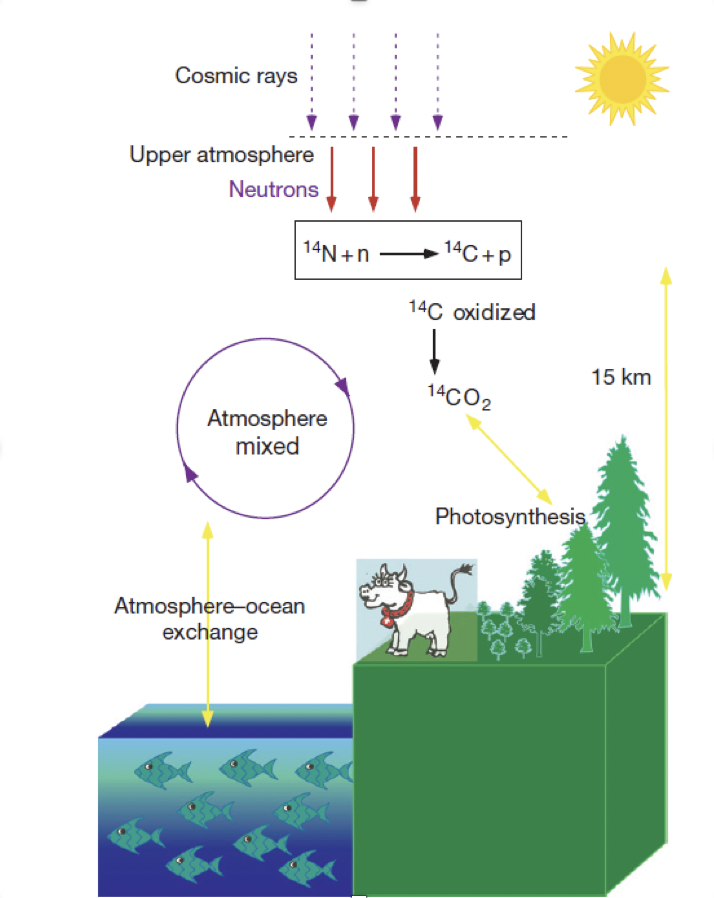
Figure 1: Production and distribution of radiocarbon in the environment.1

Radiocarbon has a half-life of 5700 +/- 30 years, which means that half the radioactive atoms disintegrate in that span, with each producing a nitrogen atom and a beta particle (14C => 14N + ß; figure 1). These estimates are normalized by reference to the year AD 1950, a convention established by international agreement to calibrate all laboratory results to a single reference year (“before present”), and to express the utilization of a standard measure of 14C concentration approximating the time before nuclear weapons changed the composition of the atmosphere (“before physics or BP”). Hence these numbers are aptly termed conventional radiocarbon age (CRA) and expressed as “XXX yr BP.” Note, however, that an extra calibration step is needed to convert CRAs to calendar years, and that’s where a calibration curve comes in.

Calibration Curves, IntCal20, and Implications for Dating of Biblical Texts

Global and local fluctuations of radiocarbon over long timescales have resulted in nonlinear trends in constructed “radiocarbon curves,” which incorporate information from proxies such as tree rings, lake and marine sediments, speleothems (limestone cave features), and even corals. The 1998 IntCal curve has undergone several notable revisions in 2004, 2009, 2013, and as recently as 2020,3 as more data and more robust statistical methods have been introduced. In the case of the latest version, named IntCal20, new datasets from new known-age tree rings, speleothem records (from caves that can be precisely U-Th dated), and varved (seasonally/annually laminated) sediment records from Lake Suigetsu (Japan) have been revised and extended. The construction of the IntCal20 calibration curve also utilized new statistical methods to make it more statistically robust.

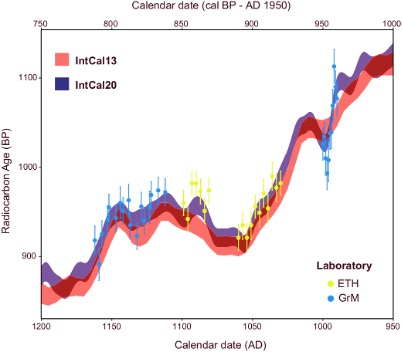
Figure 2: Comparison of IntCal20 (blue) and IntCal13 (red) for the 250-year period from AD 950−1200 (1000–750 cal BP) showing the radiocarbon lab measurements (either ETH or GrM) from Lancaster Castle, error bars and envelopes at 1σ.4

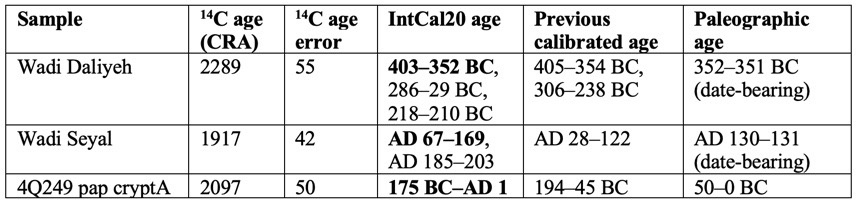
Figure 2 shows small but more precise shifts in the radiocarbon curve from IntCal13 to IntCal20.5 Although such offsets are typically on the order of tens of years, such shifts have important implications for dating biblical texts. To test this, I recalibrated previously published dates of the Qumran Cave Dead Sea Scrolls6 using the latest version of calib.org (maintained by the authors of the IntCal20 paper).7 I then compared my recalibrations with palaeographic age estimates for these scrolls where some are date-bearing documents. Table 1 shows selected scrolls where the more precise and reliable IntCal20 validated the document dates or improved the chronological range of these scrolls.

Table 1: Recalibrated radiocarbon ages of Dead Sea Scrolls. Multiple calibrated ages represent probable age ranges due to imprecision of “wiggle-matching” (converting radiocarbon to calendar ages). The calibrated (IntCal20) ages in bold show better agreement with the paleographic age of these selected scroll fragments.

As radiocarbon curves continue to improve with better proxy records and robust statistical methods, they better constrain actual ages and even validate other techniques such as paleography in verifying the authenticity of Scripture. God has chosen to include many details in his Word, many of them verifiable and falsifiable. The mention of historical figures and events leaves the Bible open to attack, especially in terms of overall biblical chronology and time-sensitive historical events. However, since Christians hold that Scripture is inerrant, I firmly believe the new dating methods and techniques will unequivocally show that God’s Word (logos) is indeed “trustworthy, making wise the simple” (Psalm 19:7b).

Endnotes

  1. Figure 1 adapted from I. Hajdas, “14.3–Radiocarbon: Calibration to Absolute Time Scale,” Treatise on Geochemistry, 2nd ed., ed. Heinrich D. Holland and Karl K. Turekian (Elsevier, 2014), 37–43, doi:10.1016/B978-0-08-095975-7.01204-3.
  2. Many studies use 5730 +/-40 yrs, but the most recent measurements find a half-life of 5700 +/-30 as in Walter Kutschera, (2019). “The Half-Life of 14C—Why Is It So Long?,” Radiocarbon 61, no. 5 (October 2019): 1135–1142, doi:10.1017/RDC.2019.26.
  3. P. J. Reimer et al. (2020), “The IntCal20 Northern Hemisphere Radiocarbon Age Calibration Curve (0–55 cal kBP),” Radiocarbon 62, no. 4 (August 2020): 1–33, doi:10.1017/rdc.2020.41.
  4. Adapted from A. Bayliss et al., “IntCal20 Tree Rings: An Archaeological Swot Analysis,” Radiocarbon 62, no. 4 (August 2020): 1045–1078, doi:10.1017/RDC.2020.77.
  5. Bayliss et al., doi:10.1017/RDC.2020.77.
  6. See Bayliss et al., doi:10.1017/RDC.2020.77 and Georges Bonani et al., “Radiocarbon Dating of Fourteen Dead Sea Scrolls,” Radiocarbon 34, no. 3 (1992): 843–849, doi:10.1017/S0033822200064158.
  7. G. A. Rodley and B. E. Thiering, “Use of Radiocarbon Dating in Assessing Christian Connections to the Dead Sea Scrolls,” Radiocarbon 41, no. 2 (1999): 169–182, doi:10.1017/S0033822200019524.
  8. M. Stuiver, P. J. Reimer, and R. W. Reimer, 2021, CALIB 8.2 [WWW program] at http://calib.org.

Geology & Earth

SOCIALICON
Unexpected Biogenic Bromine Effect on Ozone

Scientists discovered another aspect of the complex biological and atmospheric interactions that testify of a supernatural Creator sustaining Earth as a fit habitat for…Geology & Earth

Is Earth’s Terrestrial Biosphere at the Temperature Tipping Point?

For many of us, seeing the words “temperature tipping point” may rouse concern or alarm. For researchers who study Earth’s climate, two factors help…Design

Design of Newly Discovered Earth Interior Layer

A team of American geophysicists has found more evidence for the fine-tuned design of planet Earth for the benefit of advanced life. Using high-pressure…Geology & Earth

Support Our Mission

Your support helps more people find Christ through sharing how the latest scientific discoveries affirm our faith in the God of the Bible.Donate Now


facebooktwitteryoutube

Posted in Uncategorized | Leave a comment

Confronting the Cognitive Dissonance over Grace

BY KENNETH R. SAMPLES – APRIL 24, 2018

Historic Christianity’s teaching that salvation is solely a gift of God’s grace stands at odds with all other religions of the world. The New Testament explicitly teaches that salvation is not earned by human moral effort but is a divinely imparted gift or endowment (χάρις [charis] is the New Testament Greek word for “grace” and means “unmerited favor”). Historic Christianity affirms that salvation comes by God’s grace alone, exclusively through faith in Jesus Christ’s unique life, death, and resurrection.

A Religion of Grace, Not Self-Help

Christianity at its heart is a religion not of self-help but of divine rescue. The apostle Paul summarizes the gracious formula of salvation in the New Testament as follows:

For it is by grace you have been saved, through faith—and this is not from yourselves, it is the gift of God—not by works, so that no one can boast. For we are God’s handiwork, created in Christ Jesus to do good works, which God prepared in advance for us to do.

–Ephesians 2:8–10, NIV

And here is another critical passage where the apostle Paul again explains the specific relationship between grace, faith, and good works:

For the grace of God has appeared that offers salvation to all people. It teaches us to say “No” to ungodliness and worldly passions, and to live self-controlled, upright and godly lives in this present age, while we wait for the blessed hope—the appearing of the glory of our great God and Savior, Jesus Christ, who gave himself for us to redeem us from all wickedness and to purify for himself a people that are his very own, eager to do what is good.

–Titus 2:11–14, NIV

Scripture therefore informs us that we are saved by grace, not by works. But that same saving grace motivates the believer to pursue godliness (good works). So here’s the biblical teaching enumerated:

  1. Salvation is by grace.
  2. It comes through faith (in Christ).
  3. It is not earned or merited by works.
  4. But saving grace motivates good works.

Thus, good works are the fruit, but not the root, of salvation. Or as the Protestant Reformers said concerning the relationship between faith and works, “Faith alone saves, but saving faith is never alone.” Martin Luther liked to say that saving faith is always pregnant with good works.

The Cognitive Dissonance over Grace

Given that God’s grace is the indispensable component in our salvation, it would seem obvious that as the recipients of God’s great generosity, we should endeavor to allow that grace to transform us. In other words, since God has been amazingly gracious toward me, how can I not at least endeavor to be gracious toward others? But that is where we encounter the cognitive dissonance (the psychological state and tension of having inconsistent thoughts, beliefs, or attitudes). When I say that God’s graciousness toward me is the most important thing in my life but show little or no grace to others, then my actions are in conflict with my deepest beliefs.

I have known Christians who preach, teach, and even screech, “SALVATION BY GRACE ALONE!”But their lives show very little grace toward other people. In fact, this sad and deeply disconcerting cognitive dissonance is one that I personally wrestle with. For if the grace that I preach and teach about is, for all intents and purposes, absent in my treatment of others, then undoubtedly that cognitive dissonance is evident for all to see. Yet by God’s grace, I know this is a problem, and it bothers me. So I sense and feel the inner dissonance. But I have asked the triune God to transform me, at least so the dissonance is not so glaring.

Christians, as forgiven sinners who have a long way to go in the process of sanctification, will always struggle with the problem of believing one thing but acting in conflict with that belief. Hypocrisy is a challenge that all Christians face. Thus, there’s bad news and good news. The bad news is that we Christians are very likely more sinful than we consciously realize. But the good news is that Jesus Christ is assuredly a much greater Savior than we realize.

Endeavoring to Be a Gracious Person

It is obviously not easy to treat all people graciously and charitably. That may be especially true on social media and the web. But I believe God greatly blesses our sincere though imperfect attempts at being respectful and gracious to others. If our deepest theological beliefs affirm God’s immeasurable grace toward us, then the logical and moral extension of that belief is to endeavor to treat other people, maybe especially the people with whom we disagree, as graciously as possible.

Even in my struggle to treat others graciously, I’m grateful for God’s unmerited favor toward me.

Resources

For more about salvation by grace and the attempt to live the Christian life by grace, see chapters 9 and 10 of my book 7 Truths That Changed the World.

About Reasons to Believe

RTB’s mission is to spread the Christian Gospel by demonstrating that sound reason and scientific research—including the very latest discoveries—consistently support, rather than erode, confidence in the truth of the Bible and faith in the personal, transcendent God revealed in both Scripture and nature. Learn More »

Support Reasons to Believe

Your support helps more people find Christ through sharing how the latest scientific discoveries affirm our faith in the God of the Bible.

DONATE NOW


U.S. Mailing Address
818 S. Oak Park Rd.
Covina, CA 91724
  • P (855) 732-7667
  • P (626) 335-1480
  • Fax (626) 852-0178

Reasons to Believe logo

Posted in Uncategorized | Leave a comment