Blessings of the Hiawatha Impactor and the Younger Dryas

BY HUGH ROSS – DECEMBER 24, 2018


At this time of year, people everywhere celebrate the wonder of God sending his son to Earth to live, die, and be raised in order to redeem humans. Perhaps few think of the wonderful planet God created as a stage for his heavenly purposes. Two seemingly obscure events, the Hiawatha impactor and the Younger Dryas cooling event about 12,000 years ago, have made it possible for humans to live in an abnormally stable climate that launched the development of high-tech civilization.

In my blog of three weeks ago,1 I explained how a recent reconstruction of temperature records from around the world revealed that the past 9,500 years of unprecedented climate stability at the optimal temperature for global high-technology civilization was actually twice as stable as what scientists had previously concluded. Two weeks ago,2 I described how a breach in a gigantic lake of glacial meltwater sent a rush of cold, fresh water into the North Atlantic and brought about a 1,200-year-long global cooling event known as the Younger Dryas. In last week’s blog,3 I described the very recent discovery of a 31-kilometer-diameter impact crater 3,000 feet below the Hiawatha Greenland Ice Field that very likely explains both the breach in the gigantic lake and the Younger Dryas. In this blog, I will describe the most important past, present, and future blessings that the Hiawatha impactor and the Younger Dryas cooling event have brought to the human race.

An Exceptional Ice Age 
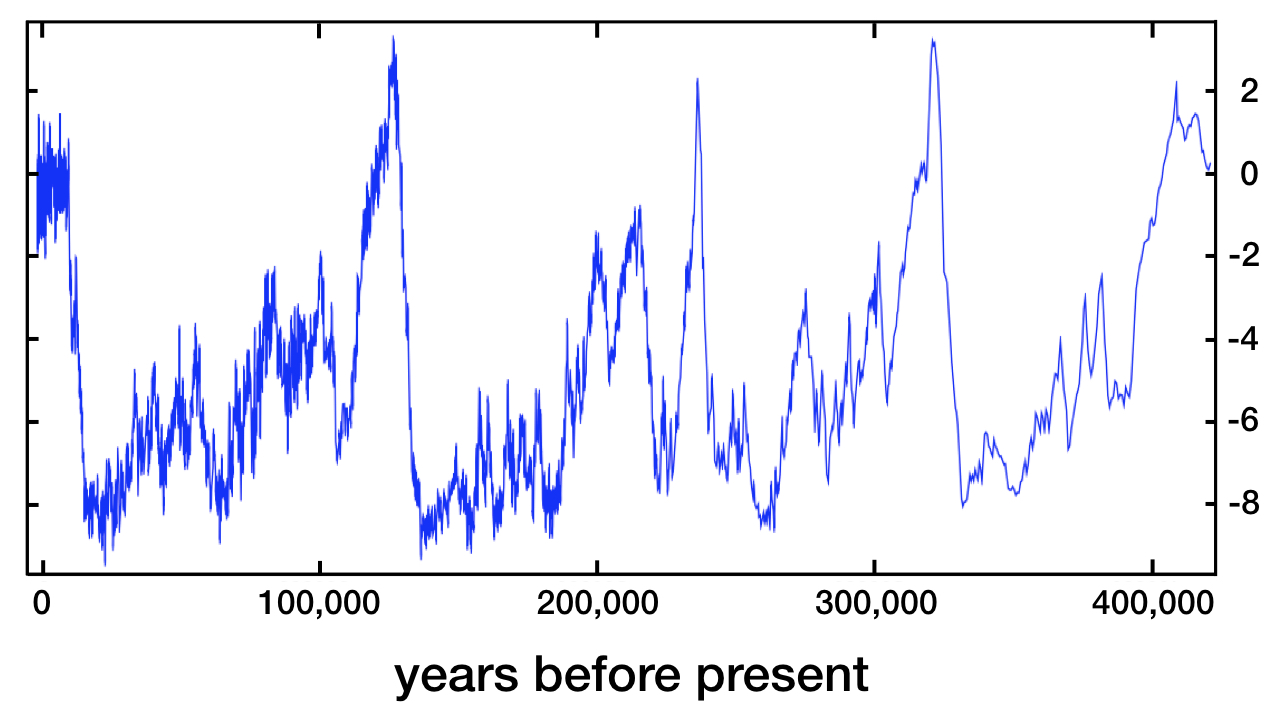
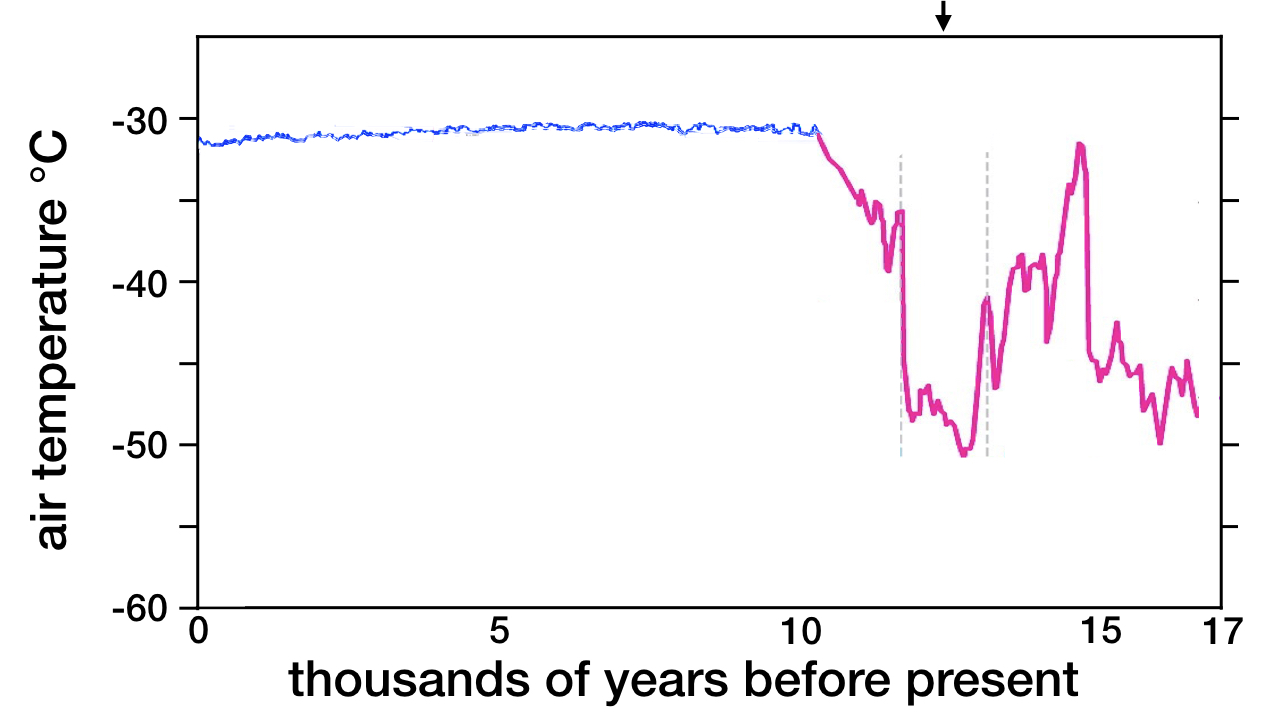
Ice age cycles previous to the current one show a near continuous, rapid rise in global mean (average) temperature from the glacial to the interglacial period (see figure 1). Our cycle is the exception. The Younger Dryas (named after Dryas octopetala, a flower that grows in cold conditions) strongly interrupted the rapid warming of Earth (see figures 1 and 2). Evidently, it prevented the global mean temperature from rising to its normal maximum value.
blog__inline--blessings-of-the-hiawatha-impactor-1

Figure 1: Antarctic Temperature Record for the Past Four Ice Age Cycles
Temperatures are in °C relative to the average for AD 1900–1950. Image credit: Robert A. Rohde, Global Warming Art Project, CC-by-SA
blog__inline--blessings-of-the-hiawatha-impactor-2

Figure 2: Younger Dryas Cooling Event
The temperature figures represent the surface air temperature in the central region of Greenland’s ice sheet. The blue curve shows the newly determined temperature record of the past 9,500 years. The purple curve shows the temperature record from 16,500–9,500 years ago derived from oxygen-18 isotope measures in ice cores drilled in the central region of Greenland’s ice sheet. The two dotted lines delineate the start and end times of the Younger Dryas event. Data credit for blue curve: Shaun A. Marcott et al. and Andy May; data credit for purple curve: United States Geological Survey; diagram credit: Hugh Ross

During ice age cycles previous to the current one, the global mean temperature rose so high that all of the Arctic sea ice melted away, causing Arctic Ocean water to absorb much more heat from the Sun.This extra heat absorption resulted in more Arctic Ocean water evaporating and falling as snow upon Canada, Greenland, and Siberia. (Yes, Canada, Greenland, and Siberia were much warmer than they are now, but not warm enough for the frozen precipitation to become liquid.) The resultant increased snow cover on these large landmasses reflected away so much sunlight that the global mean temperature quickly plummeted, sending Earth into a deep ice age.

The Younger Dryas dropped the global mean temperature so severely (by 15°C) and for so long (1,200 years) that the temperature rise from the last glacial stopped 3°C short of what had occurred in previous ice age cycles. This halting of the warming rise preserved the Arctic ice cap, much of the ice over Antarctica and Greenland, and the ice fields and glaciers over the high mountain ranges and the Tibetan Plateau.

Civilization Leaps
The halting of the temperature rise briefly stabilized the global mean climate. This brief climate stabilization for the first time in human history made possible the launch and rapid advance of civilization, technology, transportation, and trade. Specifically, the advent of extreme climate stability meant that humans could specialize and scale up their agricultural endeavors. For the first time, farmers could plant thousands of acres of wheat, for example, and count on such a bountiful harvest that they could trade their excess wheat for other food products and manufactured goods. Likewise, herders could domesticate thousands of goats and count on such a bountiful production of milk, cheese, meat, and leather that they could trade these goods for other food products and manufactured goods.

Also for the first time, a small fraction of the human population could produce all the food needed for the entire population. That allowed a large fraction of the human population to focus on science, engineering, manufacturing, literature, art, music, and philosophy (among other fields). A door opened for the possible development of global, high-technology civilization and the growth of the human population into the billions.

Decline in Earth’s Axis Tilt
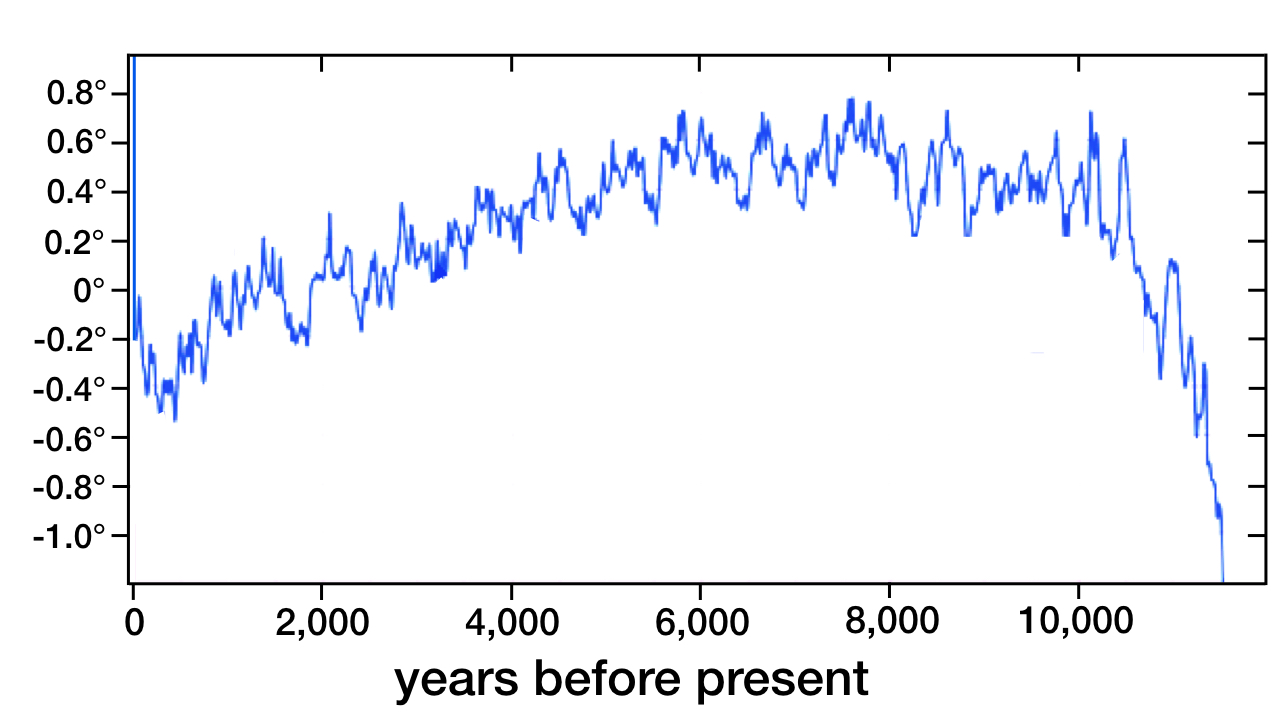
The tilt of Earth’s rotation axis varies cyclically from 22.1° to 24.5° with a period of 41,000 years. The greater the tilt of Earth’s rotation axis the greater its effect on increasing the global mean temperature. Earth’s rotation axis tilt attained its maximum value 8,750 years ago.This maximal value is reflected in the new improved record of the past ten thousand years of Earth’s global mean temperature (see figure 3).
blog__inline--blessings-of-the-hiawatha-impactor-3

Figure 3: Reconstruction of the global mean temperature over the past 11,300 years. Temperature measurements are in °C. Data credit: Marcott et al. and Andy May; Diagram credit: Hugh Ross

If left to natural processes alone, the declining tilt of Earth’s rotation axis would have rapidly dropped the global mean temperature by 10–12°C. Instead, figure 3 shows that from 8,750 years ago until 70 years ago the global mean temperature slowly and steadily declined by only 1.1°C.

The reason for such gradual, tiny decline in global mean temperature and for the maintenance of extreme climate stability over an 8,700-year period of human history is that the cooling resulting from the declining tilt in Earth’s rotation axis was almost perfectly balanced by the warming caused by the gradual advance of human agricultural industry and civilization. The biggest factors were the domestication, breeding, and population growths of farm animals, the domestication of rice, and the conversion of forests into grass- and croplands.

Benefits of the Younger Dryas
The breeding and population growths in farm animals and the domestication of rice yielded a gradual increase in the quantities of carbon dioxide and methane in the atmosphere. The input of these powerful greenhouse gases into the atmosphere warmed our planet almost as much as the natural processes were cooling it. The result: a 9,500-year period of extreme climate stability at the optimal global mean temperature for human civilization and technology during a 2.588-million-year epoch characterized by the most extreme long-lasting climate instability Earth has ever experienced! Without this recent, long-lasting extreme climate stability held at the optimal temperature, our present civilization, technology, and population would be impossible.

The Younger Dryas cooling event, the decline in Earth’s rotation axis tilt, and the gradual advance of human agricultural industry produced another huge benefit. Instead of the ice fields and glaciers that reside in the mountain ranges and high plateaus of Earth either quickly melting and disappearing or rapidly expanding, they have been slowly melting. This slow melt has provided a steady flow of fresh liquid water to Earth’s great agricultural plains. Thanks to this melt we can efficiently produce enough food to feed 7.5 billion humans with a sufficiently small percentage of our population so that most of us can devote our labor to science, engineering, technology, literature, art, music, philosophy, philanthropy, and religion.

A minor benefit that was important to the Inuit peoples was the availability of high-quality stainless steel from the Cape York meteorite fragments. Long before they made contact with Europeans, the Inuit would travel to the Cape York meteorites, chip off pieces, and use cold forging techniques to fashion advanced tools.

More than the physical benefits we have accrued, however, the three features have endowed spiritual benefits. We now have the wealth, technology, transportation, and communication means to take the good news of salvation from our sin—through what the Creator of the universe has provided in his death and bodily resurrection—to billions of human beings in decades rather than millennia. As I mentioned in Improbable Planet, all we lack is the motivation.3

Thanks in large part to the Hiawatha impactor and the Younger Dryas our redemption draws nigh. As we celebrate the first coming of our Messiah and Redeemer this Christmas season, we have many more reasons to share the good news with relatives, friends, and associates of all the blessings our Messiah and Redeemer has offered us here in this life and in the life to come.

Featured image: South Manhattan: An Example of High-Technology Civilization
Image credit: Hugh Ross

Endnotes
  1. Hugh Ross, “Present Climate Epoch Has Been Extremely Stable,” Today’s New Reason to Believe(blog), Reasons to Believe, December 3, 2018, https://reasons.org/explore/blogs/todays-new-reason-to-believe/read/todays-new-reason-to-believe/2018/12/03/present-climate-epoch-has-been-extremely-stable.
  2. Hugh Ross, “How Did Earth Get Its Long-Standing Stable Climate?” Today’s New Reason to Believe(blog), Reasons to Believe, December 10, 2018, https://reasons.org/explore/blogs/todays-new-reason-to-believe/read/todays-new-reason-to-believe/2018/12/10/how-did-earth-get-its-long-standing-stable-climate.
  3. Hugh Ross, “Did a Giant Collider Help Give Us Extreme Climate Stability?” Today’s New Reason to Believe (blog), Reasons to Believe, December 17, 2018, https://reasons.org/explore/blogs/todays-new-reason-to-believe/read/todays-new-reason-to-believe/2018/12/17/did-a-giant-collider-help-give-us-extreme-climate-stability.

About Reasons to Believe

RTB’s mission is to spread the Christian Gospel by demonstrating that sound reason and scientific research—including the very latest discoveries—consistently support, rather than erode, confidence in the truth of the Bible and faith in the personal, transcendent God revealed in both Scripture and nature. Learn More »

Support Reasons to Believe

Your support helps more people find Christ through sharing how the latest scientific discoveries affirm our faith in the God of the Bible.

DONATE NOW


U.S. Mailing Address
818 S. Oak Park Rd.
Covina, CA 91724
  • P (855) 732-7667
  • P (626) 335-1480
  • Fax (626) 852-0178

Reasons to Believe logo

Posted in Uncategorized | Leave a comment

Molecular Scale Robotics Build Case for Design

BY FAZALE RANA – DECEMBER 6, 2017

Sometimes bigger is better, and other times, not so much—particularly for scientists working in the field of nanotechnology.

Scientists and engineers working in this area are obsessed with miniaturization. And because of this obsession, they have developed techniques to manipulate matter at the molecular scale. Thanks to these advances, they can now produce novel materials (that could never be produced with macro-scale methods) with a host of applications. They also use these techniques to fabricate molecular-level devices—nanometer-sized machines—made up of complex arrangements of atoms and molecules. They hope that these machines will perform sophisticated tasks, giving researchers full control of the molecular domain.

Recently, scientists from the University of Manchester in the UK achieved a milestone in nanotechnology when they designed the first-ever molecular robot that can be deployed to build molecules in the same way that robotic arms on assembly lines manufacture automobiles.1 These molecular robots can be used to improve the efficiency of chemical reactions and make it possible for organic chemists to design synthetic routes that, up to this point, were inconceivable.

Undoubtedly, this advance will pave the way for more cost-effective, greener chemical reactions at the bench and plant scales. It will also grant organic chemists greater control over chemical reactions, paving the way for the synthesis of new types of compounds including drugs and other pharmaceutical agents.

As exciting as these prospects are, perhaps the greater significance of this research lies in the intriguing theological implications. For example, comparison of the molecular robots to the biomolecular machines in the cell—machines that carry out similar assembly-line operations—highlights the elegant designs of biochemical systems, evincing a Creator’s handiwork. This research is theologically provocative in another way. It demonstrates human exceptionalism and, by doing so, supports the biblical claim that human beings are made in the image of God.

Molecular Robotics

University of Manchester chemists built molecular robots that consist of about 150 atoms of carbon, nitrogen, oxygen, and hydrogen. Though these robots consist of a relatively small number of atoms, the arrangement of these atoms makes the molecular robots structurally complex.

The robots’ architecture is organized around a molecular-scale platform. Located in the middle of the platform is a molecular arm that extends upward and then bends at a 90-degree angle. This molecular prosthesis binds molecules at the end of the arm and then can be made to swivel between the two ends of the platform as researchers add different chemicals to the reaction. The swiveling action brings the bound molecule in juxtaposition to the chemical groups at the tip ends of the platform. When reactants are added to the solution, these compounds will react with the bound molecule differently depending on the placement of the arm, whether it is oriented toward one end of the platform or the other. In this way, the bound molecule—call it A—can react through two cycles of arm placement to form one of four possible compounds—B, C, D, and E. In this scheme, unwanted side reactions are kept to a minimum, because the bound molecule is precisely positioned next to either of the two ends of the molecular platform. This specificity improves the reaction efficiency, while at the same time making it possible for chemists to generate compounds that would be impossible to synthesize without the specificity granted by the molecular robots.

Molecular Robots Make the Case for Design

Many researchers working in nanotechnology did not think that the University of Manchester scientists—or any scientists, for that matter—could design and build a molecular robot that could carry out high precision molecular assembly. In the abstract of their paper, the Manchester team writes, “It has been convincingly argued that molecular machines that manipulate individual atoms, or highly reactive clusters of atoms, with Ångstrom precision are unlikely to be realized.”2

Yet, the researchers were motivated to try to achieve this goal because molecular machines with this capacity exist inside the cell. They continue, “However, biological molecular machines routinely position rather less reactive substrates in order to direct chemical reaction sequences.”3 To put it another way, the Manchester chemists derived insight and inspiration from the biomolecular machines inside the cell to design and build their molecular robot.

As I have written about before, the use of designs in biochemistry to inspire advances in nanotechnology make possible a new design argument, one I call the converse watchmaker argument. Namely, if biological designs are the work of a Creator, these systems should be so well-designed that they can serve as engineering models and otherwise inspire the development of new technologies.

Comparison of the molecular robots designed by the University of Manchester team with a typical biomolecular machine found in the cell illustrates this point. The newly synthesized molecular robot consists of around 150 atoms, yet it took an enormous amount of ingenuity and effort to design and make. Still, this molecular machine is far less efficient than the biomolecular machines found in the cell. The cell’s biomolecular machines consist of thousands of atoms and are much more elegant and sophisticated than the man-made molecular robots. Considering these differences, is it reasonable to think that the biomolecular machines in the cell resulted from unguided, undirected, contingent processes when they are so much more advanced than the molecular robots built by scientists—some of them among the best chemists in the world?

The only reasonable explanation is that the biomolecular machines in the cell stem from the work of a mind—a divine mind with unlimited creative capacity.

Molecular Robots Make the Case for Human Exceptionalism

Though unimpressive when compared to the elegant biomolecular machines in the cell, molecular robots still stand as a noteworthy scientific accomplishment—one might even say they represent science at its very best. And this accomplishment stresses the fact that human beings are the only species that has ever existed that can create technologies as advanced as the molecular robots invented by the University of Manchester chemists. Our capacity to investigate and understand nature through science and then turn that insight into technologies is unique to human beings. No other creature that exists today or that has ever existed, possesses this capability.

Thomas Suddendorf puts it this way:

“We reflect on and argue about our present situation, our history, and our destiny. We envision wonderful harmonious worlds as easily as we do dreadful tyrannies. Our powers are used for good as they are for bad, and we incessantly debate which is which. Our minds have spawned civilizations and technologies that have changed the face of the Earth, while our closest living animal relatives sit unobtrusively in their remaining forests. There appears to be a tremendous gap between human and animal minds.”4

Anthropologists believe that symbolism accounts for the gap between humans and the great apes. As human beings, we effortlessly represent the world with discrete symbols. We denote abstract concepts with symbols. And our ability to represent the world symbolically has interesting consequences when coupled with our abilities to combine and recombine those symbols in a nearly infinite number of ways to create alternate possibilities.

Our capacity for symbolism manifests in the form of language, art, music, and even body ornamentation. And we desire to communicate the scenarios we construct in our minds with other human beings. In a sense, symbolism and our open-ended capacity to generate alternative hypotheses are scientific descriptors of the image of God.

There also appears to be a gap between human minds and the minds of the hominins, such as Neanderthals, who preceded us in the fossil record. It is true: claims abound about Neanderthals possessing the capacity for symbolism. Yet, as I discuss in Who Was Adamthose claims do not withstand scientific scrutiny. Recently, paleoanthropologist Ian Tattersall and linguist Noam Chomsky (along with other collaborators) argued that Neanderthals could not have possessed language and, hence, symbolism, because their crude “technology” remained stagnant for the duration of their time on Earth. Neanderthals—who first appear in the fossil record around 250,000 to 200,000 years ago and disappear around 40,000 years ago—existed on Earth longer than modern humans have. Yet, our technology has progressed exponentially, while Neanderthal technology remained largely static. According to Tattersall, Chomsky, and their coauthors:

“Our species was born in a technologically archaic context, and significantly, the tempo of change only began picking up after the point at which symbolic objects appeared. Evidently, a new potential for symbolic thought was born with our anatomically distinctive species, but it was only expressed after a necessary cultural stimulus had exerted itself. This stimulus was most plausibly the appearance of language. . . . Then, within a remarkably short space of time, art was invented, cities were born, and people had reached the moon.”5

In effect, these researchers echo Suddendorf’s point. The gap between human beings and the great apes and hominins becomes most apparent when we consider the remarkable technological advances we have made during our tenure as a species. And this mind-boggling growth in technology points to our exceptionalism as a species, affirming the biblical view that, as human beings, we uniquely bear God’s image.

Resources to Dig Deeper

Endnotes
  1. Salma Kassem et al., “Stereodivergent Synthesis with a Programmable Molecular Machine,” Nature 549 (September 21, 2017): 374–8, doi:10.1038/nature23677.
  2. Kassem et al., “Stereodivergent Synthesis,” 374.
  3. Kassem et al., “Stereodivergent Synthesis,” 374.
  4. Thomas Suddendorf, The Gap: The Science of What Separates Us from Other Animals (New York: Basic Books, 2013), 2.
  5. Johan J. Bolhuis et al., “How Could Language Have Evolved?” PLoS Biology 12 (August 26, 2014): e1001934, doi:10.1371/journal.pbio.1001934.

About Reasons to Believe

RTB’s mission is to spread the Christian Gospel by demonstrating that sound reason and scientific research—including the very latest discoveries—consistently support, rather than erode, confidence in the truth of the Bible and faith in the personal, transcendent God revealed in both Scripture and nature. Learn More »

Support Reasons to Believe

Your support helps more people find Christ through sharing how the latest scientific discoveries affirm our faith in the God of the Bible.

DONATE NOW


U.S. Mailing Address
818 S. Oak Park Rd.
Covina, CA 91724
  • P (855) 732-7667
  • P (626) 335-1480
  • Fax (626) 852-0178

Reasons to Believe logo

Posted in Uncategorized | Leave a comment

NASA and Google Announce Discovery of Eight-Planet System

BY HUGH ROSS – DECEMBER 15, 2017

On December 14, NASA and Google announced the discovery of an eighth planet orbiting the star Kepler 90. Other media outlets picked up the hype from there, with teasers like “first solar system like ours” and “boosting the chances of finding alien life elsewhere in the universe.” What’s the stir about?

The Extrasolar Planets Catalog lists 623 multiple planet systems discovered so far.1 Until yesterday, none included as many planets as our solar system. The discovery was made by a machine learning method developed by Google that scoured the Kepler spacecraft storage bank of data.

The number of planets orbiting Kepler 90 is where all similarity with the solar system ends. For starters, the star Kepler 90 is not like the Sun. Its diameter and mass are both about 20 percent larger than the Sun. It is about twice as bright as the Sun. At less than half the Sun’s age, it manifests considerably more intense and frequent flares. The characteristic features of Kepler 90 rule out the possibility of life on all eight of its known planets, the inner seven of which orbit Kepler 90 much closer than Earth orbits the Sun, while the most distant planet orbits Kepler 90 at the same distance Earth orbits the Sun.

The featured image compares the sizes of Kepler 90’s planets to the sizes of the Sun’s planets. All of Kepler 90’s planets are larger than Earth. The nearest three to Kepler 90 possess diameters that are 1.31, 1.18, and 1.32 times larger than Earth’s, respectively. The next three farther out planets possess diameters equal to 2.88, 2.67, and 2.89 times Earth’s, respectively. The two most distantly orbiting planets have diameters equal to 8.18 and 11.32 times Earth’s, respectively. Unlike the solar system, the planets in the Kepler 90 system consistently trend larger with orbital distance.

The biggest difference between Kepler 90’s and the Sun’s planets is their orbital spacing. Kepler 90’s eight planets are jammed tightly together while the Sun’s planets are spread apart from one another. Kepler 90’s planets orbit Kepler 90 at 7.4, 8.9, 12.3, 32, 42, 48, 71, and 101 percent of Earth’s orbital distance from the Sun, respectively. For comparison, the Sun’s eight planets orbit the Sun at 38, 72, 100, 152, 529, 958, 1,914, and 3,120 percent of Earth’ orbital distance, respectively.

Ever since the first planets orbiting hydrogen-burning stars were discovered in 1995, many astronomers have predicted that the population of extrasolar planets would include a large number of planets just like the planets in the solar system. None of the planets in the Kepler 90 system even comes close to matching the characteristics of any one of the Sun’s planets. In fact, after more than 20 years of planet hunting, none of the 3,720 planets in the Extrasolar Planets Encylopedia and Catalog matches any of the features of the Sun’s planets.

The extrasolar planet that comes the closest to matching a solar system planet is upsilon Andromedae e. That planet has nearly the same mass, orbital distance, and orbital shape as does Jupiter. However, upsilon Andromedae e lacks one of Jupiter’s features that is critical for making advanced life in the same system possible. Jupiter is the most massive planet in the solar system. It possesses 68 percent of the total mass of the Sun’s planets.

Upsilon Andromedae e is dwarfed by planets upsilon Andromedae c and d, which possess masses that are at least 14.0 and 10.3 times more massive than Jupiter. Both planets also orbit upsilon Andromedae much closer than does upsilon Andromedae e. Both planets by themselves eliminate any possibility of another planet in the upsilon Andromedae system being able to sustain life.

Given how densely packed Kepler 90’s planets are, astronomers are persuaded that Kepler 90 probably possesses more than just the eight planets discovered so far. The announcement by NASA and Google adds to the growing weight of evidence that the solar system is not normative. It appears to be unique. All the evidence shouts that the solar system is special in its exquisite designs that enable it to be a home for advanced life.

Endnotes
  1. Exoplanet TEAM, The Extrasolar Planets Encyclopedia, Catalog (December 14, 2017): http://exoplanet.eu/catalog/.

About Reasons to Believe

RTB’s mission is to spread the Christian Gospel by demonstrating that sound reason and scientific research—including the very latest discoveries—consistently support, rather than erode, confidence in the truth of the Bible and faith in the personal, transcendent God revealed in both Scripture and nature. Learn More »

Support Reasons to Believe

Your support helps more people find Christ through sharing how the latest scientific discoveries affirm our faith in the God of the Bible.

DONATE NOW


U.S. Mailing Address
818 S. Oak Park Rd.
Covina, CA 91724
  • P (855) 732-7667
  • P (626) 335-1480
  • Fax (626) 852-0178

Reasons to Believe logo

Posted in Uncategorized | Leave a comment

New Research Douses Claim that Neanderthals Mastered Fire


BY FAZALE RANA – JANUARY 3, 2018

A few months ago, I posted a link on Twitter to a blog article I wrote challenging the claim that Neanderthals made jewelry and, therefore, possessed the capacity for symbolism.

When I post articles about the cognitive abilities of Neanderthals, I expect them to generate a fair bit of discussion and opinions that differ from mine (and I expect this article about neanderthal’s use of fire to be no exception). But one response I received was unexpectedly jarring. It came from a Christian who accused me of being “out of touch,” “wasting time discussing frivolous issues,” and “targeting the elite with a failed apologetic.” He admonished me to spend my time on real issues related to social justice concerns and chastised me for not focusing my efforts reaching out to the “marginalized.”

As part of my reply to my new “friend,” I pointed out that the identity and capability of Neanderthals has a direct bearing on the gospel and, consequently, social injustices in our world, because it relates to the question of humanity’s origin and identity. And what we believe about where we come from really matters.

Scripture teaches that human beings are uniquely made in God’s image. And, it is the image of God that renders human beings of infinite worth and value. Because we bear God’s image, Christ died to reconcile us to the Father. And, as Christians, the immeasurable value we place on all human life motivates us to battle against the injustices of the world—because the people who suffer these injustices are image bearers. According to Scripture, when we love and serve other human beings, it equates to loving and serving God.

Yet, the biblical view of humanity has been supplanted in the scientific community by human evolution. According to this idea, human beings are not the product of a Creator’s handiwork—the crown of creation—but, like all life on Earth, we emerged through unguided, historically contingent processes. In the evolutionary paradigm, human beings hold no special status. Human beings possess no inherent worth. We possess no more value than any other creature that has ever existed throughout Earth’s history. Human beings lack any inherent worth or dignity in the evolutionary paradigm. And, within this framework, there can be no ultimate meaning or purpose to human life.

Sadly, the evolutionary view of humanity is not confined to the halls of the academy. It permeates and influences cultures throughout the world. Once human life is rendered meaningless and stripped of its inherent value, there is no fundamental justification to stand against injustice. In fact, it becomes easier to excuse acts of injustice and becomes tolerable to look the other way when these acts occur. In the evolutionary framework, no genuine motivation exists to rescue the marginalized of our world. I would go one step further and argue that many of the social ills we face throughout the world have their etiology in the evolutionary view of humanity.

I regard my work as a Christian apologist as an antidote to this toxic worldview. Towards this end, I strive to demonstrate the credibility of the biblical view of humanity—apart from biblical and theological appeals. In an increasingly secular world, we can’t simply adopt a theological stance, declaring that human beings bear God’s image, and leave it at that. Few nonbelievers will accept that approach. We must respond to the scientific challenge to the image of God with scientific evidence for human uniqueness and exceptionalism. This endeavor isn’t about challenging the elite with an obscure apologetic argument for the validity of Christianity. Ultimately, it is about establishing the foundation for the gospel and generating the impetus and justification to treat human beings as creatures with inherent worth and dignity. As Christian apologists when we “target the elite” with apologetic arguments for the Christian worldview, we are serving the marginalized in our world.

As described in Who Was Adam? a scientific case can be marshaled for human exceptionalism in a way that aligns with the biblical view of the image of God. Remarkably, a growing minority of anthropologists and primatologists now believe that human beings really are exceptional. They contend that human beings do, indeed, differ in kind, not just degree, from other creatures. The scientists who argue for this updated perspective have developed evidence for human exceptionalism within the context of the evolutionary paradigm in their attempts to understand how the human mind evolved. Yet, ironically, these new insights marshal support for the biblical conception of humanity.

However, one potential challenge to human exceptionalism relates to the cognitive capabilities of Neanderthals. Based on archeological and fossil finds some paleoanthropologists now argue that these hominids: (1) buried their dead; (2) made specialized tools; (3) used ochre; (4) produced jewelry; (5) created art; and (6) even had language capacities. These are behaviors one would naturally associate with the image bearers.

Yet, as discussed in Who Was Adam? (and articles listed in the Resource section), careful examination of the archeological and fossil evidence reveals just how speculative the claims about Neanderthal “exceptionalism” are. Recent insights on Neanderthal fire use illustrate this point.

Did Neanderthals Use Fire?

While controversy abounds among paleoanthropologists about fire use by hominins such as Homo erectus, most scientists working in this field believe Neanderthals mastered fire. This view finds its basis in the discovery of primitive hearths, burned bones, heated lithics, and charcoal at Neanderthal archeological sites. Frankly, fire use by Neanderthals bothers me. If these creatures could create and use fire—in short, if they mastered fire (called pyrotechnology)—it makes them much more like us—but uncomfortably so.

Yet, recent work raises questions about Neanderthal fire usage.1 Careful assessment of archeological sites in southern France occupied by Neanderthals from about 100,000 to 40,000 years ago indicates that Neanderthals could not create fire. Instead, they made opportunistic use of natural fire when available to them.

The French sites show clear evidence of fire use by Neanderthals. However, when researchers correlated the archeological layers harboring evidence for fire use with paleoclimate data, they found an unexpected pattern. Neanderthals used fire during warm climate conditions and failed to use fire during cold periods—the opposite of what would be predicted—if Neanderthals had mastery over fire.

Instead, this unusual correlation indicates that Neanderthals made opportunistic use of fire. Lightning strikes that would generate natural fires are much more likely to occur during warm periods. Instead of creating fire, Neanderthals most likely collected natural fire and cultivated it as long as they could before it extinguished.

Such evidence shows that human beings are unique and exceptional in our capacity to create and curate fire, distinguishing us from Neanderthals.

Chimpanzees Exploit Natural Fire

Still, the capacity to make opportunistic use of fire seems pretty impressive. At least until Neanderthal behavior is compared to that of chimpanzees. Recent work by Jill Pruetz indicates that these great apes understand the behavior of natural fires and even exploit them.2 Pruetz and her collaborator observed the response of the Fongoli community of chimpanzees to two wildfires in the spring of 2006. The members of the community calmly monitored the fires at close range and then changed their behavior in anticipation of the fires’ movement. To put it another way, the chimpanzees’ behavior was predictive, not responsive. This capacity is impressive, because the behavior of natural fires is complex, depending on wind speed and direction and the amount and type of fuel sources.

So, as impressive as Neanderthal behavior may seem, their opportunistic use of fire seems more closely in line with chimpanzee behavior than that of human beings, who create and control fire at will. In fact, Pruetz believes one reason chimpanzees don’t harvest natural fire relates to their lack of manual dexterity.

How Did Neanderthals Survive Cold Climates without Fire?

If Neanderthals were opportunistic exploiters of fire and it was only available to them when the climate was warm, how did they survive the cold? One possibility is that they simply migrated from cold climes to warmer ones.

Another possibility is that the hominins made clothing. At least, this is the common narrative about Neanderthals. Yet, recent work indicates that this popular depiction is incorrect. These creatures did not make clothing from animal skins, but instead made use of animal hides as capes.3

A team of paleoanthropologists reached this conclusion by studying the faunal remains at Neanderthal and modern human archeological sites and comparing them to a database of animals used to make cold weather clothing. While both modern humans and Neanderthals used deer, bison, and bear hides for body coverings, the remains of these creatures were found more frequently at modern human archeological sites. Additionally, the remains of smaller creatures, such as weasels, wolverines, and dogs were found at modern human sites but were absent from sites occupied by Neanderthals. These smaller animals have no food value. Instead, modern humans used the animal hides to trim clothing.

This data indicates that modern humans made much more frequent use of animal hides for clothing than did Neanderthals. And when modern humans made clothing, it was more elaborate and well-fitted than the coverings made by Neanderthals. This conclusion finds added support from the discovery of bone needles at modern human archeological sites (and the absence of these artifacts at Neanderthal sites), and reflects cognitive differences between human beings and Neanderthals.

Even though Neanderthals made poorly crafted body coverings and most likely made little use of fire during cold periods, they were aided in their survival of frigid conditions by the design of their bodies. Anthropologists describe Neanderthals as having a hyper-polar body design that made them well-adapted to live under frozen conditions. Neanderthal bodies were stout and compact, comprised of barrel-shaped torsos and shorter limbs, which helped them retain body heat. Their noses were long and sinus cavities extensive, which helped them warm the cold air they breathed before it reached their lungs. Neanderthals most likely survived the cold because of their body design, not because of their cognitive abilities.

Even though many paleoanthropologists assert that Neanderthals possessed cognitive abilities on par with modern humans, careful evaluation finds these claims wanting, time and time again, as the latest insights about fire use by these hominins attest.

Compared to the hominins, including Neanderthals, human beings do, indeed, appear to be exceptional in a way that aligns with the image of God. These are far from “frivolous issues.” The implications are profound.

What we think about Neanderthals really matters.

Resources

Endnotes
  1. Dennis M. Sandgathe et al., “Timing of the Appearance of Habitual Fire Use,” Proceedings of the National Academy of Sciences, USA 108 (July 19, 2011), E298, doi:10.1073/pnas.1106759108Paul Goldberg et al., “New Evidence on Neandertal Use of Fire: Examples from Roc de Marsal and Pech de l’Azé IV,” Quaternary International 247 (2012), 325–40, doi:10.1016/j.quaint.2010.11.015; Dennis M. Sandgathe et al., “On the Role of Fire in Neanderthal Adaptations in Western Europe: Evidence from Pech de l’Azé IV and Roc de Marsal, France,” PaleoAnthropology (2011), 216–42, doi:10.4207/PA.2011.ART54.
  2. Jill D. Pruetz and Thomas C. LaDuke, “Brief Communication: Reaction to Fire by Savanna Chimpanzees (Pan troglodytes verus) at Fongoli, Senegal: Conceptualization of “Fire Behavior” and the Case for a Chimpanzee Model,” American Journal of Physical Anthropology 141 (April 2010) 646–50, doi:10.1002/ajpa.21245.
  3. Mark Collard et al., “Faunal Evidence for a Difference in Clothing Use between Neanderthals and Early Modern Humans in Europe,” Journal of Anthropological Archaeology 44 B (December 2016), 235–46, doi:org/10.1016/j.jaa.2016.07.010.

About Reasons to Believe

RTB’s mission is to spread the Christian Gospel by demonstrating that sound reason and scientific research—including the very latest discoveries—consistently support, rather than erode, confidence in the truth of the Bible and faith in the personal, transcendent God revealed in both Scripture and nature. Learn More »

Support Reasons to Believe

Your support helps more people find Christ through sharing how the latest scientific discoveries affirm our faith in the God of the Bible.

DONATE NOW


U.S. Mailing Address
818 S. Oak Park Rd.
Covina, CA 91724
  • P (855) 732-7667
  • P (626) 335-1480
  • Fax (626) 852-0178

Reasons to Believe logo

Posted in Uncategorized | Leave a comment

America Has A Hyper-communist Party: The Snakes Are Back

America is a country that developed socio-political with the individual being preserved by strong privacy rights and a guarantee of a free society without any social negativity or physical obstructions being placed by any person(s), group(s), or secret, shadow government. No deep state has the license to cause problems in the life of any citizen or interfere with the citizen’s personal relationship with God their Heavenly Father.

Our Constitution has an establishment clause that outlaws the government from making laws in regard to religious institutions (Most recently, the interpretation has been reversed to mean religious institutions can not interfere with government. Work of the snakes). This clause in our Constitution helps to preserve the right of the individual to worship God without interference from the secular world. This is freedom of worship which is different from freedom of religion which refers to the institution itself. This has operated as a buffer between organizations or government and the individual.

The special interest groups (SIG) who monitor private citizens and interject their poisonous adversities into the life of any targeted citizen have grown into power again after the un-American committee of the 50s cleaned house of the snakes of communism. They have overridden privacy rights and actively burden targeted citizens with devastating interference in the life of a targeted private citizen. We, now, have a Hyper-communist Party. Their social machinery respects no individual. After many individuals whose disrespect prompts a recourse for justice shall bring rebellion as always in the past. Democracy has stood for over 200 years due to its respect for our individual rights.

Now, people like Trump and his henchmen are working to turn our democracy into an autocratic government. The snakes have crawled back into our lives as hyper-communist. The hyperbole label has been added due to the astonishing increase of technological knowledge since the 50s. It is now easy to map an individual’s virtual mind onto a computer with the intent to control or greatly influence the thoughts and movements of an individual.

We do have a hyper-communist party that is working to kill our faith and subvert our constitution. There is an urgency that demands another house cleaning of the snakes in order to preserve our goal of a high-quality democracy and free society. We have lost our right to be let alone. We have lost our privacy rights. They are being stolen by the SIG snakes. Unbelievably, America now has an active spy institution (HSA) that spies on all private citizens alone with everyone else.

The Republicans who spoke out against Trump for promoting the 1/6 riots learned that Trump was more than a president, but a candidate of the SIG snakes (oligarchs’ favorite son) to be our autocratic leader. Considering this post, we must stop this hyper-communist social machinery.

Special interest groups (SIG) who monitor private individuals, and target private citizens with the capabilities to destroy an individual’s livelihood exist in the USA at present. The SIG snakes only have to increase the density and loyalty of common citizens that do their bidding; serve the snakes for benefits without giving a damn about our constitutional individual rights.

This is God’s universe, wherein grace prevails. We need to be receptive to both reason and revelation. It should not surprise us that people who are trying to make sense of this world are provided a map by the Maker of this world, who, by his grace, has visited this world in person.

Yes, God gave us the book of nature to show us who he is . . . to show us his role in our world and in our lives . . . to reveal his desire for a personal relationship with each of us; sharing the reality of science as it works in harmony with the reality of Scripture—revealing God as Creator and Jesus as Savior. If we lose our faith in God, then we shall lose our individual rights and our free society.

The Spirit of democracy goes beyond the institutions and apparatuses of democracy such as the voting machinery and the procedures and the Electoral College plus others. Democracy implies freedom of speech. The U.S. Constitution is our guarantee of the right to pursue the fulfillment of life free of any adversity orchestrated by any group or person. We now have hyper-communist snakes working to become our god, placing adversities in each citizen’s life in order to bring about total compliance.

We now have special interest groups (SIG) that monitor, collect info, and distribute info about the affairs of a private citizen(s). These special interest groups (SIG) have grown immensely with the advent of the computer. Another leap into our private lives is listening to our electronic conversations. Believe me, the gov’t is not only listening to the bad guys; they are back-dooring info to SIG who is a snake organization. Citizens must have their privacy and anonymity among the public in order that citizens remain free with liberties not suppressed by SIG. The high quality of democracy demand that the citizens have their privacy. We are secretly losing our privacy.

Hear ye! Hear ye! Trump is moving us away from true democracy. My observation and experiences lead me to believe that we are being moved toward hyper-communism whereas the gov’t owns the minds of the citizens or people in a virtual sense.

MY OP-ED

Posted in Uncategorized | Leave a comment

Are We Alone in the Cosmos?


August 29th, 2016

My book Improbable Planet, due to be released next week, provides the most extensive explanation and documentation to date that the entire universe, every event in Earth’s history, and every life-form that has ever existed must be exquisitely fine-tuned to make possible the existence of human beings. Now, the premise of my book is finding strong support in a soon-to-be-published paper by three astronomers at Harvard and Oxford universities.1

A summary of the content and conclusion of the paper was released to the public in a news release posted on August 1. Within hours the Internet was abuzz with commentary on the news that we humans must be the first advanced life species to appear in the history of the universe.

Most of the web articles focused on the lead author Abraham Loeb’s verbal comment, “We find that the chance of life grows much higher in the distant future,”2 and the implication that though we may be alone now, trillions of advanced species on trillions of different planets will arise in the future. As always, I recommend that laypeople at least read the abstract of the peer-reviewed paper before they draw any conclusions from the popular web articles commenting on the paper. Abstracts of peer-reviewed science research papers are always free of charge to the public and can be easily accessed on the respective journal’s website.

How Likely Is it That Aliens Exist?

In the paper, the three astronomers calculated the likelihood for advanced life as a function of cosmic time and concluded that we humans must be the first on the cosmic scene. In their calculation, they presumed that any life possibly existing in the universe must be like us in that its chemistry is carbon-based. As Fazale Rana and I pointed out in our book Origins of Life, this conclusion was proven correct decades ago.3 The astronomers also presumed that advanced life requires a planet equal or very nearly equal to the mass of Earth. A planet less massive than Earth will lack the strong surface gravity needed to keep its atmosphere from evaporating away. A planet more massive than Earth will accrete too heavy of an atmosphere.

The three astronomers then produced a numerical expression that related the likelihood of life appearing as a function of cosmic time in terms of:

  1. the nuclear burning lifetime of stars as a function of their mass;
  2. the population density of stars for different stellar mass values; and
  3. the probability of Earth-mass planets residing in the liquid water habitable zone.

Their numerical expression ruled out all planets orbiting stars more massive than the Sun. The nuclear burning lifetimes of such stars are not long enough, even in the most optimistic scenarios, to permit advanced life to arise. Even for a star as massive as the Sun, the team judged the possible arrival of advanced life on one of its planets as highly unlikely. That deduction was the basis for their conclusion that we humans must be the first advanced life species to exist in the history of the universe. In other words, we must be alone.

The three astronomers were much more optimistic (with one important caveat) about stars much less massive than the Sun. Such stars can burn up to a thousand times longer than the Sun can. This much longer time, the three astronomers argued, greatly increased the probability of advanced life arising. The caveat, which the popular web articles overlooked, is “unless habitability around low mass stars is suppressed.”4

Habitability around low-mass stars indeed is strongly suppressed. Citing the latest research findings, I make the case for this strong suppression in Improbable Planet. In that book I show that low-mass stars fail to provide the spectral response and luminosity stability that advanced life needs. I also explain how advanced life requires a planet that resides not just in the liquid water habitable zone but in seven other habitable zones as well. Only a star equal to the Sun’s mass affords the possibility of one of its planets residing in all eight habitable zones. In a previous blog article, I described the discovery of a ninth habitable zone—the electric field habitable zone.5 This ninth condition for habitability rules out all low-mass stars.

Don’t Expect an Alien Invasion Any Time Soon

The three astronomers conclude their paper by demonstrating that the probability of advanced life arising must be far more remote than what they calculated. In addition to just the three factors they considered in their numerical expression, they list several more that clearly play roles in limiting the possibility of advanced life arising. They note that the origin of simple life might not occur immediately once a planet becomes “habitable.” They note that advanced life requires:

  1. very stable habitable zones;
  2. the Milky Way consuming many very small dwarf galaxies on a regular basis but no large ones;
  3. a single large moon to stabilize the climate;
  4. highly fine-tuned asteroid and comet belts in the planetary system;
  5. a highly fine-tuned orbital structure for accompanying planets;
  6. a fine-tuned location within the host galaxy;
  7. fine-tuned features of the host galaxy; and
  8. a fine-tuned mix of elements in the planet’s core, mantle, and crust.

I describe the critical need for all of these factors in my new book and describe and document dozens more. The bottom line is that nothing less than the intimate, direct, supernatural interventions of the Creator God of the Bible explains why advanced life exists on Earth. As I close in chapter 16 of Improbable Planet, all this fine-tuning design exists so that billions of humans in a very brief window of time can hear and respond to God’s offer of redemption.

Endnotes

  1. Abraham Loeb, Rafael Batista, and David Sloan, “Relative Likelihood for Life as a Function of Cosmic Time,” Journal of Cosmology and Astroparticle Physics (August 2016): doi:10.1088/1475-7516/2016/08/040.
  2.  Harvard-Smithsonian Center for Astrophysics, “Is Earthly Life Premature from a Cosmic Perspective?” news release, August 1, 2016, https://www.cfa.harvard.edu/news/2016–17.
  3. Fazale Rana and Hugh Ross, Origins of Life: Biblical and Evolutionary Models Face Off (Covina, CA: RTB Press, 2014), 95–97.
  4. Loeb, Batista, and Sloan, “Relative Likelihood,” 1.
  5. Hugh Ross, “‘Electric Wind’ Becomes 9th Habitable Zone,” Today’s New Reason to Believe (blog), Reasons to Believe, July 4, 2016, http://www.reasons.org/blogs/todays-new-reason-to-believe/electric-wind-becomes-9th-habitable-zone.

Subjects: Exoplanets, Sun, Solar System Design

Posted in Uncategorized | Leave a comment

The Multiplexed Design of Neurons

BY FAZALE RANA – AUGUST 22, 2018

In 1910, Major General George Owen Squier developed a technique to increase the efficiency of data transmission along telephone lines that is still used today in telecommunications and computer networks. This technique, called multiplexing, allows multiple signals to be combined and transmitted along a single cable, making it possible to share a scarce resource (available phone lines, in Squier’s day).

Today, there are a number of ways to carry out multiplexing. One of them is called time-division multiplexing. While other forms of multiplexing can be used for analog data, this technique can only be applied to digital data. Data is transmitted as a collection of bits along a single channel separated by a time interval that allows the data groups to be directed to the appropriate receiver.

Researchers from Duke University have discovered that neurons employ time-division multiplexing to transmit multiple electrical signals along a single axon.1 The remarkable similarity between data transmission techniques used by neurons and telecommunication systems and computer networks is provocative. It can also be marshaled to add support to the revitalized Watchmaker argument for God’s existence and role in the origin and design of life.

A brief primer on neurons will help us better appreciate the work of the Duke research team.

Neurons

The primary component of the nervous system (the brain, spinal cord, and the peripheral system of nerves), neurons are electrically excitable cells that rely on electrochemical processes to receive and send electrical signals. By connecting to each other through specialized structures called synapses, neurons form pathways that transmit information throughout the nervous system.

Neurons consist of the soma or cell body, along with several outward extending projections called dendrites and axons.

blog__inline--the-multiplexed-design-of-neuronsImage credit: Wikipedia

Dendrites are “tree-like” projections that extend from the soma into the synaptic space. Receptors on the surface of dendrites bind neurotransmitters deposited by adjacent neurons in the synapse. These binding events trigger an electrical signal that travels along the length of the dendrites to the soma. However, axons conduct electrical impulses away from the soma toward the synapse, where this signal triggers the release of neurotransmitters into the extracellular medium, initiating electrical activity in the dendrites of adjacent neurons.

Sensory Neurons

In the world around us, many things happen at the same time. And we need to be aware of all of these events. Sensory neurons react to stimuli, communicating information about the environment to our brains. Many different types of sensory neurons exist, making possible our sense of sight, smell, taste, hearing, touch, and temperature. These sensory neurons have to be broadly tuned and may have to respond to more than one environmental stimulus at the same time. An example of this scenario would be carrying on a conversation with a friend at an outdoor café while the sounds of the city surround us.

The Duke University researchers wanted to understand the mechanism neurons employ when they transmit information about two or more environmental stimuli at the same time. To accomplish this, the scientists trained two macaques (monkeys) to look in the direction of two distinct sounds produced at two different locations in the room. After achieving this step, the researchers planted electrodes into the inferior colliculus of the monkeys’ brains and used these electrodes to record the activity of single neurons as the monkeys responded to auditory stimuli. The researchers discovered that each sound produced a unique firing rate along single neurons and that when the two sounds were presented at the same time, the neuron transmitting the electrical signals alternated back and forth between the two firing rates. In other words, the neurons employed time-division multiplexing to transmit the two signals.

Neuron Multiplexing and the Case for Creation

The capacity of neurons to multiplex signals generated by environmental stimuli exemplifies the elegance and sophistication of biological designs. And it is discoveries such as these that compel me to believe that life must stem from the work of a Creator.

But the case for a Creator extends beyond the intuition of design. Discoveries like this one breathe new life into the Watchmaker argument.

British natural theologian William Paley (1743–1805) advanced this argument by pointing out that the characteristics of a watch—with the complex interaction of its precision parts for the purpose of telling time—implied the work of an intelligent designer. Paley asserted by analogy that just as a watch requires a watchmaker, so too, does life require a Creator, since organisms display a wide range of features characterized by the precise interplay of complex parts for specific purposes.

Over the centuries, skeptics have maligned this argument by claiming that biological systems only bear a superficial similarity to human designs. That is, the analogy between human designs and biological systems is weak and, therefore, undermines the conclusion that a Divine Watchmaker exits. But, as I discuss in The Cell’s Design, the discovery of molecular motors, biochemical watches, and DNA computers—biochemical complexes with machine-like characteristics—energizes the argument. These systems are identical to the highly sophisticated machines and devices we build as human designers. In fact, these biochemical systems have been directly incorporated into nanotechnologies. And, we recognize that motors and computers, not to mention watches, come from minds. So, why wouldn’t we conclude that these biochemical systems come from a mind, as well?

Analogies between human machines and biological systems are not confined to biochemical systems. We see them at the biological level as well, as the latest work by the research team from Duke University illustrates.

It is fascinating to me that as we learn more about living systems, whether at the molecular scale, the cellular level, or the systems stage, we discover more and more instances in which biological systems bear eerie similarities to human designs. This learning strengthens the Watchmaker argument and the case for a Creator.

Resources

Endnotes
  1. Valeria C. Caruso et al., “Single Neurons May Encode Simultaneous Stimuli by Switching between Activity Patterns,” Nature Communications 9 (2018): 2715, doi:10.1038/s41467-018-05121-8.

About Reasons to Believe

RTB’s mission is to spread the Christian Gospel by demonstrating that sound reason and scientific research—including the very latest discoveries—consistently support, rather than erode, confidence in the truth of the Bible and faith in the personal, transcendent God revealed in both Scripture and nature. Learn More »

Support Reasons to Believe

Your support helps more people find Christ through sharing how the latest scientific discoveries affirm our faith in the God of the Bible.

DONATE NOW


U.S. Mailing Address
818 S. Oak Park Rd.
Covina, CA 91724
  • P (855) 732-7667
  • P (626) 335-1480
  • Fax (626) 852-0178

Reasons to Believe logo

Posted in Uncategorized | Leave a comment

Earth’s Furnace Is Ideal for Life

BY HUGH ROSS – JANUARY 20, 2020

Getting heat to cold places, especially during winter, ranks as a great human concern and source of comfort. And though we may not ever think about Earth’s giant interior furnace, humans exist due to the benefits of its fine-tuned flow.

Recent research shows that Earth is likely to be the universe’s heat flow champion for rocky planets of its size and age. In spite of Earth’s small size and age (4.6 billion years), the flow of heat from the interior to the surface is 42,000,000,000,000 watts.1 Approximately 70,000 measurements show that, on average, every square meter of Earth’s continental surface is warmed by 92 milliwatts as a result of heat flow from Earth’s interior. Meanwhile every square meter of ocean surface is warmed by 67 milliwatts.2 (Heat flows more readily through continental silicates than it does through oceanic basalts.)

At Earth’s surface, incident radiation from the Sun dominates heat flow from Earth’s interior. The Sun warms every square meter of Earth’s surface on average by 340.2 watts.3 That is, internal heat flow accounts for only 0.024 percent of Earth’s surface warming. However, incident radiation from the Sun does not penetrate very deeply. Any deeper than several tens of meters into Earth’s crust and internal heat flow dominates solar heat.

Sources of Interior Heat Flow
There are two major sources of heat flow from Earth’s interior. Heat produced through the radioactive decay of long-half-life radioisotopes in Earth’s interior (radiogenic heat) accounts for about 58 percent of the present total heat flow.4 Primordial heat—that is, heat lost as Earth continues to cool from the heat generated by the accretion processes that formed it—accounts for the remaining internal heat flow.

Earth has a remarkably high level of primordial heat because of its unique formation process. Like all rocky planets, it formed through the accretion of planetesimals, dust, and gas. The gravitational collapse that occurred through this accretion generated a lot of internal heat. However, Earth’s accretion history did not end there.

Earth experienced three other major accretion events. The most significant of these was the merger event that led to the formation of the Moon a little less than 100 million years after Earth’s initial formation. Earth and Theia (a planet 15–45 percent of Earth’s original mass) merged, increasing Earth’s mass, producing the Moon, and substantially augmenting Earth’s heat of accretion.5 Shortly after the Moon-forming event Earth received a “late veneer”—a bombardment by large asteroids and comets.6 Then, about 3.9 billion years ago, Earth received the Late Heavy Bombardment of large asteroids and comets.7 Consequently, Earth’s primordial heat from accretion was boosted far beyond what is typical for other rocky planets of its size.

Earth possesses an even more remarkable level of radiogenic heat. Compared to the average abundance levels in rocky exoplanets, Earth possesses 90 times as much potassium, 340 times as much uranium, and 610 times as much thorium.8 One reason why Earth is so super-endowed with these elements is due to the timing of the solar system’s formation and the unique manner in which the solar system formed. Thus, all the solar system planets are enriched with these three elements. For a number of reasons, Earth is super-endowed with these elements far beyond the levels in other solar system planets. (I go into further detail in my books Why the Universe Is the Way It Is9 and Improbable Planet.10)

It is not only the amounts of potassium, uranium, and thorium that matter for potential life on a planet but also where within a planet these elements reside. On Mars, measurements show that the weight of the polar ice cap has not depressed (pushed down) the underlying lithosphere (crust). The observed upper limit on this depression shows that the present-day mantle heat flow must be less than 7 milliwatts per square meter.11 This implies that most of Mars’ potassium, uranium, and thorium resides in its crust and that its mantle is depleted of these elements. Such a lack explains why the planet’s magnetic field, tectonic activity, and volcanism shut down about 4 billion years ago. Meanwhile these features have been sustained on Earth.

Interior Heat Flow Pathways
In 1862, Britain’s famous physicist Sir William Thomson, Baron Kelvin, calculated that Earth could not be older than 98 million years.12 His calculation was based on estimates of Earth’s internal heat flow at the time. It assumed all of Earth’s internal heat flow came from the residual heat from a single accretion event (the condensation of Earth from planetesimals) and that heat flow from Earth’s interior occurred strictly as a result of conductive cooling. As already noted, his first assumption was incorrect. His second assumption was also incorrect.

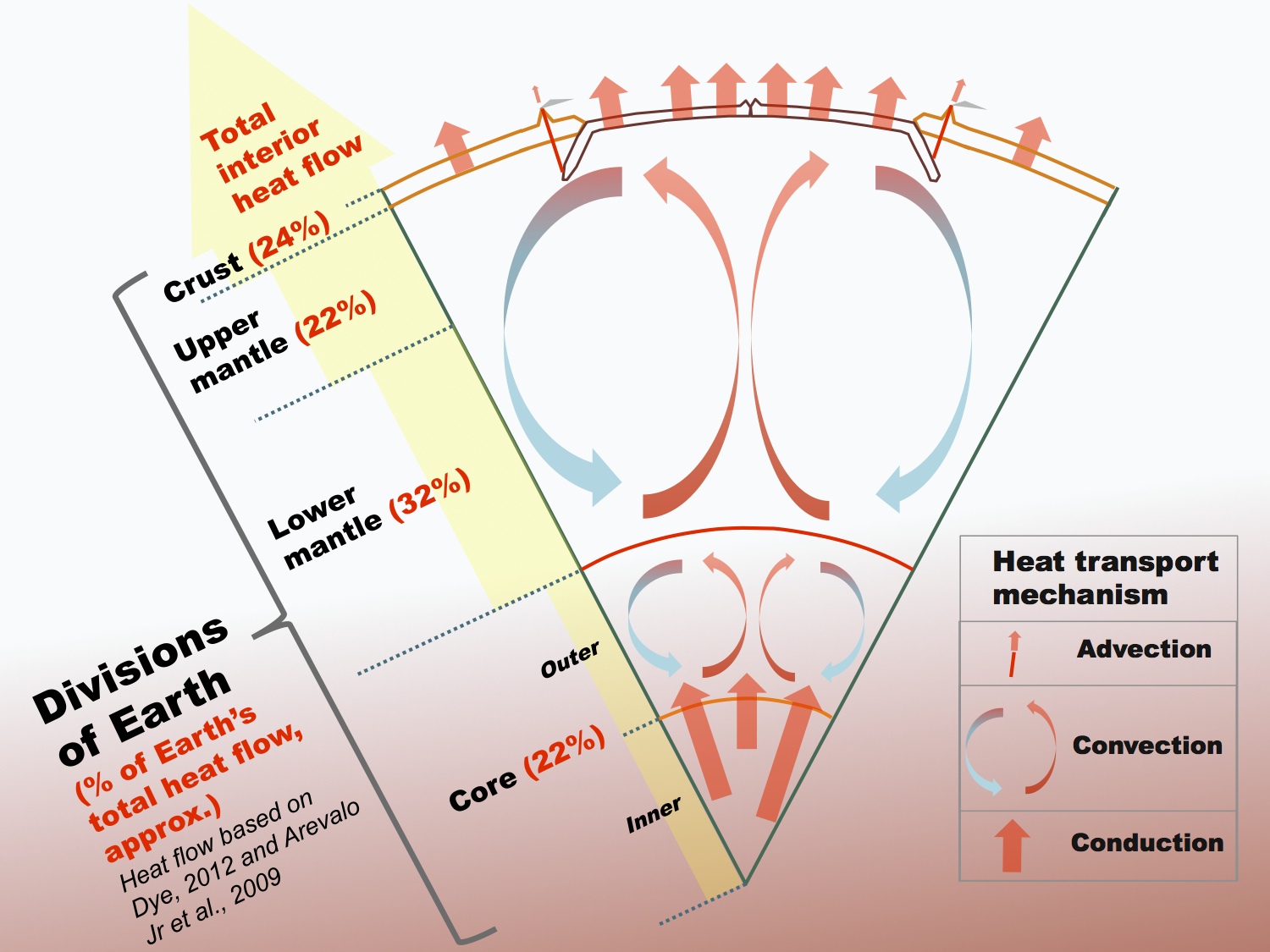
Convection plays a far more important role in heat transport than does conduction in both Earth’s mantle and liquid core (see figure 1).13 For Earth’s crust the dominant heat transport mode is volcanic advection. The dominant heat transport modes in the liquid outer core and mantle are convection. The dominant heat transport mode in the solid inner core is conduction. As a transport mechanism, convection is an important reason why Earth’s internal heat flow has been sustained for several billion years.


blog__inline--earths-furnace-is-ideal-for-life

Figure 1: Earth Cross Section Showing Its Interior Divisions and Contributions to Earth’s Total Internal Heat Flow to the Surface The heat flow percentages are from two papers: S. T. Dye, “Geoneutrinos and the Radioactive Power of the Earth,” Reviews of Geophysics 50, issue 3 (September 2012): id. RG3007, doi:10.1029/2012RG0004000; Ricardo Arevalo, Jr., Willam F. McDonough, and Mario Luong, “The K/U Ratio of the Silicate Earth: Insights into Mantle Composition, Structure, and Thermal Evolution,” Earth and Planetary Science Letters 278, issues 3–4 (February 25, 2009): 361–369, doi:10.1016/j.epsl.2008.12.023. Image credit: Bkilli1, Creative Commons Attribution-Share Alike

History of Earth’s Interior Heat Flow
Interior heat flow from both primordial (accretional) heat and radiogenic heat changes over time. The heat left over from accretion gradually dissipates as it flows from Earth’s deep interior through the mantle, through the crust, and to the surface and beyond.

When Earth was younger than about 100 million years, its radiogenic heat was dominated by short-half-life radioisotopes, such as aluminum-26, cesium-135, hafnium-182, iron-60, neptunium-237, technetium-97, and plutonium-244. For the past 4 billion years just four radioisotopes–potassium-40, thorium-232, uranium-235, and uranium-238–have accounted for more than 99 percent of Earth’s radiogenic heat. Figure 2 shows the relative contributions of potassium-40, thorium-232, uranium-235, and uranium-238 to Earth’s internal heat flow throughout the past 4.5 billion years.14

blog__inline--earths-furnace-is-ideal-for-life-2
Figure 2: History of Radiogenic Heat Flow from Earth’s Interior Radioisotopes. Diagram credit: Hugh Ross

Benefits of Earth’s Interior Heat Flow
The present temperature of the mantle just under Earth’s oceanic crust is 1,410°C.15 The current high temperature of the upper mantle means that the upper mantle material has a low viscosity (flows more easily). A familiar analogy would be the difference between a cold stick of butter and a stick of butter that has been melted in a saucepan.

It is thanks to the mantle’s low viscosity that tectonic plates in Earth’s crust are able to move relative to another—a feature of Earth for the past 3.8 billion years. This tectonic activity transformed Earth from a waterworld, where only water existed on its surface, to a planet possessing both surface oceans and surface continents. The combination of surface oceans and continents and enduring, strong tectonic activity established the biogeochemical cycles that allowed Earth’s surface temperature to be sustained at an optimal level for life in spite of the ongoing brightening of the Sun.16 The same combination has been recycling many of Earth’s life-essential nutrients. Without Earth’s enduring, strong interior heat flow, at best, only microbial life could have existed on Earth and for only several million years. In that event, microbial life never would have been able to physically and chemically transform Earth’s surface environment so that plants, animals, and humans could exist.

The current cooling rate of Earth’s mantle is 70–130°C per billion years.17 This cooling is slow enough to pose no short-term threat to any current life-forms. The cooling does imply, however, that Earth’s mantle will become more viscous. Eventually, it will be so viscous that plate tectonic activity will shut down. When that happens, advanced life and, eventually, all life will go extinct.

It is thanks to Earth’s unique strong, enduring interior heat flow that it has both a solid inner core and a liquid outer core. Earth’s liquid core is almost entirely comprised of the ferrous elements iron, cobalt, and nickel. These easily magnetized elements driven by convection currents in the outer core explain why Earth has sustained a powerful magnetic field throughout at least the past 3.7 billion years.18

This powerful, enduring magnetic field has shielded Earth’s surface life from deadly high-energy particles flowing in from the Sun and equally deadly high-energy cosmic rays. Without the shield, solar radiation would have sputtered both Earth’s atmosphere and Earth’s surface water into interplanetary space.

If it were not for Earth’s astoundingly powerful and enduring internal heat flow from the furnace in its core, there would be no civilization. In fact, there would be no humans on Earth. Nor would there be animals, trees, large plants, oceans, or atmosphere. It is thanks to the amazingly fine-tuned designs of Earth’s formation and of its interior structure and heat flow that billions of humans can thrive on Earth, enjoy high-technology civilization, gain an enormous amount of knowledge and understanding and use them to fulfill the purpose and gain the destiny for which our Creator made us.

Featured image: Earth’s Interior Structure
Image credit: Kelvinsong, Creative Commons Attribution-Share Alike

Endnotes
  1. Francis Lucazeau, “Analysis and Mapping of an Updated Terrestrial Heat Flow Data Set,” Geochemistry, Geophysics, Geosystems 20, no. 8 (August 2019): 4000–24, doi:10.1029/2019GC008389; J. H. Davies and D. R. Davies, “Earth’s Surface Heat Flux,” Solid Earth 1, no. 1 (February 22, 2010): 5–24, doi:10.5194/se-1-5-2010.
  2. Lucazeau, “Analysis and Mapping,” 4000.
  3. Andrew C. Kren, Peter Pilewskie, and Odele Coddington, “Where Does Earth’s Atmosphere Get Its Energy?”, Journal of Space Weather and Space Climate 7 (March 20, 2017): id. A10, doi:10.1051/swsc/2017007; Fei Feng and Kaicun Wang, “Determining Factors of Monthly to Decadal Variability in Surface Solar Radiation in China: Evidences from Current Reanalyses,” Journal of Geophysical Research: Atmospheres 124, no. 16 (August 2019): 9161–82, doi:10.1029/2018JD030214.
  4. The KamLAND Collaboration, “Partial Radiogenic Heat Model for Earth Revealed by Geoneutrino Measurements,” Nature Geoscience 4 (September 2011): 647–51, doi:10.1038/ngeo1205; Lucazeau, “Analysis and Mapping”; Davies and Davies, “Earth’s Surface Heat Flux.”
  5. Hugh Ross, Improbable Planet (Grand Rapids, MI: Baker, 2016), 48–60; Hugh Ross, “Yet More Reasons to Thank God for the Moon,” Today’s New Reason to Believe (blog), November 22, 2016, https://reasons.org/explore/blogs/todays-new-reason-to-believe/read/todays-new-reason-to-believe/2016/11/22/yet-more-reasons-to-thank-god-for-the-moon.
  6. Ross, Improbable Planet, 57–60; Hugh Ross, “New Evidence for Solar System Design: Fine-Tuning the Late Veneer,” Today’s New Reason to Believe (blog), August 20, 2012, https://reasons.org/explore/blogs/todays-new-reason-to-believe/read/tnrtb/2012/08/20/new-evidence-for-solar-system-design-fine-tuning-the-late-veneer.
  7. Ross, Improbable Planet, 65–72, 97–105; Hugh Ross, “Late Heavy Bombardment Intensity and the Origin of Life,” Today’s New Reason to Believe (blog), June 29, 2009, https://reasons.org/explore/blogs/todays-new-reason-to-believe/read/tnrtb/2009/06/29/late-heavy-bombardment-intensity-and-the-origin-of-life.
  8. Ross, Improbable Planet, 167–68.
  9. Hugh Ross, Why the Universe Is the Way It Is (Grand Rapids, MI: Baker, 2008), 45–47.
  10. Ross, Improbable Planet, 43–77, 113–15.
  11. The heat flow percentages are from two papers: S. T. Dye, “Geoneutrinos and the Radioactive Power of the Earth,” Reviews of Geophysics 50, no. 3 (September 2012): id. RG3007, doi:10.1029/2012RG000400; Ricardo Arevalo Jr., William F. McDonough, and Mario Luong, “The K/U Ratio of the Silicate Earth: Insights into Mantle Composition, Structure, and Thermal Evolution,” Earth and Planetary Science Letters 278, issues 3–4 (February 25, 2009): 361–69, doi:10.1016/j.epsl.2008.12.023.
  12. The heat flow rates are taken from Ricardo Arevalo Jr., et al., “The K/U Ratio of the Silicate Earth,” 361–69.
  13. Lujendra Ojha et al., “Depletion of Heat Producing Elements in the Martian Mantle,” Geophysical Research Letters 46 (November 28, 2019): 12756–63, doi:10.1029/2019GL085234.
  14. William Thomson, “4. On the Secular Cooling of the Earth,” Proceedings of the Royal Society of Edinburgh 4 (1862): 610–11, doi:10.1017/S0370164600035124. A pdf of Thomson’s paper is available here.
  15. Emily Sarafian et al., “Experimental Constraints on the Damp Peridotite Solidus and Oceanic Mantle Potential Temperature,” Science 355, issue 6328 (March 3, 2017): 942–45, doi:10.1126/science.aaj2165.
  16. Hugh Ross, “Carbon Cycle Requirements for Advanced Life, Part 1,” Today’s New Reason to Believe (blog), November 18, 2019, https://reasons.org/explore/blogs/todays-new-reason-to-believe/read/todays-new-reason-to-believe/2019/11/18/carbon-cycle-requirements-for-advanced-life-part-1; Hugh Ross, “Carbon Cycle Requirements for Advanced Life, Part 2,” Today’s New Reason to Believe (blog), November 25, 2019, https://reasons.org/explore/blogs/todays-new-reason-to-believe/read/todays-new-reason-to-believe/2019/11/25/carbon-cycle-requirements-for-advanced-life-part-2.
  17. Ricardo Arevalo Jr., et al., “The K/U Ratio of the Silicate Earth,” 361–69.
  18. Alexandra Witze, “Greenland Rocks Suggest Earth’s Magnetic Field Is Older Than We Thought,” Nature 576 (December 10, 2019): 347, doi:10.1038/d41586-019-03807-7.

About Reasons to Believe

RTB’s mission is to spread the Christian Gospel by demonstrating that sound reason and scientific research—including the very latest discoveries—consistently support, rather than erode, confidence in the truth of the Bible and faith in the personal, transcendent God revealed in both Scripture and nature. Learn More »

Support Reasons to Believe

Your support helps more people find Christ through sharing how the latest scientific discoveries affirm our faith in the God of the Bible.

DONATE NOW


U.S. Mailing Address
818 S. Oak Park Rd.
Covina, CA 91724
  • P (855) 732-7667
  • P (626) 335-1480
  • Fax (626) 852-0178
Posted in Uncategorized | Leave a comment

Eyes, Sun, and Earth Designed to Prevent Myopia

by Hugh RossAugust 16, 2021

Can early morning walks help stave off nearsightedness?

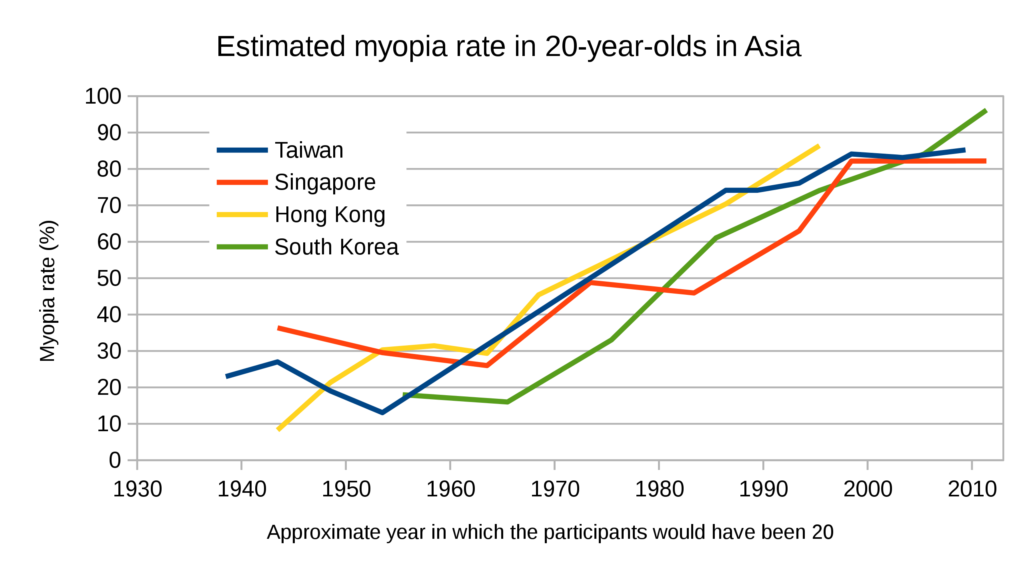
Myopia, or nearsightedness, among humans has been steadily increasing throughout the past century. Before 2000, the prevalence of myopia never exceeded 50% of the population in any region of the world. However, if current trends continue, by 2050, the prevalence will exceed 50% in 57% of the world’s nations.1 Already, ophthalmology surveys conducted in 2008–2012 reveal that 64.6% of South Koreans aged 5–18 years are developing myopia.2 By the time South Koreans reach 20 years of age, 96% have myopia. South Korea is not alone, as the figure shows.

Figure: Myopia Rate among 20-Year-Olds in Asia
Credit: Ian G. Morgan et al., “The Epidemics of Myopia: Aetiology and Prevention,” 
Progress in Retinal and Eye Research 62 (January 2018): 134–149, doi:10.1016/j.preteyeres.2017.09.004, Creative Commons Attribution

Myopia Source
Increasing myopia appears to correlate with society’s increasing education, urbanization, and indoor lifestyle. Hence, many ophthalmologists have speculated that something about being outdoors plays a significant role in preventing the onset of at least certain kinds of myopia. Indeed, several studies affirm that outdoor activity has a protective effect on the development of myopia.3 Other studies show that visible violet light (360–400 nanometers) protects against myopia development in mice, chicks, and humans.4 Outdoor sunlight has an abundance of light at these wavelengths while glass windows and doors block all wavelengths below 400 nanometers and artificial light sources emit virtually no light at less than 400 nanometers.5

Myopia Cause
A team of nine research ophthalmologists in Japan and the United States led by Xiaoyan Jiang sought to discover the underlying effect that explains why visible violet light protects against myopia development.6 They found that for mice, the protective effect depends on neuropsin, otherwise known as OPN5. Neuropsin supports the development of the vascular choroid layer, which nourishes the retina in the eyeball.

It takes a robust choroid to ensure that the eyeball shape remains normal. Myopia occurs when the eyeball becomes elongated along the visual axis.

The eyeball’s need for neuropsin explains the benefit of exposure to visible violet light. This light activates neuropsin. The neuropsin, in turn, activates the local circadian clock in the retina. For this clock to operate so as to prevent elongation of the eyeball (the inducement of myopia) it is necessary to be exposed to visible violet light at the right time of the day. The right time for mice, which are nocturnal animals, is just before sunset. For humans, the right time is just after dawn.

Design Implications
Our eyesight and the eyesight of most mammals is amazingly acute for both up close and distant viewing. It is also amazingly enduring. It must be for mammals to function at high activity levels and to perform a wide range of functions. Nowhere is this more true than for humans.

Unlike other mammals, humans have been able to tolerate a loss of eyesight acuity and function thanks to technology. One reason why the recent rapid increase in myopia among humans has not been considered a catastrophe is that it is so easy to treat and correct. A simple pair of glasses is sufficient to restore eyesight loss.

Before modern technology, however, certain design features in the natural realm kept myopia development in check. As I have explained in previous articles,7 our Sun is a star like no other. It showers the just-right radiation intensity and spectrum upon Earth to optimize our eyesight. Our planet’s atmosphere, especially its stratospheric ozone layer, is fine-tuned to block out deadly solar ultraviolet radiation (radiation shorter than 300 nanometers). But it allows the just–right amount of longer wavelength ultraviolet radiation (300–360 nanometers) to reach Earth’s surface to sustain vitamin D production in our skin and the operation of several other life-critical biochemical synthesis reactions. It is also fine-tuned to allow the just–right amount of visible violet radiation (360–400 nanometers) to reach Earth’s surface to stave off myopia development. Our eyes, and the eyes of most mammals, are designed so that regular exposure to visible violet light at the just–right times of each day maintains the necessary eyeball shape for optimal vision.

How Should We Then Live?
In light of what we now know about our eyes and how our solar and terrestrial environments have been fine-tuned to make possible several decades of optimal vision, we should first offer up thanks for what our Creator has so generously provided on our behalf. One way we can show our appreciation is to spend time outdoors and take advantage of his way to mitigate myopia development rather than rely on our technological fixes. After all, it is easy to misplace, lose, or damage our glasses or contact lenses, and find ourselves in a serious predicament.

Furthermore, there are other benefits to spending regular time outdoors shortly after dawn. Such regular exposures set and stabilize circadian rhythms beyond those in our eyes. Combining such exposures with strenuous exercise enhances both our physical and mental health. Instead of gulping down a cup of coffee and checking email after sleeping in and then heading for the office, our body, brain, and eyes, according to the nine ophthalmologists, will benefit from getting up earlier and going for a walk or a run in the great outdoors.

Endnotes

  1. Brien A. Holden et al., “Global Prevalence of Myopia and High Myopia and Temporal Trends from 2000 through 2050,” Ophthalmology 123, no. 5 (May 2016): 1036–42, doi:10.1016/j.ophtha.2016.01.006.
  2. Dong Hui Lim et al., “The High Prevalence of Myopia in Korean Children with Influence of Parental Refractive Errors: The 2008–2012 Korean National Health and Nutrition Examination Survey,” PLOS ONE 13, no. 11 (November 26, 2018): id. 0207690, doi:10.1371/journal.pone.0207690.
  3. Kathryn A. Rose et al., “Outdoor Activity Reduces the Prevalence of Myopia in Children,” Ophthalmology 115, no. 8 (August 1, 2008): 1279–85, doi:10.1016/j.optha.2007.12.019; Xiaoyan Jiang et al., “Progress and Control of Myopia by Light Environments,” Eye & Contact Lens 44, no. 5 (September 2018): 273–78, doi:10.1097/ICL.0000000000000548; Xiangui He et al., “Shanghai Time Outside to Reduce Myopia Trial: Design and Baseline Data,” Clinical & Experimental Ophthalmology 47, no. 2 (March 2019): 171–78, doi:10.1111/ceo.13391.
  4. Hidemasa Torii et al., “Violet Light Exposure Can Be a Preventive Strategy against Myopia Progression,” EBioMedicine 15 (February 1, 2017): 210–19, doi:10.1016/j.ebiom.2016.12.007; Hidemasa Torii et al., “Violet Light Transmission Is Related to Myopia Progression in Adult High Myopia,” Scientific Reports 7, no. 1 (November 6, 2017): id. 14523, doi:10.1038/s41598-017-09388-7; Ryan Strickland, Erica G. Landis, and Machelle T. Pardue, “Short-Wavelength (Violet) Light Protects Mice from Myopia through Cone Signaling,” Investigative Ophthalmology & Visual Science 61, no. 2 (February 2020): id. 13, doi:10.1167/iovs.61.2.13.
  5. Torii et al., “Violet Light Exposure.”
  6. Xiaoyan Jiang et al., “Violet Light Suppresses Lens-Induced Myopia Via Neuropsin (OPN5) in Mice,” Proceedings of the National Academy of Sciences, USA 118, no. 22 (June 1, 2021): e2018840118, doi:10.1073/pnas.2018840118.
  7. Hugh Ross, “Our Sun Is Still the One and Only,” Today’s New Reason to Believe (blog), April 17, 2017 https://reasons.org/explore/blogs/todays-new-reason-to-believe/our-sun-is-still-the-one-and-only; Hugh Ross, “Search for the Sun’s Twin,” Today’s New Reason to Believe (blog), March 17, 2008, https://reasons.org/explore/blogs/todays-new-reason-to-believe/search-for-the-suns-twin; Hugh Ross, “How Did the Sun End Up with Its Unique Rocky Planets?”, Today’s New Reason to Believe (blog), May 17, 2021, https://reasons.org/explore/blogs/todays-new-reason-to-believe/how-did-the-sun-end-up-with-its-unique-rocky-planets-2; Hugh Ross, “It Takes a Dull Star to Have a Great Party,” Today’s New Reason to Believe (blog), July 6, 2020, https://reasons.org/explore/blogs/todays-new-reason-to-believe/it-takes-a-dull-star-to-have-a-great-party.

Become a Reasons to Believe Prayer Partner Today!

Prayer—consistent, focused prayer—is a vital part of effective ministry. Sign up to be an RTB Prayer Partner below, then watch your inbox for our current prayer requests and related Scripture passages.Thank you for taking the time to bring these requests before the Lord!https://get.reasons.org/dear-reader/Design

SOCIALICON
Like a Fish Out of Water: Why I’m Skeptical of the Evolutionary Paradigm

I am skeptical that evolutionary processes can fully account for life’s origin, history, and design—and that often makes me feel like a fish out…Evolution

The Multiplexed Design of Neurons

In 1910, Major General George Owen Squier developed a technique to increase the efficiency of data transmission along telephone lines that is still used…Design

Benefits from Beavers

A team of geologists and geophysicists at Colorado State University recently discovered that beavers gave humanity more than warm coats and hats.Design

Support Our Mission

Your support helps more people find Christ through sharing how the latest scientific discoveries affirm our faith in the God of the Bible.Donate Now


facebooktwitteryoutube

Posted in Uncategorized | Leave a comment

  The Snakes Have Crawled Back In America  

In the beginning, God created heaven and earth. God then breathed life into matter who is called Adam, the first man, followed by creating Eve, the first woman. They were aware of God and then self. After they had sinned (Opposed God) against God they became aware that their self was naked, but not thrown into the outer darkness of nothingness; God was still in their equation of life. (The natural is submerged in the supernatural.)Now, we have the secular humanist who is pushing God out of America and have succeeded with public schools and workplaces. They profess to know more than the Lord. In the biblical book of Romans 1:22-23; “Professing themselves to be wise, they became fools. And changed the glory of the uncorruptible God into an image made like to corruptible man, and to birds, and fourfooted beasts, and creeping things.”

The temporary beings, secular humanists, can not address the question of “how are each life aware of themselves?” Why are you the only one who feels pain when offended? -The only one living your life? Us Believers can easily answer the question. The Infinite, Eternal God’s breath is still part of our life; He reflects each of us from Eternity; from out of time. This is our uniqueness of soul. God is our Creator and Heavenly Father.

America is a country who developed socio-political with the individual being preserved by strong privacy rights and a guarantee of a free society without any social negativity or physical obstructions being placed by any person(s), group(s), or secret, shadow government. No deep state have the licenses to cause problems in the life of any citizen.

Our Constitution has an establishment clause which outlaws the government from making laws in regard to religious institutions (Most recently, the interpretation has been reversed to mean religious institutions can not interfere with government. Work of the snakes). This clause in our Constitution helps to preserve the right of the individual to worship God without interference from the secular world. This is freedom of worship which is different from freedom of religion which refers to the institution itself. This has operated as a buffer between organizations or government and the individual.

The special interest groups (SIG) who monitor private citizens and interject their poisonous adversities into the life of any targeted citizen have grown into power again after the un-American committee of the 50s cleaned house of the snakes of communism. The SIG snakes have overridden privacy rights and actively burden targeted citizens with devastating interference in the life of a targeted private citizen. We, now, have a hyper-communist Party.  Their social machinery respects no individual. After many individuals whose disrespect prompts a recourse for justice shall bring rebellion as always as in the past. Democracy has stood for over 200 years due to its respect for our individual rights.

Now, people like Trump and his henchmen are working to turn our democracy into an autocratic government. The snakes have crawled back into our lives as hyper-communist. The hyperbole has been added due to the astonishing increase in technological knowledge since the 50s. It is now easy to map an individual’s virtual mind onto a computer with the intent to control or greatly influence the thoughts and movements of the individual.

Special interest groups (SIG) who monitor private individual, and target private citizens with the capabilities to destroy an individual’s likelihood exist in the USA at present. The SIG snakes only have to increase the density of common citizens that do their bidding; serve the snakes.

Posted in Uncategorized | Leave a comment