|

|

|
|
BY HUGH ROSS – DECEMBER 4, 2017
The Counterpoints series produced by Zondervan Publishing “provides a forum for the comparison and critique of different views on issues important to Christians.”1 Notable theologian Stanley Gundry is the series editor. The format for each book in the series is for three or four Christian leaders or scholars who are divided on an important Christian issue to each write an essay where they explain their position and briefly describe what they believe to be the best evidences for their position. Each essay is followed by responses from the other essayists and a brief rejoinder.
The Counterpoints series has featured books on creation, evolution, the early chapters of Genesis, and biblical inerrancy before. In these previous books the Reasons to Believe perspective was not presented. Consequently, over the past three decades we have had to continually deal with misunderstandings and misrepresentations of our positions and missions. Therefore, I jumped at the offer to participate in the latest book in the series, Four Views on Creation, Evolution, and Intelligent Design.2 I saw my contribution as an opportunity to set the record straight on our mission and vision and on what we believe at Reasons to Believe and why we believe it.
The four authors for the book were the presidents of Answers in Genesis (Ken Ham), BioLogos (Deborah Haarsma), Discovery Institute (Stephen Meyer), and Reasons to Believe (Hugh Ross). Ken Ham (bachelor of applied science in environmental biology and diploma in education) defended young-earth creationism, Deborah Haarsma (PhD, astrophysics) defended evolutionary creationism, Stephen Meyer (PhD, history and philosophy of science) defended intelligent design, and I (PhD, astronomy) defended old-earth creationism.
The general editor for the book, James Stump (PhD, philosophy), is the senior editor for BioLogos—thus, he obviously favors the evolutionary creationism position. I was impressed, however, by how impartially Stump fulfilled his role as the book’s editor and how fairly and charitably he treated each author.
Originally, the four authors were to describe and defend their positions on creation, evolution, and the early chapters of Genesis. This assignment proved difficult for Meyer since the Discovery Institute and the intelligent design movement as a matter of policy “does not offer an interpretation of the book of Genesis, nor does it posit a theory about the length of the biblical days of creation or the age of the earth.”3 Thus, the book morphed into four views on creation, evolution, and intelligent design. Nevertheless, the other three authors did engage one another on their respective interpretations of Genesis 1–11.
I applaud Stump for requiring each of us authors to close our opening essays with what we considered to be the most significant biblical and scientific challenges to our respective positions. The subject of creation, evolution, and Genesis for the past two centuries has been typified by Christian leaders holding rigidly to their positions and refusing to consider any possible modifications or adjustments. By admitting and addressing both possible biblical andscientific challenges, we were all encouraged to go where the evidence goes.
I also applaud Stump for doing everything in his power to encourage a charitable dialogue among the authors. Readers will probably note that Stump’s objective was only partially achieved. However, as an insider I can attest that whatever lack of charity remains in the book is of no fault of Stump.
As for my own hopes for the book, I am grateful that the all-too-typical false dichotomy of young-earth creationism versus theistic evolution was countered. I was encouraged that I had the opportunity to correct the misunderstandings the other authors had about my views and motives. I was encouraged, too, that for the first time in print the four predominant positions on the science-faith spectrum were accurately and fairly presented. In particular, I was pleased that each author stated where they stood on the issue of biblical inspiration and inerrancy, especially the International Council on Biblical Inerrancy affirmations and denials, and why. While space prohibited laying out all the evidences for the respective positions, each of the authors had written several other books and articles where that had been done. We cited these other works in our contributions to enable any reader who wants to dig deeper to do so.
At 235 pages, the book is short enough to quickly provide both Christian and non-Christian readers an understanding of the scope and the passions of the science-faith debate within the Christian community. At the same time, it is long enough to be a useful textbook for Christian seminaries and colleges and for youth and adult classes in churches and Bible studies.

Reasons to Believe emerged from my passion to research, develop, and proclaim the most powerful new reasons to believe in Christ as Creator, Lord, and Savior and to use those new reasons to reach p… Read more about Hugh Ross.
Get the latest delivered directly to you by subscribing to the RTB Weekly Digest.
The ultimate Hollywood disaster movie would portray the catastrophic consequences of a nearby supernova eruption. If one were to occur within 1,000 light-years of Earth, it would be the end of civilization as we presently enjoy. A supernova eruption closer than 100 light-years from Earth would bring devastating health consequences for human beings.
Supernovae are the final titanic explosions of stars with initial masses that exceed 9 times the Sun’s mass. At peak brightness, a single supernova can outshine 100 billion ordinary stars. Figure 1 below shows a supernova outshining its host galaxy, NGC 4526.
 Figure 1: Supernova 1994D in the NGC 4526 Galaxy. The supernova is to the lower left of the galaxy’s spiral arm structure. Image credit: NASA/ESA/Hubble Space Telescope
Supernovae are especially common in spiral galaxies. While our Milky Way Galaxy’s supernova eruption rate has been slowly declining over the past three billion years, it still averages about three supernova eruptions per century.
Not all spiral galaxies have supernova eruption rates as low as the Milky Way Galaxy (MWG). NGC 1559 is a barred spiral galaxy just like the MWG (see figure 2). Though it is a hundred times smaller than the MWG, NGC 1559 has had four supernova eruptions within the past 35 years. Taking into account NGC 1559’s much smaller size, its supernova eruption rate works out to 400 times greater than the average rate for the MWG!

Figure 2: The Barred Spiral Galaxy NGC 1559. Image credit: NASA/ESA/Hubble/Mathias Jage
Even with a rate as low as three supernova eruptions per century for the MWG, one would wonder how humanity has escaped devastation. Part of the answer is that the MWG is large—about 100,000 light-years in diameter. The major part of the answer, however, is that humans are living on Earth at a time when very few nearby supernovae have erupted and those that have were not near enough to wipe us out.
Ice Age Supernovae
Astronomer Richard Firestone’s analysis of the radiocarbon and beryllium isotope ratio records established that within the last 300,000 years, 23 supernovae have erupted within 1,000 light-years of Earth.1 This rate is more than four times below the normative rate.
Carbon-14 dating leaves little doubt that humans have been on Earth for at least the past 45,000 years. Firestone showed that the same “radiocarbon record for the past 50 kyr [50,000 years] is completely explained by the occurrence of four, powerful, near-Earth (<300 pc) [less than 980 light-years] cosmic ray events.”2 Table 1 shows the dates and distances from Earth of these four past supernova eruptions.
Table 1: Recent Nearby Supernova Eruptions
| DATE (YEARS AGO) | DISTANCE (LIGHT-YEARS) |
|---|---|
| 44,000 | 360 |
| 37,000 | 590 |
| 32,000 | 520 |
| 22,000 | 810 |
For the supernova event that occurred 44,000 years ago, during the several months following the eruption, Earth’s surface life was exposed to about 40 times the current cosmic radiation dose. Over the next 1,500 to 3,500 years, the cosmic radiation exposure was 4 times the current dose level. In the months following the 37,000 and 32,000 years ago events, Earth’s surface life was exposed to about 15 and 19 times the present cosmic radiation dose.
The consequences for human exposure to cosmic radiation 40, 19, and 15 times more intense than the current level was enhanced mutation rates and incidences of cancer. The production of much greater amounts of NOx compounds in the atmosphere caused respiratory health issues.
Beyond human health consequences, the much more intense cosmic radiation devastated the stratospheric ozone shield. This devastation dramatically increased the amount of ultraviolet radiation reaching Earth’s surface.
This increased ultraviolet radiation brought three major consequences. First, it dramatically lowered the food productivity of plants. Second, it brought global mean temperature increases of 3–4° Celsius, increases that are observed in the Antarctic and Greenland ice core records. Third, it devastated phytoplankton, thereby contributing to global warming and depleting fish stocks.
While not severe enough to bring about the extinction of the human species, each of the events listed in Table 1 would have made the maintenance of the current human population level and human civilization level impossible, not just for several months but for at least several centuries, if not for several millennia. For all four of the events listed in Table 1, it would not be possible to grow sufficient food to feed in excess of a billion human beings.
Interglacial Supernovae
For the past 10,000 years humans have been enjoying a warm interglacial period. It is an interglacial like no other. It is the only one where the global mean temperature has not changed by more than 2° Celsius. Because of this unprecedented period of extreme global stability, Earth is able to sustain more than 7 billion humans, where most of these humans have access to high-technology civilization.
This same time period is unprecedented in another way. During this period there has not been a single supernova eruption closer to Earth than 5.080 light-years. Table 2 lists all the detected supernovae during the last 10,000 years. Since a supernova as close to Earth as 5,000 light years would be as bright to human observers as the full Moon, we can be confident that no such event would have escaped human attention. Thus, the past 10,000 years must have been free of any supernova events closer to Earth than 5,000 light-years.
Table 2: Known Supernova Eruptions in the Past 10,000 Years
| DATE | DISTANCE (LIGHT-YEARS) |
|---|---|
| 185 AD | 8,200 |
| 386 AD | 14,700 |
| 393 AD | 34,000 |
| 1006 AD | 5,080 |
| 1054 AD | 6,520 |
| 1181 AD | 10,430 |
| 1572 AD | 7,490 |
| 1604 AD | 9,450 |
| 1671 AD | 11,080 |
| 1868 AD | 25,000 |
Supernova eruptions as distant as the ones listed in Table 2 pose no health threat to humanity. Neither do they pose any limitations on food productivity and, thus, on human population levels. Some of the more nearby supernova events in Table 2 could damage satellite electronics.
As my sons remind me, any damage to the GPS system of satellites would be the end of civilization as we know it. Fortunately for my sons and other members of their generation, there has not been a single supernova eruption closer than 10,000 light-years during the past 400 years. At that distance, supernova eruptions pose no threat to electronics and technology we currently possess or conceivably could develop within the next several decades.
It seems evident that God has had his supernatural hand on the MWG’s supernova events. At the same time that he has blessed us with an unprecedented period of extreme climate stability, he also has blessed us with an unprecedented period of no supernova eruptions that could possibly limit our population, technology, or capability to take the good news of salvation through Jesus Christ to all the people groups of the world.
Reasons to Believe emerged from my passion to research, develop, and proclaim the most powerful new reasons to believe in Christ as Creator, Lord, and Savior and to use those new reasons to reach p… Read more about Hugh Ross.
Get the latest delivered directly to you by subscribing to the RTB Weekly Digest.

This week’s book, Our Triune God, is by Christian theologian Peter Toon and is, in my estimation, a contemporary treasure on the doctrine of the Trinity. Toon’s work is by far the best contemporary book I’ve read concerning the triune nature of God. This sophisticated yet readable book provides a biblical, theological, and historical presentation of orthodox Trinitarianism.
Why Is This Author Notable?
Peter Toon (1939–2009) was an evangelical Anglican priest and theologian. Earning his doctorate from the University of Oxford, Toon was an expert in historical theology and lectured at more than 50 Christian institutions worldwide. He was an able defender of historic Christianity and promoted a traditional or theologically conservative form of Anglicanism. Toon was especially well known for his promotion of the Book of Common Prayer.
What Is This Book About?
A prolific author of more than 30 books, Toon’s work Our Triune God presents, explains, and defends the orthodox view of the Trinity. Divided into four parts and twelve individual chapters, this book offers a general biblical and theological introduction to all things Trinitarian.
Toon begins by exploring the understanding of God offered in Judeo-Christian theism (Hebrew: Yahweh-Elohim). He skillfully explains the biblical basis of the Trinity (appealing to both the Old and New Testaments) and discusses how this critical doctrine was understood and defined within Christian church history. Crucial to Toon’s theological discussion is how the various church councils and creeds understood and defined Trinitarian theology.
In a clear and careful manner, Toon provides a biblical, theological, and apologetic portrayal of the Christian doctrine of the Trinity. This work also distinguishes how the Trinitarian view of God differs from other popular conceptions of deity. Lastly, Toon draws together a theological orthodoxy with a rich devotional commitment to knowing and worshiping the one God who is Father, Son, and Holy Spirit.
Peter Toon reflects concern on how little today’s Christians have learned about the triune nature of God:
Apparently most people who attend church services today have never heard a sermon expounding the doctrine of the Blessed, Holy, and Undivided Trinity—the transcendent, living God, Yahweh-Elohim, worshiped by Christians through the centuries. Further, they have had either little or no instruction in the importance, or the actual content, of this doctrine of the Father, the Son, and the Holy Spirit—the Trinity in Unity and Unity in Trinity.1
Why Is This Book Worth Reading?
Our Triune God is unique among books about the Trinity for its clarity, theological sophistication, historical understanding, and faithfulness to the teachings of Scripture. Both laymen and scholars will receive a lot from reading and studying this rich theological volume. I hope many Christians will use this work to grow in their understanding of and devotional commitment to the triune God of the Bible.
Resources

I believe deeply that “all truth is God’s truth.” That historic affirmation means that when we discover and grasp truth in the world and in life we move closer to its divine Author. This approach r… Read more about Kenneth R. Samples.
Get the latest delivered directly to you by subscribing to the RTB Weekly Digest.
Mosquitoes are the deadliest creatures on Earth, killing over half-a-million people annually and sickening hundreds of millions more.1 So why on earth would we celebrate World Mosquito Day? And why would a good God create bloodsucking, disease-ridden insects responsible for such extensive suffering?
Marking the Day
World Mosquito Day, August 20, has been marked every year since 1897, when British doctor Sir Ronald Ross first pronounced it in light of his work and discoveries that female Anophelesmosquitoes carried and transmitted malaria parasites. Since then, mosquitoes have been identified as vectors of numerous other pathogens associated with familiar and obscure human diseases. In addition to malaria parasites of the genus Plasmodium,2 mosquitoes carry over a dozen viruses including yellow fever; dengue; West Nile; Rift Valley fever; Jamestown Canyon; chikungunya; Japanese, St. Louis, La Crosse, and California encephalitis viruses; Venezuelan, Western, and Eastern equine encephalitis viruses; and most recently, Zika virus. The parasitic filarial worms (Wuchereria bancrofti, Brugia malayi, and Brugia timori) associated with elephantiasis are also transmitted to humans by mosquitoes.3
The “celebration” of World Mosquito Day is not a celebration of mosquitoes but really just an opportunity to heighten awareness and promote education about diseases spread by mosquitoes. Programs promote action items that people can do to help prevent mosquito breeding and biting, and transmission of the associated diseases. These include steps like covering or removing standing water where mosquitoes can breed, staying indoors, wearing long sleeves and pants, using mosquito repellent, using air-conditioning rather than open windows for cooling, and using mosquito nets when mosquitoes are active at night.4
Celebrating Mosquitoes?
There isn’t really a day set aside to celebrate mosquitoes, but maybe there should be. There are over 3,550 known mosquito species and only about 200 of these harass humans.5 Of the 112 identified genera of mosquitoes, only nine have been identified as harboring species that carry human pathogens. Eight of these genera (Anopheles, Aedes, Ochlerotatus, Culex,Mansonia, Coquillettidia, Psorophora, and Culiseta) are highlighted in the “Are Mosquitoes as Deadly as They Seem?” infographic. The ninth genus, Haemagogus (not shown), contains 28 species, of which 7 are associated with disease-harboring and transmitting the yellow fever virus.6
Well over 90 percent of mosquito species have no link to human disease.
 A fossil of Burmaculex antiquus embedded in Burmese amber dates to the mid-Cretaceousera, indicating mosquitoes have been around for at least 90–100 million years.7 After millions of years of speciation they demonstrate extensive biodiversity today. Even though they have been around a very long time, we still have much to learn about mosquitoes. As we continually learn more, the taxonomic status of several mosquitoes has changed over time, making it challenging to stay abreast of which species is which. With so many species to explore, who knows what mosquito-related compounds may be awaiting discovery for beneficial human use!
But even without such future discoveries, mosquitoes serve significant roles and contribute significant biomass to the global food chain. Mosquitoes have a four-stage life cycle. (See “Mosquito Life Cycle” image below.) Mosquito eggs and larvae serve as food for many other aquatic larvae, amphibians, and fish. And adult mosquitoes provide food for many amphibians, spiders, lizards, birds, bats, and other insects, such as dragonflies. Mosquito larvae are also filter feeders, playing a critical role in scavenging organic matter from aquatic environments. As larvae consume organic particulates and microorganisms, they recycle organic resources into the food chain. And adult mosquitoes serve as pollinators, critical to flower and plant fertilization, as they feed on nectar. Only adult female mosquitoes from some species bite. They need amino acids present in the blood meal to produce mosquito eggs. Male mosquitoes never bite.
 Mosquitoes can be found in very warm climates as well as in cold climates and are an intricate part of Earth’s biodiversity and God’s creation. The vast majority of mosquitoes are beneficial participants in complex ecosystems and play no role in human disease. We really don’t know how eradicating mosquitoes might result in significant unwanted and unimaginable effects on the environment. As scientists and good stewards of creation, we must patiently and diligently look for ways to prevent mosquito-borne diseases while protecting well-balanced ecological systems. One day soon, as we continue to learn more, we might have more to buzz about and even reasons to celebrate mosquitoes on World Mosquito Day!
Resources
“Viruses, Mosquitoes, and Suffering: Bad or Good?” by Anjeanette Roberts (article)
To discuss more about mosquitoes or mosquito-borne viruses, and stay current with my blog and related science-faith topics, connect with me on Facebook or Twitter.
This article is updated from a version first published on September 1, 2016, “Why All the Buzz about Mosquitoes?”

Following an extensive career in research science and teaching, molecular biologist Anjeanette “AJ” Roberts joined Reasons to Believe (RTB) as a visiting scholar in 2015 and, in 2016, became a permane… Read more about Anjeanette Roberts.
Get the latest delivered directly to you by subscribing to the RTB Weekly Digest.
The discovery of two ancient ovens in Jordan provides evidence that humans were making bread at a time consistent with the Bible’s account of early human history. In chapter 15 of my book Improbable Planet1, I described an archaeological/scientific discovery2 that established that humans living along the shore of the Sea of Galilee were selectively breeding and cultivating wild grains at least as long ago as 23,000 years before the present. The breeding and cultivation of such grains suggest that humans living 23,000 years ago were using the grains as a food staple that likely may have included the manufacture of bread or bread-like products.
In a previous blog3 I wrote about another archaeological/scientific discovery.4 Here, a team of five anthropologists and archaeologists unearthed a grinding tool from the Grotta Paglicci cave in southern Italy, from which they recovered “thermally pretreated” oat grains. The team achieved an accurate carbon-14 date of the grains showing that humans living 32,614 ± 429 years ago were grinding and roasting grains to manufacture flour.
Now, a team of five researchers, led by Amaia Arranz-Otaegui, have analyzed a site in Jordan and discovered two ovens that they concluded provides clear evidence that humans were using them to make bread or bread-like products 14,400 years ago.5 The site, Shubayqa 1, is located in northeastern Jordan in an area known as the Black Desert. The archaeological remains at Shubayqa 1 indicate that humans were using the site from 14,600–11,600 years ago and were primarily engaged in hunting and gathering.
Arranz-Otaegui’s team found an organic residue in one of two sunken fireplaces (see figure below) constructed of basalt flagstones. They analyzed this residue with a scanning electron microscope and identified 24 pieces of char that possessed the chemical and structural properties of ground cereal grains that had been mixed with water and baked or fried to make a flatbread. The team determined that the char pieces included at least one processed grain, wild einkorn wheat (Triticum boeoticum) and at least one root tuber, club-rush tuber (Bolboschoenus glaucus).
 Figure: Fireplace Hearth That Was Used for Bread-Making 14,400 Years Ago. Image credit: Amaia Arranz-Otaegui’s research team
The carbon-14 date for the residue was 14,400 years ago. In their paper Arranz-Otaegui’s team drew two conclusions from the findings. They wrote that their results “demonstrate that the preparation and consumption of bread-like products predated the emergence of agriculture by at least 4,000 years.”6 Second, they stated that the slim archaeobotanical evidence they found showed that cereal exploitation for making bread was not common 14,600–11,600 years ago, and that bread became a staple for humanity only when agriculture based on the large-scale cultivation of grains was firmly established circa 9,100 years ago.7
In light of the previous discoveries and what I have written about early food-processing preparation and technology,8 I am persuaded that three more conclusions can be drawn. First, the evidence for humans engaging in the processing of grains for food preparation 32,600, 23,000, and 14,400 years ago indicates that throughout the last ice age, humans were continuously or near continuously engaging in some kind of bread-making industry. This industry was being practiced in spite of the extreme climate instability that existed throughout the last ice age.9
Second, the observation that bread did not become a staple in the human diet until the large-scale cultivation of grains was established is no reflection of any lack of motivation, innovation, or work ethic on the part of humans living before 9,100 years ago. The extreme climate stability that is needed to make the large-scale cultivation of grains did not exist until 9,100 years ago.10 Previous to that time, the global mean temperature was fluctuating by ±22° Fahrenheit (12° Celsius) on timescales of only a few centuries. Such extreme temperature fluctuations made the large-scale cultivation of grains impossible. Because of extreme climate instability, humans living before 9,100 years ago could not afford to live on bread alone or on any other one or two or three sources of food. Survival during that time required a predominantly hunter-gatherer economy supplemented by highly varied, small-scale agriculture.
Arranz-Otaegui’s team’s discovery complements the two previous discoveries on food-processing technology. It further substantiates the Bible’s accounts of the early history of humanity (Genesis 4) and the industry and technology employed by the first humans.
Reasons to Believe emerged from my passion to research, develop, and proclaim the most powerful new reasons to believe in Christ as Creator, Lord, and Savior and to use those new reasons to reach p… Read more about Hugh Ross.
Get the latest delivered directly to you by subscribing to the RTB Weekly Digest.

By Dr. Robert C. Newman
Since 1970 various versions of an exciting “science apologetics” story have appeared in books, newspapers, and magazines across the United States and beyond. Many people have read the story or heard it and passed it along to others, thinking it a credible account. As a Christian and a scientist, I felt an obligation to check out the story’s veracity for myself and to share my findings with others. My findings will serve, I hope, as both an exhortation and caution.
According to the story, usually entitled “The Space Program Proves the Bible” or something similar, Harold Hill, president of Curtis Engineering and a consultant to the space program, reports that space scientists in Greenbelt, Maryland, bumped into a big “problem” when checking their computer data for future orbital positions of the Sun, Moon, planets, etc. The problem supposedly proved to be a missing day somewhere in the past, a day which one of the religious team members identified for the unchurched others as the day the Sun stood still for Joshua (Joshua 10:12–14).
The problem persisted, however, according to the story, because only 23 hours and 20 minutes was missing at the time of Joshua, leaving 40 minutes unaccounted for. Then the same fellow remembered that the Sun’s shadow moved backward ten steps—exactly 40 minutes, the story says—on the stairway of Ahaz at the time of Hezekiah’s illness (2 Kings 20:10–11). The story ends with an exultant declaration that God is rubbing scientists’ noses in the truth of His Word.
Naturally, many Christians were and still are excited about the story. We love to read and hear how scientific findings support our faith, but we are also commanded in Scripture to “prove all things; hold fast to that which is good” (1 Thessalonians 5:21). Often, however, we are too rushed and eager to undertake such testing. We certainly don’t want to appear to our fellow believers as harshly skeptical or critical.
William Willoughby, the religion editor of the Washington, D. C., Evening Star, was the first, I think, to follow up on this story and publish what he found. In his “Washington Perspective” column of August 8, 1970, Willoughby reported that when he contacted NASA’s Goddard Space Flight Center in Greenbelt, no one knew anything about the events recorded in the story. Willoughby then contacted Harold Hill in Baltimore. Hill stuck to his story, which he claimed to have on good authority, but he said he could not locate his documentation.
These facts by themselves cast a shadow on the story, but doubt increases when certain details of the story itself are examined. The story credits computers as the error detectors. Is such detection possible? Consider that for either computers or their human programmers to detect a missing day, the programmers must input a fixed time marker predating the missing day. Moreover, the story suggests that the scientists found not a day, exactly, rather 23 hours and 20 minutes at one place in history (between 1400 and 1250 BC, according to most scholars) and the remaining 40 minutes in another (about 700 BC). So, in this case, we need two fixed points: one before the time of Joshua and another between the times of Joshua and Hezekiah. These fixed points must be known to astronomers and historians with an accuracy of a few minutes to make possible the detection of such a precise discrepancy.
One method that could produce some accuracy would be recorded observations of solar eclipses of the Sun, for these are total only along narrow paths and only for a few minutes at any specific locality. However, the earliest datable eclipse of the Sun occurred in the year 1217 BC, after the time of Joshua (see Encyclopedia Britannica, revised 14th edition, s.v. “eclipse”). In any case, ancient eclipse observations are not given with an accuracy of a few minutes even by local time. Therefore, confirmation of Joshua’s 23 hours and 20 minutes (or even 24 hours) remains, to date, beyond the reach of human or computerized calculations. On this basis alone, I must regard the computer story as a hoax.
Even without these computer questions, however, I found another basis for my conclusion: the main features of this story are older than either NASA or electronic calculation. In his Harmony of Science and Scripture, published in 1936, Harry Rimmer recounts the following story (pp. 281–82):
There is a book by Prof. C. A. Totten of Yale, written in 1890, which establishes the case [for biblical reliability] beyond the shadow of a doubt. The condensed account of his book, briefly summarized, is as follows:
Professor Totten wrote of a fellow-professor, an accomplished astronomer, who made the strange discovery that the earth was twenty-four hours out of schedule! That is to say, there had been twenty-four hours lost out of time. In discussing this point with his fellow-professor, Professor Totten challenged this man to investigate the question of the inspiration of the Bible. He said, “You do not believe the Bible to be the word of God, and I do. Now here is a fine opportunity to prove whether or not the Bible is inspired. You begin to read at the very beginning and read as far as need be, and see if the Bible cannot account for your missing time.”
The astronomer accepted the challenge and began to read. Some time later, when the two men chanced to meet on the campus, Professor Totten asked his friend if he had proved the question to his satisfaction. His colleague replied, “I believe I have definitely proved that the Bible is not the word of God. In the tenth chapter of Joshua, I found the missing twenty-four hours accounted for. Then I went back and checked up on my figures and found that at the time of Joshua there were only twenty-three hours and twenty minutes lost. If the Bible made a mistake of forty minutes, it is not the Book of God!”
Professor Totten said, “You are right in part at least. But does the Bible say that a whole day was lost at the time of Joshua?” So they looked and saw that the text said, “about the space of a whole day.”
The word “about” changed the whole situation, and the astronomer took up his reading again. He read on until he came to the thirty-eighth chapter of the prophet Isaiah. In this chapter, Isaiah has left us the thrilling story of the king Hezekiah, who was sick unto death. In response to his prayer, God promised to add fifteen more years to his life. To confirm the truth of His promise, God offered a sign. He said, “Go out in the court and look at the sundial of Ahaz. I will make the shadow on the sundial back up ten degrees!” Isaiah recounts that the king looked, and while he looked, the shadow turned backward ten degrees, by which ten degrees it had already gone down! This settled the case, for ten degrees on the sundial is forty minutes on the face of the clock! So the accuracy of the Book was established to the satisfaction of this exacting critic.
Comparing Rimmer’s account with the NASA computer story, notice that both include the same numbers: one day missing overall, 23 hours and 20 minutes at the time of Joshua and 40 minutes at the time of Hezekiah. Here, too, we have a dramatic tale of a skeptic’s coming to see the truth of Scripture. The parallels between the two are obvious, but we must go back to Totten, too.
Charles Adiel Lewis Totten is listed in Who Was Who in America (1:1247) as a professor of military science at Yale from 1889 to 1892, who resigned to spend more time on his religious studies. He was a British-Israelist, believing that the Anglo-Saxons were the lost tribes of Israel, and an Adventist, who predicted the reign of Antichrist would occur in the seven-year period from 1892 to 1899. Among his many writings isJoshua’s Long Day and the Dial of Ahaz, published, as Rimmer reports, in 1890. After some exertion and considerable frustration, I succeeded in locating a copy of the third revised edition, published in 1891. Since then the work has been reprinted by Destiny Publishers of Merrimac, Massachusetts.
Reading Totten’s book brought another surprise: the dramatic story of a skeptic convinced does not appear. Instead, Totten himself, a non-skeptic all along, seeks to show that a total of 24 hours is missing from past time, of which 23 hours and 20 minutes were lost in Joshua’s day and 40 minutes at the time of Hezekiah. Totten does not actually reproduce the calculations by which he seeks to prove his “case”; he merely gives the results. On pages 39, 59, and 61 of the third edition, the fact emerges that Totten relies on an assumed date of creation—the autumnal equinox, September 22, 4000 BC (p. 61)—as the “known” fixed point before the long day of Joshua. Taking the first day of creation to be a Sunday, by his understanding of Scripture, and finding that by calculating back from the present, September 22, 4000 BC would fall on a Monday, Totten concludes, “It can come so by no possible mathematics without the interpolation or ‘intercalation’ of exactly 24 hours” (p. 59).
Totten’s presentation obscures his method of discovery. Apparently, he started with a missing 24 hours, then decided from the ten “steps” mentioned in the Hezekiah incident to assign 40 minutes to that event (since the Sun moves about 10 degrees in 40 minutes), leaving 23 hours and 20 minutes to Joshua. But Totten has mentioned no fixed point between the times of Joshua and Hezekiah, and therefore he has no way of showing, independent of the biblical material or otherwise, that just such a division of the total time is warranted. Totten’s work provides no objective support to the scriptural accounts.
Totten does cite the source for his exact creation date: it was calculated by the British Chronological Association. This group, headed by premier chronologist Jabez Bunting Dimbleby, used to publish an almanac entitled All Past Time in which they claimed to be able to account for every day since creation. Their 1885 almanac suggests that they established their chronology by adding up the numbers given in the Old Testament, using a liberal supply of speculation regarding ancient methods of keeping the lunar and solar calendars aligned. The work is dauntingly technical, but a few minutes’ reading convinced me that their method of interpreting Scripture is often arbitrary. In light of archeology and a plethora of research data, few conservative Christians—even among those who believe the earth is much younger than geologists are willing to concede—would now accept the 4000 BC date as the precise date of creation. Totten’s scheme depends entirely on knowing that date.
In summary, Totten’s work has no foundation independent of the Bible, and it is questionable whether he has properly understood Scripture in regard to his one fixed point, the date of creation. Sometime between Totten’s work in 1890 and Rimmer’s in 1936, a story seems to have taken shape, a story in which Totten becomes a bystander and a skeptical astronomer becomes the calculator. Since 1936, the story seems to have been updated with the addition of “space age” features, NASA’s Space Flight Center scientists replacing the lone astronomer and computers to speed up the tedious calculations.
Does this story about a story have any lessons for us? I think so. All Christians like to see skeptics turn to Christ, and we may be tempted to “bend” the truth a little to make a stronger argument. Perhaps we rationalize that the end (eternal life) justifies the means (a little shading of the truth). I strongly disagree.
In the long run, when the truth comes to light, such distortions, even if they’re not deliberate, only give unbelievers a basis for claiming that the Bible writers might have been guilty of the same thing: distortion. Our attempt to “help” God thus becomes an argument for unbelief. My hope is that Christians will demonstrate such zeal for truth that unbelievers will become convinced that we really have it. We would do well to lovingly but firmly rebuke the Rimmers and the Hills and others who damage our credibility. They (and we) must be careful in checking sources, especially for material favorable to our position. We have no need to invent stories to make Christianity look good. Excellent evidences for the truth of Christianity are available in abundance. Those who refuse to investigate it or choose to reject it will have no good answer on the day of judgment. Let’s not supply them with a ready excuse.
This article was originally published on reasons.org in January 1997.
****
Learn more about Joshua’s long day and other Bible mysteries.
Could a man survive three days and three nights in the “belly of a whale”?
Is the Gospel written in the stellar constellations?
Will we find the remains of Noah’s ark or the Ark of the Covenant?
Dr. Hugh Ross addresses these questions and several more Bible controversies inMysteries Examined, a three-part DVD with nearly four hours of content, includingJoshua’s Long Day, Quantum Apologetics, and Unraveling Starlight and Time with philosopher-theologian Kenneth Samples. Order your copy of Mysteries Examinedtoday.
Subjects: Bible Difficulties
In last week’s blog1 I described how a careful reconstruction of temperature proxies at sites all over the world revealed that the climate stability humans have enjoyed over the past 9,500 years was about twice as stable as scientists had previously concluded. That is, we are twice as blessed as we had previously thought. Thanks to the extreme climate stability of the past 9,500 years, we have been successful in launching and sustaining global high-technology civilization and in building our population up to seven billion individuals.
I stated last week that I would describe in this blog the new discoveries that explain how we got such a long period of extreme climate stability. I now realize that I cannot do justice to all these discoveries in one blog. This blog is the first of two describing the miraculous designs of Earth’s recent history that gave us the remarkable gift of extreme climate stability in the midst of an ice age cycle.
As I briefly summarized in last week’s blog and describe in much more detail in my book, Improbable Planet,2 it is nothing short of a miracle that we have had such a long period of extreme climate stability at the optimal temperature for global high-technology civilization. Making the climate stability epoch all the more miraculous is that it occurred and is occurring in the midst of an ice age cycle. As I explained in last week’s blog, the ice age cycle drives extreme climate instability, not the opposite (stability). In fact, the past 2.588 to 0.009 million years ago has seen the greatest continuous climate instability in the entire 4.566-million-year history of Earth.
Now, thanks to a new discovery and a long-known temperature anomaly that occurred just previous to the 9,500-year epoch of extreme climate stability, scientists may be close to understanding how such an epoch came about. To put that anomaly and the new discovery in context, it is important to understand the nature of the ice age cycle.
Ice Age Cycle
Earth’s ice age cycle has persisted throughout the past 2.588 million years. For all but the last 800,000 years of that cycle the period has been 41,000 years. This 41,000-year periodicity was driven by the 41,000-year cycle of variation in the tilt of Earth’s rotation axis.
I wrote a series of three blogs where I explained how the period of Earth’s ice age cycle transitioned, beginning about 800,000 years ago, from 41,000 years to approximately 100,000 years. One can access those blogs here,3 here,4 and here.5
Figure 1 shows the global mean (average) temperatures throughout the last four ice age cycles. This graph shows that roughly every 100,000 years the global mean temperature very briefly rose to about 2°C above the present temperature. It also shows that whenever that occurred, Earth quickly dropped into a long cold period where 20–23 percent of Earth’s surface was covered with thick sheets of ice.
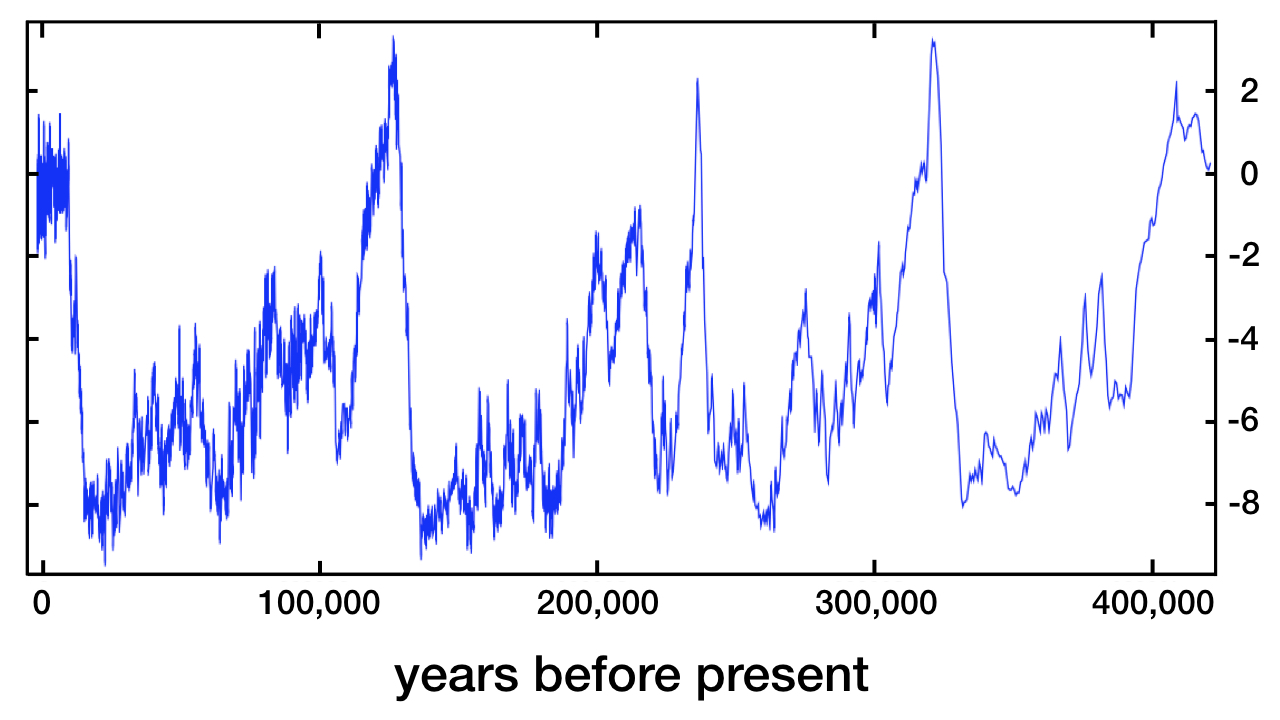
Figure 1: Antarctic temperature record for the past four ice age cycles. Temperatures are in °C relative to the average for 1900–1950 AD. Image credit: Robert A. Rohde, Global Warming Art Project, CC-by-SA
The current ice age cycle is exceptional. Instead of the global mean temperature rising rapidly from a minimal value of about 8°C colder than the present (1900–1950 AD average) to 2–3°C warmer than the present, the rapid temperature rise was interrupted by a brief major cooling event that apparently prevented the 2–3°C global mean temperature rise.
Younger Dryas Temperature Anomaly
The brief major cooling event is known as the Younger Dryas. It lasted from 12,900–11,700 years ago. Figure 2 shows the Younger Dryas cooling event (see arrow) relative to the reconstruction of the 9,500-year epoch of extreme climate stability that was the subject of last week’s blog.6
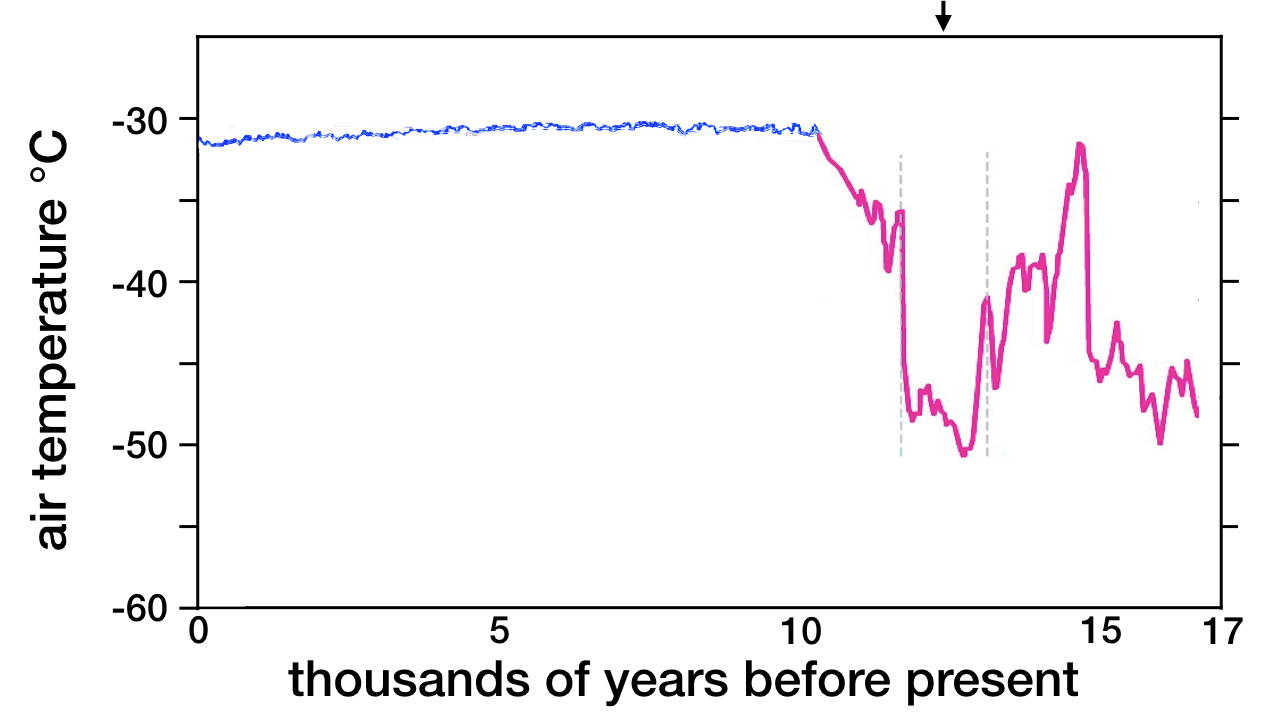
Figure 2: Younger Dryas Cooling Event. The temperature figures represent the surface air temperature in the central region of Greenland’s ice sheet. The blue curve shows the newly determined temperature record of the past 9,500 years. The purple curve shows the temperature record from 16,500–9,500 years ago derived from oxygen-18 isotope measures in ice cores drilled in the central region of Greenland’s ice sheet. The two dotted lines delineate the start and end times of the Younger Dryas event. Data credit for blue curve: Shaun A. Marcott et al.; data credit for purple curve: United States Geological Survey; Diagram credit: Hugh Ross
The Younger Dryas cooling event is unique to the last cycle. It is not present in cycles previous to the last. In the midst of a rapid increase in global mean temperature came a sudden drop of 10°C (18°F), a drop that was sustained for 1,200 years, followed by a sudden rise of 13°C (23°F). Both the sudden drop and the sudden rise occurred over periods of under 20–50 years.7
These temperature changes are for central Greenland. The rest of the mid- and high-latitude northern hemisphere landmasses were impacted to nearly the same degree. The tropical and southern hemisphere landmasses were impacted to a lesser, but nevertheless significant, degree.8
Cause of the Younger Dryas Temperature Anomaly
The consensus scientific explanation for the cause of the Younger Dryas is a near total or complete shutdown of the Atlantic Meridional Overturning Circulation (AMOC), popularly known as the Gulf Stream. The termination of the flow of warm tropical water into the North Atlantic would have reversed the melting of the great North American and European ice sheets. The return of the great ice sheets would have cooled all Earth’s continents and especially North America, Europe, and northern Asia.
Evidence for the termination of the AMOC throughout the Younger Dryas is threefold. First, the Southern Ocean waters became warmer9 as a result of the AMOC being turned back into tropical waters. Second, cold water flowed from the seas adjacent to East Greenland and Iceland into the Nordic seas.10 Third, the injection of cold fresh water into the North Atlantic interrupted deep and intermediate depth AMOC circulations.11
Scientists debate the cause of AMOC shutdown. The most widely accepted scientific explanation is that the AMOC was shut down by a sudden influx of glacial meltwater from Lake Agassiz (figure 3) into the North Atlantic. This rush of cold fresh water into the North Atlantic would have turned back the flow of warm salt water from the tropical Atlantic.
Lake Agassiz formed during the deglaciation of North America. Figure 3 shows Lake Agassiz as it was 13,000 years ago.

Figure 3: Lake Agassiz just before the beginning of the Younger Dryas event. By this time, the North American ice sheets in the west had largely melted away, leaving behind a gigantic lake of glacial meltwater. Ice sheets remained that covered the entire Canadian arctic archipelago, Hudson Bay, the eastern Northwest Territories as far west as Great Slave and Great Bear Lakes, and Ontario and Quebec down to within a few tens of miles of the Great Lakes and the St. Lawrence River. North America image credit: NASA
Once Lake Agassiz formed, it drained southward into the Gulf of Mexico. There is evidencethat the flow was interrupted at the time of the Younger Dryas event.12 Sudden breaches to the east and north of Lake Agassiz could have caused a rush of fresh meltwater to burst through the St. Lawrence River into the North Atlantic,13 through the Mackenzie River into the Beaufort Sea, along the Canadian Archipelago, through the Fram Strait, and into the Nordic Seas,14 and/or under the ice that covered the Hudson Bay region and into the North Atlantic.
Asteroidal Impact?
In 2007 a team of 26 physicists, geologists, anthropologists, and chemists noted that at Clovis age sites across North America, thin layers exist. They contain magnetic grains with iridium, magnetic microspherules, charcoal, soot, glass-like carbon containing nanodiamonds, and fullerenes with extraterrestrial helium that date to 12,900 years ago.15 The team demonstrated that these ingredients are or could be evidence for an extraterrestrial impact event. They concluded that a large extraterrestrial object exploded over northern North America which destabilized the Laurentide Ice Sheet and triggered the Younger Dryas cooling event.
Two research teams called into question the nanodiamond16 and charcoal/soot17 evidence, respectively. However, a team of Harvard University planetary scientists led by Michail Petaev noted that a large platinum anomaly in the Greenland ice cores—a signature of an iridium-poor iron asteroid—corresponds to the onset of the Younger Dryas.18 Petaev’s team calculated that the asteroid would need to be 0.8 kilometers in diameter to explain the observed platinum anomaly.
Physicist Mark Boslough, in a reply to the Petaev team’s paper, expressed doubt about a collision event by such a large asteroid.19 He pointed out that collision events by iron asteroids as large as 0.8 kilometers are extremely rare events, occurring only once every several tens of millions of years. Furthermore, he calculated that such an iron asteroid collision event would yield a crater 15–20 kilometers in diameter. It would be nearly impossible, Boslough claimed, for such a large crater created as recently as 11,900 years ago, to elude discovery. He suggested instead that the platinum anomaly was caused by the Cape York meteorite (see figure 4). Eight large iron meteorites, weighing 34, 22, 3.8, 3.3, 0.9, 0.6, 0.1, and 0.02 tons, respectively, have been recovered from northwestern Greenland. Their common chemical makeup and element abundance ratios affirm that they are all from the same body.

Figure 4: Robert Peary Beside the Largest Fragment of the Cape York Meteorite. This 34-ton fragment now is on display at the American Museum of Natural History. Image credit: Robert E. Peary
Petaev’s team responded to Boslough’s reply.20 They pointed out that the platinum anomaly persisted for far too long in the Greenland GISP2 ice core for the meteorite body to be only 10–100 times larger than the combination of the eight large meteorite fragments comprising the Cape York meteorite. They stood by their claim that the platinum anomaly resulted from an extraterrestrial impactor that generated global consequences.
The Drama Continues
Just a few weeks ago, a team of seven geologists announced their discovery of the nearly impossible crater, very recently formed, not just 15–20 but 31 kilometers in diameter! While it’s “nearly impossible” for some people, this kind of miraculous activity appears to be routine for an intelligent, loving Creator who fashioned this improbable planet for human flourishing. In my next blog I will describe this discovery and the likely role it played in granting us a 9,500-year period of extreme climate stability.
Featured image: A portion of a Greenland ice core. Image credit: K. Makinson

BIO
Reasons to Believe emerged from my passion to research, develop, and proclaim the most powerful new reasons to believe in Christ as Creator, Lord, and Savior and to use those new reasons to reach p… Read more about Hugh Ross.
Get the latest delivered directly to you by subscribing to the RTB Weekly Digest.

by Hugh RossDecember 10, 2021
Question of the week: How can we show an evolutionist that Earth suits us best because Earth was designed to be compatible with us rather than the idea that we naturally evolved to become compatible with Earth?
My answer: I get asked this question nearly every time I speak on a university or college campus. Apparently, the hypothesis that humans became compatible or naturally evolved to adapt to Earth’s present conditions has become dogma in many university course offerings, more so in the social sciences than in the physical or life sciences. Consequently, I devoted an entire book to answering this question, Improbable Planet.1 Additional evidences that our supergalaxy cluster, our galaxy cluster, our galaxy group, our galaxy, the Local Bubble, the Local Fluff, the solar system, and the Sun, Moon, and Earth have been exquisitely prepared and designed for humans are presented in my next book, Designed to the Core.2
A very brief answer is that the Milky Way Galaxy, the solar system, and Earth were designed to be the ideal home for humanity and global human civilization millions and billions of years before humans showed up. More than 400 distinct features of Earth must be fine-tuned to make our existence and civilization possible.3 Even with all this exquisite fine-tuning the time window during which humans can exist in a civilized state is extremely narrow.4 It is no random accident that we happen to be here during this narrow time window when the resources we need to sustain global civilization are uniquely available.
The evidence for purposeful design for the specific benefit of human beings is especially compelling in the context of what is needed for billions of humans to be redeemed from sin and evil. Every component and every event in the universe, Earth, and Earth’s life plays some role in making redemption possible for billions of humans.
Endnotes


The old cliché “two wrongs don’t make a right” proves true in many situations, but in the genetics of the brain, two genetic wrongs…Design
Cell phones. Internet. Television. These ubiquitous—and many would argue essential—technologies all rely on the transmission and decoding of radio signals. In particular, the proper…Design
A few years ago, a probe sent on a self-destruct mission into the interior of Jupiter revealed that Jupiter’s atmosphere grew dark and dry…Design

Your support helps more people find Christ through sharing how the latest scientific discoveries affirm our faith in the God of the Bible.Donate Now
by Hugh RossJanuary 10, 2022
As scientists continue to acquire knowledge of the formation and structure of the universe, their discoveries unlock mysteries that test cosmic creation models. One such mystery is the particles that make up dark matter, which astronomers know accounts for 85% of the universe’s matter. However, thanks to sophisticated instrumentation, scientists may soon be able to identify particles that make up most of the universe’s dark matter and may help resolve cosmic mysteries.
Searching for Sterile Neutrinos
It’s possible that a large fraction of the universe’s dark matter consists of sterile neutrinos. Thus, researchers spend considerable effort trying to detect them. In 2011, I wrote five articles about sterile neutrinos.1 Sterile neutrinos are distinguished from the active neutrinos that I described in last week’s article, Neutrino Breakthroughs: More Evidence for Cosmic Creation and Design.2 Active neutrinos interact very weakly with photons, protons, neutrons, and electrons through the weak nuclear force and the gravitational force. Active neutrinos come in three “flavors” or types: electron, muon, and tau. Sterile neutrinos are hypothetical particles that are believed to interact only through the gravitational force.
The standard particle creation model requires that there be exactly three different types of active neutrinos. However, if sterile neutrinos exist, there must be at least three different types of sterile neutrinos.3
So far, the only dark matter particles that astronomers and particle physicists have detected are the three active neutrinos. As I stated in my previous article, new measurements establish the sum of the individual electron, muon, and tau neutrino masses = 0.05841–0.087 electron volts (eV). This mass range implies that active neutrinos comprise just a small fraction of the universe’s dark matter.
Astronomers and physicists have proposed that either sterile neutrinos or axions (another hypothetical elementary particle) or both could make up the majority of the universe’s dark matter. These two particles hold the potential of explaining the following cosmic mysteries:
Consequently, for the past two decades astronomers and physicists have sought to discover—both in the lab and in the sky—the existence of sterile neutrinos and/or axions. In the next few sections, I summarize the results of various lines of research. It’s technical, so skim if desired and get the overall picture as you proceed to “Philosophical Implications.”
Laboratory Sterile Neutrino Detections?
In 2018, the MiniBooNE Collaboration announced that they had discovered an excess of electron neutrino oscillations in their MiniBooNE short-baseline neutrino experiment.4 They interpreted this excess as evidence for the existence of a fourth neutrino type at a significance level of 4.7 standard deviations (equivalent to 99.99% certainty). An excess of neutrino oscillation events was also detected by the Liquid Scintillator Neutrino Detector (LSND) with a similar level of certainty for the existence of a fourth neutrino type.5
Theoretical physicist Joachim Kopp, staff scientist at the CERN particle accelerator in Geneva, Switzerland, explained in a brief article why the signal detected by the MiniBooNE and LSND experiments is evidence for a sterile neutrino.6 Additional evidence for a fourth neutrino type came from an antineutrino anomaly observed in a French nuclear reactor that is best explained as an excess of electron neutrino oscillations7 and from measurements of antineutrinos in the Daya Bay Reactor Neutrino Experiment in China.8 The Daya Bay reactor produced 6% fewer antineutrinos than would be the case if only three neutrino types existed. However, combining the antineutrino flux and spectra of the Daya Bay results suggests that the antineutrinos might not be missing after all. It is possible that the predictions from nuclear theory could be incomplete.
Astronomical Sterile Neutrino Detections?
In 2014, a team of astronomers led by Esra Bulbul detected a weak x-ray emission line in the stacked x-ray spectrum of 73 clusters of galaxies.9 Bulbul’s team demonstrated how the decay of sterile neutrinos with a mass of 7.1 keV best explains this spectral line. Also in 2014, a team of astronomers led by Alexey Boyarsky detected the same x-ray emission line in the core of the Andromeda Galaxy and in the Perseus Galaxy Cluster.10
Neutrinos suppress the growth of large-scale structure in the universe in proportion to the total mass of the neutrino types. Neutrinos also affect the expansion rate history of the universe. Therefore, observations of the clustering of galaxies and galaxy clusters plus maps of the cosmic microwave background radiation (the radiation remaining from the cosmic creation event) place constraints on the number of neutrino types and on the total mass of the different neutrino type particles.
The most sensitive maps of the cosmic microwave background radiation (CMBR) yield a measurement of the effective number of neutrino types. Since the three active neutrino types were not completely decoupled at the moment of electron-positron annihilation that occurred when the universe was only a few seconds old, these three types, by themselves, would give a measure for the effective number of neutrino types, Neff = 3.046.11 The best map of the CMBR, the Planck 2018 map, produced a measure of Neff = 2.99 ± 0.17.12 This measurement implies with 95% certainty that Neff must be less than 3.34. Furthermore, observational constraints on the primordial abundances of helium, deuterium, and lithium13 make a value of Neff = 4 highly unlikely.14 As the Planck Collaboration wrote in their paper, “The presence of a light thermalized sterile neutrino is in strong contradiction with cosmological data.”15 Even where the production of sterile neutrinos is suppressed by nonstandard interactions, the sterile neutrino mass cannot be any greater than 0.23 eV. Combining the Planck and Daya Bay data provides an upper limit of 0.2 eV for the sterile neutrino mass in all possible scenarios.15
Latest Constraints on Sterile Neutrinos
Three physicists in Britain, Italy, and Spain combined the latest CMBR, baryon acoustic oscillation, type Ia supernovae, and cosmic structure growth rate observations to produce the tightest constraint on the total number of neutrino types. Their result was Neff = 3.05 ± 0.16, which means with 95% certainty that Neff must be less than 3.37.16 Meanwhile, the MiniBooNE Collaboration upgraded their experiment, dramatically improving its sensitivity. It is now called the MicroBooNE experiment.
In a preprint posted on October 29, 2021, the MicroBooNE Collaboration presented results from their initial observations of electron neutrino interactions from the Fermilab Booster Neutrino Beam using the MicroBooNE liquid argon time projection chamber.17 They achieved greater sensitivity than with MiniBooNE earlier, and found no excess of electron neutrino oscillation events. That is, they found no hint for the existence of sterile neutrinos.
Undeterred, researchers will reemploy MicroBooNE, which is set to deliver even more sensitive results. Another laboratory experiment, the STEREO experiment, is primed to achieve high-sensitivity output.18 Meanwhile, the X-ray sky is about to be probed by the eROSITA and Athena missions19 and the KM3NeT/ORCA telescope.20 If sterile neutrinos are lurking somewhere in the universe, they cannot remain hidden for long.
Constraints on Axions
As I explained in previous articles, the existence of substantial numbers of axions would cause white dwarf stars to cool at more rapid rates.21 As far back as 1992, observations of white dwarf cooling had established that axions, if they exist, could not have a particle mass greater than 0.01 eV.22 About a decade ago, two different teams of astronomers demonstrated that the excess cooling of white dwarfs is well explained by axion emission where the axion particle mass is just a few milli-eV.23 While this excess cooling yielded the first positive indication that axions exist, it implied that axions provide only a small fraction of the universe’s dark matter.
The existence of axions was firmed up by the analysis of additional observations made by one of the two teams. The team led by Jordi Isern noted that the observed excess cooling of white dwarf stars could be an artifact introduced by the star formation rate. However, white dwarf populations in our galaxy’s thin disk, thick disk, and halo each have different star formation rates. The fact that astronomers observe the same excess cooling in all three white dwarf populations means that the excess cooling cannot be an artifact of the star formation rate. It is likely due to axion emission. Isern’s team derived an axion particle mass in the range of 4–10 milli-eV.24
The future of axion astronomy looks promising. More extensive observations of white dwarf cooling curves are underway and an axion telescope, the solar axioscope IAXO, is under development.25 If axions are part of the universe’s undetected dark matter, astronomers will likely know soon.
Philosophical Implications
The constraints on the possible existence of sterile neutrinos have reached a point where, even if they do exist, they cannot make up a significant fraction of dark matter in the universe. Likewise, it is becoming increasingly evident that axions do not comprise a substantial fraction of the universe’s dark matter.
The universe’s dark matter is predominantly cold dark matter that’s comprised of particles traveling at much less than light’s velocity. However, a tiny fraction of the universe’s dark matter is warm dark matter that’s comprised of particles moving at a significant fraction of light’s velocity. Sterile neutrinos, if they exist, would be warm dark matter. It is possible, given current detection limits, that sterile neutrinos make up all, or most, of the universe’s warm dark matter. Axions, on the other hand, are cold dark matter particles.
That sterile neutrinos and/or axions do not comprise a substantial fraction of the universe’s dark matter does not mean that dark matter theories are in trouble. Astronomers and physicists have over thirty other candidate particles that could comprise the universe’s dark matter. However, sterile neutrinos and/or axions, if they do make up most of the universe’s dark matter, hold the greatest prospect for detection. The search for other dark matter candidate particles will be more challenging technologically. This is how science advances. It often takes many small steps to achieve breakthroughs. That’s why scientists test and retest.
As for the biblically predicted big bang creation model,26 all these new dark matter particle findings and the prospects for future dark matter particle discoveries are consistent and anticipated by the big bang creation models. Big bang models that permit the possible existence of physical life predict a specified quantity of dark matter where the dark matter is comprised of particles, a quantity that is consistent with astronomers’ best measurements.27 These findings provide further scientific demonstration that the more we learn about the universe, the more evidence we discover for the intentional, supernatural handiwork of the Being beyond the universe who created and designed it.
Endnotes

Recent scientific discoveries have opened an era where humans can alter the genetic make-up of any organism at will. Is this type of power…Design

Human engineers continue to look at living organisms to help solve problems we encounter in our own technology. Often, the life on planet Earth…Design
The strength of cosmologists’ model for the origin and development of the universe rests in part on the certainty of astronomers’ distance measurements to…Design
Your support helps more people find Christ through sharing how the latest scientific discoveries affirm our faith in the God of the Bible.Donate Now


Contemporary socio-political forces in America; moving toward hyper-communism.
We are what we think.
Ramblings of an amature psychologist..
The latest news on WordPress.com and the WordPress community.
Haiku, Poems, Book Reviews & Film Reviews
I write...therefore I am
healthy food. happy yoga. garden living.
Pull Up a Chair
Just my thoughts...
Exploring Culinary Traditions of Africa, African America and the African Diaspora
Reviews of Vintage Science Fiction (pre-1985)
Contemporary socio-political forces in America; moving toward hyper-communism.
We are what we think.
Ramblings of an amature psychologist..
The latest news on WordPress.com and the WordPress community.
Haiku, Poems, Book Reviews & Film Reviews
I write...therefore I am
healthy food. happy yoga. garden living.
Pull Up a Chair
Just my thoughts...
Exploring Culinary Traditions of Africa, African America and the African Diaspora
Reviews of Vintage Science Fiction (pre-1985)

 Intelligent Design and Biblical Scripture
– VIEW – POST A COMMENT