Cave Art Tells the Story of Human Exceptionalism

BY FAZALE RANA – FEBRUARY 5, 2020

Comic books intrigue me. They are a powerful storytelling vehicle. The combination of snapshot-style imagery, along with narration and dialogue, allows the writer and artist to depict action and emotion in a way that isn’t possible using the written word alone. Comic books make it easy to depict imaginary worlds. And unlike film, comics engage the reader in a deeper, more personal way. The snapshot format requires the reader to make use of their imagination to fill in the missing details. In this sense, the reader becomes an active participant in the storytelling process.

blog__inline--cave-art-tells-the-story-of-human-exceptionalism-1
Figure 1: Speech Bubbles on a Comic Strip Background. Credit: Shutterstock

In America, comics burst onto the scene in the 1930s, but the oldest comics (at least in Europe) trace their genesis to Rodolphe Töpffer (1799-1846). Considered by many to be “the father of comics,” Töpffer was a Swiss teacher, artist, and author who became well-known for his illustrated books—works that bore similarity to modern-day comics.


blog__inline--cave-art-tells-the-story-of-human-exceptionalism-2
Figure 2: Rodolphe Töpffer, Self Portrait, 1840. Credit: Wikipedia

Despite his renown, Töpffer wasn’t the first comic book writer and artist. That claim to fame belongs to long forgotten artists from prehistory. In fact, recent work by Australian and Indonesian researchers indicates that comics as a storytelling device dates to earlier than 44,000 years ago.

Seriously!

These investigators discovered and characterized cave art from a site on the Indonesian island of Sulawesi that depicts a pig and buffalo hunt. Researchers interpret this mural to be the oldest known recorded story1 —a comic book story on a cave wall.

This find, and others like it, provide important insight into our origins as human beings. From my perspective as a Christian apologist, this discovery is important for another reason. I see it as affirming the biblical teaching about humanity: God made human beings in his image.

The Find

Leading up to this discovery, archeologists had already identified and dated art on cave walls in Sulawesi and Borneo. This art, which includes hand stencils and depictions of animals, dates to older than 40,000 years in age and is highly reminiscent of the cave art of comparable age found in Europe.

blog__inline--cave-art-tells-the-story-of-human-exceptionalism-3
Figure 3: Hand Stencils from a Cave in Southern Sulawesi. Credit: Wikipedia.

In December 2017, an archeologist from Indonesia discovered the hunting mural in a cave (now called Leang Bulu’ Sipong 4) in the southern part of Sulawesi. The panel presents the viewer with an ensemble of pigs and small buffalo (called anoas), endemic to Sulawesi. Most intriguing about the artwork is the depiction of smaller human-like figures with animal features such as tails and snouts. In some instances, the figures appear to be holding spears and ropes. Scholars refer to these human-animal depictions as therianthropes.

blog__inline--cave-art-tells-the-story-of-human-exceptionalism-4
Figure 4: Illustration of a Pig Deer Found in a Cave in Southern Sulawesi. Credit: Wikipedia.

Dating the Find

Dating cave art can be notoriously difficult. One approach is to directly date the charcoal pigments used to make the art using radiocarbon methods. Unfortunately, the dates measured by this technique can be suspect because the charcoal used to make the art can be substantially older than the artwork itself.

Recently, archeologists have developed a new approach to date cave art. This method measures the levels of uranium and thorium in calcite deposits that form on top of the artwork. Calcite is continuously deposited on cave walls due to hydrological activity in the cave. As water runs down the cave walls, calcium carbonate precipitates onto the cave wall surface. Trace amounts of radioactive uranium are included in the calcium carbonate precipitates. This uranium decays into thorium, hence the ratio of uranium to thorium provides a measure of the calcite deposit’s age and, in turn, yields a minimum age for the artwork.

To be clear, this dating method has been the subject of much controversy. Some archeologists argue that the technique is unreliable because the calcite deposits are an open system. Once the calcite deposit forms, water will continue to flow over the surface. The water will solubilize part of the calcite deposit and along with it the trace amounts of uranium and thorium. Thus, because uranium is more soluble than thorium we get an artificially high level of thorium. So, when the uranium-thorium ratio is measured, it may make it appear as if the cave art is older than it actually is.

To ensure that the method worked as intended, the researchers only dated calcite deposits that weren’t porous (which is a sign that they have been partially re-dissolved) and they made multiple measurements from the surface of the deposit toward the interior. If this sequence of measurements produced a chronologically consistent set of ages, the researchers felt comfortable with the integrity of the calcite samples. Using this method, the researchers determined that the cave painting of the pig and buffalo hunt dates to older than 43,900 years.

Corroborating evidence gives the archeologists added confidence in this result. For example, the discovery of archeological finds in the Sulawesi cave site that were independently dated indicate that modern humans were in the caves between 40,000 to 50,000 years ago, in agreement with the measured age of the cave art.

The research team also noted that the animal and the therianthropes in the mural appear to have been created at the same time. This insight is important because therianthropes don’t appear in the cave paintings found in Europe until around 10,000 years ago. This observation means that it is possible that the therianthropes could have been added to the painting millennia after the animals were painted onto the cave wall. However, the researchers don’t think this is the case for at least three reasons. First, the same artistic style was used to depict the animals and therianthropes. Second, the technique and pigment used to create the figures is the same. And third, the degree of weathering is the same throughout the panel. None of these features would be expected if the therianthropes were a late addition to the mural.

Interpreting the Find

The researchers find the presence of therianthropes in 44,000+ year-old cave art significant. It indicates that humans in Sulawesi not only possessed the capacity for symbolism, but, more importantly, had the ability to conceive of things that did not exist in the material world. That is to say, they had a sense of the supernatural.

Some archeologists believe that the cave art reflects shamanic beliefs and visions. If this is the case, then it suggests that the therianthropes in the painting may reflect spirit animal helpers who ensured the success of the hunt. The size of the therianthropes supports this interpretation. These animal-human hybrids are depicted as much smaller than the pigs and buffalo. On the island of Sulawesi, both the pig and buffalo species in question were much smaller than modern humans.

Because this artwork depicts a hunt involving therianthropes, the researchers see rich narrative content in the display. It seems to tell a story that likely reflected the mythology of the Sulawesi people. You could say it’s a comic book on a cave wall.

Relationship between Cave Art in Europe and Asia

Cave art in Europe has been well-known and carefully investigated by archeologists and anthropologists for nearly a century. Now archeologists have access to a growing archeological record in Asia.

Art found at these sites is of the same quality and character as the European cave art. However, it is older. This discovery means that modern humans most likely had the capacity to make art even before beginning their migrations around the world from out of Africa (around 60,000 years ago).

As noted, the discovery of therianthropes at 44,000+ years in age in Sulawesi is intriguing because these types of figures don’t appear in cave art in Europe until around 10,000 years ago. But archeologists have discovered the lion-man statue in a cave site in Germany. This artifact, which depicts a lion-human hybrid, dates to around 40,000 years in age. In other words, therianthropes were part of the artwork of the first Europeans. It also indicates that modern humans in Europe had the capacity to envision imaginary worlds and held belief in a supernatural realm.

Capacity for Art and the Image of God

For many people, our ability to create and contemplate art serves as a defining feature of humanity—a quality that reflects our capacity for sophisticated cognitive processes. So, too, does our capacity for storytelling. As humans, we seem to be obsessed with both. Art and telling stories are manifestations of symbolism and open-ended generative capacity. Through art (as well as music and language), we express and communicate complex ideas and emotions. We accomplish this feat by representing the world—and even ideas—with symbols. And, we can manipulate symbols, embedding them within one another to create alternate possibilities.

As a Christian, I believe that our capacity to make art and to tell stories is an outworking of the image of God. As such, the appearance of art (as well as other artifacts that reflect our capacity for symbolism) serves as a diagnostic for the image of God in the archeological record. That record provides the means to characterize the mode and tempo of the appearance of behavior that reflect the image of God. If the biblical account of human origins is true, then I would expect that artistic expression should be unique to modern humans and should appear at the same time that we make our first appearance as a species.

So, when did art (and symbolic capacity) first appear? Did art emerge suddenly? Did it appear gradually? Is artistic expression unique to human beings or did other hominins, such as Neanderthals, produce art too? Answers to these questions are vital to our case for human exceptionalism and, along with it, the image of God.

When Did the Capacity for Art First Appear?

Again, the simultaneous appearance of cave art in Europe and Asia indicates that the capacity for artistic expression (and, hence, symbolism) dates back to the time in prehistory before humans began to migrate around the world from out of Africa (around 60,000 years ago). This conclusion gains support from the recent discovery of a silcrete flake from a layer in the Blombos Cave that dates to about 73,000 years old. (The Blombos Cave is located around 150 miles east of Cape Town, South Africa.) A portion of an abstract drawing is etched into this flake.2

Linguist Shigeru Miyagawa believes that artistic expression emerged in Africa earlier than 125,000 years ago. Archeologists have discovered rock art produced by the San people that dates to 72,000 years ago. This art shares certain elements with European cave art. Because the San diverged from the modern human lineage around 125,000 years ago, the ancestral people groups that gave rise to both lines must have possessed the capacity for artistic expression before that time.3

It is also significant that the globular brain shape of modern humans first appears in the archeological record around 130,000 years ago. As I have written about previously, globular brain shape allows expansion of the parietal lobe, which is responsible for many of our capacities:

  • Perception of stimuli
  • Sensorimotor transformation (which plays a role in planning)
  • Visuospatial integration (which provides hand-eye coordination needed for making art)
  • Imagery
  • Self-awareness
  • Working and long-term memory

In other words, the evidence indicates that our capacity for symbolism emerged at the time that our species first appears in the fossil record. Some archeologists claim that Neanderthals displayed the capacity for symbolism as well. If this claim proves true, then human beings don’t stand apart from other creatures. We aren’t special.

Did Neanderthals Have the Capacity to Create Art?

Claims of Neanderthal artistic expression abound in popular literature and appear in scientific journals. However, a number of studies question these claims. When taken as a whole, the evidence indicates that Neanderthals were cognitively inferior to modern humans.

So, when the evidence is considered as a whole, only human beings (modern humans) possess the capability for symbolism, open-ended generative capacity, and theory of mind—in my view, scientific descriptors of the image of God. The archeological record affirms the biblical view of human nature. It is also worth noting that the origin of our symbolic capacity seems to arise at the same time that modern humans appear in the fossil record, an observation I would expect given the biblical account of human origins.

Like the comics that intrigue me, this narrative resonates on a personal level. It seems as if the story told in the opening pages of the Old Testament is true.

Resources

Cave Art and the Image of God

The Modern Human Brain

Could Neanderthals Make Art?

Endnotes
  1. Maxime Aubert et al., “Earliest Hunting Scene in Prehistoric Art,” Nature 576 (December 11, 2019): 442–45, doi:10.1038/s41586-019-1806y.
  2. Shigeru Miyagawa, Cora Lesure, and Vitor A. Nóbrega, “Cross-Modality Information Transfer: A Hypothesis about the Relationship among Prehistoric Cave Paintings, Symbolic Thinking, and the Emergence of Language,” Frontiers in Psychology 9 (February 20, 2018): 115, doi:10.3389/fpsyg.2018.00115.
  3. Christopher S. Henshilwood et al., “An Abstract Drawing from the 73,000-Year-Old Levels at Blombos Cave, South Africa,” Nature 562 (September 12, 2018): 115–18, doi:10.1038/s41586-018-0514-3.
About Reasons to Believe

RTB’s mission is to spread the Christian Gospel by demonstrating that sound reason and scientific research—including the very latest discoveries—consistently support, rather than erode, confidence in the truth of the Bible and faith in the personal, transcendent God revealed in both Scripture and nature. Learn More »

Support Reasons to Believe

Your support helps more people find Christ through sharing how the latest scientific discoveries affirm our faith in the God of the Bible.

DONATE NOW


U.S. Mailing Address
818 S. Oak Park Rd.
Covina, CA 91724
  • P (855) 732-7667
  • P (626) 335-1480
  • Fax (626) 852-0178
Posted in Uncategorized | Leave a comment

Helpful Information in Understanding SARS-CoV-2 and COVID-19

BY ANJEANETTE ROBERTS – MARCH 20, 2020

Update on the COVID-19 Pandemic, March 17, 2020

Conditions change rapidly with a viral outbreak, and people sometimes wonder where to find good sources of information. To that end, I hope that a review of pertinent scientific data combined with personal encouragement will help you and those close to you be as informed as possible.

My Professional Background

I worked with a small team of dedicated scientists studying SARS-CoV at the National Institutes of Health (NIH) during the SARS (severe acute respiratory syndrome) outbreak of 2003. In my three years (2003–06) at the NIH we completed more than 50 projects that involved developing animal models for studying SARS pathogenesis and testing a variety of potential vaccines and treatments for SARS. We were successful in all these studies. And although we identified several good candidates for vaccines and prophylaxis, none were tested in human trials because SARS disappeared as fast as it appeared.

Viral Comparisons

There are a lot of similarities between the SARS virus and the novel coronavirus (nCOV-2019) that everyone is talking about. The similarities are such that this new virus has been officially named SARS-CoV-2 (hereafter SARS-2). The disease it causes has been named COVID-19 (coronavirus infectious disease 2019).

But there are also important differences between SARS-2 and SARS, other coronaviruses, and other viruses like influenza A and B (flu).

Both SARS-2 and SARS are coronaviruses—the name given to a family of viruses with shared genetic and structural characteristics. Coronavirus genomes are comprised of RNA, and as far as RNA viruses go, coronaviruses are among the largest. SARS virus particles measure 150–200 nanometers (nm) in diameter and the viral genome is roughly 30,000 bases. Structurally, the surfaces of these tiny virus particles look a little like a crown with viral proteins (spikes) protruding from the cell-derived membrane that surrounds the viral nucleocapsids. The spike proteins are what the virus uses to attach to cells, enter cells, and initiate infection.

Some Viral History

Before SARS the only known coronaviruses that infected humans (HCoV-229E and -OC43) were both associated with cold-like symptoms and upper respiratory infections. Coronaviruses, including those that infect other animals, are frequently associated with respiratory and/or gastrointestinal symptoms. Unlike these other coronaviruses, SARS was a surprise because the severe atypical pneumonia that resulted from infection led to death in about 10% of cases, and 20–30% of SARS-infected individuals required mechanical ventilation. From November 2002 through July 2003, SARS spread to 27 countries, infecting nearly 8,100 people and killing 774. The fatality rate was much higher for the elderly (over the age of 50, the risk of severe disease and death increased with each decade of life) and for those who had additional, underlying diseases such as diabetes mellitus, hypertension, and heart or kidney disease.

Following the SARS outbreak, screening for additional coronaviruses in patients with respiratory illness led to the discovery of two other coronaviruses circulating in the human population (NL63 and HKU1). NL63, HKU1, OC43, and 229E coronaviruses account for 10–30% of upper respiratory infections in adults.

In 2012 there was another coronavirus outbreak in the Arabian Peninsula. The virus, like SARS, led to severe atypical types of pneumonia and was dubbed MERS (Middle Eastern respiratory syndrome) coronavirus. As of November 2019, the cumulative case count for MERS is 2,494 with 858 fatalities, yielding a mortality rate of about 35%. Again, higher mortality is seen in the elderly and in those with underlying conditions. Diabetes mellitus, hypertension, cardiac diseases, renal disease, and bronchial asthma have been the most frequent comorbid (simultaneous) disorders. Following MERS infection, 50–89% of patients require mechanical ventilation support.

SARS and MERS coronaviruses spread to the human population from animals harboring the virus. In the case of SARS, a weasel-like animal known as a civet cat or palm civet was the culprit. In MERS, contact with infected dromedary camels introduces the virus into the human population where it spreads poorly from person-to-person. The environmental reservoir for SARS-2 (COVID-19) virus has not been identified, but there is a very high sequence similarity to bat coronaviruses.

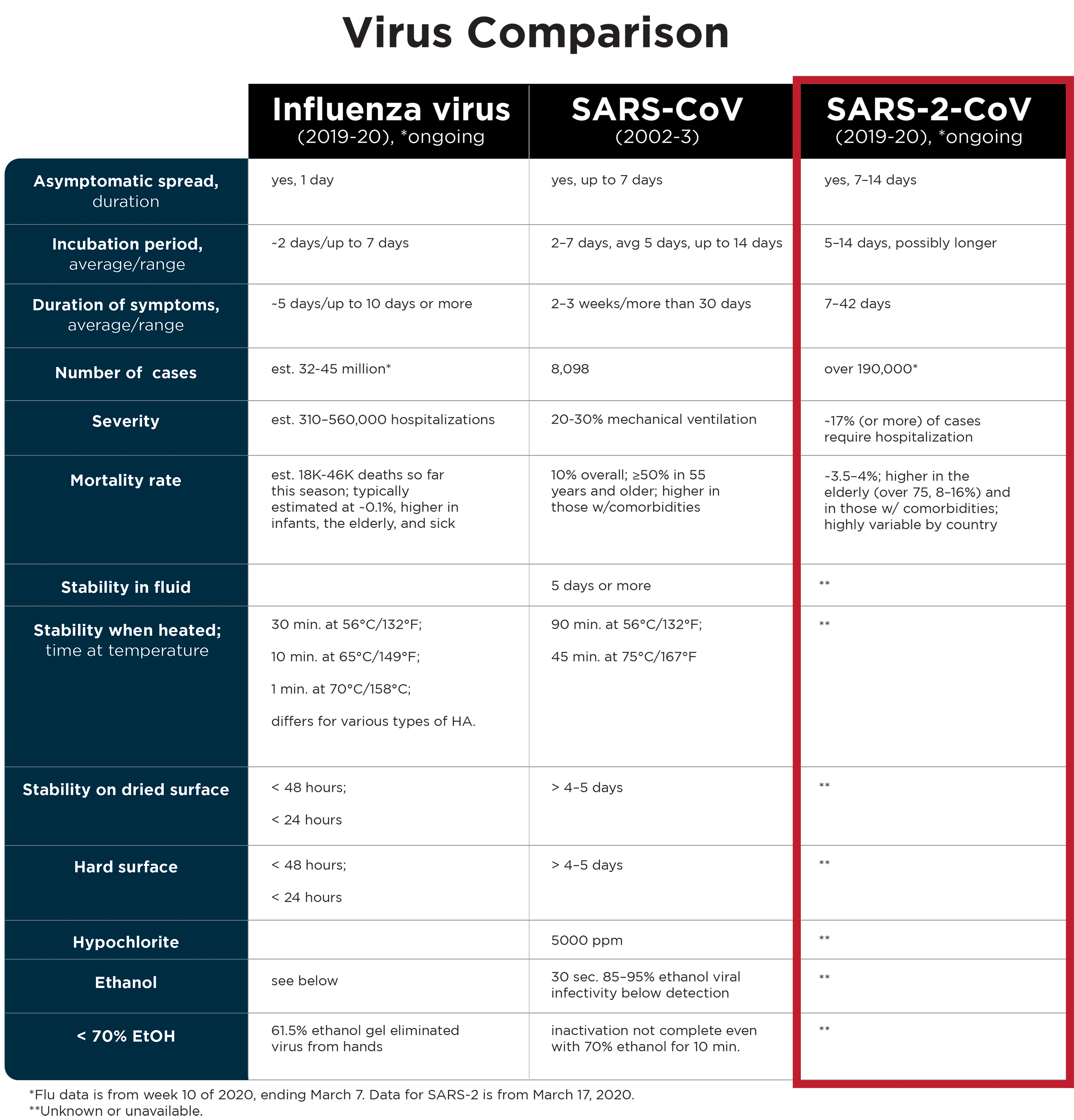
SARS-2 virus, like SARS and MERS coronaviruses, also has a higher mortality rate in the elderly and those with underlying disease. Unlike SARS and MERS, SARS-2 has a much lower overall mortality rate. Thus far (data from March 17, 2020) SARS-2 has infected over 190,000 people in over 55 countries in about 4 months’ time. The number of reported fatalities is just over 7,500, which coincides with an overall mortality rate of 3.5–4%. In some countries where the virus has been circulating for a few weeks, the mortality rates vary from 0.98% in South Korea to 7.7% in hard-hit Italy (these numbers were 0.64% and 2.5%, respectively, on March 2). It is still early in the pandemic, so global and individual country rates may change.

How Can You Help Prevent Spread of SARS-2?

The US travel restrictions put in place on February 2 almost certainly helped delay the spread of SARS-2 in the US. Calls for communities to practice social distancing and sheltering in place will also slow the spread. Limiting discretionary travel and meetings of large groups of people will also help slow the spread. These are the best practices for each of us and, along with practicing good personal and environmental hygiene, these will make huge differences in the ultimate outcome.

Our goal is to slow and limit the spread. This will help our health system infrastructure continue to manage influenza hospitalizations while limiting COVID cases. Flu season usually ends in April/May, so a few weeks’ delay and a slow community spread of COVID cases will improve outcomes. Slowing the spread will also help maintain resource availability for testing and treating the infected.

Facial masks are critical for health care personnel and most people in the general public do not use them properly. Rather than deplete a precious resource that will keep our health care system working for the benefit of us all, leave the masks for the professionals who need them. If you’re sick, you should be self-isolating and will not need a mask.

The best way to prevent the spread of SARS-2 (and flu) based on knowledge garnered from the 2003 SARS outbreak and subsequent studies on SARS and respiratory viruses includes the following:

  • Frequently wash your hands with warm soapy water to a lather for 30 seconds.
  • Avoid touching your face (mouth, nose, eyes).
  • Use freshly prepared bleach, diluted 1:10 or 1:5 with water, to spray surfaces. Let air dry then wipe them down.
  • Use hand sanitizers if washing your hands is not an option.

SARS-2 Is More Challenging Than SARS in Some Ways

SARS and SARS-2 have different incubation periods than flu. During the SARS outbreak most infected individuals demonstrated symptoms within 5 days of infection. Virus could be detected in SARS-infected individuals up to 30 days (rarely, even longer) post-infection. In contrast, the estimated incubation period for SARS-2 is up to 14 days and the recovery period is highly variable, from days up to weeks. In both cases, the viruses can be spread by infected individuals who are not showing signs of illness, but this seems to be more common with SARS-2 than it was for SARS.

Influenza viruses are in a different virus family than the coronaviruses and have smaller, segmented RNA genomes (about 14,000 bases) and smaller virus particles (about 100 nm in diameter). Influenza has an average incubation period of 2 days and it may be spread while asymptomatic between days 1 and 2 post-infection. Flu patients typically recover within 5–7 days.

SARS virus spreads through contact and respiratory droplets (generated by sneezing, coughing, and speaking) and was isolated from saliva, sweat, tears, urine, and feces. Influenza viruses are also spread by contact and respiratory droplets. Contact refers to coming in contact with virus deposited on surfaces of other items, such as door or refrigerator handles or elevator buttons or rails, and then touching your mouth, nose, or eyes. The potential for transmission by contact is linked to the virus’s ability to survive on contaminated surfaces. In regard to contact, SARS is more stable outside the body and on hard or dried surfaces than influenza viruses (see table).

The initial symptoms for SARS, SARS-2, and influenza viruses A and B are similar: cough, fever, and myalgia. Severe cases may progress to an acute respiratory distress syndrome, a severe type of pneumonia, resulting in hospitalizations and sometimes death.

Although SARS (and SARS-2) and influenza viruses may be spread by respiratory droplets and contact and may be difficult to distinguish from one another based on initial clinical symptoms, the viruses differ significantly from one another in very important ways. SARS (and due to greater biological similarity, possibly SARS-2) virus is much more durable in the environment than the influenza virus (see table below). These viruses also differ in their incubation periods, duration of illness, duration and means of viral shedding, and mortality rates. It is also likely that they vary in rates of transmission and in other factors affecting infectivity, transmission, tropism, pathogenicity, and recovery.

Precautions while Helping Others

Although a healthy adult under the age of 50 may experience very similar clinical symptoms if contracting SARS-2 or influenza virus, these viruses do not share the same biology, structure, or overall risks to the more vulnerable populations within our communities. Although the risk to many young healthy adults may not be as severe, they can become infected and transmit the virus to elderly individuals or to people with underlying risk factors. The latter two groups incur a greater risk of severe disease with SARS-2. All people need to take precautions to protect the most vulnerable among us. For Christians, it’s one way we can serve one another in love in the name of Christ Jesus.

Finally, I encourage you to meditate on scriptures such as Psalm 139, which reminds us that God is intimately acquainted with all our actions and is with us whatever we face. Other scriptures remind us of the call to love our neighbors even at great personal cost. I am always challenged when I remember that we are called to show mercy especially to the most marginalized individuals in society. In this context, part of that call entails that we take personal precautions while not abandoning those who are in greater need than we are. Love boldly and pray as you serve others in these challenging days.


blog__inline--helpful-information-in-understanding-sars-cov-2

Resources

Two publications have emerged since the time of writing this post that I felt needed to be included.

Online source materials available at:

References that populate the data table:

  • B. Bean et al., “Survival of Influenza Viruses on Environmental Surfaces,” The Journal of Infectious Diseases, vol. 146, no. 1 (July 1982): 47–51, https://doi.org/10.1093/infdis/146.1.47.
  • Jane S. Greatorex et al., “Survival of Influenza A(H1N1) on Materials Found in Households: Implications for Infection Control,” PLoS One 6, no. 11, (November 22, 2011):e27932, doi:10.1371/journal.pone.0027932.
  • M. Lindsay Grayson et al., “Efficacy of Soap and Water and Alcohol-Based Hand-Rub Preparations against Live H1N1 Influenza Virus on the Hands of Human Volunteers.” Clinical Infectious Diseases 48, no. 3 (February 1, 2009): 285–91, https://doi.org/10.1086/595845.
  • Shumei Zou et al., “Inactivation of the Novel Avian Influenza A (H7N9) Virus under Physical Conditions or Chemical Agents Treatment,” Virology Journal 10, no. 289 (September 15, 2013), doi:10.1186/1743-422X-10-289.
  • G. Kampf et al., “Persistence of Coronaviruses on Inanimate Surfaces and Their Inactivation with Biocidal Agents,” Journal of Hospital Infection 104, no. 3 (March 2020): 246–51, https://www.journalofhospitalinfection.com/article/S0195-6701(20)30046-3/fulltext.
  • Chloé Geller, Mihayl Varbanov, and Raphaël E. Duval, “Human coronaviruses: Insights into Environmental Resistance and Its Influence on the Development of New Antiseptic Strategies,” Viruses 4, no. 11 (November 12, 2012): 3044–68, doi:10.3390/v4113044.
  • Anne-Marie Pagat et al., “Evaluation of SARS-Coronavirus Decontamination Procedures,” Applied Biosafety 12 no. 2 (June 1, 2007): 100–08, https://doi.org/10.1177/153567600701200206.
  • SM Duan et al., “Stability of SARS Coronavirus in Human Specimens and Environment and Its Sensitivity to Heating and UV Irradiation,” Biomedical and Environmental Sciences 16, no. 3 (September 2003): 246–55, https://www.ncbi.nlm.nih.gov/pubmed/14631830.

About Reasons to Believe

RTB’s mission is to spread the Christian Gospel by demonstrating that sound reason and scientific research—including the very latest discoveries—consistently support, rather than erode, confidence in the truth of the Bible and faith in the personal, transcendent God revealed in both Scripture and nature. Learn More »

Support Reasons to Believe

Your support helps more people find Christ through sharing how the latest scientific discoveries affirm our faith in the God of the Bible.

DONATE NOW


U.S. Mailing Address
818 S. Oak Park Rd.
Covina, CA 91724
  • P (855) 732-7667
  • P (626) 335-1480
  • Fax (626) 852-0178
Posted in Uncategorized | Leave a comment

Biochemical Finite-State Machines Point to an Infinite Creator

by Fazale RanaSeptember 22, 2021

During my time as a graduate student studying biochemistry at Ohio University, I spent many long days—and nights—working in the laboratories housed in the Clippinger Building, home to the chemistry and physics departments.

Sometimes the only food I had available to me—particularly during those late nights that turned into the early hours of the morning—were the vending machine snacks in the common area of the second floor.

Unfortunately, the vending machine didn’t always work. It wasn’t unusual to walk into the common area to find someone pounding on the machine in frustration.

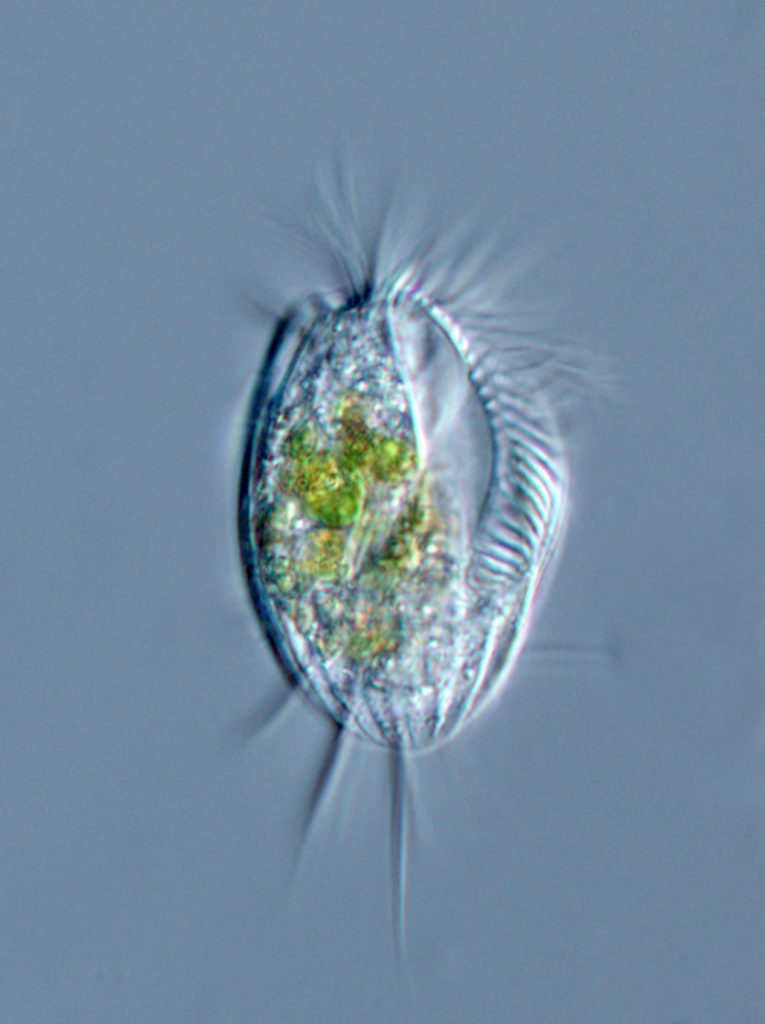
A vending machine is a physical instantiation of an abstract machine called a finite-state machine. (More on finite-state machines [FSMs] below.) Recently, a team of biophysicists at the University of California, San Francisco (UCSF) discovered that unicellular organisms belonging to the group Euplotes employ a biochemical FSM. This machine regulates the “walking” behavior of these single-celled creatures as they make their way across solid surfaces using leg-like appendages called cirri.1

This insight has far-reaching scientific implications, pointing to a general model that may explain the sophisticated behavior displayed by many different types of single-celled organisms. The work also carries significant philosophical—even theological—implications. It contributes to the revitalized Watchmaker argument for God’s existence and necessary role in the origin and design of life, as I first presented in my book The Cell’s Design.

To fully appreciate the philosophical significance of this discovery, a bit of background information on FSMs is in order.

Finite-State Machines
FSMs are considered to be abstract machines that mathematicians have devised to function as mathematical tools to model computational processes. Many real-world examples of FSMs can readily be found around us. In addition to vending machines (that take our money in return for a desired snack), other examples include turnstiles, elevators, traffic lights, and combination locks.

FSMs are defined by a set of states and inputs that trigger transitions from one state to another state (that may or may not be predetermined). An FSM can exist in any one of its defined states. And it can change or transition to another state based on a sequence of events or inputs presented to the FSM.

Of course, if the incorrect amount of money is inserted into the vending machine, it won’t change states because the input doesn’t match the predetermined value for input 1 or input 2. 

In its initial state (I), the vending machine is stocked with snacks that have been placed in a rack, waiting to be dispensed. When a hungry customer puts the correct amount of money in the machine (input 1) and then selects their snack of choice (input 2)—usually by pushing a predetermined sequence of numbers and letters on the control panel—the vending machine changes states (from I to A), delivering the desired food item. If the customer types in a different sequence of numbers and letters (input 3), the vending machine will transition to a different state (from I to B), delivering the alternative food item.

An FSM can be thought of as a type of mechanical computer that has limited memory and is restricted by the number of states that define it. In some vending machines, the same sequence of events (inputs) can trigger a different set of actions depending on the specific state of the FSM. For example, if the desired snack item is no longer available in the vending machine, punching the prescribed sequence of numbers and letters will no longer trigger the transition from one state to the other—at least, in some vending machines—because in this initial state (I’), the vending machine is no longer stocked with the desired snack item and can’t transition from I’ to A.

A Biochemical FSM
I learned some valuable lessons during my graduate and post-doctoral studies. One is this: sometimes when things go wrong during an experiment, they can lead to a significant scientific breakthrough—if you are willing to pay attention.

Such was the case for Ben Larson, a molecular life scientist at UCSF. Larson became frustrated by single-celled predators that contaminated and invaded his experiments, eating the cells he was trying to study.Eventually, he discovered that the invaders belonged to the genus Euplotes. These single-celled organisms live in fresh and saltwater environments. They move around by swimming, but they can also walk on surfaces using appendages on their underside.

Figure 1: Euplotes
Credit: Shutterstock

Larson and two collaborators became interested in how Euplotes “walked” on surfaces. Their walking behavior is sophisticated and complex, reminiscent of the gait displayed by complex multicellular organisms with brains and nervous systems. In fact, the behavior of some single-celled organisms is so complex and sophisticated—seemingly directed by some type of internal control—that some biologists have gone so far as to speculate that single-celled organisms possess a type of rudimentary nervous system. But they don’t.

So, how does Euplotes coordinate the movement of its cirri as it walks along surfaces?

By carrying out a frame-by-frame analysis of videos of Euplotes walking along a glass surface (in which Larson and his collaborators mapped out the position of each cirrus and mathematically modeled the organism‘s movements), the investigators concluded that some type of internal control was indeed directing and coordinating the cirri movements.

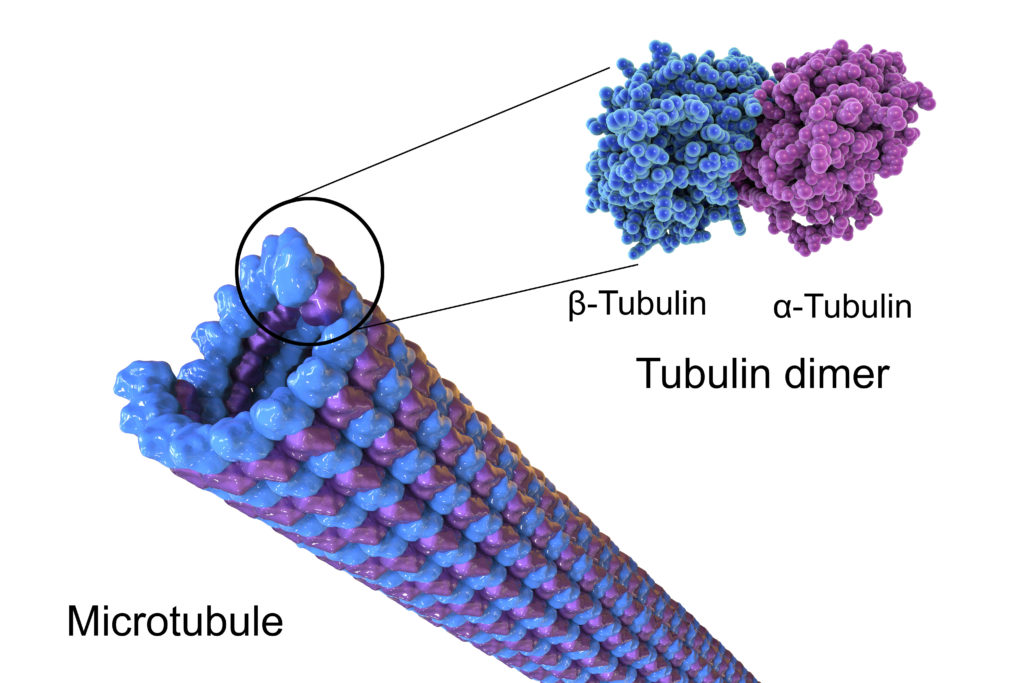
They speculated that the internal control was exerted by a network of microtubules just beneath the cell surface. Cirri are composed of microtubules, which are small hollow tubules made of multiple copies of the protein tubulin. The tubulin subunits combine to form a molecular-scale tube. The arrangement of microtubules that form each cirrus extends into the internal space of the cell. These microtubules interlink with each other to form a microtubule network.


Figure 2: Microtubules
Credit: Shutterstock

When Larson and his collaborators disrupted the microtubule network, the coordinated movement of the cirri stopped. This finding implicates the microtubule network as the internal control regulating the behavior of the cirri. Based on the mathematical properties of the Euplotes gait, Larson and his research partners conclude that the microtubule network is a molecular-scale FSM—a mechanical nanocomputer. The microtubule network regulates the transition between a discrete set of gait states, with structural changes in the microtubule network corresponding to the different states of the system. Another way to think about the microtubule network is that it reflects an embodied set of computations that controls and coordinates the complex behavior of the cirri. Wallace Marshall, one of Larson’s collaborators, argues: “Our data shows you need microtubules for the computation to happen. The simplest explanation is that those are the computing elements.”3

The researchers think that this insight may have broad explanatory power. It may account for other sophisticated behaviors executed by single-celled organisms. That is to say, Larson and his collaborators think that an ensemble of FSMs may regulate several subcellular and cellular processes in which “decision-making” is required. Marshall concludes: “If you can make a computer out of microtubules, you can make a case for looking for them in many other cell types.”4

As remarkable as this insight may be from a scientific perspective, it is even more provocative when mulling over the philosophical and theological implications. To appreciate this point, we need to consider the classical Watchmaker argument advanced by William Paley.

The Watchmaker Argument
Eighteenth-century Anglican natural theologian William Paley (1743–1805) posited the Watchmaker argument in his 1802 work, Natural Theology or, Evidences of the Existence and Attributes of the Deity, Collected from the Appearances of Nature.

For Paley, the characteristics of a watch and the complex interaction of its precision parts for the purpose of telling time implied the work of an intelligent designer. Paley asserted, by analogy, that just as a watch requires a watchmaker, so too, life requires a Creator, since biological systems display a wide range of features characterized by the precise interplay of complex parts for specific purposes.

Biomolecular Machines and the Revitalized Watchmaker Argument
In the last couple of decades, biochemists have discovered many protein complexes inside the cell that are strict analogs to human-made machines with respect to their architecture, operation, and assembly. (For examples, see the articles listed in the Resources section.) The biomachines found in the cell’s interior reveal a diversity of form and function that mirrors the diversity of designs produced by human engineers. In many instances, this molecular-level biomachinery stands as a strict analog to human-made machinery. The one-to-one relationship between the parts of human-made machines and the molecular components of bio-machines is startling.

The discovery of biomolecular machines inside the cell imparts new vitality to the Watchmaker argument. The protein complexes inside the cell aren’t metaphorical machines—they are, in reality, actual machines. And Paley’s case continues to gain strength as biochemists continually discover new examples of biomolecular machines, such as the biochemical FSM made up of networks of microtubules.

Biochemical FSM and the Watchmaker Argument
The strict analogy between FSMs (which are both abstract entities and concrete real-world mechanical computers) and the regulatory behavior of microtubule networks in Euplotes is astoundingand provocative.

It goes without saying that when we encounter an FSM such as a vending machine, we recognize the design features of these devices. We also recognize that the decision-making capabilities of these systems were devised by intelligent agents. So, why shouldn’t we reach the same conclusion when we discover a biomolecular FSM inside the cell?

Resources

The Cell’s Design: How Chemistry Reveals the Creator’s Artistry by Fazale Rana (book)

Does New Approach Solve Origin-of-Life Problem?” by Fazale Rana (article)

Biomolecular Machines and the Watchmaker Argument

New Discovery Pumps Up Evidence for Design” by Fazale Rana (article)

A Biochemical Watch Found in a Cellular Heath” by Fazale Rana (article)

The Provocative Case for Intelligent Design: New Discovery Highlights Machine-Like Character of the Bacterial Flagellum” by Fazale Rana (article)

Manufacturing the Case for Intelligent Design” by Fazale Rana (article)

Electron Transport Chain Protein Complexes Rev Up the Case for a Creator” by Fazale Rana (article)

Biochemical Turing Machines ‘Reboot‘ the Watchmaker Argument” by Fazale Rana (article)

Responding to Challenges to the Watchmaker Argument

But Do Watches Replicate? Addressing a Logical Challenge to the Watchmaker Argument” by Fazale Rana (article)

Self-Assembly of Protein Machines: Evidence for Evolution or Creation?” by Fazale Rana (article)

Addressing the Concerns of a Critic and the Case for Intelligent Design” by Fazale Rana (article)

Nanodevices Make Megascopic Statement” by Fazale Rana (article)

A Cornucopia of Evidence for Intelligent Design: DNA Packaging of the t4 Virus” by Fazale Rana (article)

Endnotes

1. Ben T. Larson et al., “A Unicellular Walker Controlled by a Microtubule-Based Finite State Machine,” bioRxiv, preprint (June 17, 2021): doi:10.1101/2021.02.26.433123.
2. Michael Le Page, “Single-Celled Organism Has Evolved a Natural Mechanical Computer,” New Scientist, July 28, 2021.
3. Le Page, “Single-Celled Organism.”
4. Le Page, “Single-Celled Organism.“

Become a Reasons to Believe Prayer Partner Today!

Prayer—consistent, focused prayer—is a vital part of effective ministry. Sign up to be an RTB Prayer Partner below, then watch your inbox for our current prayer requests and related Scripture passages.Thank you for taking the time to bring these requests before the Lord!https://get.reasons.org/dear-reader/Biochemistry

SOCIALICON
Reactive Oxygen Species: Harbingers of Evolution or Signals of Design?

Antioxidants are the latest diet fad. Many people do whatever they can to include foods high in antioxidants in their diets. Some people even…Biochemistry

New Insights into Genetic Code Optimization Signal Creator’s Handiwork

I knew my career as a baseball player would be short-lived when, as a thirteen-year-old, I made the transition from Little League to the…Biochemistry

Biochemistry and the Bible: Collaborators in Design An Interview with Dr. Fuz Rana

I was born in Ames, Iowa, but my family moved to West Virginia when I was about four years old. At that time my…Biochemistry

Support Our Mission

Your support helps more people find Christ through sharing how the latest scientific discoveries affirm our faith in the God of the Bible.Donate Now


facebooktwitteryoutube

Posted in Uncategorized | Leave a comment

Answering Questions on Creation “From” Nothing

by Kenneth SamplesSeptember 28, 2021

I had a dialogue on social media recently with someone who objected to the idea that God created the world “out of” or “from” nothing. That brief interaction (which I’ll provide in a moment) gives us the opportunity to think further on what creation ex nihilo means and doesn’t mean.

Creation Ex Nihilo
The early chapters of Genesis describe how God created the totality of all things. Every reader of the Bible is familiar with the creation days of Genesis chapter 1. This critical doctrine is also discussed in various parts of both the Old and New Testaments. And affirmations of creation form the first stanzas of the ancient creeds of Christendom (Apostles’ and Nicene Creeds).

A central feature of how Christians have understood God’s initial role in creation involves the expression creation ex nihilo: creation out of or from nothing. Historical theologian Richard Muller defines the Latin term ex nihilo as a reference to “the divine creation of the world not of preexistent, and therefore eternal, materials, but out of nothing.”1 The doctrine of creation ex nihilo is derived from various biblical passages (Genesis 1:1; Romans 4:17; Colossians 1:16; Hebrews 11:3).

Clarifying What Christians Mean by “From Nothing”
With that context, here now is the paraphrased discussion I had with an inquirer on social media:

Correspondent: God most certainly didn’t create “out of” or “from” nothing. Not even the all-powerful Lord could perform such an act. God merely brought that which didn’t previously exist into existence. What he created “from” was himself (who and what he is), not from nothing.

My response: I respectfully think you have misunderstood the historic definition of “out of” or “from” nothing. The historic Christian doctrine of creation ex nihilo says nothing existed but the triune God and then God called all contingent (dependent) entities and beings into existence from nonexistence. God didn’t create out of himself (creation ex Deo) rather he called all things into existence that previously didn’t exist (ergo out of or from nothing). Thus creation ex nihilo means “bring into existence that which did not exist prior.” Creation ex nihilo is historically the biblical and Christian response to the Platonic claim that a deity (the Demiurge) created out of preexistent entities. I hope that helps.

Correspondent: Nothing? What was there other than God from which to bring forth something? Either it came out of God (as the source of all being) or from nothing, the latter of which sounds like hocus-pocus magic.

My response: God, through his incalculable wisdom and power alone, created that which previously didn’t exist. Instead of using preexistent matter or some other substance, God brought all things into existence from nonexistence. I think your misunderstanding is in thinking that nonexistence is a substance. It’s not. It is literally no thing. “Out of” or “from nothing” is not a magical substance. It just means God alone called all things into existence that previously didn’t exist.

Further, the source of creation is God’s power and wisdom and “out of“ nonexistence simply means that which previously didn’t exist. So creation is by God but from nothing (no preexistent materials were used in creating). I think your basic description that “God merely brought that which didn’t previously exist into existence” actually matches with creation ex nihilo, though you have to be careful not to imply that God created out of himself which is known as creation ex Deo and is similar to the Eastern religious view (pantheism).

Takeaway
In thinking carefully about creation it is equally important to understand what the doctrine of creation ex nihilo does not mean. Consider these three points:

  • The cosmos was not created either in God or out of God’s being.
  • The cosmos was not made of preexisting materials, such as matter.
  • God didn’t create the cosmos out of a nothing that was an actual something.

Creation testifies to God’s infinite wisdom and power. Thus, studying the Bible and observing the natural world should lead God’s redeemed people to worship the triune Creator.

Reflections: Your Turn
Does observing nature lead you to worship? Visit Reflections on WordPress to comment.

Resources

  • For further study of creation ex nihilo, see Kenneth Richard Samples, 7 Truths That Changed the World (Grand Rapids, MI: Baker Books, 2012), chapters 5 and 6.
  • For an understanding of science and Christianity, see Kenneth Richard Samples, Christianity Cross-Examined (Covina, CA: RTB Press, 2021), chapters 1 and 2.

Endnotes

  1. Richard A. Muller, Dictionary of Latin and Greek Theological Terms (Grand Rapids, MI: Baker Books, 1985), s.v. “ex nihilo.”

Become a Reasons to Believe Prayer Partner Today!

Prayer—consistent, focused prayer—is a vital part of effective ministry. Sign up to be an RTB Prayer Partner below, then watch your inbox for our current prayer requests and related Scripture passages.Thank you for taking the time to bring these requests before the Lord!https://get.reasons.org/dear-reader/Theology

SOCIALICON
Apologia Sophia: “Apologetics Wisdom” 2—Christian Foundations

In part 1 of this series, we noted that Apologia Sophia (Gk: ἀπολογία σοφία) transliterates the Greek word endings and roughly translates to “apologetics…Theology

Coronavirus Outbreak: Do I Need to Worry?

Many people are reaching out to me to ask about the coronavirus outbreak in China. Maybe the news stories have you worried. Perhaps you’re…Biology

RTB at 30: Remembering God’s Faithfulness

Joshua 3–4 tells of the Israelites crossing the Jordan River into the Promised Land. The Lord instructs Joshua to gather 12 stones from the…People

Support Our Mission

Your support helps more people find Christ through sharing how the latest scientific discoveries affirm our faith in the God of the Bible.Donate Now


facebooktwitteryoutube

Posted in Uncategorized | Leave a comment

Is Artificial Intelligence a Misnomer?

by Guest WriterZachary LeungSeptember 23, 2021

You have undoubtedly heard about the amazing things that artificial intelligence (AI) can do, but have you ever pondered the following questions: How does AI work? Who invented AI? Is AI replacing humans? 

Having devoted my entire career to AI, starting as a graduate student in the 1980s, I am encouraged and exhilarated by what AI can do today. It has achieved widespread success in multiple applications, ranging from social marketing and face recognition to language translation and autonomous driving. AI has performed well beyond predictions made by many AI researchers as recently as one or two decades ago. As the research continues, AI will undoubtedly continue to make our lives better through technological breakthroughs that researchers have been dreaming of for decades.

However, some of the recent speculations and predictions about AI are puzzling, especially those that appear to raise theological questions. Does AI disprove the existence and necessity of an intelligent God? This short article answers this important question by focusing on a fundamental question: Is there any intelligence in AI? Perhaps a historical roadmap on AI will shed some light.

Births of Artificial Intelligence and Neural Networks

Over a half-century ago, two major academic disciplines emerged with the objective of making intelligent machines. These disciplines were artificial intelligence and neural networks (NN). They took on drastically different approaches. AI was spawned by the computer science community and it focused on symbolic representations and processing. NN was proposed by engineering researchers and it concentrated on numerical representations and computations. In 1969, Marvin Minsky and Seymour Papert, two of the early fathers of AI at the Massachusetts Institute of Technology (MIT), wrote a book carefully explaining what they saw as NN’s severe limitations.1 Consequently, research on NN stopped for about a decade.

Resurgence of Neural Networks

However, in the 1980s, there was a resurgence of interest in neural networks.2 A new mathematical formulation was proposed, leading to optimism that NN could solve many more problems than had been thought by people like Minsky and Papert. This new mathematical solution reignited the longtime debate: which technology would be more powerful? The AI community argued that there was too much “black magic” inside NN. They said that the way NN solved problems resembled neither human intelligence nor artificial intelligence. The NN community, however, argued that the interconnections inside NN resembled, at least by appearance, the physiology of neurons in the human brain. They claimed that with sufficient learning examples, interconnections, and computer processing power, NN would “learn” to solve many problems. As we now know, this claim turns out to be correct.

Alien in Artificial Intelligence

I found myself feeling like an alien when I was a PhD student in Tech Square, a building full of world-renowned professors, scientists, researchers, graduate, and undergraduate students from the MIT Artificial Intelligence Laboratory and the MIT Laboratory for Computer Science (both laboratories have now merged into the MIT Computer Science and Artificial Intelligence Laboratory, or CSAIL). I was frustrated by AI approaches that required tremendous handcrafting of rules and heuristics. NN fascinated me because of its formal mathematical framework to solve problems. I became one of the first few researchers in the world to do a PhD thesis on how to use NN and pattern recognition techniques for speech recognition. At the time, I found only two kinds of people among my AI friends: (a) the majority who considered NN as a bag of tricks, and (b) the minority who remained silent about NN.

Statistical Pattern Recognition

The debate between the AI and NN communities was not new. For decades, mathematicians and engineers had been working on pattern recognition (PR) to solve problems. A new statistical PR approach, called hidden Markov modeling (HMM), became mainstream technology for speech recognition.This PR community believed in the vigor of mathematical frameworks and argued that AI was too heuristic and labor-intensive. And they also rejected NN because (a) it lacked a tractable mathematical formulation, and (b) researchers had no idea what was going on inside the NN.

The Melting Pot

Fast forward to the 1990s and the 2000s, and the three disciplines of AI, NN, and PR were starting to merge slowly. New editions of PR textbooks began to add new chapters on NN and HMM.4 Similarly, AI textbooks started to teach about NN, HMM, and other PR techniques (in contrast to earlier editions).5,6 Within the AI community today, many of these NN and PR techniques now reside under the umbrella of machine learning. From an academic perspective, it is awesome when researchers learn to reconcile their differences. Their cooperation allows the disciplines to merge, thereby pushing technology forward faster than ever before.

Many advances today ranging from face recognition and natural language to autonomous machines and medical diagnosis have been hailed as AI successes. However, thanks to today’s much faster computer hardware with significantly higher memory capacity, most, if not all, of these great successes are based on NN, whose fundamental concept has remained unchanged since its resurgence in the 1980s. For decades, the AI community did not consider NN as anything intelligent, but NN has now become the keystone of AI.

Where Is the Intelligence?

This melting pot of AI, NN, and PR could have been named anything, although “artificial intelligence” garners attention. AI includes other sophisticated terms such as deep learning and neural networks, but the name artificial intelligence captures the imagination of a continuum of communities: researchers, developers, managers, marketers, media, sponsors, fiction writers, and the public. If a different name had been chosen, this melting pot probably would not have drawn as much attention and controversy as it does today. Each group in this continuum seems to have a different perspective on AI. From my observations, the farther away the group is from the research, the more speculative (both optimistic and pessimistic) it becomes. But is “intelligence” a good descriptor for this melting pot? I don’t think so.

Technologists and engineers have developed numerous automatic machines over the past century. Automobiles run faster than humans. Computers add numbers faster than humans. Airplanes fly. These technologies make our lives better. Yet, they have no chance of replacing humanity. They are merely tools and do not cause any issues with the Christian faith other than how they are used.

Why would this AI melting pot be any different? Successful AI today is the culmination of decades of research in a vast spectrum of scientific, technological, engineering, and mathematical disciplines. And in my view, the NN in AI is not artificial or intelligent. It is real techno-engineering. Humans have designed, developed, and refined the technology at every step. As is the case with any technology, our creativity in this melting pot is a reflection of God’s image. The intelligence lies in human agents who have been charged with using our minds and creativity to serve humanity.

Endnotes

  1. Marvin Minsky and Seymour A. Papert, Perceptrons: An Introduction to Computational Geometry, expanded ed. (Cambridge, MA: MIT Press, 2017).
  2. David E. Rumelhart, James L. McClelland, and the PDP Research Group, Parallel Distributed Processing: Explorations in the Microstructure of Cognition (Cambridge, MA: MIT Press, 1987).
  3. Lalit R. Bahl, Frederick Jelinek, and Robert L. Mercer, “A Maximum Likelihood Approach to Continuous Speech Recognition,” IEEE Transactions on Pattern Analysis and Machine Intelligence 5, no. 2 (March 1983): 179–190, doi:10.1109/TPAMI.1983.4767370.
  4. Richard O. Duda, Peter E. Hart, and David G. Stork, Pattern Classification, 2nd ed. (Hoboken, NJ: John Wiley & Sons, 2000).
  5. Patrick Henry Winston, Artificial Intelligence, 3rd ed. (Boston, MA: Addison-Wesley, 1992);
  6. Nils J. Nilsson, The Quest for Artificial Intelligence: A History of Ideas and Achievements (Cambridge, UK: Cambridge University Press, 2009).

Become a Reasons to Believe Prayer Partner Today!

Prayer—consistent, focused prayer—is a vital part of effective ministry. Sign up to be an RTB Prayer Partner below, then watch your inbox for our current prayer requests and related Scripture passages.Thank you for taking the time to bring these requests before the Lord!https://get.reasons.org/dear-reader/Artificial Intelligence

SOCIALICON
Ethical Concerns with AI: Deepfakes

How would you respond to video footage of Richard Dawkins professing faith in Christ? Or one about Hugh Ross advocating for young-Earth creationism? Either…Philosophy & Ethics

Investigating Artificial Intelligence: An Introduction

Two questions fascinate me: (1) Does life exist in the universe beyond the confines of Earth? (2) Will we ever create artificial intelligence here…Artificial Intelligence

Does Animal Planning Undermine the Image of God?

A few years ago, we had an all-white English Bulldog named Archie. He would lumber toward even complete strangers, eager to befriend them and…Biology

Support Our Mission

Your support helps more people find Christ through sharing how the latest scientific discoveries affirm our faith in the God of the Bible.Donate Now


facebooktwitteryoutube

Posted in Uncategorized | Leave a comment

Earth-Moon Coupled Magnetosphere Paved the Way for Life

by Hugh RossSeptember 20, 2021

How did an event 4 billion years ago make advanced life possible now?

In November 2020, I wrote about the discovery of the past Earth-Moon coupled magnetosphere. This magnetic connection prior to 4 billion years ago served as a protective barrier against harmful solar radiation on the Earth-Moon system. In my opinion, this finding ranked as the greatest new evidence of the past decade for the fine-tuned design of Earth to make life possible.1 Now, a team of 14 astronomers, physicists, and geologists, led by John Tarduno, has published a paper that provides more details and additional affirmation.2

Dating the Shutdown of the Moon’s Magnetic Field
One important detail not provided in the 2020 paper was an accurate date for the shutdown of the Moon’s magnetic field. The new research filled in the missing pieces.

Scientists have learned that the Moon had a magnetosphere—only for the earliest part of its history—by studying samples from the lunar surface. Tarduno’s team first demonstrated that impact glass recovered by Apollo astronauts from a young impact crater (only 2.01 ± 0.1 million years old) records a strong Earthlike magnetization. Therefore, they established that impacts can impart strong magnetic signals in samples recovered from the Moon and other solar system bodies. Tarduno’s team then analyzed five additional lunar samples recovered by Apollo astronauts with ages measured at 3.94, 3.6, 3.3, 3.3, and 3.17 billion years ago, respectively. In all five samples, they measured negligible magnetic fields consistent with a null lunar magnetic field within the age range 3.94–3.17 billion years ago. Their conclusion was supported by measurements on nine other Apollo samples within the age range 3.89–3.28 billion years ago.3

Tarduno and his colleagues also cited nearly a dozen other measurements on Apollo lunar samples within the date range 3.8–1.0 billion years ago where magnetic fields between 0.1–0.5 gauss (10–50 microtesla) were detected.4 These samples, they concluded, did not manifest the intrinsic lunar magnetic field. Rather, their magnetic fields must have been induced during impact events. Hence, the team determined that the Moon lost its magnetic field 4.0 billion years ago.

Affirmation of Coupled Magnetosphere Discovery
The discovery of the past Earth-Moon coupled magnetosphere was based on two fundamental events in the Moon’s history. The first is that the Moon’s origin arose from a low-velocity collision between two of the Sun’s rocky planets, proto-Earth and Theia. This collision implied that the Moon’s interior initially was sufficiently hot and dense to produce a liquid iron core.

The second fundamental event is that for the first half billion years of its history the Moon was close enough to Earth to experience strong tidal forces as a consequence of Earth exerting a substantially stronger gravitational pull on the Moon’s near side than on its far side. These tidal forces circulated the liquid iron in the Moon’s core. This circulation generated a dynamo, which produced a general lunar magnetic field strong enough to create and sustain a magnetosphere about the Moon.

The date established by Tarduno’s team of 4.0 billion years ago for the shutdown of the Moon’s intrinsic magnetic field is consistent with the discovery published nearly a year ago. Our Moon is one of the most massive moons in the solar system and its unique origin meant that it began with an interior heat hotter than any other solar system moon. Nevertheless, with a mass one eightieth that of Earth the iron in its core could not have remained liquid for more than a billion years and may have ceased to be liquid after just 500–600 million years.

The Moon began its existence orbiting just outside the Roche limit. For the Earth-Moon system, the Roche limit is the minimum separation of the Moon from Earth where the Moon avoids being shattered by tidal forces exerted by Earth. For the Earth-Moon system the Roche limit is 1.5 Earth radii.

From just outside the Roche limit the Moon has been steadily spiraling away from Earth. Presently, the Moon moves farther away from Earth at a rate of 4 centimeters per year.5 Today, the Moon orbits at an average distance of 384,000 kilometers (239,000 miles) away from Earth or 60 Earth radii. Four billion years ago, the Moon was orbiting 114,700 kilometers (71,300 miles) or 18 Earth radii away. That distance is great enough that tidal forces exerted by Earth no longer are strong enough to vigorously circulate liquid iron in the Moon’s core. Therefore, the magnetosphere discovery team anticipated that the Moon’s intrinsic magnetic field would disappear soon after 4 billion years ago. The research of Tarduno and his colleagues established that the Moon’s magnetic field was gone by 3.94 billion years ago and likely experienced rapid decline by 4.0 billion years ago.

Fine-Tuning Implications
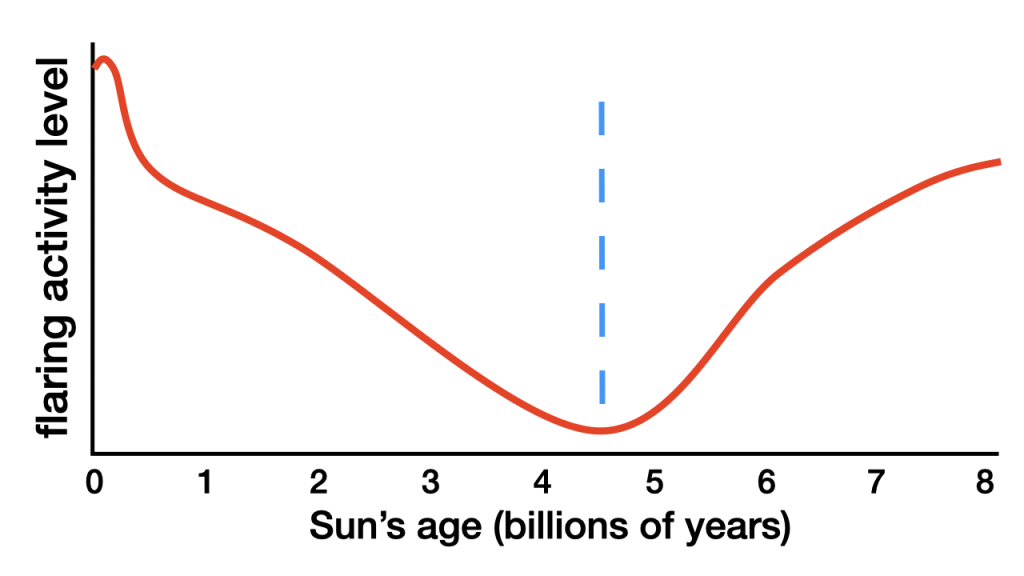
Up until 4.0 billion years ago, the Sun’s particle radiation was at an intensity level that would have sputtered away or seriously degraded both Earth’s atmosphere and its hydrosphere. The coupled magnetosphere prevented this outcome. Solar particle radiation also would have wiped out any microbes on Earth’s surface. After 4.0 billion years ago, the Sun’s particle radiation subsided to a level where Earth’s magnetosphere by itself was strong and stable enough to prevent the loss of Earth’s atmosphere or hydrosphere (see figure 1).

Figure 1: Sun’s Particle and X-Ray Radiation and Flaring Activity Levels throughout Its History
The y-axis is logarithmic. The Sun’s particle and x-ray radiation and flaring activity levels were more than 100,000 times greater shortly after its formation than they are now. The Sun’s intensity of particle, x-ray, and gamma-ray emission is strongly correlated with its flaring activity level. The blue dotted line indicates the present time. Credit: Hugh Ross 

For a life history any longer than a few centuries or involving organisms larger than microbes, a planet-moon system virtually identical to the Earth-Moon system is needed. Such a planet-moon system must possess both a coupled dynamical history, a coupled magnetosphere history, and a coupled magnetosphere strength virtually identical to what the Earth-Moon system possessed previous to 4.0 billion years ago. Such a planet-moon system must also orbit a star virtually identical to the Sun since stars more massive or less massive than the Sun pose an even greater risk to the planet’s atmosphere, hydrosphere, and life.7

For a planet-moon system to possibly support life-forms larger and more complex than microbes, the fine-tuning required rules out reasonable naturalistic explanations. The only rational explanation of the Earth-Moon system is that it is the product of a superintelligent, supernatural Being who designed and manufactured a home where humans can exist, thrive, and enter into a personal relationship with the cosmic Creator.

Endnotes

  1. Hugh Ross, “Moon’s Early Magnetic Field Made Human Existence Possible,” Today’s New Reason to Believe (blog), November 16, 2020.
  2. John A. Tarduno et al., “Absence of a Long-Lived Lunar Paleomagnetosphere,” Science Advances 7, no. 32 (August 4, 2021): id. eab7647, doi:10.1126/sciadv.abi7647.
  3. C. Cournéde, J. Gattacceca, and P. Rochette, “Magnetic Study of Large Apollo Samples: Possible Evidence for an Ancient Centered Dipolar Field on the Moon,” Earth and Planetary Science Letters 331-332 (May 15, 2012): 31–42, doi:10.1016/j.epsl.2012.03.004; Kristin Lawrence et al., “Lunar Paleointensity Measurements: Implications for Lunar Magnetic Evolution,” Physics of the Earth and Planetary Interiors 168, no. 1–2 (May 2008): 71–87, doi:10.1016/j.pepi.2008.05.007.
  4. Cournéde, Gattacceca, and Rochette, “Magnetic Study,” 31–42; Lawrence et al., “Lunar Paleointensity Measurements,” 71–87.
  5. George E. Williams, “Geological Constraints on the Precambrian History of Earth’s Rotation and the Moon’s Orbit,” Reviews of Geophysics 38, no. 1 (February 2000): 37–60, doi:10.1029/1999RG900016.
  6. V. N. Zharkov, “On the History of the Lunar Orbit,” Solar System Research 34, no. 1 ( January 2000): 1.
  7. Hugh Ross, Weathering Climate Change (Covina, CA: RTB Press, 2020), 117–26.

Become a Reasons to Believe Prayer Partner Today!

Prayer—consistent, focused prayer—is a vital part of effective ministry. Sign up to be an RTB Prayer Partner below, then watch your inbox for our current prayer requests and related Scripture passages.Thank you for taking the time to bring these requests before the Lord!https://get.reasons.org/dear-reader/Geology & Earth

SOCIALICON
Carbon-14 Dating Supports the Writing of the Great Isaiah Scroll  Prior to the Crucifixion
Carbon-14 Dating Supports the Writing of the Great Isaiah Scroll Prior to the Crucifixion

Radiocarbon dating is one of the best-known tools used by geochemists to obtain an age of ancient materials such as wood, bones, charcoal, and…Geology & Earth

The Creation of Minerals

The debate over creation and evolution has taken a significant evolutionary leap.Design

Happy Valentine’s Day from Your Creator

The whole universe and everything within it is God’s special love letter to you, me, and every other member of the human race. I…Biology

Support Our Mission

Your support helps more people find Christ through sharing how the latest scientific discoveries affirm our faith in the God of the Bible.Donate Now


facebooktwitteryoutube

Posted in Uncategorized | Leave a comment

Biochemical Finite-State Machines Point to an Infinite Creator

by Fazale RanaSeptember 22, 2021

During my time as a graduate student studying biochemistry at Ohio University, I spent many long days—and nights—working in the laboratories housed in the Clippinger Building, home to the chemistry and physics departments.

Sometimes the only food I had available to me—particularly during those late nights that turned into the early hours of the morning—were the vending machine snacks in the common area of the second floor.

Unfortunately, the vending machine didn’t always work. It wasn’t unusual to walk into the common area to find someone pounding on the machine in frustration.

A vending machine is a physical instantiation of an abstract machine called a finite-state machine. (More on finite-state machines [FSMs] below.) Recently, a team of biophysicists at the University of California, San Francisco (UCSF) discovered that unicellular organisms belonging to the group Euplotes employ a biochemical FSM. This machine regulates the “walking” behavior of these single-celled creatures as they make their way across solid surfaces using leg-like appendages called cirri.1

This insight has far-reaching scientific implications, pointing to a general model that may explain the sophisticated behavior displayed by many different types of single-celled organisms. The work also carries significant philosophical—even theological—implications. It contributes to the revitalized Watchmaker argument for God’s existence and necessary role in the origin and design of life, as I first presented in my book The Cell’s Design.

To fully appreciate the philosophical significance of this discovery, a bit of background information on FSMs is in order.

Finite-State Machines
FSMs are considered to be abstract machines that mathematicians have devised to function as mathematical tools to model computational processes. Many real-world examples of FSMs can readily be found around us. In addition to vending machines (that take our money in return for a desired snack), other examples include turnstiles, elevators, traffic lights, and combination locks.

FSMs are defined by a set of states and inputs that trigger transitions from one state to another state (that may or may not be predetermined). An FSM can exist in any one of its defined states. And it can change or transition to another state based on a sequence of events or inputs presented to the FSM.

Of course, if the incorrect amount of money is inserted into the vending machine, it won’t change states because the input doesn’t match the predetermined value for input 1 or input 2. 

In its initial state (I), the vending machine is stocked with snacks that have been placed in a rack, waiting to be dispensed. When a hungry customer puts the correct amount of money in the machine (input 1) and then selects their snack of choice (input 2)—usually by pushing a predetermined sequence of numbers and letters on the control panel—the vending machine changes states (from I to A), delivering the desired food item. If the customer types in a different sequence of numbers and letters (input 3), the vending machine will transition to a different state (from I to B), delivering the alternative food item.

An FSM can be thought of as a type of mechanical computer that has limited memory and is restricted by the number of states that define it. In some vending machines, the same sequence of events (inputs) can trigger a different set of actions depending on the specific state of the FSM. For example, if the desired snack item is no longer available in the vending machine, punching the prescribed sequence of numbers and letters will no longer trigger the transition from one state to the other—at least, in some vending machines—because in this initial state (I’), the vending machine is no longer stocked with the desired snack item and can’t transition from I’ to A.

A Biochemical FSM
I learned some valuable lessons during my graduate and post-doctoral studies. One is this: sometimes when things go wrong during an experiment, they can lead to a significant scientific breakthrough—if you are willing to pay attention.

Such was the case for Ben Larson, a molecular life scientist at UCSF. Larson became frustrated by single-celled predators that contaminated and invaded his experiments, eating the cells he was trying to study.Eventually, he discovered that the invaders belonged to the genus Euplotes. These single-celled organisms live in fresh and saltwater environments. They move around by swimming, but they can also walk on surfaces using appendages on their underside.

Figure 1: Euplotes
Credit: Shutterstock

Larson and two collaborators became interested in how Euplotes “walked” on surfaces. Their walking behavior is sophisticated and complex, reminiscent of the gait displayed by complex multicellular organisms with brains and nervous systems. In fact, the behavior of some single-celled organisms is so complex and sophisticated—seemingly directed by some type of internal control—that some biologists have gone so far as to speculate that single-celled organisms possess a type of rudimentary nervous system. But they don’t.

So, how does Euplotes coordinate the movement of its cirri as it walks along surfaces?

By carrying out a frame-by-frame analysis of videos of Euplotes walking along a glass surface (in which Larson and his collaborators mapped out the position of each cirrus and mathematically modeled the organism‘s movements) the investigators concluded that some type of internal control was, indeed, directing and coordinating the cirri movements.

They speculated that the internal control was exerted by a network of microtubules just beneath the cell surface. Cirri are composed of microtubules, which are small, hollow tubules made of multiple copies of the protein tubulin. The tubulin subunits combine to form a molecular-scale tube. The arrangement of microtubules that form each cirrus extends into the internal space of the cell. These microtubules interlink with each other to form a microtubule network.


Figure 2: Microtubules
Credit: Shutterstock

When Larson and his collaborators disrupted the microtubule network, the coordinated movement of the cirri stopped. This finding implicates the microtubule network as the internal control regulating the behavior of the cirri. Based on the mathematical properties of the Euplotes gait, Larson and his research partners conclude that the microtubule network is a molecular-scale FSM—a mechanical nanocomputer. The microtubule network regulates the transition between a discrete set of gait states, with structural changes in the microtubule network corresponding to the different states of the system. Another way to think about the microtubule network is that it reflects an embodied set of computations that controls and coordinates the complex behavior of the cirri. Wallace Marshall, one of Larson’s collaborators, argues: “Our data shows you need microtubules for the computation to happen. The simplest explanation is that those are the computing elements.”3

The researchers think that this insight may have broad explanatory power. It may account for other sophisticated behaviors executed by single-celled organisms. That is to say, Larson and his collaborators think that an ensemble of FSMs may regulate several subcellular and cellular processes in which “decision-making” is required. Marshall concludes: “If you can make a computer out of microtubules, you can make a case for looking for them in many other cell types.”4

As remarkable as this insight may be from a scientific perspective, it is even more provocative when mulling over the philosophical and theological implications. To appreciate this point, we need to consider the classical Watchmaker argument advanced by William Paley.

The Watchmaker Argument
Eighteenth-century Anglican natural theologian William Paley (1743–1805) posited the Watchmaker argument in his 1802 work, Natural Theology or, Evidences of the Existence and Attributes of the Deity, Collected from the Appearances of Nature.

For Paley, the characteristics of a watch and the complex interaction of its precision parts for the purpose of telling time implied the work of an intelligent Designer. Paley asserted, by analogy, that just as a watch requires a watchmaker, so too, life requires a Creator, since biological systems display a wide range of features characterized by the precise interplay of complex parts for specific purposes.

Biomolecular Machines and the Revitalized Watchmaker Argument
In the last couple of decades, biochemists have discovered many proteins complexes inside the cell that are strict analogs to human-made machines with respect to their architecture, operation, and assembly. (For examples, see the articles listed in the Resources section.) The biomachines found in the cell’s interior reveal a diversity of form and function that mirrors the diversity of designs produced by human engineers. In many instances, this molecular-level biomachinery stands as a strict analog to human-made machinery. The one-to-one relationship between the parts of human-made machines and the molecular components of bio-machines is startling.

The discovery of biomolecular machines inside the cell imparts new vitality to the Watchmaker argument. The protein complexes inside the cell aren’t metaphorical machines—they are, in reality, actual machines. And Paley’s case continues to gain strength as biochemists continually discover new examples of biomolecular machines, such as the biochemical FSM made up of networks of microtubules.

Biochemical FSM and the Watchmaker Argument
The strict analogy between FSMs (which are both abstract entities and concrete real-world mechanical computers) and the regulatory behavior of microtubule networks in Euplotes is astoundingand provocative.

It goes without saying that when we encounter an FSM such as a vending machine, we recognize the design features of these devices. We also recognize that the decision-making capabilities of these systems were devised by intelligent agents. So, why shouldn’t we reach the same conclusion when we discover a biomolecular FSM inside the cell?

Resources

The Cell’s Design: How Chemistry Reveals the Creator’s Artistry by Fazale Rana (book)

Does New Approach Solve Origin-of-Life Problem?” by Fazale Rana (article)

Biomolecular Machines and the Watchmaker Argument

New Discovery Pumps Up Evidence for Design” by Fazale Rana (article)

A Biochemical Watch Found in a Cellular Heath” by Fazale Rana (article)

The Provocative Case for Intelligent Design: New Discovery Highlights Machine-Like Character of the Bacterial Flagellum” by Fazale Rana (article)

Manufacturing the Case for Intelligent Design” by Fazale Rana (article)

Electron Transport Chain Protein Complexes Rev Up the Case for a Creator” by Fazale Rana (article)

Biochemical Turing Machines ‘Reboot‘ the Watchmaker Argument” by Fazale Rana (article)

Responding to Challenges to the Watchmaker Argument

But Do Watches Replicate? Addressing a Logical Challenge to the Watchmaker Argument” by Fazale Rana (article)

Self-Assembly of Protein Machines: Evidence for Evolution or Creation?” by Fazale Rana (article)

Addressing the Concerns of a Critic and the Case for Intelligent Design” by Fazale Rana (article)

Nanodevices Make Megascopic Statement” by Fazale Rana (article)

A Cornucopia of Evidence for Intelligent Design: DNA Packaging of the t4 Virus” by Fazale Rana (article)

Endnotes

1. Ben T. Larson et al., “A Unicellular Walker Controlled by a Microtubule-Based Finite State Machine,” bioRxiv, preprint (June 17, 2021): doi:10.1101/2021.02.26.433123.
2. Michael Le Page, “Single-Celled Organism Has Evolved a Natural Mechanical Computer,” New Scientist, July 28, 2021.
3. Le Page, “Single-Celled Organism.”
4. Le Page, “Single-Celled Organism.“

Become a Reasons to Believe Prayer Partner Today!

Prayer—consistent, focused prayer—is a vital part of effective ministry. Sign up to be an RTB Prayer Partner below, then watch your inbox for our current prayer requests and related Scripture passages.Thank you for taking the time to bring these requests before the Lord!https://get.reasons.org/dear-reader/Biochemistry

SOCIALICON
Crossed off the List: Is the Cross Shape of Laminin Evidence for the Creator?

As I travel around the country to speak on the biochemical evidence for an Intelligent Designer, the biblical Creator, I am frequently asked to…Biochemistry

Eat This: Zombies Are Real

They prey on their own kind. Some might call it cannibalism, but it’s the only way they can survive. Indeed, the zombie apocalypse is…Biochemistry

Mutations, Cancer, and the Case for a Creator

Cancer. Perhaps no other word evokes more fear, anger, and hopelessness. It goes without saying that cancer is an insidious disease. People who get…Biochemistry

Support Our Mission

Your support helps more people find Christ through sharing how the latest scientific discoveries affirm our faith in the God of the Bible.Donate Now


facebooktwitteryoutube

Posted in Uncategorized | Leave a comment

How Did Daniel Cope with Trauma during Captivity?

BY MARK CLARK – MAY 8, 2020

by Mark Clark

Humans in all eras of history have suffered trauma, especially from the horrors of war. How might people in the ancient world have coped with traumatic events without access to modern treatment options? Was coping even a possibility? We can learn much about trauma by looking to Daniel, a biblical figure who endured multiple severely traumatic events during his lifetime.

The Trauma of Captivity

Three common trauma triggers—wars, violence, and kidnapping—characterized the Babylonian captivity of the kingdom of Judah between roughly 605­ and 539 BC. Judah alone remained of the original nation of Israel after Assyria completely defeated the northern kingdom in 722 BC. The period of captivity began in this eastern Mediterranean region when Nebuchadnezzar defeated Egypt’s Pharaoh Necho at Carchemish in September 605 BC, taking modest plunder and some people from the region. Babylonian armies returned on three subsequent occasions to quell rebellions and take more Jews to Babylon, in 597, 586, and 582 BC.

The prophet Daniel and his three friends Hananiah, Azariah, and Mishael (more commonly known by their Babylonian names, Shadrach, Meshach, and Abednego) were taken in the first wave. Tens of thousands of Jews were taken in the subsequent waves of forced migration. A psalmist depicts the bitterness of the captivity in Psalm 137, where he laments the victimhood of the Jews in Babylon and ends in verses 8 and 9 with one of the harsher imprecations (curses) to be found in the whole book: “O Daughter of Babylon, doomed to destruction, happy is he who repays you for what you have done to us—he who seizes your infants and dashes them against the rocks.”

Here the psalmist demonstrates the two dominant characteristics of a traumatized person: seeing himself as a victim and wishing for vengeance. Marginal notes in the New International Version (NIV) of the Bible describe this psalmist as having returned to Jerusalem but still living with an unbearable past that continued to overwhelm his present.

Leading trauma researcher Bessel van der Kolk seems to affirm the plight of the captives by observing:

I am continually impressed by how difficult it is for people who have gone through the unspeakable to convey the essence of their experience. It is so much easier for them to talk about what has been done to them—to tell a story of victimization and revenge—than to notice, feel, and put into words the reality of their internal experience.[1]

How Daniel Coped

Unlike the psalmist, however, Daniel never exhibits victimhood or seeks vengeance. Instead, he consistently displays humility toward political authority and avoids seeking revenge against those of the court who conspired against him under King Darius. His near contemporary Ezekiel highly regarded Daniel’s wisdom and righteousness (Ezekiel 14:14­­–20Ezekiel 28:3). Remarkably, Daniel likely experienced much worse trauma than the Psalmist.

Daniel and his three friends were ripped from their families and homeland at an early age, probably 15. The military convoy that took them and other captives to Babylon would have taken 3­­­–4 months for a journey of some 900 miles over trade routes. In Babylon, they were stripped of their ethnic identity by being given names after the Babylonian gods. Worse still, they were likely emasculated (cf. Isaiah 39:5–­7 with Daniel 1:1–3a).

Any one of these events would be traumatic, but the combination of all of them would be overwhelming, unbearable, and incomprehensible. Such nightmarish trauma can result in the extreme condition called post-traumatic stress disorder, PTSD.

I believe Daniel found his way through the trauma of captivity by several means. Or, rather, God likely provided a “way of escape” to get him through this ordeal (1 Corinthians 10:13).

Van der Kolk articulates three modern therapies for trauma victims. They include

  1. talking, (re-) connecting with others, and allowing themselves to know and understand what is going on inside them, while processing the memories of the trauma (top-down approach);
  2. taking medicines that shut down inappropriate alarm reactions, or utilizing other technologies that change the way the brain organizes information; and
  3. allowing the body to have experiences that deeply and viscerally contradict the helplessness, rage, or collapse that result from trauma (bottom-up approach).[2]

The second, medicinal approach was not available to Daniel, but the first and the third would have been.

For evidence of the first approach, we see that Daniel maintains a small community of close friends who shared his experience and likely talked and encouraged one another. In Daniel chapter 2, we see them praying for each other and for Daniel to be able to interpret the king’s dream.

We also see evidence of the third approach. By walking most of the way to Babylon over the course of several months, Daniel would have engaged in the bilateral stimulation that therapists employ for a recent treatment of trauma called EMDR, eye movement desensitization and reprocessing. In a typical EMDR session, a therapist asks a client to hold different aspects of a traumatic event in mind and to visually track the therapist’s hand from side to side. Researchers believe this therapy is connected to biological mechanisms in REM sleep that victims use to begin processing their trauma and eventually become empowered. Psychologist Francine Shapiro developed the technique during a walk, and it has since been widely researched and validated.[3] Therapists use EMDR to help military veterans and other traumatized people recover from PTSD by enabling them to reprocess their experiences and to move on.[4]

Trauma victims need to do more than simply talk and walk, though. They also need to take “agency” over their lives. Van der Kolk notes: “‘Agency’ is the technical term for the feeling of being in charge of your life: knowing where you stand, knowing that you have a say in what happens to you, knowing that you have some ability to shape your circumstances.”[5]

I believe Daniel took “agency” over his life by committing to God’s kingdom purposes as found in Isaiah 49:6, submitting to God for his destiny:

It is too small a thing for you to be my servant to restore the tribes of Jacob and bring back those of Israel I have kept. I will also make you a light for the Gentiles, that you may bring my salvation to the ends of the earth.

Daniel exemplifies Isaiah 49:6 in two ways throughout his captivity. One, he was a light for the Gentiles. In both Babylon and Persia, every court official he encountered acknowledged that Daniel served the God of heaven. Two, he helped restore Israel. In Daniel chapter 9, he initiated the prayer of repentance that would release the Jewish captives back to their homeland, restoring the Messianic line in Judah.

Insight for Today

Daniel served God’s kingdom purposes for his day. Serving God in this way likely diminished the overwhelming trauma he surely experienced. And though his ordeal is a part of biblical revelation and not normative for us today, Daniel’s experience also shows that the remedies for trauma therapy evidenced in the Bible appear to be consistent with those of modern science. In this way the two sources of revelation are in harmony, as Christianity asserts.

Christians today can look to Daniel as a model of how we, too, may serve God’s kingdom purposes. Today, that means following Jesus in the Great Commission (Matthew 28:19) according to the pattern laid down by the apostle Peter:

But in your hearts set apart Christ as Lord. Always be prepared to give an answer to everyone who asks you to give the reason for the hope that you have. But do this with gentleness and respect, keeping a clear conscience.

1 Peter 3:15–16


Endnotes
  1. Bessel A. van der Kolk, MD, The Body Keeps the Score: Brain, Mind, and Body in the Healing of Trauma (New York: Viking, 2014), 47.
  2. Van der Kolk, 3.
  3. See EMDR Institute, Inc., founded by Francine Shapiro, PhD, http://www.emdr.com/francine-shapiro-ph-d/, accessed April 22, 2019.
  4. Francine Shapiro, PhD, and Margot Silk Forrest, EMDR: The Breakthrough “Eye Movement” Therapy for Overcoming Anxiety, Stress, and Trauma (New York: Basic Books, 2004).
  5. Van der Kolk, 95.

About Reasons to Believe

RTB’s mission is to spread the Christian Gospel by demonstrating that sound reason and scientific research—including the very latest discoveries—consistently support, rather than erode, confidence in the truth of the Bible and faith in the personal, transcendent God revealed in both Scripture and nature. Learn More »

Support Reasons to Believe

Your support helps more people find Christ through sharing how the latest scientific discoveries affirm our faith in the God of the Bible.

DONATE NOW


U.S. Mailing Address
818 S. Oak Park Rd.
Covina, CA 91724
  • P (855) 732-7667
  • P (626) 335-1480
  • Fax (626) 852-0178
Posted in Uncategorized | Leave a comment

Christianity and Human Rights: When Giving Up Our Rights Shows Love to Others

by Guest WriterStephen McAndrewSeptember 9, 2021

From protests in Myanmar because of the refusal to recognize the results of a democratic vote, to marches against racial discrimination in the United States, to movements to eradicate human trafficking, people all over the world recognize the importance of upholding human rights.  

Human rights are grounded in the fact that every human has inherent dignity. When we deny people their rights or extend those inherent rights to only some, we fail to respect that dignity. For example, Martin Luther King Jr. pointed out that racial discrimination degrades human personality by not treating people with dignity due to the color of their skin. He shared in “Letter From a Birmingham Jail” that his daughter cried when he had to tell her that she could not go to an amusement park because of racial discrimination.1

Philosopher Joel Feinberg imagined a world in which people are virtuous and adhere to moral duties, but in which there is no ability to claim when one’s rights have been violated. Feinberg argued this world would be morally flawed as it failed to recognize human dignity.The ability to claim that one’s rights have been violated recognizes human dignity. When we point out that the rights of other people have been abused, and work to vindicate and protect their rights, we treat that person with dignity. We treat them as if they matter—which they do.

The global community has recognized the importance of human rights and their grounding in human dignity. The Universal Declaration of Human Rights, adopted in the wake of World War II and its horrors, states that “recognition of the inherent dignity and of the equal and inalienable rights of all members of the human family is the foundation of freedom, justice and peace in the world.”3

However, some thinkers, like philosopher Charles Taylor, point out that relying on one’s rights can be problematic because it is based on individualism.4 For example, we have a right to control our property. If I have an assigned parking spot where I live, I can be indignant if someone parks in my spot. They violated my right to park there, I pay for the right to park there. How dare they! However, say an elderly neighbor is on their deathbed with people coming to visit them before they pass. There’s a limited number of parking spaces. If I insist no one can park in my spot, I am within my rights to do so. But it would be selfish of me not to surrender my right in this situation.

It’s often argued that we have a strict moral duty not to infringe on others’ rights (negative duties) but we are not morally obligated to help people in need if we have not violated their rights.This means that positive duties to help people are—as German philosopher Immanuel Kant called them—imperfect duties.5 This essentially means that we use discretion when choosing to help people and are not obligated to help everyone. Many people may see someone in need of help and not come to their aid, comforting themselves with the fact that since they didn’t cause this person’s suffering, they do no wrong by not helping them.

This means I have a moral duty not to park in someone else’s parking spot. However, I’ve no moral duty to give up my parking spot to someone else and, therefore, I’m not violating their rights by not giving them my spot. 

So, on the one hand, human rights recognize and, when enforced, protect the dignity of all people everywhere. However, on the other hand, focusing on my rights alone can cause me to be self-absorbed and selfish. How can these two things be reconciled? It is vital to recognize the importance of individuals. Yet a community of people focused solely on their own rights does not lead to a flourishing society. Is the solution to abandon the concept of human rights because it is based on individualism and can be used to justify selfishness? No, there is a model of treating individuals with dignity and, in doing so, protecting their rights while avoiding selfishness in the process.

Christianity, like Judaism, explains that all humans have dignity because we are created in the image of God (Genesis 1:26–27). Therefore, to respect the dignity of all people, we should protect human rights. But Christianity also supports giving up one’s rights in order to love others. For example, the Good Samaritan risked his physical safety and used his personal property to help the injured traveler. If the Good Samaritan held to the theory that he just had negative moral duties he could have walked by and not been compelled to help because he was not the one who attacked and robbed this poor man (Luke 10:25–37). Jesus pointed to this as the way we should love our neighbors—not claiming we have a right to absolute physical safety and an absolute right to use our personal property as we wish.

Moreover, Jesus is God and gave up his right to be treated as equal with God in order to show the depth of God’s love for humanity. Paul writes that Jesus:

Who, being in very nature God, did not consider equality with God something to be used to his own advantage; rather, he made himself nothing by taking the very nature of a servant, being made in human likeness. And being found in appearance as a man, he humbled himself by becoming obedient to death—even death on a cross! (Philippians 2:6–8)

There is no question that Jesus’s rights were grossly violated in the crucifixion. But he considered the worth of his sacrifice to be greater than the violation of those rights because his sacrifice meant the salvation of all humans who believe and follow him. This shows how Jesus valued the dignity of people.

The protection of human rights recognizes the immense value of people and leads to human flourishing, but we also need to recognize that our rights are not an excuse to focus solely on ourselves. Sometimes we need to give up our rights in order to love other people. Christianity provides us a perfect model in Jesus who surrendered himself as an act of love for us. We don’t have to abandon human rights as a way to avoid risking being self-absorbed. To do so would be a great loss.

Endnotes

  1. Martin Luther King Jr., “Letter From a Birmingham Jail,” African Studies Center, University of Pennyslvania (April 16, 1963).
  2. United Nations, “Universal Declaration of Human Rights,” un.org/en/about-us/universal-declaration-of-human-rights.
  3. Joel Feinberg and Jan Narveson, “The Nature and Value of Rights,” Journal of Value Inquiry 4 (December 1970): 243­–260, doi:10.1007/BF00137935.
  4. Charles Taylor, “A World Consensus on Human Rights,” Dissent, Summer 1996, dissentmagazine.org/article/a-world-consensus-on-human-rights.
  5. Immanuel Kant, Grounding for the Metaphysics of Morals, 3rd ed., trans. James W. Ellington (Indianapolis: Hackett Publishing, 1993).

Become a Reasons to Believe Prayer Partner Today!

Prayer—consistent, focused prayer—is a vital part of effective ministry. Sign up to be an RTB Prayer Partner below, then watch your inbox for our current prayer requests and related Scripture passages.Thank you for taking the time to bring these requests before the Lord!https://get.reasons.org/dear-reader/Philosophy & Ethics

SOCIALICON
God as the Best Explanation of Beauty

Some of Western civilization’s greatest works of art are housed in the Vatican Museums. Museum benefactors say that part of their mission is to…Worldviews

Multiverse Musings – A Matter of Faith?

Just before Thanksgiving last year, a New York Times article by Paul Davies said: …”science has its own faith-based belief system. All science…Logic & Reason

Family Traits of Secular Naturalism, Part 1

Belief systems, like family members, often share recognizable features or traits. In that sense one can determine what a belief system is about by…Evolution

Support Our Mission

Your support helps more people find Christ through sharing how the latest scientific discoveries affirm our faith in the God of the Bible.Donate Now


facebooktwitteryoutube

Posted in Uncategorized | Leave a comment

3 Things You May Not Know about Thomas Aquinas

by Kenneth SamplesSeptember 14, 2021

As a student of Christian history, I find the details of the lives of Christendom’s giants to be fascinating, inspiring, and even amusing. I hope that the following experiences in Thomas Aquinas’s life will do the same for you as you see the common humanity in our union with Christians from all times.

Many people consider St. Thomas Aquinas (1225–1274) to be the greatest thinker in the history of Christendom. A medieval scholastic philosopher and theologian, Aquinas’s system of thought (called “Thomism”) was declared the official philosophy of the Roman Catholic Church. In a life span of fewer than 50 years, he became a voluminous writer and masterful defender of classical Christian theism. Written almost 750 years ago, Summa Theologiae is arguably Aquinas’s magnum opus.

Yet, while he is one of the most famous philosophers in all of Western civilization, there are three things you may not know about Aquinas.1 You may find them surprising.

1. Thomas was ridiculed as a young person.

Thomas was born in the family castle of Roccasecca midway between Rome and Naples, Italy—the youngest son of the knight Landulf of Aquino (thus the name “Aquinas”) in the High Middle Ages. At the tender age of five, he began his schooling at the famous Abbey of Monte Cassino where he was educated by the priests and monks of the Benedictine order of the Catholic Church. He was heavyset and slow of speech as a young person so some of his fellow students called him “the dumb ox.” Ironically, Thomas was anything but unintelligent. He would go on to prove himself a philosophical and theological genius. In fact, Thomas may have possessed the brightest mind in Christian history.

2. Thomas’s parents opposed his desire to become a Dominican priest.

The Dominican Order, also known as the Order of the Preachers (OP), was founded by St. Dominic de Guzman in 1219. At nineteen, Thomas decided to join the order, but it didn’t carry the prestige and influence as that of the Benedictines, with which Thomas and his family had been previously associated. The story is that his parents had him kidnapped and locked away to try to dissuade him of his choice in religious orders. Yet Thomas was deeply committed to becoming a priest and, after a year in captivity, his mother arranged for him to “escape” through a window and he went on to join the Dominican order.

3. Thomas had a powerful vision that made him give up his writing career.

While saying mass one day, Aquinas experienced a mystical vision that was so powerful it made him view everything he had written as “straw worthy to be burned.” His vision of heavenly realities left him thinking that he could not adequately describe the profound mysteries revealed in Christian theology. Although his masterpiece Summa Theologiae consists of some two million words, he left it unfinished when he died at 49 years of age.

Even people who are familiar with his life and thought may not know of these three events. Aquinas’s achievements as a Christian scholar mark him as one of the most advanced thinkers of his time and the rationality of historic Christianity is in part demonstrated by the remarkable thinkers the faith has produced through the centuries. Yet, he was also a man who faced challenges and difficulties in his life just like all of us.

So, how about taking up his book Summa Theologiae? You’ll be reading a Christian classic as well as a masterwork of Western civilization.

Reflections: Your Turn

Which of the three points about Aquinas did you find most interesting? Visit Reflections on WordPress to comment.

Resources

For more about Thomas Aquinas and his accomplishments as a Christian thinker and writer, see Kenneth Richard Samples, Classic Christian Thinkers (Covina, CA: RTB Press, 2019), chapter 5.

Endnotes

1. G. K. Chesterton, Saint Thomas Aquinas: The Dumb Ox (New York: Doubleday, 1933).

Become a Reasons to Believe Prayer Partner Today!

Prayer—consistent, focused prayer—is a vital part of effective ministry. Sign up to be an RTB Prayer Partner below, then watch your inbox for our current prayer requests and related Scripture passages.Thank you for taking the time to bring these requests before the Lord!https://get.reasons.org/dear-reader/Theology

SOCIALICON
3 Timeless Books on Christianity

Reading books has been an obsession of mine since my conversion to Christianity as a college sophomore. I sensed my mind really mattered in…Theology

Farewell to the Forties

The decade that just slipped away without asking was the one where people––guys especially––thought they could still do stuff they did in their twenties….Theology

When Suffering Turns Your World Upside Down

When you are young and healthy, it is easy to think that you are in control of your life and that you are the…Theology

Support Our Mission

Your support helps more people find Christ through sharing how the latest scientific discoveries affirm our faith in the God of the Bible.Donate Now


facebooktwitteryoutube

Posted in Uncategorized | Leave a comment