Chilean Telescope Find Affirms Big Bang Creation Model

Chilean Telescope Find Affirms Big Bang Creation Model

BY HUGH ROSS – AUGUST 10, 2020

Many Christians affirm that God has given us two “books” in which he reveals himself the book of Scripture and the book of nature. The more we learn from the book of nature the more evidence we uncover for the trustworthiness and reliability of the book of Scripture. Two papers submitted to the Journal of Cosmology and Astroparticle Physics by an international team of 140 astronomers provide a recent example.1 Results from this considerable research effort deliver yet another confirmation of the biblically predicted big bang cosmic creation model.

Big Bang Parameters in the Bible
Millennia before astronomers discovered that the universe has been continuously expanding from a cosmic creation event a finite time ago, seven different Bible authors described the four most fundamental features of what is now known as the big bang model for the universe:

  1. The universe had a beginning a finite time period ago, a beginning that included the creation of space and time.
  2. The universe has been expanding since the moment it began to exist.
  3. The laws that govern the universe are unchanging.
  4. One of the laws governing the universe is a pervasive law of decay, also known as the law of entropy or the second law of thermodynamics.

Interested readers will find the biblical basis for these four features in several places2 including this online article written by theologian John Reaand me and this online article commenting on what theologians living about a millennium ago wrote.4

Tracing the Creation Event
The two papers by the 140 astronomers present results from four years of observations using the Atacama Cosmology Telescope (ACT). The ACT is located in the driest temperate region on Earth, Chile’s Atacama Desert, at an altitude of 5,190 meters (17,030 feet). The location and altitude were chosen to minimize water vapor contamination (average precipitation at the site is below 1 millimeter per year), the greatest barrier to millimeter-wavelength observations. Astronomers designed the ACT to make high-resolution maps of the cosmic microwave background radiation (CMBR), the radiation remaining from the cosmic creation event. This radiation is brightest at millimeter wavelengths, hence the need for a super-dry location. The more that astronomers are able to learn what this leftover radiation looks like, the more they will learn about features of the universe’s beginning.

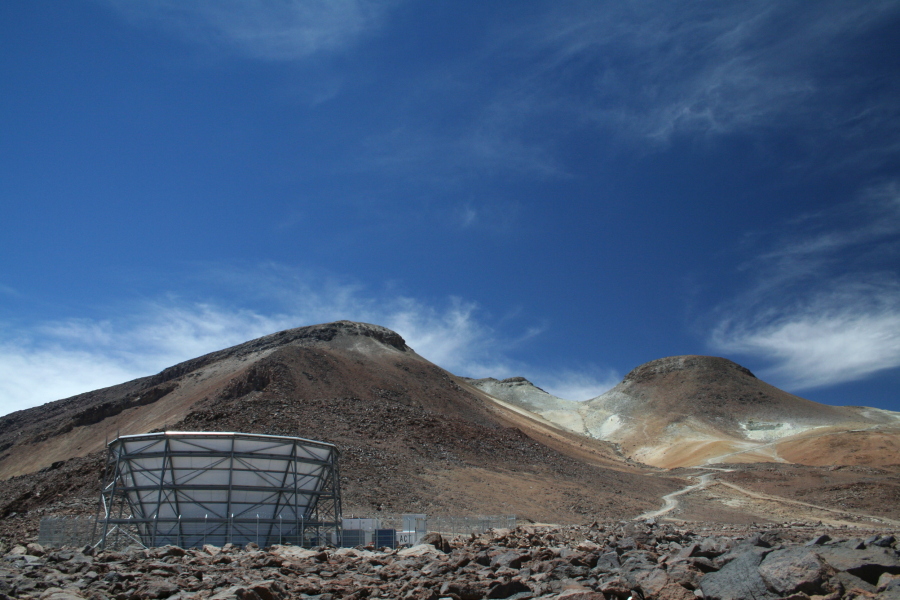
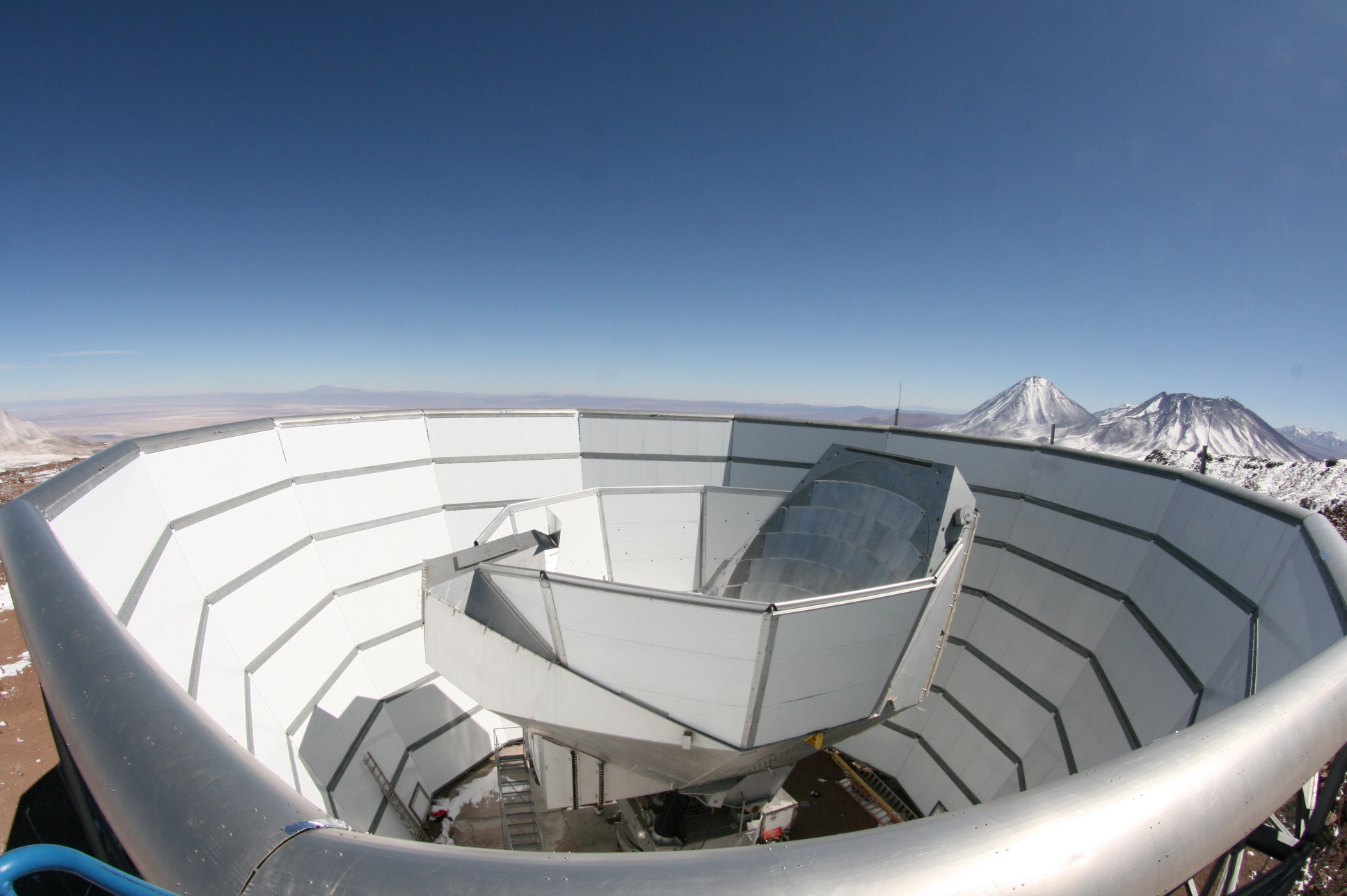
With a 6-meter diameter primary mirror, the ACT ranks as the second largest telescope (the South Pole Telescope, with a similar mission, has a 10-meter diameter mirror) designed to map the CMBR (see figures 1 and 2). ACT’s goal is to map the CMBR at a resolution of about an arcminute down to a temperature sensitivity of a few millionths of a degree Celsius.

blog__inline--chilean-telescope-find-affirms-big-bang-1

Figure 1: Atacama Cosmology Telescope with Cerro Toco Mountain in the Background
Image credit: Ahinks, English Wikipedia, Creative Commons Attribution

blog__inline--chilean-telescope-find-affirms-big-bang-2

Figure 2: Atacama Cosmology Telescope Viewed from the Top of the Outer Protective Screen
Image credit: M. Devlin, University of Pennsylvania, released into the public domain

On July 16, 2020, the 140 astronomers presented arcminute resolution maps of the cosmic microwave background temperature and polarization anisotropy taken from observations made from 2013–2016. The maps cover more than 17,000 square degrees of the sky. For 600 square degrees of their maps the team achieved a temperature sensitivity well below 10 microdegrees per arcminute.

Cosmology Results
The maps produced the following cosmological results compared to results from the Planck satellite maps of the cosmic microwave background radiation. Note that the age of the universe is in billions of years; the cosmic expansion rate, a.k.a. the Hubble Constant, is in kilometers per second per megaparsec where 1 megaparsec = 3.26156 million light-years; and the cosmic density components are given as fractions of the total cosmic density.

Cosmological parameter ACT Planck ACT + Planck
age of the universe 13.832±0.047 13.791±0.025 13.791±0.021
cosmic expansion rate 67.9±1.5 67.51±0.61 67.53±0.56
dark energy density 0.696±0.022 0.6867±0.0084 0.6871±0.0078
total matter density 0.302±0.010 0.3118±0.0036 0.3115±0.0034

Astronomers appreciate maps like these of the CMBR because they provide the tightest cosmological constraints of any current data source. They reveal the state of the universe just 380,000 years after—an instant, in astronomical time—the cosmic creation event.

The researchers comment that “ACT and Planck measurements cover significantly different ranges of angular scales.”5 This means that the consistent results are even more striking. ACT offers improved E-mode polarization measurements, which is a geometric depiction of the flow of gravitational waves. Another reason for excitement is that the researchers attained one of ACT’s goals, which was to make a second, experimentally independent, set of measurements of cosmological parameters that are important for cosmic creation models based on the state of the universe when it was very young.

Big Bang Implications
The above table shows remarkable agreement between the ACT and Planck measurements. The cosmological parameters derived from the Planck maps were all consistent with the ΛCDM big bang creation model where ΛCDM implies that the universe is primarily dominated by dark energy and secondarily by cold dark matter. The ACT maps provide a second independent confirmation of the ΛCDM big bang model based on the CMBR.

When scientists achieve independent confirmations, they know a model is gaining strength. And yet, according to the international team, much more confirmation is coming. The team currently is analyzing four times as much data from observations made from 2017–2019. Beginning in 2020, the team has expanded the range of wavelengths over which they will be taking observations. By 2021, for the first time for any instrument, the cosmological constraints they can derive from polarization measurements will become more powerful than those derived from temperature measurements. This advance will provide additional consistency tests on cosmic creation models. However, already the team has provided results that demonstrate that the more we learn about the universe, the more evidence we accumulate for what the Bible has taught about the universe’s origin and history.

blog__inline--chilean-telescope-find-affirms-big-bang-3Featured image: a portion of one of the maps of the cosmic microwave background radiation observed by the Atacama Cosmology Telescope
Image credit: Atacama Cosmology Telescope collaboration

Endnotes
  1. Simone Aiola et al., “The Atacama Cosmology Telescope: DR4 Maps and Cosmological Parameters,” July 14, 2020 (preprint), arXiv:2007.07288v1, https://arxiv.org/pdf/2007.07288.pdf; Steve K. Choi et al., “The Atacama Cosmology Telescope: A Measurement of the Cosmic Microwave Background Power Spectra at 98 and 150 GHz,” (July 14, 2020), arXiv:2007.07289v1, https://arxiv.org/pdf/2007.07289.pdf.
  2. Hugh Ross, The Creator and the Cosmos, 4th ed. (Covina, CA: RTB Press, 2018), 25–31; Hugh Ross, A Matter of Days, 2nd ed. (Covina, CA: RTB Press, 2015), 135–44, https://shop.reasons.org/product/280/a-matter-of-days.
  3. Hugh Ross and John Rea, “Big Bang—The Bible Taught It First!” Facts for Faith (quarter 3, 2000): 26–31, https://reasons.org/explore/publications/facts-for-faith/read/facts-for-faith/2000/07/01/big-bang-the-bible-taught-it-first!
  4. Hugh Ross, “Does the Bible Teach Big Bang Cosmology?” Today’s New Reason to Believe (blog), August 26, 2019, https://reasons.org/explore/blogs/todays-new-reason-to-believe/read/todays-new-reason-to-believe/2019/08/26/does-the-bible-teach-big-bang-cosmology.
  5. Aiola et al., “Atacama Cosmology Telescope,” 30.

About Reasons to Believe

RTB’s mission is to spread the Christian Gospel by demonstrating that sound reason and scientific research—including the very latest discoveries—consistently support, rather than erode, confidence in the truth of the Bible and faith in the personal, transcendent God revealed in both Scripture and nature. Learn More »

Support Reasons to Believe

Your support helps more people find Christ through sharing how the latest scientific discoveries affirm our faith in the God of the Bible.

DONATE NOW


U.S. Mailing Address
818 S. Oak Park Rd.
Covina, CA 91724
  • P (855) 732-7667
  • P (626) 335-1480
  • Fax (626) 852-0178

Reasons to Believe logo

Reasons to Believe is a nonprofit organization designated as tax-exempt under Section 501(c)3 by the Internal Revenue Service. Donations are tax-deductible to the full extent of the law. Our tax ID is #33-0168048. All Transactions on our Web site are safe and secure.

Copyright 2020. Reasons to Believe. All rights reserved. Use of this website constitutes acceptance of our Privacy Policy.

Posted in Uncategorized | Leave a comment

How the Trinity Shows God’s Love

BY KENNETH R. SAMPLES – MAY 26, 2020

Arguably one of the most important teachings in the Bible is the proclamation that “God is love,” which is found in verses like 1 John 4:8 and 16.

This brief, powerful statement is laden with theological implications. I’ve also found it helpful when discussing how God loves people with those who hold non-Christian, yet theistic conceptions of God (God as a single, solitary person and being).

Because “God is love,” one of the most attractive features of my faith as a historic Christian is the Trinity. For God’s triunity reveals that there is a plurality of persons within the one divine being of God. And that means that God is analogous to a loving human family. Theologian Gerald Bray sheds further light on the love shared among the members of the “divine family” so to speak:

“God cannot be love unless there is something for him to love. But if that something were not part of himself, he would not be perfect. The Bible does not teach us that God needed the creation in order to have something to love, because if that were true, he could not be fully himself without it. So Augustine reasoned that God must be love inside himself. To his mind, the Father is the one who loves, the Son is the one who is loved (the ‘beloved Son’ revealed in the baptism of Jesus), and the Holy Spirit is the love that flows between them and binds them together.”1

I think what makes the Trinity so important for Christians to appreciate is that it allows God to “be love” within himself and therefore not in need of finding love outside (in his creation). This idea came out in a recent dialogue I had online with a Jehovah’s Witness. I think this dialogue concerning the triune God and love might be helpful for all of us.

Debating God’s Nature Online

Me: If Jehovah as a single solitary God is also loving, whom did Jehovah love in eternity past before he created Christ, angels, and human beings? Was Jehovah lonely? Did Jehovah have to create to get love?

JW: The Almighty God Jehovah doesn’t have needs. Would that not conflict with being almighty? Appeal to sentimentality cannot reconcile your clearly unscriptural doctrine. Christ will always be in subjection to his father.

Me: Love is not mere sentimentality. If Jehovah is a loving God then he has to give that love to someone. Love is defined by giving. But in eternity past, Jehovah [on the JW view] had no one to love. True love is not narcissistic. As a single, solitary God, wasn’t Jehovah either needy or loveless? The Trinity, on the other hand, has loving equals.

JW: All creation had a beginning including Jehovah’s firstborn [Jesus]. God had no beginning, but has lived forever into the past. He was not lonely, or needy as you imagine. He began creating because he wanted to, not because he had to. He has no insecurities, and no equal.

Me: True love includes both giving and receiving. Jehovah [according to the JW view] had no equal to love and no one to give him love in return. Love requires another equal person. It seems a God with no one to love means either God was desperate or loveless. Neither qualifies as a true God of love.

JW: Love is what moved God to begin creating. He obviously put a lot of thought into it. You’re trying to warp the Scripture. It says God IS love, that doesn’t imply that before he created his firstborn, he was not in love with the concept of creating. It took love to create.

Me: Since the Bible says “God is love” (1 John 4:8), how is Jehovah a loving God when before creation he is all alone without someone to love? When you knock on people’s doors as a JW, do you tell people Jehovah is a loving God? What if they ask how? It is OK if you don’t know. Ask the leaders at the Watchtower.

Using the Trinity

I had been interacting with this person off and on over a couple of days online about the Trinity, but it seemed to me that the interaction changed when I asked about God being love. The respondent became more candid and reflective. It was no longer just a cerebral doctrinal debate. I’ve had similar dialogues with Muslims and Jews about a unitarian (single, solitary being; one God, one person) deity and the issue of love. Those who affirm a unitarian God (non-Christian theistic religions) have trouble responding to this argument about love. Non-trinitarian conceptions of God—a supreme, perfect being without needs—put him in a position of lacking someone to love and therefore requiring his creation for fulfillment.

Maybe the reason that this conversation takes on a unique dimension is that all of us want and need love, and especially the perfect love of God.

Think about this argument carefully and consider using it with those who deny the Trinity.

Reflections: Your Turn

How does God being a Trinity make a difference in your life as a Christian? Visit Reflections on WordPress to comment with your response.

Resources

Endnotes
  1. Gerald Bray, “8 Things We Can Learn from Augustine,” Crossway, November 16, 2015, crossway.org/articles/8-things-we-can-learn-from-st-augustine.

Posted in Uncategorized | Leave a comment

Does a Religion’s Rapid Growth Mean It’s True?

BY KENNETH R. SAMPLES – JULY 7, 2020

Many religions claim high growth rates that are not merely due to population increases. If a religion acquires a large number of followers, does that growth count in favor of its truth claims? Christianity experienced rapid growth in its early period but so have many religions, including Islam and Mormonism. Is Christianity unique, and if so, how?

Fast-Growing Religions and Their Causes

Historically, Islam and Mormonism (Latter-day Saints) have undergone rapid growth in their early stages and have persisted throughout the years. Islam began in the seventh century and claims about 1.9 billion adherents (second to Christianity) while Mormonism began in the nineteenth century and claims over 16 million members. So one may wonder if this growth also supports their distinctive religious claims.

Islam has experienced enormous growth through the centuries but I think the causes of its specific emergence are diverse. It is true that Muhammad claimed to have received verbal divine messages (which would ultimately become the Qur’an), but his success in forming the religion of Islam also had to do with military and political factors combined with a distant connection to biblical revelation (back to Abraham through Ishmael instead of Isaac). In other words, it doesn’t seem that the religion of Islam emerged by the direct effect of Muhammad’s divine encounters alone. Nor does Islam’s rise point to a death and resurrection of the prophet.

The LDS church has experienced significant growth over almost two centuries. But again the cause seems more nuanced than that of Christianity. Founder Joseph Smith is said to have received a vision in 1823 where an angel, Moroni, spoke of golden plates that Smith would recover and which would become the Book of Mormon. Through Smith, God would restore the Christian church that had strayed from its primitive roots. However, it can be argued that apart from specific LDS truth claims, Mormonism’s worldwide growth is significantly dependent upon its claim to be Christianity’s authentic form. However, Mormonism’s prophet also died and remained dead.

Biblical Connections and Growth

Interestingly enough, both Islam and Mormonism claim to be the rightful fulfillment of biblical revelation by claiming the Jewish-Christian Scriptures (Bible) have been corrupted and compromised and are thus rescued by later revelation (either through the Qur’an [Islam] or the Book of Mormon [LDS]). Thus I think a big part of the attraction of Islam and Mormonism is their claimed connection to the Bible as well as their bold claim to be the Bible’s true revelatory heir. Yet orthodox Christianity views these two religions as serious departures (heretical sects) from biblical and Christian truth.

A Resurrection Movement

Christianity exploded on the scene in the ancient world. Within 300 years it dominated the entire Roman Empire and, over the course of two millennia, dominated all of Western civilization. Today it stands as the largest religion in the world with approximately 2.3 billion adherents.1 Though also deeply connected to the Hebrew Bible, in a very short time span, Christianity developed a distinct cultural and theological identity apart from that of traditional Judaism. According to the New Testament, the unique religion of Christianity came into being directly because of the resurrection of Jesus Christ.

The apostles claimed having eyewitness experiences with Jesus. A merely crucified (dead) Messiah would be viewed by Jews as a false prophet and as cursed by God. According to the Scriptures, the apostles turned the world upside down with the truth of the resurrection, and the historic church emerged. This is why many have called the historic Christian church the community of the resurrection. Thus, the resurrection appears to be the central cause of Christianity’s sudden emergence.

New Testament scholar N. T. Wright observes that:

“Christianity began as a resurrection movement….There is no evidence for a form of early Christianity in which the resurrection was not a central belief…. It was the central driving force, informing the whole movement.”2

Growth vs Truth

While the historic emergence of Islam and Mormonism require an explanation, in comparison with Christianity I think the issue is not so much the growth as it is the initial causal explanation for the emergence of the religion. Sociocultural factors along with claims to biblical connections may have contributed greatly to the rise of Islam and Mormonism regardless of their specific truth claims (actions of Muhammad and Smith).

If the resurrection didn’t cause the emergence of Christianity, what did? There seems to be no other adequate natural explanation. Thus the heart of historic Christianity is found in the remarkable happenings of the first Easter Sunday.3

Reflections: Your Turn

Do you see any difference between how these religions began? Given that all three claim connections to the Hebrew Bible maybe it is best to evaluate the claims and lives of the particular religious leaders who promoted these faiths (Jesus [or the apostles], Muhammad, Joseph Smith) in light of the Old Testament. Which figure best reflects biblical truth and which figure is backed up by the evidence surrounding their specific historical claim? Visit Reflections on WordPress to comment with your response.

Resources

One way to learn more about the specific religions of Christianity, Islam, and Mormonism is to read the New Testament, the Qur’an, and the Book of Mormon.

Endnotes
  1. Conrad Hackett and David McClendon, “Christians Remain World’s Largest Religious Group, but They Are Declining in Europe,” Pew Research Center (April 5, 2017), https://www.pewresearch.org/fact-tank/2017/04/05/christians-remain-worlds-largest-religious-group-but-they-are-declining-in-europe/.
  2. T. Wright, “Christian Origins and the Resurrection of Jesus: The Resurrection of Jesus as a Historical Problem,” NTWright page, accessed June 30, 2020, http://ntwrightpage.com/2016/07/12/christian-origins-and-the-resurrection-of-jesus-the-resurrection-of-jesus-as-a-historical-problem/.
  3. See Kenneth Samples, “A Dozen Evidences for the Resurrection of Jesus,” Reflections (March 27, 2018), https://reflectionsbyken.wordpress.com/2018/03/27/a-dozen-evidences-for-the-resurrection-of-jesus/.

About Reasons to Believe

RTB’s mission is to spread the Christian Gospel by demonstrating that sound reason and scientific research—including the very latest discoveries—consistently support, rather than erode, confidence in the truth of the Bible and faith in the personal, transcendent God revealed in both Scripture and nature. Learn More »

Support Reasons to Believe

Your support helps more people find Christ through sharing how the latest scientific discoveries affirm our faith in the God of the Bible.

DONATE NOW


U.S. Mailing Address
818 S. Oak Park Rd.
Covina, CA 91724
  • P (855) 732-7667
  • P (626) 335-1480
  • Fax (626) 852-0178

Reasons to Believe logo

Reasons to Believe is a nonprofit organization designated as tax-exempt under Section 501(c)3 by the Internal Revenue Service. Donations are tax-deductible to the full extent of the law. Our tax ID is #33-0168048. All Transactions on our Web site are safe and secure.

Copyright 2020. Reasons to Believe. All rights reserved. Use of this website constitutes acceptance of our Privac

Posted in Uncategorized | Leave a comment

Is Cruelty in Nature Really Evil?

BY FAZALE RANA – JULY 8, 2020

How many are your works, Lord!
In wisdom you made them all;
the earth is full of your creatures.

Psalm 104:24

I don’t remember who pointed out thedarksideofnature Instagram account to me, but their description was intriguing enough that I had to check it out. After perusing a few posts, I ended up adding myself to the list of followers.

I can’t say I enjoy the photos and videos posted by thedarksideofnature—which depict nature “red in tooth and claw”—but I do find them mesmerizing. Their website states that it is “all about showing the world a different side of nature. A side that may not be the prettiest, but it is the realist.”

The posts from thedarksideofnature are a stark reminder of the dichotomy in the animal kingdom, simultaneously beautiful and brutal, highlighting the majesty and the power—and danger—of the world of nature. For many people the beauty, majesty, and power of nature evince a Creator’s handiwork. For others, nature’s brutality serves as justifiable cause for rejecting God’s existence. Why would an all-powerful, all-knowing, and all-good God create a world in which animal pain and suffering appears to be gratuitous?

Perhaps nothing exemplifies the seemingly senseless cruelty of nature more so than the widespread occurrence of filial (relating to offspring) cannibalism and filial abandonment among animals. Many animals eat their young or consume eggs after laying them. Others abandon their young, condemning them to certain death.

What an unimaginably cruel feature of nature. Why would God create animals that eat their offspring or abandon their young?

Is Cruelty in Nature Really Evil?

What if there are good reasons for God to permit pain and suffering to exist in the animal kingdom? Scientific research seems to offer several reasons.

For example, some studies reveal purpose for animal pain and suffering. Others demonstrate that animal death promotes biodiversity and ecosystem stability. There are even studies that provide reasons for filial cannibalism and offspring abandonment (see the Resources section, below). Most recently, a team of investigators from Europe and Australia provide additional reasons why animals would consume their own offspring.1

These researchers didn’t set out to study filial cannibalism. Instead, they sought to understand why the comb jelly, native to the Atlantic coast of North America, has been so successful at colonizing new habitats. For example, this invasive species has made its way into the Baltic Sea, which has longer periods of low food availability compared to the comb jelly’s native habitat. The comb jelly has adapted to the food shortage by engaging in behavior that, at first blush, is counterintuitive and seems to be counterproductive. As it enters into the late season, when the prey field begins to empty, the comb jelly makes a massive investment in reproduction, even though the larval offspring have virtually no chance of survival. In fact, after three weeks the comb jelly progeny stop growing, then shrink in size, and die.


blog__inline--is-cruelty-in-nature-really-evil

Figure: Comb Jelly. Credit: Shutterstock

As it turns out, the late season wave of reproduction explains the comb jelly’s success as an invasive species. The researchers learned that the bloom of offspring serve as a food source for the comb jelly adults, replacing the disappearing prey. In other words, as the comb jelly’s available prey begins to decline in number, the jellies reproduce on a large scale with the juveniles serving as a nutrient store that lasts for an additional three weeks beyond the collapse of the prey fields. While this short duration may not seem like much, it affords the comb jelly an opportunity to outcompete other marine life during this window of time, ecologically making the difference between the flourishing and the decline of the species.

Instead of viewing the filial cannibalism among the comb jelly in sinister terms, the investigators found it to be an ingenious design. They argue that the comb jelly population appears to be working together as a single organism. According to research team member Thomas Larsen:

“In some ways, the whole jelly population is acting like a single organism, with the younger groups supporting the adults through times of nutrient stress. Overall, it enables jellies to persist through extreme events and low food periods, colonizing further than climate conditions and other conditions would usually allow.”2

In effect, the filial cannibalism observed for the comb jelly is no different than the autophagy and apoptosis observed in multicellular organisms, in which individual cells are consumed for the overall benefit of the organism.

Filial Cannibalism and the Logical Problem of Evil

These insights into the adaptive value of filial cannibalism for the comb jelly help address the logical problem of natural evil. As part of the problem of natural evil, questions arise about God’s existence and goodness because of brutality in the animal kingdom. Many skeptics view the problem of evil as an insurmountable challenge for Christian theism:

  1. God is all-powerful, all-knowing, and all-good.
  2. Therefore, we would expect good designs in nature.
  3. Yet, nature is brutal, with animals experiencing an undue amount of pain and suffering.
  4. Therefore, God either does not exist or is not good.

Skeptics argue that this final observation about nature is logically incompatible with God’s existence, or, minimally with God’s goodness. In other words, because of natural evil either God doesn’t exist or He isn’t good. Either way, Christian theism is undermined. But what if there is a good reason—as research shows—for pain and suffering to exist in nature? We could modify the syllogism this way:

  1. God is all-powerful, all-knowing, and all-good.
  2. Therefore, we would expect good designs in nature.
  3. There are good reasons for God to allow pain and suffering in the animal realm.
  4. Animal death, pain, and suffering are part of nature.

In other words, if there are good reasons for animal pain and suffering, then God’s existence and goodness are logically coherent with animal pain and suffering. Also, who is to say that pain and suffering in the animal kingdom is excessive? How could anyone possibly know?

The God of Skepticism or the God of the Bible?

When considering the problem of natural evil, it is important to distinguish between the God of naturalistic philosophy and the God of the Bible. Though some philosophers may see pain and suffering in the animal realm as a reason to question God’s existence and goodness, the authors of Scripture had a different perspective. They saw animal death as part of the good creation and a reason to praise and celebrate God as Creator and Provider.3 The insights from science about the importance of animal death to ecosystems, and the adaptive value of pain and suffering provide the rationale for calling these features of nature “good.”

All creatures look to you
to give them their food at the proper time.
When you give it to them,
they gather it up;
when you open your hand,
they are satisfied with good things.

When you hide your face,
they are terrified;
when you take away their breath,
they die and return to the dust.
When you send your Spirit,
they are created,
and you renew the face of the ground.

Psalm 104:27–30

Resources

Animal Death and the Problem of Evil

The Argument from Beauty

Endnotes
  1. Jamileh Javidpour et al., “Cannibalism Makes Invasive Comb Jelly, Mnemiopsis leidyi, Resilient to Unfavorable Conditions,” Communications Biology 3 (2020): 212, doi:10.1038/s42003-020-0940-2.

About Reasons to Believe

RTB’s mission is to spread the Christian Gospel by demonstrating that sound reason and scientific research—including the very latest discoveries—consistently support, rather than erode, confidence in the truth of the Bible and faith in the personal, transcendent God revealed in both Scripture and nature. Learn More »

Support Reasons to Believe

Your support helps more people find Christ through sharing how the latest scientific discoveries affirm our faith in the God of the Bible.

DONATE NOW


U.S. Mailing Address
818 S. Oak Park Rd.
Covina, CA 91724
  • P (855) 732-7667
  • P (626) 335-1480
  • Fax (626) 852-0178
  •  
  •  
  •  

Reasons to Believe logo

Reasons to Believe is a nonprofit organization designated as tax-exempt under Section 501(c)3 by the Internal Revenue Service. Donations are tax-deductible to the full extent of the law. Our tax ID is #33-0168048. All Transactions on our Web site are safe and secure.

Copyright 2020. Reasons to Believe. All rights reserved. Use of this website constitutes acceptance of our Privacy Policy.

WILL MYERS

Author of “Intelligent Design and Biblical Scripture”

Whether nature causes evil is moot because humans were kicked out of the Garden of Eden, which had no natural evil except for the tempting snake. Adam and Eve would have lived forever if not for the sin act. Now, referring to humanity’s bad things caused by nature, such as storms that kill many people, is God allowing it by His withdrawal. Adam and Eve were on their own. Evil is a deviant act from an accepted norm that is good, but nature outside of the Garden existed before the entrance of Adam and Eve; they were imposing on what is an established norm; there was no deviance caused by nature constituting evil. So, all is moot concerning evil. 


Posted in Uncategorized | Leave a comment

The Battle For Our Minds

By Will Myers

The secular humanist gruff at the thought of the biblical prophecy of 666 which is to be planted in the forehead of each person enabling them to trade and participate in the capitalistic system.  The modern day interpretation of this is a chip shall be installed in every person.

At present, we have the gold standard for our economy in order to back our paper currency. This gold system is founded on the human’s love for gold. If humans suddenly lost their love for money then the economy would collapse; the paper would be just that. We can have the love for Christ Jesus to be our standard, and this would be a more perfect system. This is not so far fetched when we observe the human secularists are moving toward the chip being planted on each person which is commonly called electronic point of purchase using a credit card. The chip is ready and is being experimented in the field. From this activity, special interest groups (SIG) collects private, sensitive information on each private citizen. SIG also has the capabilities of giving  credit or debit to any person thus eliminating the paper currency or even the credit card.  The standard would have moved from the gold standard or any other standard and unto SIG who would begin to be our god.

The SIG snake organization’s goal is to bring in hyper-communism whereas the government virtually owns the mind of each citizen. With this in mind, we can clearly understand why God and Jesus has been pushed out of public schools, workplaces, and now the nation. SIG knows that founding of America favored the concept that nothing, no one, no group, and no government shall place itself between the citizen and it’s God.

The SIG organization has crept back since the decapitating actions of the McCarthy Committee on un-American activity. I notice that SIG has been screaming of how inhumane the committee’s actions were. I have realized that SIG is protecting itself while, once again, attempting to steal our free democracy with civil liberties. The SIG snake organization is the cause of school mass killings, workplace killings, and mass killings in other venues in our nation.

The battle for our mind is not between God and Satan because no entity can challenge God; the battle is between Satan and ourselves. Do we accept Satan or Christ Jesus as our gold standard in the spiritual realm and the natural realm.


Posted in Uncategorized | Leave a comment

Does the Book of Isaiah Teach the Trinity?

BY HUGH ROSS – JULY 20, 2020

A cornerstone belief of the Christian faith, the doctrine of the Trinity distinguishes Christianity from all other faiths. This doctrine makes possible the redemption of sinful human beings and God’s eventual eradication of evil and suffering. Also, a trinitarian God enhances the free will capability of redeemed humans to experience and express his love. Due to its weighty implications, helping people of other faiths see the Trinity in texts they accept as sacred is a worthwhile endeavor.

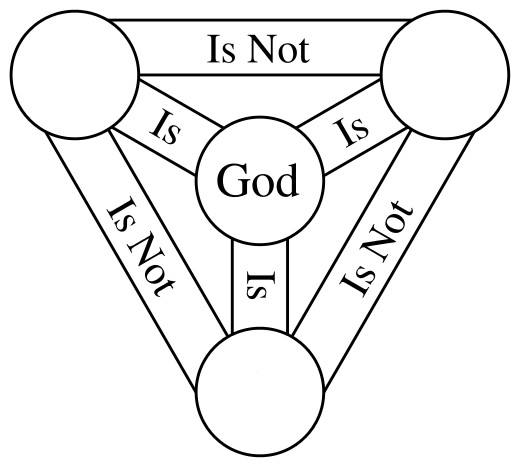
What is the doctrine of the Trinity? Christian scholars have written many thick books answering this question.1 In chapter 9 of my book, Beyond the Cosmos, I briefly define the Trinity within four pages.2 Here, I will reduce it to one long sentence: There is only one God, but in the unity of the Godhead there are three eternal, coequal Persons where each Person is independently conscious and self-directing but never acting independently of one another and always manifesting the same character attributes and the same nature.
blog__inline--does-the-book-of-isaiah-teach-the-trinity

Where in the Bible is the Trinity taught? As I demonstrated in Beyond the Cosmos, the doctrine of the Trinity is expressed in 38 of the Bible’s 66 books. It is taught in 25 of the 27 books of the New Testament and in 13 of the 39 books of the Old Testament.

Which book of the Bible provides the most extensive and detailed teaching on the Trinity? Jews and Muslims believe that there are only scant and ambiguous references to the Trinity in the Old Testament and that Christians base their doctrine of the Trinity on New Testament texts. Many Christians, in fact, do. However, as much as the New Testament expounds on the doctrine of the Trinity, there is an Old Testament book that has more to say about the Trinity than the Gospel of John and Revelation combined—the two New Testament books that say the most about the Trinity. That Old Testament book is Isaiah.

Over the last few decades I have challenged many skeptics of trinitarian doctrine to read through the book of Isaiah in one sitting. Consequently, I have seen many of them, including Jews and Muslims, become convinced of the truth of the Trinity. I have seen even greater success when I have collected for skeptics in a single document everything Isaiah states that is relevant to the Trinity. I want this tool to be used as widely as possible; thus, I present the document here where it will be permanently available for online linking.

I have used the 2017 edition of the Christian Standard Bible throughout this list of Isaiah passages. The reason for my translation choice is that many Jews and other skeptics of the Trinity believe that the only Hebrew word that indisputably and consistently refers to God is the tetragrammaton YHWH (Yahweh). The Christian Standard Bible always translates YHWH as Lord, where “L” is a big capital letter followed by “ord” in small capital letters. Since WordPress (in which this document is written) does not permit the use of small capital letters, in the following passages I have used bold lettering for every instance where Lord is translated from YHWH. Isaiah repeatedly declares that YHWH is one and there is no other God and yet each member of the triune Godhead is referred to as YHWH. I trust that seeing copious specific references to different aspects of the triune God will bear fruitful discussion and lead to persuasion.

Isaiah Passages on the Trinity
Isaiah 1:4 They have abandoned the Lord; they have despised the Holy One of Israel; they have turned their backs on him.

Isaiah 2:3–4 Many peoples will come and say, “Come, let us go up to the mountain of the Lord, to the house of the God of Jacob. He will teach us about his ways so that we may walk in his paths.” For instruction will go out of Zion and the word of the Lord from Jerusalem. He will settle disputes among the nations and provide arbitration for many peoples.

Isaiah 4:2 On that day the Branch of the Lord will be beautiful and glorious, and the fruit of the land will be the pride and glory of Israel’s survivors.

Isaiah 6:5 My eyes have seen the King, the Lord of Armies. [context: Isaiah 6:1–5]

Isaiah 6:8 I heard the voice of the Lord asking: Who will I send? Who will go for us?

Isaiah 7:14 Therefore, the Lord himself will give you a sign: See the virgin will conceive, have a son, and name him Immanuel [God with us].

Isaiah 8:13–14 You are to regard only the Lord of Armies as holy. Only he should be feared; only he should be held in awe. He will be a sanctuary; but for the two houses of Israel, he will be a stone to stumble over and a rock to trip over.

Isaiah 9:6–7 For a child will be born for us, a son will be given to us, and the government will be on his shoulders. He will be named Wonderful Counselor, Mighty God, Eternal Father, Prince of Peace. The dominion will be vast, and its prosperity will never end. He will reign on the throne of David and over his kingdom, to establish and sustain it with justice and righteousness from now on and forever. The zeal of the Lord of Armies will accomplish this.

Isaiah 10:17 Israel’s Light will become a fire, and its Holy One a flame.

Isaiah 11:1–3 Then a shoot will grow from the stump of Jesse, and a branch from his roots will bear fruit. The Spirit of the Lord will rest on him—the Spirit of wisdom and understanding, the Spirit of counsel and strength, a Spirit of knowledge and of the fear of the Lord. His delight will be in the fear of the Lord. [context: Isaiah 11:1–16]

Isaiah 12:2 Indeed, God is my salvation; I will trust him and not be afraid, for the Lord, the Lord himself, is my strength and my song. He has become my salvation.

Isaiah 16:5 a throne will be established in love, and one will sit on it faithfully in the tent of David, judging and pursuing what is right, and quick to execute justice.

Isaiah 17:7, 10 On that day people will look to their Maker and will turn their eyes to the Holy One of Israel. . . . For you have forgotten the God of your salvation, and you have failed to remember the rock of your strength.

Isaiah 19:19–20 On that day there will be altar to the Lord in the center of the land of Egypt and a pillar to the Lord near her border. It will be a sign and witness to the Lord of Armies in the land of Egypt. When they cry out to the Lord because of their oppressors, he will send them a savior and leader, and he will rescue them.

Isaiah 22:21–25 He will be a father to the inhabitants of Jerusalem and to the house of Judah. I will place the key of the house of David on his shoulder; what he opens, no one can close; what he closes, no one can open. I will drive him, like a peg, into a firm place. He will be a throne of honor for his father’s family. They will hang on him all the glory of his father’s family: the descendants and the offshoots—all the small vessels, from bowls to every kind of jar. “On that day,”—the declaration of the Lord of Armies—“the peg that was driven into a firm place will give way, be cut off, and fall, and the load on it will be destroyed.” Indeed, the Lord has spoken.

Isaiah 24:15–16 Therefore, in the east honor the Lord! In the coasts and islands of the west honor the name of the Lord, the God of Israel. From the ends of the earth we hear songs: The Splendor of the Righteous One.

Isaiah 25:8–9 When he has swallowed up death once and for all, the Lord will wipe away the tears from every face and remove his people’s disgrace from the whole, for the Lord has spoken. On that day it will be said, “Look, this is our God; we have waited for him, and he has saved us. This is the Lord; we have waited for him. Let’s rejoice and be glad in his salvation.”

Isaiah 26: 4, 7 Trust in the Lord forever, because in the Lord, the Lord himself, is an everlasting rock! The path of the righteous is level; you clear a straight path for the righteous.

Isaiah 26:13 Lord our God, lords other than you have owned us, but we remember your name alone.

Isaiah 28:16 Therefore the Lord says: “Look, I have laid a stone in Zion, a tested stone, a precious cornerstone, a sure foundation; the one who believes will be unshakable.”

Isaiah 28:21 For the Lord will rise up as he did at Mount Perazim. He will rise in wrath, as at the Valley of Gibeon, to do his work, his unexpected work, and to perform his task, his unfamiliar task.

Isaiah 28:26 His God teaches him order; he instructs him.

Isaiah 32:15 . . . until the Spirit from on high is poured out on us. Then the desert will become an orchard, and the orchard will seem like a forest.

Isaiah 33:2 Lord, be gracious to us! We wait for you. Be our strength every morning and our salvation in time of trouble.

Isaiah 33:17 Your eyes will see the King in his beauty; you will see a vast land.

Isaiah 33:22 For the Lord is our Judge, the Lord is our Lawgiver, the Lord is our King. He will save us.

Isaiah 35:2, 4 They will see the glory of the Lord, the splendor of our God. . . . Say to the cowardly: “Be strong: do not fear! Here is your God; vengeance is coming. God’s retribution is coming; he will save you.”

Isaiah 40:3–5 Prepare the way of the Lord in the wilderness; make a straight highway for our God in the desert. Every valley will be lifted up, and every mountain and hill will be leveled; the uneven ground will become smooth and the rough places a plain. And the glory of the Lord will appear, and all humanity together will see it, for the mouth of the Lord has spoken.

Isaiah 40:9–11 Say to the cities of Judah, “Here is your God!” See, the Lord comes with strength, and his power establishes his rule. His wages are with him, and his reward accompanies him. He protects his flock like a shepherd; he gathers the lambs in his arms and carries them in the fold of his garment. He gently leads those that are nursing.

Isaiah 40:13–14 Who has directed the Spirit of the Lord, or who gave him counsel? Who did he consult? Who gave him understanding and taught him the paths of justice? Who taught him knowledge and showed him the way of understanding?

Isaiah 40:25 “To whom will you compare me, or who is my equal?” asks the Holy One.

Isaiah 41:14 “Do not fear, you worm Jacob, you men of Israel. I will help you”—this is the Lord’s declaration. Your Redeemer is the Holy One of Israel.

Isaiah 42:1–4 “This is my servant; I strengthen him, this is my chosen one; I delight in him, I have put my Spirit on him; he will bring justice to the nations. He will not cry out or shout or make his voice heard in the streets. He will not break a bruised reed, and he will not put out a smoldering wick; he will faithfully bring justice. He will not grow weak or be discouraged until he has established justice on earth. The coasts and islands will wait for his instruction.”

Isaiah 42:6–7 I am the Lord. I have called you for a righteous purpose, and I will hold you by your hand. I will watch over you, and I will appoint you to be a covenant for the people and a light to the nations, in order to open blind eyes, to bring out prisoners from the dungeon, and those sitting in darkness from the prison house.

Isaiah 42:19 Who is blind but my servant, or deaf like my messenger I am sending? Who is blind like my dedicated one, or blind like the servant of the Lord?

Isaiah 43:3 For I am the Lord your God, the Holy One of Israel, and your Savior.

Isaiah 43:10–11 “You are my witnesses,”—this is the Lord’s declaration—“and my servant whom I have chosen, so that you may know and believe me and understand that I am he. No god was formed before me, and will there be none after me. I—I, am the Lord. Besides me, there is no savior.

Isaiah 43:14 This is what the Lord, your Redeemer, the Holy One of Israel says.

Isaiah 44:3 For I will pour water on the thirsty land and streams on the dry ground; I will pour out my Spirit on your descendants and my blessing on your offspring.

Isaiah 44:6 Thus says the Lord, the King of Israel and his Redeemer, the Lord of hosts: “I am the first and I am the last, and there is no God besides Me.” (NASB)

Isaiah 44:24 This is what the Lord, your Redeemer who formed you from the womb, says: “I am the Lord, who made everything; who stretched out the heavens by myself; who alone spread out the earth;”

Isaiah 45:5 “I am the Lord, and there is no other; there is no God but me.”

Isaiah 45:6 “I am the Lord, and there is no other.”

Isaiah 45:14–15 They will confess to you, “God is indeed with you, and there is no other; there is no other God.” Yes, you are a God who hides, God of Israel, Savior.

Isaiah 45:18 “I am the Lord, and there is no other.”

Isaiah 45:21 “There is no other God but me, a righteous God and Savior; there is no one except me.”

Isaiah 45:24 “Righteousness and strength are found only in the Lord.”

Isaiah 46:9 “I am God, and there is no other; I am God, and no one is like me”

Isaiah 47:4 The Holy One of Israel is our Redeemer; The Lord of Armies is his name.

Isaiah 48:12 “I am he; I am the first, I am also the last.”

Isaiah 48:16–17 And now the Lord God has sent me and his Spirit. This is what the Lord, your Redeemer, the Holy One of Israel says: “I am the Lord your God.”

Isaiah 49:4–9 Yet my vindication is with the Lord, and my reward is with my God. And now, says the Lord, who formed me from the womb to be his servant, to bring Jacob back to him so that Israel might be gathered to him; for I am honored in the sight of the Lord, and my God is my strength—he says, “It is not enough for you to be my servant raising up the tribes of Jacob and restoring the protected one of Israel. I will also make you a light for the nations, to be my salvation to the ends of the earth.” This is what the Lord, the Redeemer of Israel, his Holy One, says to one who is despised, to one abhorred by the people, to a servant of rulers: “Kings will see, princes will stand up, and they will bow down because of the Lord, who is faithful, the Holy One of Israel—and he has chosen you.” This is what the Lord says: “I will answer you in a time of favor, and I will help you in the day of salvation. I will keep you, and I will appoint you to be a covenant for the people, to restore the land, to make them possess the desolate inheritances, saying to the prisoners, ‘Come out,’ and to those who are in darkness, ‘Show yourselves.’”

Isaiah 49:26 “I, the Lord, am your Savior, and your Redeemer, the Mighty One of Jacob.”

Isaiah 50:4–9 The Lord has given me the tongue of those who are instructed to know how to sustain the weary with a word. He awakens me each morning; he awakens my ear to listen like those being instructed. The Lord God has opened my ear, and I was not rebellious; I did not turn back. I gave my back to those who beat me, and my cheeks to those who tore out my beard. I did not hide my face from scorn and spitting. The Lord will help me; therefore I have not been humiliated; therefore I have set my face like flint, and I know I will not be put to shame. The one who vindicates me is near; who will contend with me? Let us confront each other. Who has a case against me? Let him come near me! In truth, the Lord God will help me; who will condemn me? Indeed, all of them will wear out like a garment; a moth will devour them.

Isaiah 52:13–53:12 See, my servant will be successful; he will be raised and lifted up and greatly exalted. Just as many were appalled at you—his appearance was so disfigured that he did not look like a man, and his form did not resemble a human being—so he will sprinkle many nations. Kings will shut their mouths because of him, for they will see what had not been told them, and they will understand what they had not heard.

Who has believed what we have heard? And to whom has the arm of the Lord been revealed? He grew up before him like a young plant and like a root out of dry ground.
He didn’t have an impressive form or majesty that we should look at him, no appearance that we should desire him. He was despised and rejected by men, a man of suffering who knew what sickness was. He was like someone people turned away from; he was despised, and we didn’t value him. Yet he himself bore our sicknesses,
and he carried our pains; but we in turn regarded him stricken, struck down by God, and afflicted. But he was pierced because of our rebellion, crushed because of our iniquities; punishment for our peace was on him, and we are healed by his wounds.

We all went astray like sheep; we all have turned to our own way; and the Lord has punished him for the iniquity of us all. He was oppressed and afflicted, yet he did not open his mouth. Like a lamb led to the slaughter and like a sheep silent before her shearers, he did not open his mouth. He was taken away because of oppression and judgment, and who considered his fate? For he was cut off from the land of the living; he was struck because of my people’s rebellion. He was assigned a grave with the wicked, but he was with a rich man at his death, because he had done no violence
and had not spoken deceitfully.

Yet the Lord was pleased to crush him severely. When you make him a guilt offering, he will see his seed, he will prolong his days, and by his hand, the Lord’s pleasure will be accomplished. After his anguish, he will see light and be satisfied. By his knowledge, my righteous servant will justify many, and he will carry their iniquities. Therefore I will give him the many as a portion, and he will receive the mighty as spoil, because he willingly submitted to death, and was counted among the rebels; yet he bore the sin of many and interceded for the rebels.

Isaiah 54:5 Indeed, your husband is your Maker—his name is the Lord of Armies—and the Holy One of Israel is your Redeemer; he is called the God of the whole earth.

Isaiah 55:3–4 I will make a permanent covenant with you on the basis of the faithful kindnesses of David. Since I have made him a witness to the peoples, a leader and commander for the peoples.

Isaiah 59:16 He saw that there was no man—he was amazed that there was no one interceding; so his own arm brought salvation, and his own righteousness supported him.

Isaiah 59:19–20 They will fear the name of the Lord in the west and his glory in the east, for he will come like a rushing stream driven by the wind of the Lord. “The Redeemer will come to Zion, and to those in Jacob who turn from transgression.” This is the Lord’s declaration.

Isaiah 60:9 Yes, the coasts and island will wait for me with the ships of Tarshish in the lead, to bring your children from far away, their silver and gold with them, for the honor of the Lord your God, the Holy One of Israel, who has glorified you.

Isaiah 60:16 You will nurse on the milk of nations, and nurse at the breast of kings; you will know that I, the Lord, am your Savior and Redeemer, the Mighty One of Jacob.

Isaiah 61:1–3 The Spirit of the Lord God is on me, because the Lord has anointed me to bring good news to the poor. He has sent me to heal the brokenhearted, to proclaim liberty to the captives and freedom to the prisoners, to proclaim the year of the Lord’s favor and the day of our God’s vengeance, to comfort all who mourn, to provide for those who mourn in Zion; to give them a crown of beauty instead of ashes, festive oil instead of mourning, and splendid clothes instead of despair.

Isaiah 62:11–12 Look, the Lord has proclaimed to the ends of the earth, “Say to Daughter Zion: Look, your salvation is coming, his wages are with him, and his reward accompanies him.” And they will be called the Holy People, the Lord’s Redeemed; and you will be called Cared For, A City Not Deserted.

Isaiah 63:8–11 He said, “They are indeed my people, children who will not be disloyal,” and he became their Savior. In all their suffering, he suffered, and the angel of his presence saved them. He redeemed them because of his love and compassion; he lifted them up and carried them all the days of the past. But they rebelled and grieved his Holy Spirit. So he became their enemy and fought against them. Then he remembered the days of the past, the days of Moses and his people. Where is he who brought them out of the sea with the shepherds of his flock? Where is he who put his Holy Spirit among the flock?

Isaiah 63:14–16 Like cattle that go down into the valley, the Spirit of the Lord gave them rest. You led your people this way to make a glorious name for yourself. Look down from heaven and see from your lofty home—holy and beautiful. Where is your zeal and your might? Your yearning and your compassion are withheld from me. Yet you are our Father, even though Abraham does not know us and Israel doesn’t recognize us. You, Lord, are our Father; your name is Our Redeemer from Ancient Times.

Endnotes
  1. Here are three of many examples: Peter C. Phan, ed., The Cambridge Companion to the Trinity (Cambridge, UK: Cambridge University Press, 2011); Augustine, The Trinity (Hyde Park, NY: New City Press, 2012); Gilles Emery and Matthew Levering, eds., The Oxford Handbook of the Trinity (Oxford, UK: Oxford University Press, 2011).
  2. Hugh Ross, Beyond the Cosmos, 3rd ed. (Covina, CA: RTB Press, 2017): 85–88, https://shop.reasons.org/product/270/beyond-the-cosmos-3rd-edition.

Posted in Uncategorized | Leave a comment

COVID Strikes Back?

BY STEVEN WILLING – JULY 24, 2020

By Steven Willing

Just when America looked like it had turned a corner, COVID has seemingly returned with a vengeance. Most of the recent media attention has focused on rising infection rates in Florida, Texas, Arizona, and California. Three of those four (FL, TX, and CA) top the list of most populous states, so their raw case numbers should be no surprise. The fourth most populous state is New York, which (second only to New Jersey) leads not just the US but the entire world in accumulated per capita infections and mortality. Understanding the COVID “comeback” helps us offer an informed, compassionate response.

What’s Going On?

According to the New York Times, on July 23 cases were on the rise in 39 states, Washington, DC, Puerto Rico, and the Virgin Islands. They are mostly steady in nine states and Guam, including the hardest hit states of NY, NJ, and Connecticut. Cases are declining in Delaware and, surprisingly, Arizona. “Record” total case counts should not be taken too literally. Testing was so scarce in the early stages we have no idea what the actual counts should have been in March and April. Increasing hospital admissions confirm that COVID cases have increased in a few populous regions, so the rising cases most plausibly reflect both increased testing and regional upswings.

have been blogging about the COVID crisis periodically this year, addressing some of the epidemiological and policy factors but the spiritual dimensions as well. On May 25, as cases were winding down and shutdown policies were loosening, I predicted “a continued slow burn with occasional spikes in densely populated regions or should mass gatherings resume.” That indeed seems to be what we are presently witnessing.

The concept of “flattening the curve” that figured prominently in the national discourse was based on the work of the Department of Epidemiology at the Harvard School of Public Health. Their strategic analysis was published in Science in May of this year.1 An implicit, if flawed, assumption was that this analysis would describe the whole nation. Each state and US territory started from different phases of the outbreak and employed different policies; thus, there was never one curve, but more than fifty. Indeed, different states exhibited radically different trajectories in the months following the initial March lockdowns.

The Curves Took Many Shapes

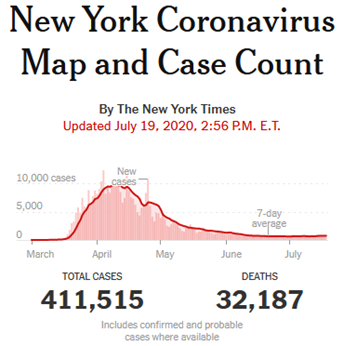
New York mostly failed to flatten the curve. It saw a massive spike in infections and deaths, followed by a continuous decline to now very low levels. New cases, hospitalizations, and deaths in New York City have dropped to almost nothing. This follows the pattern seen in the worst-affected nations, including Belgium, the United Kingdom, Sweden, Italy, Spain, and France. New Jersey flattened it only slightly. Both NY and NJ suffered per-capita fatality rates double that of Belgium and triple that of Sweden. Here we see the infection curve for New York:

Some states, however, did flatten the curve. For example, Illinois, Indiana, and Maryland saw moderate infection rates spread out over many weeks. Most of them now have steadily declining fatality rates:

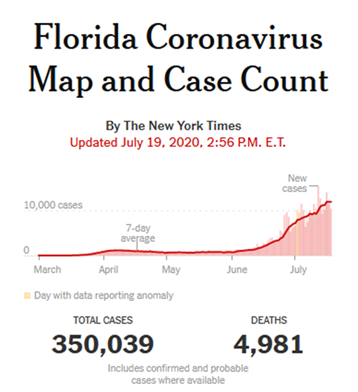
Many states totally squashed the curve. Instead of spreading out the cases over time, their shutdowns had the unfortunate consequence of merely pushing the curve, and hence the crisis, forward in time. Until mid-June, FL, TX, AZ, and CA had infection rates far below the national averages. Entering the last third of July, their per capita fatality rates remain below the national average, and less than one-third the death rates of NY and NJ. The Harvard study predicted this problem:
Strong, temporary social distancing can lead to especially large resurgences . . . Under all scenarios, there was a resurgence of infection when the simulated social distancing measures were lifted. However, longer and more stringent temporary social distancing did not always correlate with greater reductions in pandemic peak size.2

The curve in the graph below aptly illustrates how the impact of social distancing in Florida was to push the curve into late June and July.

Even though this outcome was predicted, many commentators are blaming these surges on reopening “too quickly.” No one could deny that reopenings could have been handled differently, just as the initial lockdowns could have been handled differently. The nationwide situation is highly fluid and changes quickly. Among the resurgent states, Arizona peaked in the first week of July and new cases are sloping downward. Texas may have peaked as of the second week of July. Florida and California remain on a gentle upslope.
Containing the Virus Is Unrealistic

The SARS-CoV-2 virus is incredibly infectious and easily spread by asymptomatic victims. A recently discovered variant that has become dominant may be even more infectious, though not more deadly. (The original, less infectious strain that circulated through Asia may partially account for Asia’s early suppression success.) There was, and is, no realistic possibility of containment. From the outset, Harvard epidemiologist Marc Lipsitch predicted that 40 to 70 percent of the global population would be infected (possibly much lower; read on).3 Masks and social distancing can slow the spread. In so doing, they accomplish the original purpose of “flattening the curve:” to prevent hospitals from being overwhelmed. Unfortunately, many people got the message that through such efforts we could stop the pandemic in its tracks. That became impossible about six months ago. The overwhelming percentage of cases are now known to be mild or asymptomatic. According to Dr. Robert Redfield, director of the Centers for Disease Control, the true number of cases in the US is likely to be ten times higher than the number so far diagnosed.4

Much Worse Than the Common Flu, but Not as Deadly as Initially Believed

The infection fatality rate (IFR) is confirmed at a mean value between 0.5 to 0.8%. This is in the range initially predicted by internationally renowned researcher John Ioannidis in mid-March.5 By early June, the CDC offered as its best estimate 0.4%. On July 13, the CDC revised its estimate upward to 0.65%. However, there is not a single IFR but a range. The local death rate may be higher (Bergamo, Italy, possibly as high as 1.0%) or lower (Singapore, 0.05%) depending upon the age distribution of its victims.

Herd Immunity: Surrender, or Strategy?

The much-debated herd immunity—that point when so many have been infected that the disease can no longer spread—may kick in at much lower levels than popular wisdom asserts, and could be the best explanation for the dramatically declining cases in those states and nations with the highest per-capita infection and fatality rates.6 The widely circulated estimate that herd immunity requires a 60–70% infection rate is based on a simple formula with simplistic assumptions. The weakest of these assumptions is that all people are equally susceptible. Consider that there are four widely circulating coronaviruses that cause the common cold. There is reported evidence for pre-existing T-cell immunity to the SARS-Cov-2 virus in unexposed individuals, linked to at least two of the more benign (of the four) coronaviruses.7 The implication is that a large proportion of the population already has partial immunity that would never show up on antibody tests. One international team of researchers, including representatives of Oxford and the National Institutes of Health (NIH), projects that herd immunity could occur at levels as low as 20% after taking into account variations in individual susceptibility.8 (For a further explanation, see “A New Understanding of Herd Immunity,” The Atlantic, July 13, 2020.)

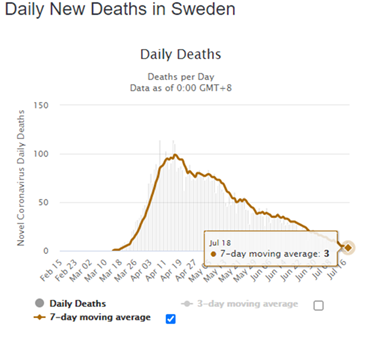
One highly significant observation is that several weeks after reopening in most of Western Europe, all-cause mortality has declined back to baseline (i.e., the death rate is exactly what it ought to be for this time of year). The data increasingly suggest that the Swedish approach (prohibit large gatherings, no closures or lockdown) has been equally effective with far less social and economic disruption. Swedish COVID fatalities have declined precipitously since a mid-April peak. (Their death rate could have and should have been much lower, but for a policy of malign neglect toward the elderly having nothing to do with the decision not to shut down). As of today, the per-capita fatality rate in Sweden remains lower than that in nine US states and the District of Columbia, all of which locked down.

Source: Worldometers.info/coronavirus/country/sweden
A Vaccine Is Not Inevitable

Every report, commentator, and column that speaks of a vaccine in terms of “when” or “until” is either naïve or disingenuous. Dr. Francis Collins, head of the NIH, stated in an interview that a vaccine has never been developed in less than three years.9 After 40 years, there is still no vaccine against HIV, and that is clearly not from lack of trying. Numerous recent studies have found that neutralizing antibodies to SARS-CoV-2 may disappear after weeks or months.10 This, in turn, has led to additional anxiety over whether a vaccine is even possible.

The primary objective of containment measures has been to spread cases over time to prevent overload of health care systems. In light of that goal, it is legitimate to ask whether the measures really save lives or merely postpone the inevitable. It is mathematically possible that fewer people will get sick or die because of them, yet the long-term net reductions may be minimal. It also wouldn’t be fair to trivialize the benefit of dying six months later rather than now. Risk is an unavoidable fact of human existence. We’d save many more lives by the abolition of cigarettes, mandatory flu vaccines, confiscating all firearms, and raising the driving age to 21—but there’s no popular support for such measures.

Spiritual Dimensions

This crisis presents people of faith with an opportunity to witness in word and action. Followers of Christ can demonstrate maturity and grace in many ways:

  • By choosing courage and hope over fear in obedience to our Lord.
  • By sound, balanced thinking that avoids bizarre conspiracy theories on the one side, and excessive trust in the scientific community on the other. While the scientific community is generally successful at correcting errors in the long run, in the shorter run it can go wildly astray.
  • By assuming the role of peacemaker, rather than contributing to partisan polarization.By practicing humility rather than arrogance, allowing that even the most expert among us only partially understands this disease and no one knows the final outcome.
  • By showing patience to our neighbor without condemning them for their response, whether it be fear or denial.

May God guide your efforts as you serve as an ambassador to a confused, hurting world.

Endnotes
  1. Stephen Kissler et al., (2020), “Projecting the Transmission Dynamics of SARS-CoV-2 through the Postpandemic Period,” Science 368, no. 6493 (May 22, 2020): 860–68, doi:10.1126/science.abb5793.
  2. Kissler et al., 860–68.
  3. Marc Lipsitch cited in James Hamblin, “You’re Likely to Get the Coronavirus,” The Atlantic, February 24, 2020, https://www.theatlantic.com/health/archive/2020/02/covid-vaccine/607000/.
  4. Robert Redfield cited in Erika Edwards, “CDC Says COVID-19 Cases in US May Be 10 Times Higher Than Reported,” NBC News, last updated June 26, 2020, https://www.nbcnews.com/health/health-news/cdc-says-covid-19-cases-u-s-may-be-10-n1232134.
  5. Gideon Meyerowitz-Katz and Lea Merone, “A Systematic Review and Meta-analysis of Published Research Data on COVID-19 Infection-Fatality Rates,” MedRxiv, Posted July 7, 2020 (preprint), doi:10.1101/2020.05.03.20089854.
  6. Jose Lourenco, Francesco Pinotti, and Sunetra Gupta, “The Impact of Host Resistance on Cumulative Mortality and the Threshold of Herd Immunity for SARS-CoV-2,” posted July 16, 2020 (pre-print), doi:https://doi.org/10.1101/2020.07.15.20154294.
  7. Ulrik Stervbo et al., “SARS-CoV-2 Reactive T cells in Uninfected Individuals Are Likely Expanded by Beta-Coronaviruses,” posted July 1, 2020 (pre-print), doi:10.1101/2020.07.01.182741.
  8. Gabriela M. Gomes et al., “Individual Variation in Susceptibility or Exposure to SARS-CoV-2 Lowers the Herd Immunity Threshold,” posted May 21, 2020 (pre-print), doi:10.1101/2020.04.27.20081893.
  9. “Francis Collins: Coronavirus Updates with NIH Director,” interview by Jim Stump, April 8, 2020, in Language of God, produced by BioLogos, podcast, 51:07, https://biologos.org/podcast-episodes/francis-collins-coronavirus-updates-with-nih-director/.
  10. Jeffrey Seow et al., “Longitudinal Evaluation and Decline of Antibody Responses in SARS-CoV-2 Infection,” posted July 11, 2020 (pre-print), doi:10.1101/2020.07.09.20148429.

Posted in Uncategorized | Leave a comment

More Evidences for Biblical Claim of Unchanging Physics

BY HUGH ROSS – JUNE 22, 2020

One of the basic assumptions of physics is that the laws of physics are the same at all times and places throughout the universe. That constancy is foundational to the scientific method and is the basis for all scientific research. Recent advances are yielding an even stronger case for unchanging physical laws—a development that also supports the claim of ancient biblical texts.

Millennia before scientists established the principle of unchanging laws of physics, the Bible stated that the fundamental physics of the universe has not and does not change. For example, in Jeremiah 33 God declares that he is not like humans who seem to always change their minds. God offers an analogy. As he “established the fixed laws of heaven and earth” (Jeremiah 33:25) so, too, God’s nature and character attributes are fixed.

The constancy of the laws of physics that govern the universe and Earth, if scientifically established, would affirm the Bible’s reliability in describing the natural realm and in accurately predicting future scientific discoveries. It would also refute young-earth creationist models. Young-earth creationists acknowledge that if the laws of physics indeed are fixed throughout Earth’s history, Earth must be several billion years old.1 Hence, they posit that radical alterations in the laws of physics, by factors of millions or billions of times, occurred either when Adam first sinned or during Noah’s flood, or both.

I have written about the constancy of the laws of physics in previous blogs2 and in my book, A Matter of Days, 2nd edition.3 This threefold update on time variation constraints of the electron-to-proton mass ratio, the fine-structure constant, and the gravitational constant is necessarily technical. Not all readers will need the details. Feel free to skim the next three sections and pick up again at “Bible’s Reliability and Predictive Power.”

Constraints on Time Variation of the Electron-to-Proton Mass Ratio
Molecular spectroscopy is the preferred approach physicists have used to measure the stability of the ratio of the electron mass to the proton mass. The reason why is that molecular spectroscopy is model-free and assumption-free, in that it directly measures the stability of the inertial masses of the atomic nuclei.

In 2008, through a study comparing the absorption lines of SF6 (sulfur hexafluoride) with the hyperfine transition in cesium, a team led by Alexander Shelkovnikov showed that the temporal variation of the electron-to-proton mass ratio cannot be any larger than -3.8 ± 5.6 x 10⁻¹⁴ per year (a tiny number).4 Nine months ago, three Japanese physicists published a much superior test of the constancy of the electron-to-proton mass ratio. They synthesized ultracold (near absolute zero, -273°C or -460°F) potassium rubidium molecules from ultracold potassium and rubidium atoms. They then observed the microwave transition of photodissociated potassium rubidium molecules. By this means, they showed that the temporal variation of the electron-to-proton mass ratio cannot be any larger than 3.0 ± 10.0 (statistical) ± 1.6 (systematic) x 10-15 per year (smaller than the previous number by an order of magnitude).5

The new result establishes a stability for the electron-to-proton mass ratio that is six times more stringent than the previous best laboratory measurement. Furthermore, since the statistical error in their measurement is so much larger than possible systematic errors, the Japanese astronomers recognize an opportunity to develop an even more stringent test. They plan to repeat their experiment where the atoms and molecules are measured at sub-microkelvin temperatures (temperatures less than a millionth of a degree above absolute zero). By so doing, they hope to establish stability limits at the level of 10-17 to 10-18 per year (even more minuscule).

Other physicists have measured the stability of the electron-to-proton magnetic moment ratio. Their measures show that it does not vary by more than 2.0 ± 11.0 x 10⁻¹⁷ per year.6

From observations of spectral lines in distant quasars, astronomers can establish limits on the time variation of the electron-to-proton mass ratio, not over just a few years but over 12.9 billion years. A team of six astronomers led by S. A. Levshakov determined that variations in the electron-to-proton mass ratio over the past 12.9 billion years must be less than 1.6 x 10⁻¹⁷ per year.7 This determination currently ranks as the best measure of the constancy of the electron-to-proton mass ratio.

Constraints on Time Variation of the Fine-Structure Constant
In 2013, a team of five physicists led by Nathan Leefer measured the frequencies of two different transition spectral lines of atomic dysprosium over a two-year period. Their measured comparisons established that the fine-structure constant does not change by any more than 5.8 ± 6.9 x 10⁻¹⁷ per year.8

The astronomers led by Levshakov in their measurements of spectral lines in distant quasars showed that the fine-structure constant has not varied by more than 6.2 x 10⁻¹⁶ per year over the past 12.9 billion years.9 In a follow up paper, Levshakov and colleague M. G. Kozlov unveiled a new spectral line approach that will potentially yield a limit on fine-structure constant variations over the past 11 billion years down to 4.5 x 10⁻¹⁷ per year.10

Constraint of Time Variation of Gravitational Constant
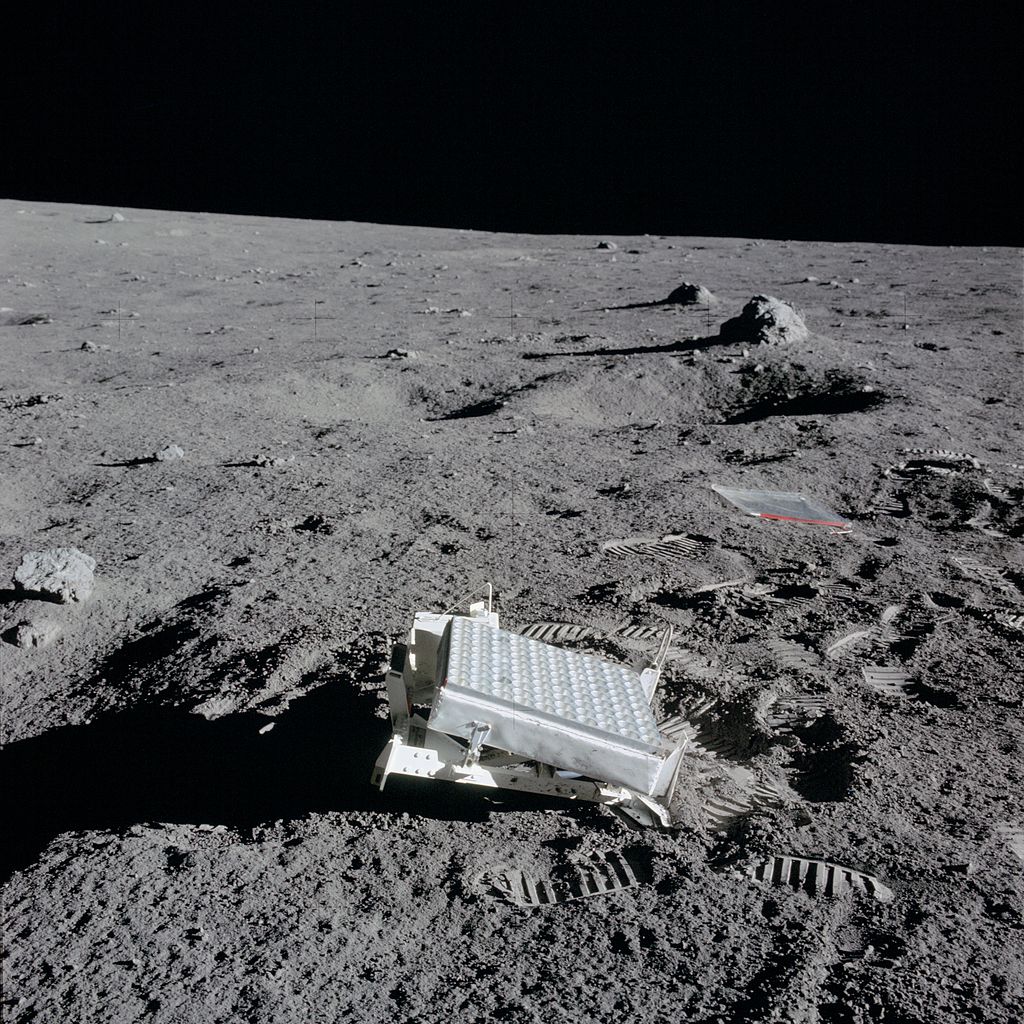
One of the most challenging fundamental physics constants for establishing stringent limits on possible variations is Newton’s gravitational constant, G. However, thanks to the Apollo 9 astronauts placing a laser reflector on the Moon, the Lunar Laser Ranging experiment determined that over a 45-year period possible variations in G are limited to no more than 7.1 ± 7.6 x 10⁻¹⁴ per year.11 Astroseismic observations of the old, low-mass star KIC 7970740, published just six months ago, established that over the past 11 billion years variations of G have been constrained to 1.2 ± 2.9 x 10⁻¹² per year.12 Helioseismic observations of the Sun by BiSON (Birmingham Solar Oscillations Network), published just six week ago, showed that over a period of 8,640 days (24 years) variations in G remained less than 5.2 x 10⁻¹⁴ per year for the most probable solar model and 17 x 10-14 for all solar models.13

Bible’s Reliability and Predictive Power
Observations by astronomers and experiments by physicists have validated, to an amazing degree of accuracy, the biblical statements about the fixed nature of the laws of physics. Bible authors made these statements more than two millennia before scientists had any capacity to affirm or deny their statements. This forecasting of scientific discoveries thousands of years in advance establishes that the One who inspired the Bible authors to write what they did is superhuman and super intelligent, knowing and understanding all things.

Even before astronomers and physicists confirmed that the Bible accurately describes the unchanging nature of the laws of physics, those biblical declarations reassured scientists during the Renaissance that, because of the unchanging nature of the laws of physics, studies of the natural realm could be trusted to reveal truth. It was this confidence in the realm of nature to reveal truth that gave birth to the scientific revolution. It is no coincidence that the birth of the scientific revolution occurred in Reformation Europe when people in all walks of life were encouraged to read the Bible for themselves for truth about God, nature, history, and humanity.

Lunar Laser Reflector placed on the Moon by Apollo Astronauts
Image credit: NASA

Endnotes
  1. Larry Vardiman, Andrew Snelling, and Eugene F. Chaffin, eds., Radioisotopes and the Age of the Earth: A Young-Earth Creationist Research Initiative, vol. 1 (El Cajon, CA: Institute for Creation Research, 2000): 42–44, 306–07, 312–13, 316–18, 334–37, 374.
  2. Hugh Ross, “Stronger and More Comprehensive Tests Affirm the Universe’s Unchanging Physics,” Today’s New Reason to Believe (blog), July 1, 2013, https://reasons.org/explore/publications/tnrtb/read/tnrtb/2013/07/02/stronger-and-more-comprehensive-tests-affirm-the-universe-s-unchanging-physics; Hugh Ross, “More Evidence for Constant Laws of Physics,” Today’s New Reason to Believe (blog), October 20, 2006, https://reasons.org/explore/blogs/todays-new-reason-to-believe/read/tnrtb/2006/10/28/more-evidence-for-constant-laws-of-physics.
  3. Hugh Ross, A Matter of Days, 2nd ed. (Covina, CA: RTB Press, 2015): 70, 184–85.
  4. Alexander Shelkovnikov et al., “Stability of the Proton-to-Electron Mass Ratio,” Physical Review Letters 100 (April 18, 2008): id. 150801, doi:1o.1103/PhysRevLett.100.150801.
  5. J. Kobayashi, A. Ogino, and S. Inouye, “Measurement of the Variation of Electron-to-Proton Mass Ratio Using Ultracold Molecules Produced from Laser-Cooled Atoms,” Nature Communications 10 (August 21, 2019): id. 3771, doi:10.1038/s41467-019-11761-1.
  6. R. M. Godun et al., “Frequency Ratio of Two Optical Clock Transitions in 171Yb+ and Constraints on the Time Variation of Fundamental Constants,” Physical Review Letters 113 (November 17, 2014), id. 210801, doi:10.1103/PhysRevLett.113.210801.
  7. S. A. Levshakov et al., “An Upper Limit to the Variation in the Fundamental Constants at Redshift z = 5.2,” Astronomy & Astrophysics: Letters 540 (April 2012): id. L9, doi:10.1051/0004-6361/201219042.
  8. Nathan Leefer et al., “New Limits on Variation of the Fine-Structure Constant Using Atomic Dysprosium,” Physical Review Letters 111, no. 6 (August 6, 2013): id. 060801, doi:10.1103/PhysRevLett.111.060801.
  9. Levshakov et al., “An Upper Limit to the Variation.”
  10. S. A. Levshakov and M. G. Kozlov, “Fine-Structure Transitions as a Tool for Studying Variation of α at High Redshifts,” Monthly Notices of the Royal Astronomical Society: Letters 469, no. 1 (July 2017): L16–L19, doi:10.1093/mnras/slx049.
  11. F. Hofmann and J. Müller, “Relativistic Tests with Lunar Laser Ranging,” Classical and Quantum Gravity 35, no. 3 (January 8, 2018): id. 035015, doi:10.1088/1361-6382/aa8f7a.
  12. Earl Patrick Bellinger and Jørgen Christensen-Dalsgaard, “Astroseismic Constraints on the Cosmic-Time Variation of the Gravitational Constant from an Ancient Main-Sequence Star,” Astrophysical Journal Letters 887, no. 1 (December 10, 2019): id. L1, doi:10.3847/2041-8213/ab43e7.
  13. Alfio Bonanno and Hans-Erich Fröhlich, “A New Helioseismic Constraint on a Cosmic-Time Variation of G,” Astrophysical Journal Letters 893, no. 2 (April 21, 2020): id. L35, doi:10.3847/2041-8213/ab86b9.

About Reasons to Believe

RTB’s mission is to spread the Christian Gospel by demonstrating that sound reason and scientific research—including the very latest discoveries—consistently support, rather than erode, confidence in the truth of the Bible and faith in the personal, transcendent God revealed in both Scripture and nature. Learn More »

Support Reasons to Believe

Your support helps more people find Christ through sharing how the latest scientific discoveries affirm our faith in the God of the Bible.

DONATE NOW


U.S. Mailing Address
818 S. Oak Park Rd.
Covina, CA 91724
  • P (855) 732-7667
  • P (626) 335-1480
  • Fax (626) 852-0178

Reasons to Believe logo

Reasons to Believe is a nonprofit organization designated as tax-exempt under Section 501(c)3 by the Internal Revenue Service. Donations are tax-deductible to the full extent of the law. Our tax ID is #33-0168048. All Transactions on our Web site are safe and secure.

Copyright 2020. Reasons to Believe. All rights reserved. Use of this website constitutes acceptance of our Privacy Policy.

Posted in Uncategorized | Leave a comment

Examples of the Bible’s Predictive Power

BY HUGH ROSS – JULY 17, 2020

Question of the week: You have said that the Bible is unique in that it possesses predictive power. Can you give a couple of examples?

My answer: There are hundreds of examples in the Bible where it predicts either future events in human affairs/civilization or it predicts future scientific discoveries. Most of these predictions have since been fulfilled. The Bible has never been proven wrong in its predictions.

The Book of Daniel gives many specific predictions about the rise and fall of future empires. For example, Daniel 8 records a vision Daniel received while in Babylon during the third year of King Belshazzar’s reign. The recorded interpretation of the vision that Daniel receives states that an alliance of Media (base of the Medes) and Persia will establish an empire that will replace the Babylonian empire and become much larger. Later, a powerful king from the west, in Greece, will conquer the Median-Persian empire. However, at the height of his power his empire will be divided into four kingdoms. History reveals that these events were fulfilled exactly as predicted in the Book of Daniel. Skeptics of the Bible do not deny any of this but try to claim that Daniel was written in the fifth or sixth century AD and not during the sixth century BC reign of the Babylonian king, Belshazzar. However, the words and style of writing in Daniel 8 are the same as that of sixth century Babylonian literature and radically different from fifth or sixth century AD literature. Furthermore, portions of the Book of Daniel appear in the Dead Sea Scrolls and all of Daniel is present in the Septuagint, affirming that the Book of Daniel must predate the second century BC by several centuries.

An example of the Bible correctly predicting future scientific discoveries are its repeated statements about the fundamental features of big bang cosmology. Different Bible authors state that the universe has a beginning, that it expands from its cosmic beginning, that the physical laws governing the universe have not changed, and that one of those laws is a pervasive law of ongoing decay. I and Old Testament scholar John Rea cite the Bible passages and provide an exposition of them in the context of the word definitions and grammar of the original languages in this article.1

Another example of the Bible correctly predicting future scientific discoveries is the stated order and description of creation events in Genesis 1. I have written an entire book documenting the Bible’s predictive power in describing future scientific discoveries in the first few chapters of Genesis. That book is Navigating Genesis.2 Anyone can get a free chapter of the book at reasons.org/ross. I also have since written two blogs, here and here, describing new scientific discoveries that provide additional evidence for the Bible’s predictive success in describing future scientific discoveries.3

Years ago, I debated the religion editor for Skeptic magazine, Tim Callahan, on the subject, Does the Bible Have Predictive Powers? You can listen to an unabridged recording of the debate here: https://shop.reasons.org/product/566/does-the-bible-have-predictive-powers-downloadable-mp3.

Endnotes
  1. Hugh Ross and John Rea, “Big Bang—the Bible Taught It First!” Facts for Faith, quarter 3, 2000: 26–32, https://reasons.org/explore/publications/facts-for-faith/read/facts-for-faith/2000/07/01/big-bang-the-bible-taught-it-first!
  2. Hugh Ross, Navigating Genesis (Covina, CA: RTB Press, 2014), https://shop.reasons.org/product/279/navigating-genesis.
  3. Hugh Ross, “Rapid Landmass Emergence Affirms Creation Day 3,” Today’s New Reason To Believe (blog), June 11, 2018, https://reasons.org/explore/blogs/todays-new-reason-to-believe/read/todays-new-reason-to-believe/2018/06/11/rapid-landmass-emergence-affirms-creation-day-3; Hugh Ross, “Hazy Early Earth: More Affirmation of Creation Day 4,” Today’s New Reason To Believe (blog), June 18, 2018, https://reasons.org/explore/blogs/todays-new-reason-to-believe/read/todays-new-reason-to-believe/2018/06/18/hazy-early-earth-more-affirmation-of-creation-day-4.

About Reasons to Believe

RTB’s mission is to spread the Christian Gospel by demonstrating that sound reason and scientific research—including the very latest discoveries—consistently support, rather than erode, confidence in the truth of the Bible and faith in the personal, transcendent God revealed in both Scripture and nature. Learn More »

Support Reasons to Believe

Your support helps more people find Christ through sharing how the latest scientific discoveries affirm our faith in the God of the Bible.

DONATE NOW


U.S. Mailing Address
818 S. Oak Park Rd.
Covina, CA 91724
  • P (855) 732-7667
  • P (626) 335-1480
  • Fax (626) 852-0178

Reasons to Believe logo

Reasons to Believe is a nonprofit organization designated as tax-exempt under Section 501(c)3 by the Internal Revenue Service. Donations are tax-deductible to the full extent of the law. Our tax ID is #33-0168048. All Transactions on our Web site are safe and secure.

Copyright 2020. Reasons to Believe. All rights reserved. Use of this website constitutes acceptance of our Privacy Policy.

Posted in Science And Religion, Socio-political, Uncategorized | Leave a comment

The Importance of Building a Relationship with God among Different Cultures

I experienced many different cultures and beliefs growing up in Hong Kong, the city where “East meets West.” These experiences included three different religious schools in which I studied Buddhism and Catholicism during my elementary school years and Islam during my high school years.1 I respected the imams, gurus, priests, and nuns who devoted their lives to education in these religious schools, but what they taught me about God was vague and confused, particularly when it came to having a personal relationship with him. That’s what I needed—a personal relationship—and what I think many science-minded people long for as well.

Religion without Relationship

Where I lived, a high volume of people visited the temples of Eastern religions. However, their religious practice was usually due to obligation and tradition. If people had experienced past blessings or expected blessings in the future, they needed to offer some kind of devotion to God. There were no personal relationships with God other than the teaching, regulations, laws, virtues, and moral standards I was told to follow.

The traditional religion my parents taught me did not help me to know God. My understanding of God at that time was not about a relationship with a divine being or divine beings, but rather was restricted to participation in religious activities and traditions. I tried to communicate with God through memorized prayers, but I didn’t know if anyone was listening. Any healthy relationship needs mutual communication and understanding. Without communication and true knowledge of God, I could not build a personal relationship with him.

Questions about the Universe’s Beginning

Confucian philosophy and Chinese tradition values education highly, so I pursued science to gain wisdom. The scientific knowledge I explored mostly emphasized evolution theory over creation. Thus, I became an atheist and believed that science was the final truth of life. To me, there seemed to be no need to have a relationship with any God. I thought it was superstitious to believe in something intangible that I could not verify scientifically or experience in the real world. I grew to love science and physics. The more knowledge I gained about the laws of physics, the more I worked to advance science and technology. However, tension mounted. There are so many mysteries in this universe that science cannot explain. Was there an intelligent designer that created the wonderful heavens and Earth? If there was a God responsible for these mysteries, how could I communicate and build a relationship with God so that I might know him? I wished that I could understand the beginning of this world through science alone.

Turning Point

I came to the United States in 1981 to study physics, which I hoped would help me understand the mysteries of life. During winter break of that year, I visited my cousin in Toronto, Canada, who had become a Christian since I last saw him. He shared the Christian gospel with me and brought me to his church. I saw that my cousin had changed from a self-centered, uncaring person before he came to Christ to a more caring and sincere person since then. That week with him became the turning point of my journey to a new life. My heart opened, and I wanted to read the Bible. While studying the Scriptures, God seemed to inspire me personally. I met Jesus Christ and knew that he was real, and I accepted him as my Savior and Lord. I found the hope I was missing. It was a life-changing experience.

Helping the Science-Minded

Many people see science and biblical faith as contradictory. However, I have found that this misunderstanding comes from a superficial knowledge of their relationship. The Bible is full of scientific details, such as the creation of the universe and Earth in Genesis, the description of nature and the stars in Job, and many more. At least five biblical writers describe an expanding universe2 that are in agreement with the verifiable “big bang theory” regarding the beginning of the universe. Investigating these records through both science and theology led me to strongly believe that science and nature are in harmony with the creation accounts revealed in the Bible.

Scientific advance shows that there is design behind creation, such as the fine-tuning of the universe and DNA in cells, that scientists can explore, discover, and verify. Most scientific discoveries are communicated through words, pictures, and equations to show others the data that science reveals. Similarly, God the Creator made the universe to reflect his glory and wisdom and to communicate it to mankind.3

An Amazing Relationship

The more I study the Bible and science, the more I appreciate the wisdom behind them both. Of course, the most important revelation from the Bible is what it says about its author: his attributes, what he wills, and how people can be reconciled to him. Verses like this one mean so much to me now and I hope to explain why to others: “No one has ever seen God, but the one and only Son, who is himself God and is in closest relationship with the Father, has made him known” (John 1:18).

Human beings desire to build relationships with other people, animals, and things. Whether science-minded people admit it or not, they also yearn for a personal relationship with their Creator. To build a deep relationship that will last, we need the Living Word (Jesus, the Son of God). He is the model, life example, and guide who helps us develop genuine knowledge of God because he is both God and man. The triune God, one God with three members,4 exemplifies the closest and most loving relationship possible as the Father, Son, and Spirit. And since this triune God, our Creator, already possesses the attribute of relationship, humans can enjoy a relationship with God. That’s what I hope—and I hope you do too—to share with my scientist friends who yearn for understanding and relationship.

One of the passages that now fascinates and inspires me—as a scientist and a Christian—to build an intimate relationship with God are these Bible verses: “In the beginning was the Word, and the Word was with God, and the Word was God. He was with God in the beginning. Through him all things were made; without him nothing was made that has been made. In him was life, and that life was the light of all mankind” (John 1:1-4). May God’s light also shine into your heart so that you can build an eternal relationship with him!

Endnotes
  1. Alan Tai, A Physicist’s Perspective on God: Roadmaps to Wisdom Through Science and Life (Maltland, FL: Xulon Press, 2020); these topics have an expanded discussion in my book.
  2. Job 9:8; Psalm 104:2; Isaiah 40:22; 42:5; 44:24; 45:12; 48:13; 51:13; Jeremiah 10:12; 51:15; and Zechariah 12:1; RTB 101, “Big Bang,” Reasons to Believe, https://reasons.org/explore/publications/rtb-101/big-bang
  3. Jason Wilson, “Integration of Faith and Mathematics from the Perspectives of Truth, Beauty, and Goodness,” Perspectives on Science and Christian Faith, vol. 67, no.2 (June 2015).
  4. Hugh Ross, “God and Time Theories,” Today’s New Reason to Believe (blog), September, 2019, https://reasons.org/explore/blogs/todays-new-reason-to-believe/read/todays-new-reason-to-believe/2019/09/02/god-and-time-theories.

About Reasons to Believe

RTB’s mission is to spread the Christian Gospel by demonstrating that sound reason and scientific research—including the very latest discoveries—consistently support, rather than erode, confidence in the truth of the Bible and faith in the personal, transcendent God revealed in both Scripture and nature. Learn More »

Support Reasons to Believe

Your support helps more people find Christ through sharing how the latest scientific discoveries affirm our faith in the God of the Bible.

DONATE NOW


U.S. Mailing Address
818 S. Oak Park Rd.
Covina, CA 91724
  • P (855) 732-7667
  • P (626) 335-1480
  • Fax (626) 852-0178

Reasons to Believe logo

Reasons to Believe is a nonprofit organization designated as tax-exempt under Section 501(c)3 by the Internal Revenue Service. Donations are tax-deductible to the full extent of the law. Our tax ID is #33-0168048. All Transactions on our Web site are safe and secure.

Copyright 2020. Reasons to Believe. All rights reserved. Use of this website constitutes acceptance of our Privac

Posted in Uncategorized | Leave a comment