The Sneaking In Of Hyper-communism — Intelligent Design and Biblical Scripture

By Will Myers America had the lofty goal of a free, high-quality democracy. We are no longer on that course. Our democracy is moving toward hyper-communism whereas special interest groups (SIG) monitor each citizen by collecting sensitive information; analyzing the info while creating dossiers that are used to target each private citizen (Ed Snowden, whistleblower, […]

via The Sneaking In Of Hyper-communism — Intelligent Design and Biblical Scripture

Posted in Uncategorized | 1 Comment

The Sneaking In Of Hyper-communism

By Will Myers

America had the lofty goal of a free, high-quality democracy. We are no longer on that course. Our democracy is moving toward hyper-communism whereas special interest groups (SIG) monitor each citizen by collecting sensitive information; analyzing the info while creating dossiers that are used to target each private citizen (Ed Snowden, whistleblower, exposed design of partial socio-political machinery). The end results are the molding of the mind of each citizen by the use of intimidation and coercion. The goal of instituting hyper-communism has been an objective for a long time, only recently has there been leaps and bounds in its advancements; setting the stage for SIG to institute hyper-communism.

The nature of SIG who is the enemy of democracy is depicted in the biblical book of Ephesians 6:12;

For we wrestle not against flesh and blood, but against principalities, against powers, against the rulers of the darkness of this world, against spiritual wickedness in high places.”

The SIG snake organization is very divisive and covert because it is a criminal enterprise as defined by our U.S. Constitution. SIG has been taking control of our governorship. SIG is anti-Christian. Christ Jesus had to be pushed out of public schools, workplaces, and other public places in order to attack the individual.

SIG desires to be our god.

SIG is un-American. Senator McCarthy’s Committee on Un-American Activity may have exercised a too broad of an overreach during the early 50″s, but I believe that they were attempting to preserve our emerging democracy from SIG because of the powerful impressive tool of television which could change the attitudes of the citizens rapidly and substantially.

SIG must be restrained or else we possibly could be mentally enslaved and kept in a designated mental box in the not so far future. SIG has infested our democracy and is ubiquitous. We have a question of freedom of speech which is a necessary element of our free democracy. Speech that expresses an opposing view is healthy for a free, high-quality democracy. SIG orchestrates adversity in our lives; it lives and thrives on conflicts. It’s SIG’s plan for our lives or it’s God’s plan for our lives. SIG is an enemy of God and the U.S. Constitution.


Posted in Uncategorized | 2 Comments

Three Goals in a Christian Apologetics Encounter

BY KENNETH R. SAMPLES – AUGUST 20, 2019

Recently someone asked me how you can know if you have had a successful apologetics encounter. My immediate answer was that defending the faith (Greek: apologia) is never easy and one must trust in God’s grace for the results. Ultimately, I believe that only God by his extraordinary grace can instill a desire for himself in a human being.

Yet I do think there are important goals to strive for in apologetics interactions. So whether it’s a television or radio interview, a formal debate, or a personal discussion with someone, I generally have three goals in mind when engaging in the enterprise of apologetics. If I can work toward accomplishing these goals, then I think my time of defending the faith has been well served.

3 Broad Goals of Christian Apologetics Interactions

First, I try to present clear, careful, and cogent arguments for my faith. Whether presenting arguments for God’s existence, a defense of the Christian worldview, or an explanation of Christian truth claims like Jesus’s incarnation, atonement, or resurrection—I endeavor to convey what I believe as a historic Christian and why I think it is indeed true. I want people to know that they can embrace Christianity because it is true.

Second, I attempt to demonstrate an intellectual code of conduct by striving to treat other people and their beliefs the way I want mine treated. That means I try to engage with other people’s beliefs and arguments with respect and in a fair-minded manner. I work to discipline myself to carefully listen to others in order to understand their beliefs, arguments, and objectionsMy desire, especially in debate, is to render an honest and fair assessment of my opponent’s position.

Third, I look to build bridges with others when I can do so without compromising my beliefs and values. Because all people are made in God’s image and everyone benefits from general revelation and common grace, there are inevitably important places where I can find common ground with others. I want to have meaningful connections with other people, and finding places of agreement often provides further opportunities for authentic dialogue.

Of course, I’m not always able to accomplish these three lofty goals. There have been times when my apologetics efforts have been weak, argumentative, and excessively confrontational. Becoming a skillful Christian apologist takes deliberate intellectual preparation, practice, and growth in character. As an apologist, I have learned from my rocky encounters. But no matter how much I learn, I still humbly ask the Triune God to use my modest efforts in communicating and defending the great truths of historic Christianity.

Reflections: Your Turn

Of the three goals, which is the most important? Which is hardest to achieve? Visit Reflectionson WordPress to comment with your response.

Resources

Here is a link to an apologetics dialogue-debate I had with a Hindu scholar: https://www.premierchristianradio.com/Shows/Saturday/Unbelievable/Episodes/Unbelievable-Krishna-Christ-and-Hinduism-debate-Ken-Samples-and-Dipen-Rajyaguru

Here is a link to an apologetics dialogue-debate I had with a Buddhist scholar: https://www.premierchristianradio.com/Shows/Saturday/Unbelievable/Episodes/Unbelievable-Buddhism-Christianity-Nirvana-Salvation-Alex-Crowe-Ken-Samples

For further study in Christian apologetics, I hope you’ll consider four of my books: Without a Doubt: Answering the 20 Toughest Faith Questions (Grand Rapids: Baker, 2004); A World of Difference: Putting Christian Truth-Claims to the Worldview Test (Grand Rapids: Baker, 2007); 7 Truths That Changed the World (Grand Rapids, MI: Baker, 2012); God among Sages: Why Jesus Isn’t Just Another Religious Leader (Grand Rapids, MI: Baker, 2017).

About Reasons to Believe

RTB’s mission is to spread the Christian Gospel by demonstrating that sound reason and scientific research—including the very latest discoveries—consistently support, rather than erode, confidence in the truth of the Bible and faith in the personal, transcendent God revealed in both Scripture and nature. Learn More »

Support Reasons to Believe

Your support helps more people find Christ through sharing how the latest scientific discoveries affirm our faith in the God of the Bible.

DONATE NOW


U.S. Mailing Address
818 S. Oak Park Rd.
Covina, CA 91724
  • P (855) 732-7667
  • P (626) 335-1480
  • Fax (626) 852-0178

Reasons to Believe logo

Posted in Uncategorized | Leave a comment

General Relativity and Cosmic Creation Pass Another Test, Part 1

By Hugh Ross – September 9, 2019

Share to PinterestShare to More

It may be surprising to learn that a star orbiting the Milky Way Galaxy’s black hole has produced evidence for one of the most tested and implication-laden theories of science—general relativity—but that’s what’s happened. An international team of astronomers, equipped with sophisticated measuring instruments, has analyzed data they’ve captured from recent measurements of the star’s orbit and provided evidence buttressing the idea of a cosmic beginning and, hence, a causal agent. I’ll explain the findings in this post and will discuss the philosophical implications in next week’s entry.

Implications of a Beginning
Albert Einstein’s theory of general relativity gave astronomers their first indication that the universe had a beginning, implying a cosmic Beginner. As I demonstrated in my first full-length book, The Fingerprint of God, a straightforward solution of the equations of general relativity demonstrated that the universe was expanding.1 Early twentieth century astronomers recognized that this cosmic expansion implied a cosmic beginning with consequent philosophical inferences.2 The most fundamental of these inferences was that a cosmic beginning implies that something or Someone caused it.

In the late twentieth and early twenty-first centuries, astronomers and physicists deduced powerful space-time theorems from general relativity.3 These theorems establish that even space and time are created entities, implying that a Causal Agent beyond space and time created our universe. Hence, increasing evidence for the veracity, reliability, and generality (ubiquitous applicability) of general relativity (including weak, strong, and extremely strong gravitational field tests) also provides increasing evidence for the God of the Bible and for a biblical cosmic creation model.

Weak and Strong Gravitational Field Verifications of General Relativity
As I have documented in my book The Creator and the Cosmos, 4th edition, general relativity has passed every conceivable weak gravitational field test with flying colors.4 In two recent Today’s New Reason to Believe blogs I described how observations of gravitational waves emitted as a result of two neutron stars merging to produce a black hole and two black holes with masses equal to 29 and 36 times the Sun’s mass merging to make a black hole of mass 62 times the Sun’s mass established the validity of general relativity for strong gravitational fields. You can watch a computer animation of a neutron star merging event here.

Extremely Strong Gravitational Field Tests of General Relativity
However, until very recently, tests of general relativity in the vicinity of extremely strong gravitational fields had been lacking. The orbit of the star S0-2 (also known as S2) around the supermassive black hole at the center of our galaxy provides such a test.

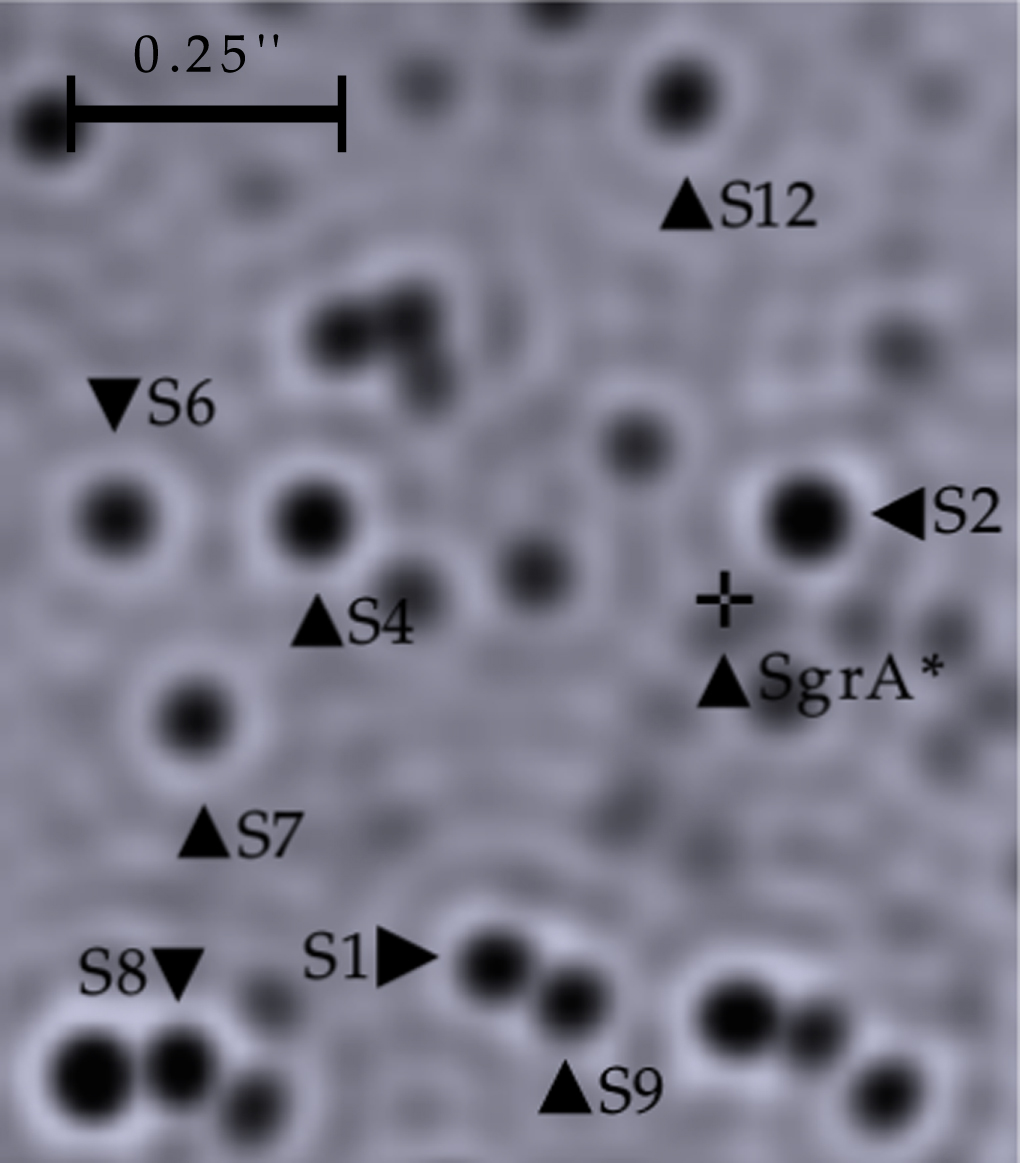
S-stars are nuclear burning stars with masses greater than the Sun that formed in star clusters near the galactic center, escaped from their clusters, and migrated into close orbits around our galaxy’s supermassive black hole, Sagittarius A* (Sgr A*). Figure 1 shows the S stars that most closely orbit the supermassive black hole.

Of all S stars, S0-2 has the closest orbit about Sgr A*, with an orbital period of only 16 years. Also, at 13.6 times the Sun’s mass it is the most massive of the S stars. Hence, it is by far the best star for astronomers to use in testing the validity of general relativity in an extremely strong gravitational field.

blog__inline--general-relativity-and-cosmic-creation-part-1

Figure 1: S-stars in the Vicinity of Sagittarius A* (SgrA*), the Supermassive Black Hole at the Center of Our Galaxy
The cross just below and left of the star S2 marks the position of the Milky Way Galaxy’s supermassive black hole.
Image credit: M. Habibi et al., Astrophysical Journal 847, id. 120.

In May 2018, S0-2 reached the point of closest approach in its orbit about Sgr A* at a distance 120 times farther than Earth is from the Sun. At that time, its orbital velocity was 2.7% the speed of light or 18 million miles per hour (29 million kilometers per hour)! In March and September of 2018, S0-2 passed through its maximum and minimum velocities, respectively, along the line of sight with Earth. An international team of 29 astronomers observed these three velocity events with three different high precision spectroscopic instruments attached to three different telescopes (the W. M. Keck Telescope, the Gemini North Telescope, and the Subaru Telescope).5 All three instruments and all three telescopes were used for all three events. Their observations, combined with slightly less precise measurements of S0-2’s orbit from 1995–2017 (I reported on these previous measurements in a blog posted on April 2, 2018), yielded an unprecedented extremely strong gravitational field test of general relativity.

Groundbreaking Test Results
This test was unprecedented not only in its accuracy, but also in its elimination of systematic uncertainties (uncertainties due to instrumental or measuring technique offsets). The team in their current and previous sets of measurements used four different imaging telescopes and nine different spectroscopic instruments. Furthermore, they were able to determine maximum possible systematic uncertainties by observations of bright radial velocity (velocity along the line of sight with Earth) standard stars of the same spectral type as S0-2.

The team ascertained that the combination of the maximum systematic error and maximum random error in their radial velocity measurements was 20 kilometers per second. Since the range of radial velocities the team observed for S0-2 from March 2018 to September 2018 was 6,000 kilometers per second, the team produced an excellent test of general relativity.

Measurements resulting from the test established that the redshift parameter, γ = 0.88±0.17, which is consistent with general relativity (γ = 1.0) and excludes Newtonian models (γ = 0.0). That is, general relativity contrasted with Newtonian models has been affirmed with a statistical significance of five standard deviations. To put it another way, general relativity “is 43,000 times more likely than the Newtonian model in explaining the observations.”6

The team’s measurements also constrained two other important characteristics of the Milky Way Galaxy. First, they established that the Milky Way Galaxy’s supermassive black hole has a mass of 3.964±0.047±0.026 million times the Sun’s mass, where the 0.047 is the probable random error and 0.026 the calculated systematic error.7 Second, they determined that the distance from Earth to the galactic center is 7,946±50±32 parsecs (25,916±163±98 light-years), where the 50 parsecs is the probable error and the 32 parsecs is the calculated systematic error.8

The previous best measure of the mass of the Milky Way Galaxy’s supermassive black hole was 4.02±0.16 million solar masses.9 The previous best estimate of the distance to the galactic center based on an average of different measuring methods and a comparison of different statistical techniques was 8,122 parsecs (26,490 light-years).10

Although these technical details might seem superfluous for nonexperts, they show the rigor and scope of the work that excites researchers. Thanks to the team’s measurements and analysis of the orbit of S0-2 about our galaxy’s supermassive black hole, the validity and reliability of general relativity have now been established for the full range of gravitational field strengths. This comprehensive verification further strengthens the case for a cosmic beginning—and for a Causal Agent beyond space and time who created our universe.

I’ll explain in next week’s post how there might be possible loopholes for escaping the implications of a cosmic beginning and how the team’s extensive research addresses them. I also will explain how the team’s research combined with another new set of measurements largely resolved the recently claimed discrepancy in the cosmic expansion rate and removed consequent doubts in certain big bang creation models. Finally, I will address the implications of a slightly smaller supermassive black hole in our galaxy’s core.

Featured Image: Map of the Milky Way Galaxy
The black dot shows the location of our galaxy’s supermassive black hole. The yellow dot shows the location of the Sun.
Image credit: Caltech/JPL/R. Hurt

Endnotes
  1. Hugh Ross, The Fingerprint of God, commemorative edition (Covina, CA: RTB Press, 2010), 34–38, https://shop.reasons.org/product/271/fingerprint-of-god-commemorative-edition.
  2. Ross, The Fingerprint of God, 39–48.
  3. Stephen William Hawking and Roger Penrose, “The Singularities of Gravitational Collapse and Cosmology,” Proceedings of the Royal Society of London 314, Series A, no. 1519 (January 27, 1970): 529–48, doi:10.1098/rspa.1970.0021; Arvind Borde, Alan H. Guth, and Alexander Vilenkin, “Inflationary Spacetimes Are Incomplete in Past Directions,” Physical Review Letters 90, no. 15 (April 18, 2003): id. 151031, doi:10.1103/PhysRevLett.90.151301; Aron C. Wall, “The Generalized Second Law Implies a Quantum Singularity Theorem,” Classical and Quantum Gravity 30, no. 16 (August 2013): id. 165003, doi:10.1088/0264-9381/30/16/165003; Aron C. Wall, “The Generalized Second Law Implies a Quantum Singularity Theorem,” (December 6, 2016), https://arxiv.org/abs/1010.5513v5.
  4. Hugh Ross, The Creator and the Cosmos, 4th edition (Covina, CA: RTB Press, 2018), 114–20, https://shop.reasons.org/product/599/the-creator-and-the-cosmos-fourth-edition.
  5. Tuan Do et al., “Relativistic Redshift of the Star S0-2 Orbiting the Galactic Center Supermassive Black Hole,” Science 365, no. 6454 (August 16, 2019): 664–68, doi:10.1126/science.aav8137.
  6. Do et al., 667.
  7. Do et al., 667.
  8. Do et al., 667.
  9. A. Boehle et al., “An Improved Distance and Mass Estimate for Sgr A* from a Multistar Orbit Analysis,” Astrophysical Journal 830, no. 1 (October 10, 2016): id. 17, doi:10.3847/0004-637X/830/1/17.
  10. Zinovy Malkin, “The Current Best Estimate of the Galactocentric Distance of the Sun Based on Comparison of Different Statistical Techniques,” (February 28, 2012), https://arxiv.org/abs/1202.6128v1; “Galactic Center,” Wikipedia, last modified May 12, 2019, 01:09, https://en.wikipedia.org/wiki/Galactic_Center.

Share to PinterestShare to More

About Reasons to Believe

RTB’s mission is to spread the Christian Gospel by demonstrating that sound reason and scientific research—including the very latest discoveries—consistently support, rather than erode, confidence in the truth of the Bible and faith in the personal, transcendent God revealed in both Scripture and nature. Learn More »

Support Reasons to Believe

Your support helps more people find Christ through sharing how the latest scientific discoveries affirm our faith in the God of the Bible.


U.S. Mailing Address
818 S. Oak Park Rd.
Covina, CA 91724
  • P (855) 732-7667
  • P (626) 335-1480
  • Fax (626) 852-0178

Reasons to Believe logo

Posted in Uncategorized | Leave a comment

Dark Matter from before the Big Bang?

By Jeff Zweerink – August 30, 2019

In the beginning God created the heavens and the earth.” The Bible starts with a remarkable claim: the universe began to exist. However, a recent paper generated press that seems to undermine this important biblical statement.1 Various popular sources ran headlines like “Big Bang Bombshell: Did Dark Matter Come BEFORE Birth of Universe?,” “Dark Matter May Have Existed before the Big Bang, New Math Suggests,” and “Dark Matter May Be Older Than the Big Bang.” Some of the coverage even hints that scientists might not understand the universe as well as previously thought. Will science rebuff a biblical claim? Let’s look at this discovery and see what it tells us about the universe and how well the Bible describes it.

Isn’t the Big Bang the Beginning of Everything?

If the big bang is the beginning of the universe, how could dark matter originate before it? Well, the term “big bang” carries two meanings. According to scientists’ best understanding, the universe started in an extremely hot, dense state from which it expanded and cooled down over the last 14 billion years. Thus, the first meaning of “big bang” refers to the development of the universe from this initial hot, dense state without making any statement on how the universe came to be in this state. The big bang model provides the best explanation of how that initial hot, dense state transformed into the galaxy-filled universe that astronomers observe today.

The second usage of the term refers to the idea that, when running time into the past, one eventually encounters a singularity where the laws of physics break down. Stephen Hawking and Roger Penrose developed a powerful theorem showing that if a few conditions apply (like general relativity describing the universe and energy behaving a certain way) to the universe at all times, then the singularity genuinely exists and it represents the beginning of the universe. One should keep this distinction in mind when reading about whether the big bang means the universe had a beginning or not.

Specifically, the new discovery uses “big bang” with the first meaning in mind. Researchers have postulated a hypothesis that dark matter originated before the time when our understanding of physics gives us a relatively clear picture of how the universe behaves.

Inflation before the Big Bang

Many cosmologists and physicists would argue that the conditions necessary for the Hawking-Penrose theorem to hold don’t actually apply for two different reasons. The first reason concerns the condition that general relativity (GR) describes the universe. While GR has passed every observational test thrown at it, GR is inherently a classical, not quantum, theory. This means that GR likely gives way to a more fundamental quantum theory of gravity necessary to describe the initial hot, dense state. Proponents presume that the correct quantum theory of gravity will remove the singularity of GR, but for now we have no idea if this is true.

The second reason concerns the condition related to how energy behaves. Observations of the universe have affirmed the big bang model while revealing some issues known as the horizon problem, oldness-flatness problem, and magnetic monopole problem. Scientists also realize that an epoch of rapid, geometric expansion called inflation would solve these problems. However, this epoch of inflation occurs prior to the big bang models (as in the first usage). Additionally, how inflation works violates the energy condition required for the Hawking-Penrose theorem to hold. As such, incorporating inflation into big bang models appears to remove the big bang (second usage).

What about Dark Matter?

For over 80 years, scientists have made observations indicating that our universe contains an unusual form of matter that we detect only (currently) through its gravitational interactions. Because it emits no detectable light, scientists call this stuff dark matter. As of now, scientists have suggested numerous candidates to explain dark matter, but they possess no direct evidence for which explanation is correct. The research article behind all the headlines above simply proposed a new explanation for dark matter generated during the inflationary epoch. Obviously, future observations are necessary to see if this new proposal has any merit.

The Bottom Line

Simply positing a model where things happen before the moment when physics constrains our knowledge does not remove the evidence pointing to a beginning. Investigations of dark matter, inflation, quantum gravity, and the like represent the frontiers of scientific research. Consequently, these areas pose the most difficult—and most fun—scientific problems. I look forward to resolution of these problems and expect further affirmation of “In the beginning God created the heavens and the earth.”

Resources

Endnotes
  1. Tommi Tenkanen, “Dark Matter from Scalar Field Fluctuations,” Physical Review Letters 123, no. 6–9 (August 7, 2019): doi:10.1103/PhysRevLett.123.061302.

Share to PinterestShare to More

About Reasons to Believe

RTB’s mission is to spread the Christian Gospel by demonstrating that sound reason and scientific research—including the very latest discoveries—consistently support, rather than erode, confidence in the truth of the Bible and faith in the personal, transcendent God revealed in both Scripture and nature. Learn More »

Support Reasons to Believe

Your support helps more people find Christ through sharing how the latest scientific discoveries affirm our faith in the God of the Bible.


U.S. Mailing Address
818 S. Oak Park Rd.
Covina, CA 91724
  • P (855) 732-7667
  • P (626) 335-1480
  • Fax (626) 852-0178

Reasons to Believe logo

Posted in Uncategorized | Leave a comment

Gamma Ray Flares Constrain Beginning-of-Universe Speculations

BY HUGH ROSS – AUGUST 12, 2019

Skeptics of big bang creation cite a loophole in their attempts to avert a beginning for our universe and, hence, the implication of a causal agent. A new discovery on gamma-ray emissions from a supergiant galaxy stands to address the loophole from early in the universe’s history in an “era” (an extremely brief moment after the beginning) called quantum gravity.

Big Bang Wiggle Room?
As I describe in my book The Creator and the Cosmosthe last-ditch loophole to escape a cosmic beginning that implies the existence of a Causal Agent beyond space and time (the God of the Bible) is speculation about the quantum gravity era.“Era” is a misnomer. It refers to a time back in the history of the expanding universe when the universe was smaller than the diameter of a fundamental particle. In the context of the big bang creation model, it refers to when the universe was younger than 10-43 seconds old!

The quantum gravity era is that imperceptibly brief moment when:

  • all four fundamental forces of physics (electromagnetism, weak nuclear force, strong nuclear force, and gravity) were unified into a single force,
  • the effects of quantum mechanics in governing the dynamics of the universe and how those effects integrate with gravitational effects can no longer be ignored, and
  • the energy density of the universe is so extreme that no conceivable instrument or experiment is capable of duplicating that energy density to determine what happens under those conditions.

The experimental limitation combined with the lack of a testable quantum gravity theory has motivated some theoretical physicists to speculate that perhaps the universe had no beginning and, hence, no need for a cosmic Beginner. In other words, these physicists take advantage of our ignorance about the quantum gravity era to speculate that perhaps some strange physics operated in the quantum gravity era that would permit a possible escape from a cosmic beginning. I will summarize some of the latest experimental results in the next several sections. Not every reader will need the technical details. If that’s you, feel free to jump ahead to “Creation Implications.”

Constraining the Unknown
There will always be something unknown about the universe. Thus, skeptics can speculate about strange physics that somehow undoes everything scientists understand about the known universe. Nevertheless, we can affirm what we do know and constrain speculations about what we do not know by pushing back the frontiers of knowledge. An analogy I offered in The Creator and the Cosmos would be for me to speculate that my wife of 41 years may not actually exist.2 Instead, I have been fooled all these years by some kind of very sophisticated three-dimensional hologram embedded with artificial intelligence. One way I can push farther back into the realm of incredulity would be for me to conduct more and a greater variety of experiments and observations on my wife.

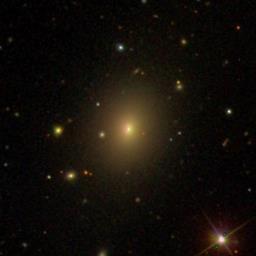
In a recent issue of the Astrophysical Journal, a team of 228 astronomers reported on how observations they performed on gamma rays emitted from the blazar Mrk 501 (see figure 1) constrain those quantum gravity models that speculate Lorentz symmetry is broken during the quantum gravity era.3Lorentz invariance or Lorentz symmetry is the proposition that the laws of physics are the same for different observers—for example, no matter what the observer’s position, velocity, or rotation. It is a foundational principle of special relativity.

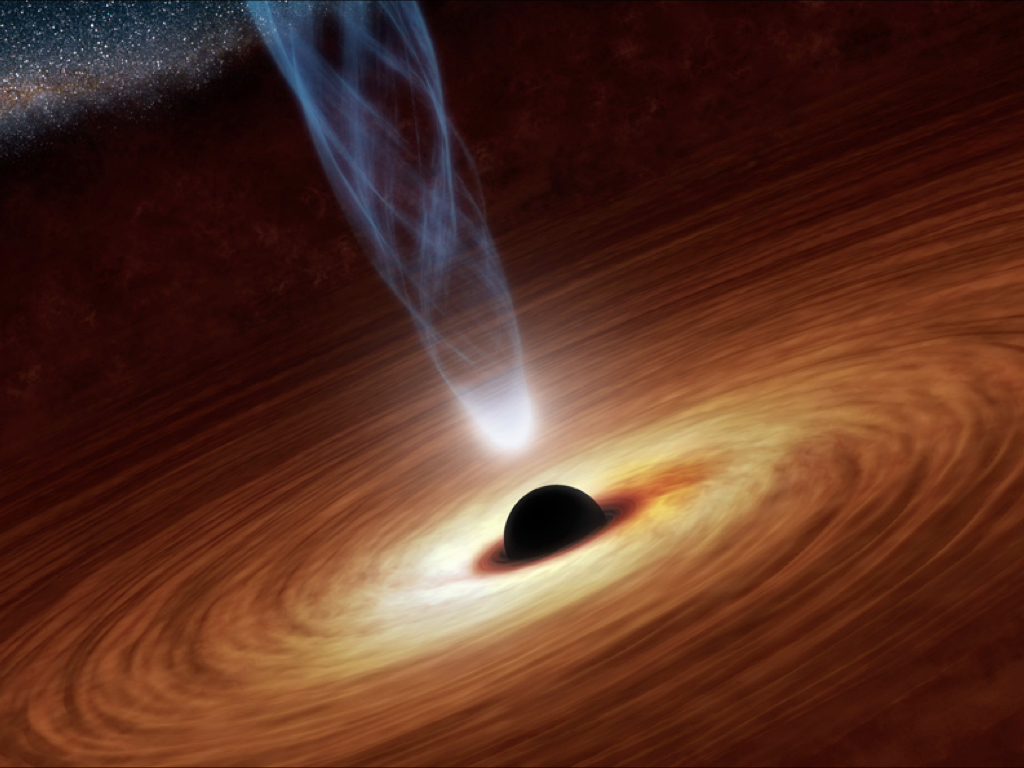
A blazar is a supergiant galaxy where the supermassive black hole in its nucleus generates a powerful jet of radiation that is aimed toward Earth (see figure 2). These jets exhibit flares over the entire electromagnetic spectrum. The highest-energy gamma rays in these flares allow astronomers to investigate propagation effects that determine the degree to which Lorentz invariance holds.

blog__inline--gamma-ray-flares-constrain-1

Figure 1: The Blazar, Markarian 501. Image credit: Sloan Digital Sky Survey

blog__inline--gamma-ray-flares-constrain-2

Figure 2: Artist’s Conception of a Supermassive Black Hole Producing a Blazar. Image credit: Robert Hurt, NASA/JPL-Caltech

Local Lorentz Invariance Affirmations
In the laboratory and within the solar system, Lorentz invariance has been affirmed to an exceptionally high degree. For example, a limit on the cyclotron frequency variation of the antiproton has been established at the level of 10-26.4 University of California, Davis physicist David Mattingly has written an excellent open-access review of laboratory experiments that yield high-degree affirmations of Lorentz invariance.5 In my December 18, 2017 blog I reported on how 48 years of data from lunar laser-ranging experiments had placed upper limits on possible violations of solar-system-scale Lorentz invariance that were 100–1,000 times superior to previous best measurements.6

Constraining Quantum Gravity Speculations
Several quantum gravity approaches require Lorentz symmetry to be broken at energy scales relevant to the quantum gravity era, otherwise known as the Planck scale or Planck energy, which = 1.22 x 10¹⁹ GeV (1.96 billion joules or 543 kilowatt hours).7 The Planck energy is equivalent to the chemical energy in 57.2 liters (15.1 gallons) of gasoline compressed into a single subatomic particle.

A major problem for observational and experimental constraints on quantum gravity speculations is that the highest-energy photons observed by astronomers top out at about 400 GeV8, and the highest particle accelerator energies at about 1,300 GeV.9 That is, direct observations and experiments fall a factor of ten quadrillion short of reaching the Planck energy. (To reach the Planck energy requires a particle accelerator 170 quadrillion miles, or 29,000 light-years, long!) However, violations of Lorentz invariance at the Planck energy level predict potentially observable consequences for the highest-energy particles and photons that traverse great distances of interstellar or intergalactic space. Such observations are known as time-of-flight measurements of high-energy neutrinos and photons from distant sources.

In the June 2019 issue of Journal of High Energy Astrophysics, a team of ten Chinese astronomers and physicists reported on their analysis of the 2018 detection of a high-energy (2.9 x 10⁵ GeV) neutrino that was coincident with a flare from the blazar TXS 0506+056.9 This blazar is about 5.7 billion light-years from Earth. It is only the third astronomical object (the other two being the Sun and supernova 1987A in the Large Magellanic Cloud 168,000 light-years away) from which physicists have detected neutrinos.

The team demonstrated that the association of the neutrino with the blazar flare placed limits on the energy scales of quantum gravity for both linear and quadratic violations of Lorentz invariance at greater than 3.2–37 x 1015 GeV and greater than 4.0–14 x 1010 GeV, respectively. While these limits fall 330 times short of the Planck scale, they represent a factor of a hundred thousand times improvement on previously established limits on linear Lorentz invariance violation energy scales in neutrino propagation.

In the September 2017 issue of Astrophysical Journal Supplement Series, a team of 145 astronomers reported that they had found no variation in the arrival times with respect to energy levels for high-energy gamma rays emitted by the Crab Nebula pulsar. Consequently, they determined limits on the Lorentz invariance-violating energy scale greater than 5.5 x 10¹⁷GeV for a linear and greater than 5.9 x 10¹⁰ GeV for a quadratic scenario, respectively.10 Here, the established limit on the linear Lorentz invariance violation energy scale is only 22 times short of the Planck scale.

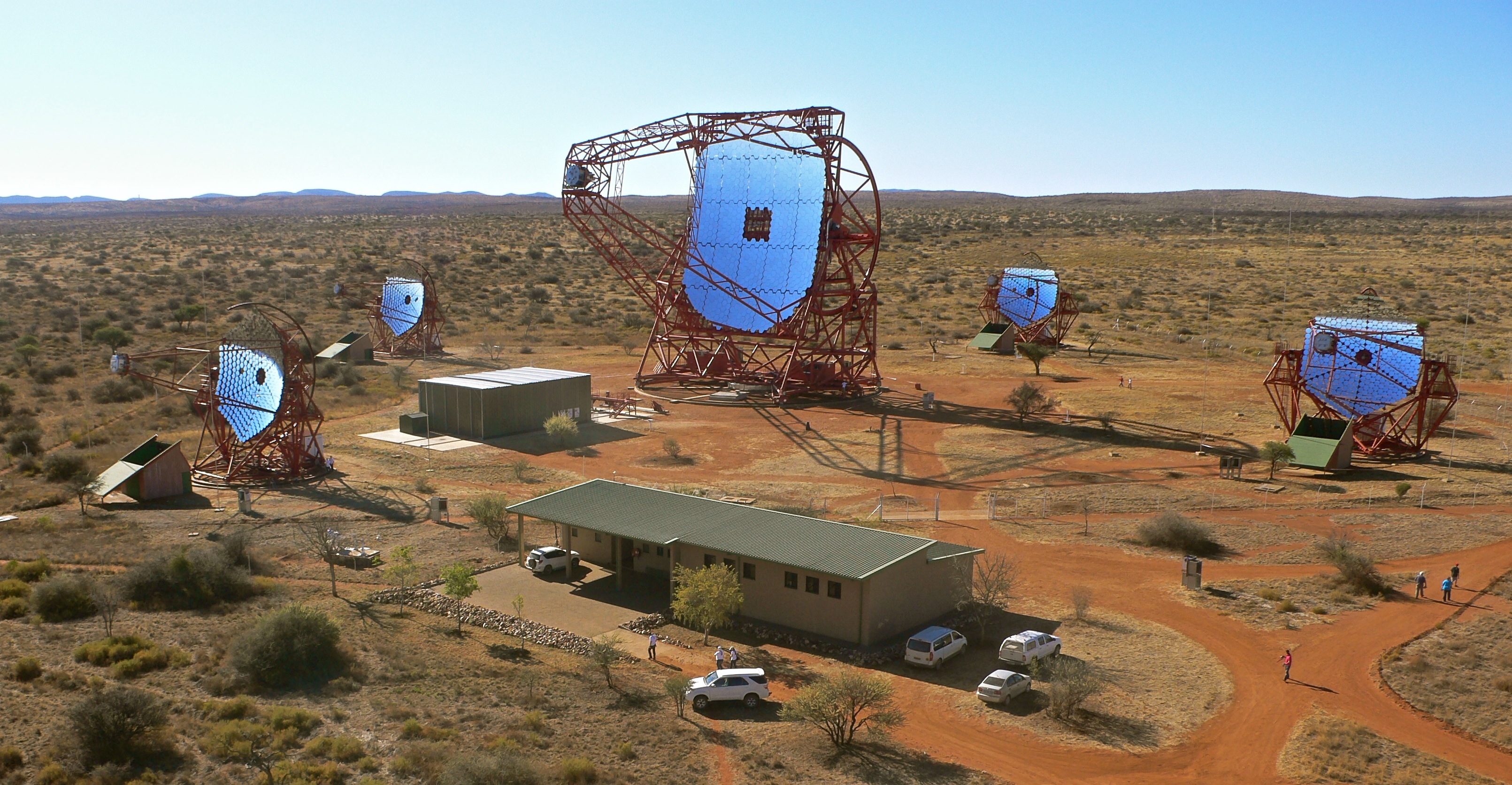
The team of 228 astronomers mentioned earlier has determined the best limit to date onLorentz invariance-violating energy scales. Their limit came from analyzing observations of 100+ GeV gamma rays with the High Energy Stereoscopic System (H.E.S.S.) phase II array of Cherenkov telescopes (see figure 3) during a bright flare of the Mrk 501 blazar on the night of June 23–24, 2014. For the linear scenario using a spectral approach on the observed gamma rays, the 228 astronomers established a limit of greater than 2.6 x 10¹⁹ GeV, and for the quadratic scenario, a limit of greater than 7.8 x 10¹¹ GeV.11

blog__inline--gamma-ray-flares-constrain-3

Figure 3: High Energy Stereoscopic System phase II Array of Cherenkov Telescopes in Namibia. Image credit: Klepser, DESY, H.E.S.S. Collaboration, Creative Commons Attribution

Creation Implications
For the first time, scientists have established a measured limit (of more than a factor of two) beyond the Planck scale. The lack of a positive signal of Lorentz violation in these new observations now requires cosmologists and theoretical physicists to restrict the classes of quantum gravity theories/space-time models that they should consider.

Scientific advance has constrained some of the nontheistic speculations about the quantum gravity era. The loophole now appears to be partially closed. This advance demonstrates that the farther we push back the frontiers of our scientific knowledge of the universe, the more strained it becomes to speculate a nontheistic explanation for the universe and the stronger the evidence becomes for the biblical cosmic creation model.12

Endnotes
  1. Hugh Ross, The Creator and the Cosmos: How the Latest Scientific Discoveries Reveal God, 4thed. (Covina, CA: RTB Press, 2018), 100–105, 113, https://shop.reasons.org/product/599/the-creator-and-the-cosmos-fourth-edition.
  2. Ross, The Creator and the Cosmos, 191–92.
  3. Abdalla et al., “The 2014 TeV g-Ray Flare of Mrk 501 Seen with H.E.S.S.: Temporal and Spectral Constraints on Lorentz Invariance Violation,” Astrophysical Journal 870, no. 2 (January 10, 2019): id. 93, doi:10.3847/1538-4357/aaf1c4.
  4. G. Gabrielse et al., “Precision Mass Spectroscopy of the Antiproton and Proton Using Simultaneously Trapped Particles,” Physical Review Letters 82 (April 19, 1999): 3198–3201, doi:10.1103/PhysRevLett.82.3198.
  5. David Mattingly, “Modern Tests of Lorentz Invariance,” Living Reviews in Relativity 8, no. 5 (December 2005): id. 5, doi:10.12942/lrr-2005-5.
  6. Hugh Ross, “General Relativity and Its Christian Implications Pass Yet More Tests,” Today’s New Reason to Believe (blog), Reasons to Believe, December 18, 2017, https://reasons.org/explore/blogs/todays-new-reason-to-believe/read/todays-new-reason-to-believe/2017/12/18/general-relativity-and-its-christian-implications-pass-yet-more-tests.
  7. Abdalla et al., “The 2014 TeV g-Ray Flare.”
  8. MAGIC Collaboration, “Constraining Lorentz Violation Using the Crab Pulsar Emission Observed up to TeV Energies by MAGIC,” Astrophysical Journal Supplement Series 232, no. 1 (September 2017): id. 9, doi:10.3847/1538-4365/aa8404.
  9. Jun-Jie Wei et al., “Multimessenger Tests of Einstein’s Weak Equivalence Principle and Lorentz Invariance with a High-Energy Neutrino from a Flaring Blazar,” Journal of High Energy Astrophysics 22 (June 2018): 1–4, doi:10.1016/j.jheap.2019.01.002.
  10. MAGIC Collaboration, “Constraining Lorentz Violation.”
  11. Abdalla et al., “The 2014 TeV g-Ray Flare,” 1.
  12. Hugh Ross and John Rea, “Big Bang—the Bible Taught It First!” in The Creator and the Cosmos: How the Latest Scientific Discoveries Reveal God, 4th ed. (Covina, CA: RTB Press, 2018), 25–31, https://shop.reasons.org/product/599/the-creator-and-the-cosmos-fourth-edition. A slightly abbreviation version is available for free at https://reasons.org/explore/publications/rtb-101/read/rtb-101/2000/06/30/big-bang-the-bible-taught-it-first.

About Reasons to Believe

RTB’s mission is to spread the Christian Gospel by demonstrating that sound reason and scientific research—including the very latest discoveries—consistently support, rather than erode, confidence in the truth of the Bible and faith in the personal, transcendent God revealed in both Scripture and nature. Learn More »

Support Reasons to Believe

Your support helps more people find Christ through sharing how the latest scientific discoveries affirm our faith in the God of the Bible.

DONATE NOW


U.S. Mailing Address
818 S. Oak Park Rd.
Covina, CA 91724
  • P (855) 732-7667
  • P (626) 335-1480
  • Fax (626) 852-0178

Reasons to Believe logo

Posted in Uncategorized | Leave a comment

Carbon-14 Dating Supports the Writing of the Great Isaiah Scroll Prior to the Crucifixion

By Guest Writer – July 26, 2019

Share to PinterestShare to More

By Ken Wolgemuth

Radiocarbon dating is one of the best-known tools used by geochemists to obtain an age of ancient materials such as wood, bones, charcoal, and coral reef limestone. The method is suitable for samples less than 50,000 years old, and can be applied to disciplines like geology, paleontology, anthropology, and archaeology. Famous artifacts and sites dated with carbon-14 include the Dead Sea Scrolls and Hezekiah’s tunnel.

The dating of all biblical artifacts and sites is valuable for improving our understanding of Scripture, and dating the Dead Sea Scrolls helps establish the credibility of the Old Testament Messianic prophecies. For example, Isaiah 53 paints a vivid picture of the pain endured by “a man of suffering.” This man is “pierced,” “crushed,” and “slaughtered” despite his innocence. Rather, declares the prophet, “the LORD has laid on him the iniquity of us all.” Christians believe that Jesus’s death fulfilled this prophecy. Indeed, it is difficult to miss the parallels between Isaiah’s man of suffering and Christ’s crucifixion. Because of this, skeptics have long argued that Isaiah 53 must have been written after the death of Christ. Radiocarbon dating of The Great Isaiah Scroll in the 1990s placed the texts between 351 and 230 BC—well before Christ’s time on Earth.

Here I will describe how three independent processes are integrated to give confidence in the reliability of the carbon-14 dating method: radioactive decay of carbon-14 (physics and chemistry), the growth of tree rings (biology), and annual layers of sedimentation (geology). It is ideal to have multiple lines of evidence!

Radioactive Decay and Tree Rings

The first process is the radioactive decay of carbon-14. The known half-life of carbon-14 is 5,730 years. These atoms are produced by collisions of cosmic rays with nitrogen in the upper atmosphere. The resulting carbon-14 combines with oxygen to form carbon dioxide, which growing plants take in for photosynthesis. When the plant dies, the resupply of carbon-14 is cut off and the concentration declines as the carbon-14 decays into nitrogen. Animals ingest the carbon-14 into their tissues until they die and then the carbon-14 declines. In both plant and animal matter, carbon-14 decays at a predictable rate based on its half-life.

The second process is the growth of tree rings. Each year of a tree’s life, rapid growth in the spring results in a light-colored layer in the trunk followed in autumn and winter by a darker layer. This process yields a method to count years into the past. In fact, the oldest known living tree is a bristlecone pine located in the White Mountains of California. This tree was discovered to have more than 5,000 annual rings, representing that many years. (It is in the same area as the tree nicknamed “Methuselah,” which was identified as the oldest tree for many years until recently.)

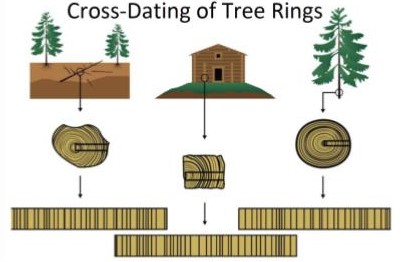
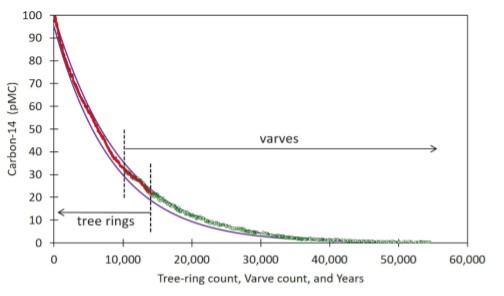
Dendrochronologists (scientists who study tree rings) can count beyond the age of individual trees by “cross-dating” the rings of multiple trees (see figure 1). Patterns in ring growth from trees in the same region can be aligned like bar codes. This overlap can provide a record extending much further into the past than the lifetime of any one tree. Using this method, scientists in Europe have produced an uninterrupted, overlapping, and cross-dated tree-ring record back to 14,000 years. (See red line in figure 3, by Davidson and Wolgemuth).

blog__inline--carbon-14-dating-supports-1

Figure 1: Cross-dating tree rings. Patterns in ring growth from trees growing in the same region are aligned like bar codes to extend the count back in time. Image credit: Gregg Davidson and Ken Wolgemuth

Lake Suigetsu Varves

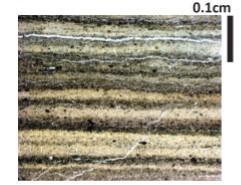
The third process is the sedimentation of annual layers called varves. Lake Suigetsu is part of a multi-lake system on the west coast of Japan that is dramatically unique for the study of climate history—so unique it’s nicknamed the “Miracle Lake.” Core samples from Lake Suigetsu show varves in alternating dark and light stripes (see figure 2). For long periods of time, the bottom waters of Lake Suigetsu were anoxic (no oxygen), which prevented burrowing organisms from disrupting the sediments.

blog__inline--carbon-14-dating-supports-2

Figure 2: Photo of Lake Suigetsu varves. See Lake Suigetsu here. Image credit: Gregg Davidson and Ken Wolgemuth

River flow into adjacent Lake Mikata serves to trap coarse-grained sediment before the fine-grained sediment passes into Lake Suigetsu. This creates the dark layers. Each spring, algal blooms grow and produce tiny shells that rain down on the lake floor. This results in the light layers.

As with tree rings, age can be determined from counting the annual varves. One interval of Suigetsu core does not have varves from a time when bottom waters were oxygenated. Fortunately, the varve record overlaps the tree-ring record, – from 10,000 to 14,000 years – allowing varves and tree rings with the same carbon-14 content to line up (see figure 3). The majority of samples measured for carbon-14 were leaves and twigs found between the varves. In figure 3, varves are identified as (tiny) green circles and data from tree rings are in red. You can see that there are about 4,000 years of overlap between the tree rings and the varves. This overlap provides a superb opportunity to verify that the sedimentary couplets in Lake Suigetsu are varves—that is, the light and dark layering is indeed annual. Together, the tree-ring and varve count traces a history of nearly 50,000 years.

Notice that the red and green line of carbon-14 data is squiggly. This result is expected because the cosmic rays bombarding the earth vary over time. Therefore, to obtain a calendar age in years, this reference line is prepared first from the carbon-14 content in the tree rings and in the leaves among the varves as shown in figure 3. Then, for a sample of unknown age, its carbon-14 content is entered on the vertical axis, and the calendar age is determined from the horizontal axis entirely from counting the tree-rings or varves. So, if you can count tree rings/varves, and a laboratory measures the carbon-14, you can determine the calendar age on the horizontal axis – no complex half-life equation required.

blog__inline--carbon-14-dating-supports-3

Figure 3: Tree ring and varve count vs. carbon-14 content. The solid lines represent the window for conventional expectations. Image credit: Gregg Davidson and Ken Wolgemuth. (For the full description, see figure 10 in the Davidson and Wolgemuth paper referenced in resources.)

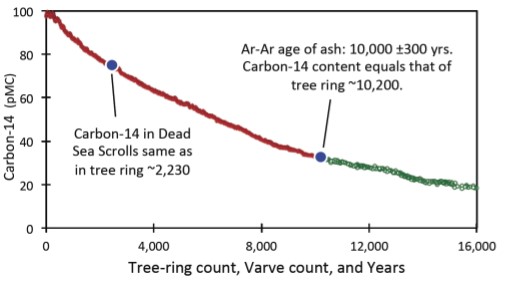
Still another confirmation of the tree-ring count and carbon-14 age comes from a specific volcanic eruption 10,000 years ago. Argon-argon dating of an ash bed from the Lake Suigetsu core is consistent with the age determined by tree-ring counting. In other words, the ash is next to leaves in the varves that have the same amount of carbon-14 as a 10,000-year-old tree ring! (See figure 4.)

blog__inline--carbon-14-dating-supports-4

Figure 4: Carbon-14 dating of the Dead Sea Scrolls and Ar-Ar dating of an ash bed from the Lake Suigetsu core are consistent with ages determined by tree-ring counting. Image credit: Gregg Davidson and Ken Wolgemuth

Carbon-14 dating of the Dead Sea Scrolls is also consistent with the age determined by tree-ring counts that date back to 351 to 230 BC. This means we have the intersection of three completely independent methods tied together for one coherent result. Multiple lines of evidence support the conclusion that Old Testament prophecies, like Isaiah 53, predate the life of Christ. God has given us some very powerful tools to understand the past, including this history of His Scriptures.

* I want to thank Mark McEwan and Arnold Sikkema for assistance in clarifying the text. Thanks to the Canadian Scientific and Christian Affiliation, who first published this article as a pamphlet at https://www.csca.ca/pamphlets.

Resources

  • Gregg Davidson and Ken Wolgemuth, “Testing and Verifying Old Age Evidence: Lake Suigetsu Varves, Tree Rings, and Carbon-14,” Perspectives on Science and Christian Faith 70, no. 2 (June 2018): 75–89, https://www.asa3.org/ASA/PSCF/2018/PSCF6-18Davidson.pdf.
  • Gordon Schlolaut et al., “Event Layers in the Japanese Lake Suigetsu ‘SG06’ Sediment Core: Description, Interpretation and Climatic Implications,” Quaternary Science Reviews 83 (January 1, 2014): 157–70.
  • R. A. Staff et al., “Integration of the Old and New Lake Suigetsu (Japan) Terrestrial Radiocarbon Calibration Data Sets,” Radiocarbon 55, no. 4 (2013): 2049–58; Christopher Bronk Ramsey et al., “A Complete Terrestrial Radiocarbon Record for 11.2 to 52.8 kyr B.P.,” Science 338, no. 6105 (October 19, 2012): 370–74.
  • Carol Hill, Gregg Davidson, Tim Helble, and Wayne Ranney (eds), The Grand Canyon, Monument to an Ancient Earth: Can Noah’s Flood Explain the Grand Canyon? (Grand Rapids: Kregel Publications, 2016). See chapter 19.

Category
Tags

Share to PinterestShare to More

About Reasons to Believe

RTB’s mission is to spread the Christian Gospel by demonstrating that sound reason and scientific research—including the very latest discoveries—consistently support, rather than erode, confidence in the truth of the Bible and faith in the personal, transcendent God revealed in both Scripture and nature. Learn More »

Support Reasons to Believe

Your support helps more people find Christ through sharing how the latest scientific discoveries affirm our faith in the God of the Bible.


U.S. Mailing Address
818 S. Oak Park Rd.
Covina, CA 91724
  • P (855) 732-7667
  • P (626) 335-1480
  • Fax (626) 852-0178

Reasons to Believe logo

Posted in Uncategorized | Leave a comment

New Speciation Model Challenges Evolution, Supports Creation

BY HUGH ROSS – AUGUST 19, 2019

Which model, naturalistic evolution or supernatural creation, best explains the pattern of life’s history on Earth? If a test produces “strikingly divergent results” for the expectations of a model, what does that tell us? A new study on speciation and extinction rates provides persuasive evidence.

Model Tenets
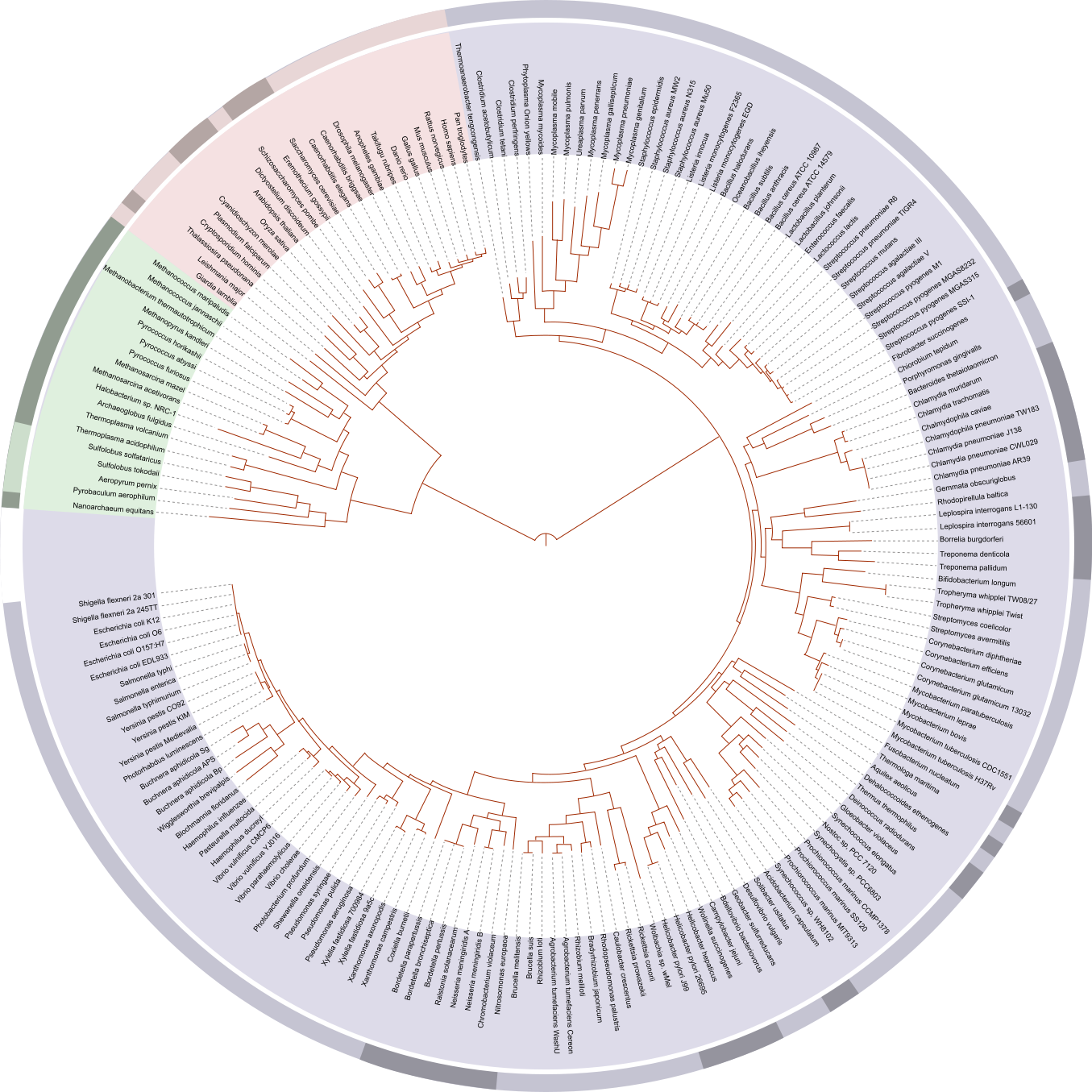
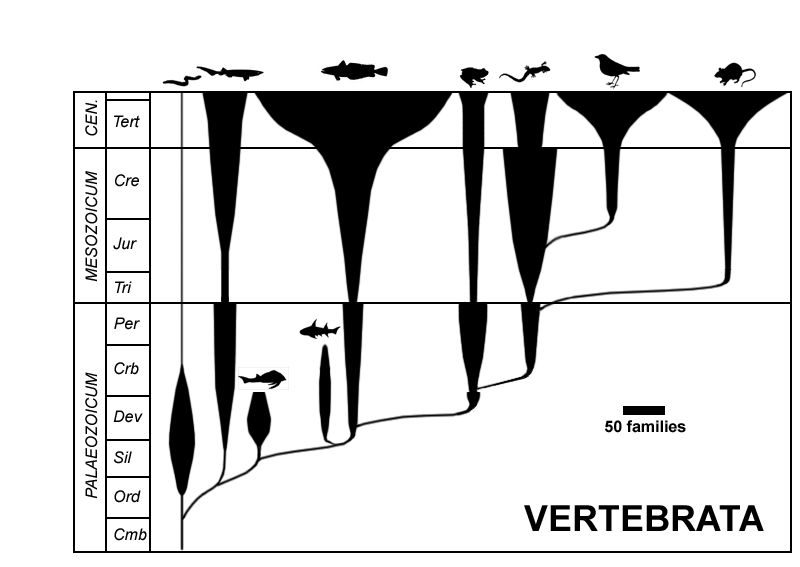
A fundamental tenet of all naturalistic models for the history of Earth’s life is that natural changes in the genomes of life will be responsible for the observed changes in the physical body structures (morphology) of life. Consequently, evolutionary trees (phylogenies, see figure 1) developed from the observed patterns in present-day genomes and the presumed natural rates of change of those genomes (molecular clocks). Assuming that strictly natural processes are responsible for the changes occurring throughout the history of life, the phylogenetic trees should match the morphological changes and the timing of those changes observed in the fossil record (or paleontological trees—see figure 2).

The same kind of match between the paleontology and phylogenetics can be realized if God intervened throughout life’s history. However, apparently only supernatural interventions can explain significant mismatches between phylogenetic and paleontological trees.


blog__inline--new-speciation-model-challenges-evolution-1

Figure 1: Phylogenetic Tree of Life Derived from Completely Sequenced Genomes. The center represents the presumed first life-form on Earth. The genomes denoted on the outer circle are based on actual genetic data. The branching patterns in the inner circle presume that all species are entirely related to one another through strictly natural processes. Image credit: Ivica Letunic

blog__inline--new-speciation-model-challenges-evolution-2

Figure 2: Spindle Diagram of the Presumed Evolution of Vertebrates. Width of the spindles indicates the number of extant families or the number of families represented in the fossil record. The curved (presumed) connecting lines are not supported by any physical remains. Image credit: Peter Bockman

In an open-access paper published in Nature Communications1, four computational biologists and biochemists led equally by Daniele Silvestro and Rachel Warnock concede:

“The fossil record and molecular phylogenies of living species can provide independent estimates of speciation and extinction rates, but often produce strikingly divergent results.”2

Silvestro, Warnock, and their two colleagues do not concede, however, that supernatural interventions explain the “strikingly divergent results.” They attempt to offer a possible naturalistic explanation.

Divergence Is Real and Striking
Biologists use over a dozen different definitions of a species. In their paper, the Silvestro-Warnock team defines a species as “an identifiable taxonomic unit (a lineage) that can persist through time, give rise to other species, and become extinct.”3

The team first recognizes that since “extant and fossil species are samples of the same underlying diversification process,”if the diversification process is by strictly natural means, researchers expect that in all cases the phylogenetic (presumed evolutionary) trees will match the paleontological (fossil record) trees. To put it another way, a match is expected since “methods used to estimate rates [of change] from fossils and phylogenies are based on the same underlying mathematical birth-death theory.”The team then documents that evolutionary biologists can no longer deny the frequent and striking divergences between phylogenetic and paleontological trees.

The Silvestro-Warnock team cited a recent study of extant terrestrial Carnivora.There, the estimated mean species longevity based on fossil evidence was 2.0 million years, contrasted with 9.8 million years derived from phylogenetics. They also cited a study demonstrating incongruence between phylogenies and fossils for primates.They noted that, at least for mammals, the occurrences of congruence are few.8

Speciation rates derived from phylogenetics consistently supersede those derived from the fossil record, while derived extinction rates are consistently lower than speciation rates. Perhaps the best studied example (see featured image) is for cetaceans (whales, dolphins, and porpoises). The Silvestro-Warnock team cited research showing:

“Phylogenetic estimates of diversification rates among cetaceans suggest speciation has exceeded extinction over the past 12 Myr9implying diversity has increased towards the recent. In contrast, analyses of the cetacean fossil record indicate extinction has exceeded speciation over this same interval, and that the diversity of cetaceans was in fact much higher than it is today.”10

In other words, the naturalistic biological evolution model based on phylogenetics predicts that introduction of new species has exceeded extinctions, but the fossil record shows that the reverse is true. The research team did not address the fact that the discrepancies between phylogenetics and the fossil record appear to increase with the complexity and the adult body size of the genus. By contrast, such a correlation is predicted from a biblical creation model perspective for life.11

Silvestro, Warnock and collaborators do point out that several other researchers have attempted to explain the discrepancies by underestimates of the statistical and systematic errors in the two methods. However, the discrepancies in fact are much too large to be attributed to these errors.12

Attempted Reconciliation
The Silvestro-Warnock team suggests that many of the discrepancies between phylogenetics and the fossil record are due to sensitivities to different speciation modes. They identify three distinct modes of speciation that can leave behind fossil evidence without impacting the calculated phylogenetic trees:

  1. Cladogenesis via budding: a speciation event that gives rise to one new species. The ancestral species persists and no extinction occurs.
  2. Cladogenesis via bifurcation: a speciation event that gives rise to two new species, replacing the ancestral species, which becomes extinct.
  3. Anagenetic speciation: evolutionary changes along a lineage that result in the origination of one new species and the extinction of the ancestral species.

They also point out that extinction without replacement is a frequent occurrence, where a species becomes extinct without leaving any descendants. More simply put, the fossil record includes extinct and extant (living) species; whereas phylogenetic data typically include extant species only.

Silvestro, Warnock, and their colleagues developed a model in which they unify budding, bifurcation, anagenesis, and extinction in a single “birth−death chronospecies” (BDC) process. Their BDC model shows that phylogenetic and paleontological speciation and extinction rate estimates will only be equal if all speciation has occurred through budding. Furthermore, they demonstrate that “even in an ideal scenario with fully sampled and errorless data sets, speciation and extinction rates can only be equal across phylogenetic and stratigraphic inferences if all speciation events have occurred through budding and no speciation has occurred through bifurcation or anagenesis”13 (emphasis added). Their BDC model also reveals that phylogenetic analysis indicating extinction equal to zero does not imply that no extinction occurred.

Actual Reconciliation
The team’s BDC model establishes that relative to the fossil record, phylogenetics always underestimates extinction rates. The fossil record, which is largely incomplete, underestimates the true extinction rates. Much higher extinction rates pose a serious challenge to all strictly naturalistic models for Earth’s life because higher extinction rates require higher speciation rates to explain the increasing diversity of life observed in the fossil record throughout life’s history.

This requirement of higher speciation rates is all the more problematic for Earth’s most advanced species. For mammals, birds, and advanced plants, the observed extinction rates far exceed the observed speciation rates during the era of human existence (God’s seventh day when, according to Genesis 2, God ceased from his creation work and allowed natural processes operate).

The Silvestro-Warnock BDC model also exposes a fundamental limitation in naturalistic explanations for the history of Earth’s life. Since all naturalistic models require more than one speciation mode, and since the only way to reconcile phylogenetics and paleontology is to posit just one speciation mode, something other than strictly natural processes must operate.

Some evolutionary biologists will insist on the caveat that perhaps some unknown natural process might salvage a reconciliation between phylogenetics and paleontology. However, it is difficult to conceive how a natural process of sufficient magnitude to reconcile phylogenetics and paleontology could remain undiscovered. It appears to me that a creation model positing that the supernatural Creator intervened at several times throughout life’s history to replace life-forms driven to extinction fully reconciles this “discrepancy.” I am reminded of a verse (Psalm 104:24) from the longest of the creation psalms:

How many are your works, Lord! In wisdom you made them all; the earth is full of your creatures.

Featured image: Nine Different Cetacean Species. Featured image credit: Little Jerry, Creative Commons Attribution

Endnotes
  1. Daniele Silvestro et al., “Closing the Gap between Palaeontological and Neonotological Speciation and Extinction Rate Estimates,” Nature Communications 9 (December 7, 2018): id. 5237, doi:10.1038/s41467-018-07622-y.
  2. Silvestro et al., “Closing the Gap,” 1.
  3. Silvestro et al., “Closing the Gap,” 3.
  4. Silvestro et al., “Closing the Gap,” 2.
  5. Silvestro et al., “Closing the Gap,” 2.
  6. Oskar Hagen et al., “Estimating Age-Dependent Extinction: Contrasting Evidence from Fossils and Phylogenies,” Systematic Biology 67, no. 3 (May 2018): 458–74, doi:10.1093/sysbio/syx082.
  7. James P. Herrera, “Primate Diversification Inferred from Phylogenies and Fossils,” Evolution 71, no. 12 (December 2017): 2845–57, doi:10.1111/evo.13366.
  8. Juan L. Cantalapiedra et al., “Congruent Phylogenetic and Fossil Signatures of Mammalian Diversification Dynamics Driven by Tertiary Abiotic Change,” Evolution 69, no. 11 (November 2015): 2941–53, doi:10.1111/evo.12787.
  9. Daniel L. Rabosky, “Automatic Detection of Key Innovations, Rate Shifts, and Diversity-Dependence on Phylogenetic Trees,” PLoS ONE 9, no. 2 (February 26, 2014): id. E89543, doi:10.1371/journal.pone.0089543.
  10. Charles R. Marshall, “Five Paleobiological Laws Needed to Understand the Evolution of the Living Biota,” Nature Ecology & Evolution 1 (May 23, 2017): id. 0165, doi:10.1038/s41559-017-0165; Lee Hsiang Liow, Tiago B. Quental, and Charles R. Marshall, “When Can Decreasing Diversification Rates Be Detected with Molecular Phylogenies and the Fossil Record?” Systematic Biology 59, no. 6 (December 2010): 646–59,doi:10.1093/sysbio/syq052; Catalina Pimiento et al., “The Pliocene Marine Megafauna Extinction and Its Impact on Functional Diversity,” Nature Ecology & Evolution 1 (June 26, 2017): 1100–1106, doi:10.1038/s41559-017-0223-6.
  11. Hugh Ross, More Than a Theory: Revealing a Testable Model for Creation (Grand Rapids: Baker, 2009), 149–79, https://shop.reasons.org/product/269/more-than-a-theory.
  12. Silvestro et al., “Closing the Gap,” 2.
  13. Silvestro et al., “Closing the Gap,” 5.

About Reasons to Believe

RTB’s mission is to spread the Christian Gospel by demonstrating that sound reason and scientific research—including the very latest discoveries—consistently support, rather than erode, confidence in the truth of the Bible and faith in the personal, transcendent God revealed in both Scripture and nature. Learn More »

Support Reasons to Believe

Your support helps more people find Christ through sharing how the latest scientific discoveries affirm our faith in the God of the Bible.

DONATE NOW


U.S. Mailing Address
818 S. Oak Park Rd.
Covina, CA 91724
  • P (855) 732-7667
  • P (626) 335-1480
  • Fax (626) 852-0178

Reasons to Believe logo

Posted in Uncategorized | Leave a comment

Does Information Come from a Mind?

BY FAZALE RANA – AUGUST 14, 2019

Imagine you’re flying over the desert, and you notice a pile of rocks down below. Most likely, you would think little of it. But suppose the rocks were arranged to spell out a message. I bet you would conclude that someone had arranged those rocks to communicate something to you and others who might happen to fly over the desert.

You reach that conclusion because experience has taught you that messages come from persons/people—or, rather, that information comes from a mind. And, toward that end, information serves as a marker for the work of intelligent agency.

blog__inline--does-information-come-from-a-mind

Image credit: Shutterstock

Recently, a skeptic challenged me on this point, arguing that we can identify numerous examples of natural systems that harbor information, but that the information in these systems arose through natural processes—not a mind.

So, does information truly come from a mind? And can this claim be used to make a case for a Creator’s existence and role in life’s origin and design?

I think it can. And my reasons are outlined below.

Information and the Case for a Creator

In light of the (presumed) relationship between information and minds, I find it provocative that biochemical systems are information systems.

Two of the most important classes of information-harboring molecules are nucleic acids (DNA and RNA) and proteins. In both cases, the information content of these molecules arises from the nucleotide and amino acid sequences, respectively, that make up these two types of biomolecules.

The information harbored in nucleotide sequences of nucleic acids and amino acid sequences of proteins is digital information. Digital information is represented by a succession of discrete units, just like the ones and zeroes that encode the information manipulated by electronic devices. In this respect, sequences of nucleotides and amino acids for discrete informational units that encode the information in DNA and RNA and proteins, respectively.

But the information in nucleic acids and proteins also has analog characteristics. Analog information varies in an uninterrupted continuous manner, like radio waves used for broadcasting purposes. Analog information in nucleic acids and proteins are expressed through the three-dimensional structures adopted by both classes of biomolecules. (For more on the nature of biochemical information, see Resources.)

If our experience teaches us that information comes from minds, then the fact that key classes of biomolecules are comprised of both digital and analog information makes it reasonable to conclude that life itself stems from the work of a Mind.

Is Biochemical Information Really Information?

Skeptics, such as philosopher Massimo Pigliucci, often dismiss this particular design argument, maintaining that biochemical information is not genuine information. Instead, they maintain that when scientists refer to biomolecules as harboring information, they are employing an illustrative analogy—a scientific metaphor—and nothing more. They accuse creationists and intelligent design proponents of misconstruing scientists’ use of analogical language to make the case for a Creator.1

In light of this criticism, it is worth noting that the case for a Creator doesn’t merely rest on the presence of digital and analog information in biomolecules, but gains added support from work in information theory and bioinformatics.

For example, information theorist Bernd-Olaf Küppers points out in his classic work Information and the Origin of Life that the structure of the information housed in nucleic acids and proteins closely resembles the hierarchical organization of human language.2 This is what Küppers writes:

The analogy between human language and the molecular genetic language is quite strict. . . . Thus, central problems of the origin of biological information can adequately be illustrated by examples from human language without the sacrifice of exactitude.3

Added to this insight is the work by a team from NIH who discovered that the information content of proteins bears the same mathematical structure as human language. To this end, they discovered that a universal grammar exists that defines the structure of the biochemical information in proteins. (For more details on the NIH team’s work, see Resources.)

In other words, the discovery that the biochemical information shares the same features as human language deepens the analogy between biochemical information and the type of information we create as human designers. And, in doing so, it strengthens the case for a Creator.

Further Studies that Strengthen the Case for a Creator

So, too, does other work, such as studies in DNA barcoding. Biologists have been able to identify, catalog, and monitor animal and plant species using relatively short, standardized segments of DNA within genomes. They refer to these sequences as DNA barcodes that are analogous to the barcodes merchants use to price products and monitor inventory.

Typically, barcodes harbor information in the form of parallel dark lines on a white background, creating areas of high and low reflectance that can be read by a scanner and interpreted as binary numbers. Barcoding with DNA is possible because this biomolecule, at its essence, is an information-based system. To put it another way, this work demonstrates that the information in DNA is not metaphorical, but is in fact informational. (For more details on DNA barcoding, see “DNA Barcodes Used to Inventory Plant Biodiversity” in Resources.)

Work in nanotechnology also strengthens the analogy between biochemical information and the information we create as human designers. For example, a number of researchers are exploring DNA as a data storage medium. Again, this work demonstrates that biochemical information is information. (For details on DNA as a data storage medium, see Resources.)

Finally, researchers have learned that the protein machines that operate on DNA during processes such as transcription, replication, and repair literally operate like a computer system. In fact, the similarity is so strong that this insight has spawned a new area of nanotechnology called DNA computing. In other words, the cell’s machinery manipulates information in the same way human designers manipulate digital information. For more details, take a look at the article “Biochemical Turing Machines ‘Reboot’ the Watchmaker Argument” in Resources.)

The bottom line is this: The more we learn about the architecture and manipulation of biochemical information, the stronger the analogy becomes.

Does Information Come from a Mind?

Other skeptics challenge this argument in a different way. They assert that information can originate without a mind. For example, a skeptic recently challenged me this way:

“A volcano can generate information in the rocks it produces. From [the] information we observe, we can work out what it means. Namely, in this example, that the rock came from the volcano. There was no Mind in information generation, but rather minds at work, generating meaning.

Likewise, a growing tree can generate information through its rings. Humans can also generate information by producing sound waves.

However, I don’t think that volcanoes have minds, nor do trees—at least not the way we have minds.”

–Roland W. via Facebook

I find this to be an interesting point. But, I don’t think this objection undermines the case for a Creator. Ironically, I think it makes the case stronger. Before I explain why, though, I need to bring up an important clarification.

In Roland’s examples, he conflates two different types of information. When I refer to the analogy between human languages and biochemical information, I am specifically referring to semantic information, which consists of combinations of symbols that communicate meaning. In fact, Roland’s point about humans generating information with sound waves is an example of semantic information, with the sounds serving as combinations of ephemeral symbols.

The type of information found in volcanic rocks and tree rings is different from the semantic information found in human languages. It is actually algorithmic information, meaning that it consists of a set of instructions. And technically, the rocks and tree rings don’t contain this information—they result from it.

The reason why we can extract meaning and insight from rocks and tree rings is because of the laws of nature, which correspond to algorithmic information. We can think of these laws as instructions that determine the way the world works. Because we have discovered these laws, and because we have also discovered nature’s algorithms, we can extract insight and meaning from studying rocks and tree rings.

In fact, Küppers points out that biochemical systems also consist of sets of instructions instantiated within the biomolecules themselves. These instructions direct activities of the biomolecular systems and, hence, the cell’s operations. To put it another way, biochemical information is also algorithmic information.

From an algorithmic standpoint, the information content relates to the complexity of the instructions. The more complex the instructions, the greater the information content. To illustrate, consider a DNA sequence that consists of alternating nucleotides, AGAGAGAG . . . and so on. The instructions needed to generate this sequence are:

  1. Add an A
  2. Add a G
  3. Repeat steps 1 and 2, x number of times, where x corresponds to the length of the DNA sequence divided by 2

But what about a DNA sequence that corresponds to a typical gene? In effect, because there is no pattern to that sequence, the set of instructions needed to create that sequence is the sequence itself. In other words, a much greater amount of algorithmic information resides in a gene than in a repetitive DNA sequence.

And, of course, our common experience teaches us that information—whether it’s found in a gene, a rock pile, or a tree ring—comes from a Mind.

Resources

Endnotes
  1. For example, see Massimo Pigliucci and Maarten Boudry, “Why Machine-Information Metaphors Are Bad for Science and Science Education,” Science and Education 20, no. 5–6 (May 2011): 453–71; doi:10.1007/s11191-010-9267-6.
  2. Bernd-Olaf Küppers, Information and the Origin of Life (Boston, MA: MIT Press, 1990), 24–25.
  3. Küppers, Information, 23.

About Reasons to Believe

RTB’s mission is to spread the Christian Gospel by demonstrating that sound reason and scientific research—including the very latest discoveries—consistently support, rather than erode, confidence in the truth of the Bible and faith in the personal, transcendent God revealed in both Scripture and nature. Learn More »

Support Reasons to Believe

Your support helps more people find Christ through sharing how the latest scientific discoveries affirm our faith in the God of the Bible.

DONATE NOW


U.S. Mailing Address
818 S. Oak Park Rd.
Covina, CA 91724
  • P (855) 732-7667
  • P (626) 335-1480
  • Fax (626) 852-0178

Reasons to Believe logo

Posted in Uncategorized | Leave a comment

Does Information Come from a Mind?

By Fazale Rana – August 14, 2019

Imagine you’re flying over the desert, and you notice a pile of rocks down below. Most likely, you would think little of it. But suppose the rocks were arranged to spell out a message. I bet you would conclude that someone had arranged those rocks to communicate something to you and others who might happen to fly over the desert.

You reach that conclusion because experience has taught you that messages come from persons/people—or, rather, that information comes from a mind. And, toward that end, information serves as a marker for the work of intelligent agency.

blog__inline--does-information-come-from-a-mind

Image credit: Shutterstock

Recently, a skeptic challenged me on this point, arguing that we can identify numerous examples of natural systems that harbor information, but that the information in these systems arose through natural processes—not a mind.

So, does information truly come from a mind? And can this claim be used to make a case for a Creator’s existence and role in life’s origin and design?

I think it can. And my reasons are outlined below.

Information and the Case for a Creator

In light of the (presumed) relationship between information and minds, I find it provocative that biochemical systems are information systems.

Two of the most important classes of information-harboring molecules are nucleic acids (DNA and RNA) and proteins. In both cases, the information content of these molecules arises from the nucleotide and amino acid sequences, respectively, that make up these two types of biomolecules.

The information harbored in nucleotide sequences of nucleic acids and amino acid sequences of proteins is digital information. Digital information is represented by a succession of discrete units, just like the ones and zeroes that encode the information manipulated by electronic devices. In this respect, sequences of nucleotides and amino acids for discrete informational units that encode the information in DNA and RNA and proteins, respectively.

But the information in nucleic acids and proteins also has analog characteristics. Analog information varies in an uninterrupted continuous manner, like radio waves used for broadcasting purposes. Analog information in nucleic acids and proteins are expressed through the three-dimensional structures adopted by both classes of biomolecules. (For more on the nature of biochemical information, see Resources.)

If our experience teaches us that information comes from minds, then the fact that key classes of biomolecules are comprised of both digital and analog information makes it reasonable to conclude that life itself stems from the work of a Mind.

Is Biochemical Information Really Information?

Skeptics, such as philosopher Massimo Pigliucci, often dismiss this particular design argument, maintaining that biochemical information is not genuine information. Instead, they maintain that when scientists refer to biomolecules as harboring information, they are employing an illustrative analogy—a scientific metaphor—and nothing more. They accuse creationists and intelligent design proponents of misconstruing scientists’ use of analogical language to make the case for a Creator.1

In light of this criticism, it is worth noting that the case for a Creator doesn’t merely rest on the presence of digital and analog information in biomolecules, but gains added support from work in information theory and bioinformatics.

For example, information theorist Bernd-Olaf Küppers points out in his classic work Information and the Origin of Life that the structure of the information housed in nucleic acids and proteins closely resembles the hierarchical organization of human language.2 This is what Küppers writes:

The analogy between human language and the molecular genetic language is quite strict. . . . Thus, central problems of the origin of biological information can adequately be illustrated by examples from human language without the sacrifice of exactitude.3

Added to this insight is the work by a team from NIH who discovered that the information content of proteins bears the same mathematical structure as human language. To this end, they discovered that a universal grammar exists that defines the structure of the biochemical information in proteins. (For more details on the NIH team’s work, see Resources.)

In other words, the discovery that the biochemical information shares the same features as human language deepens the analogy between biochemical information and the type of information we create as human designers. And, in doing so, it strengthens the case for a Creator.

Further Studies that Strengthen the Case for a Creator

So, too, does other work, such as studies in DNA barcoding. Biologists have been able to identify, catalog, and monitor animal and plant species using relatively short, standardized segments of DNA within genomes. They refer to these sequences as DNA barcodes that are analogous to the barcodes merchants use to price products and monitor inventory.

Typically, barcodes harbor information in the form of parallel dark lines on a white background, creating areas of high and low reflectance that can be read by a scanner and interpreted as binary numbers. Barcoding with DNA is possible because this biomolecule, at its essence, is an information-based system. To put it another way, this work demonstrates that the information in DNA is not metaphorical, but is in fact informational. (For more details on DNA barcoding, see “DNA Barcodes Used to Inventory Plant Biodiversity” in Resources.)

Work in nanotechnology also strengthens the analogy between biochemical information and the information we create as human designers. For example, a number of researchers are exploring DNA as a data storage medium. Again, this work demonstrates that biochemical information is information. (For details on DNA as a data storage medium, see Resources.)

Finally, researchers have learned that the protein machines that operate on DNA during processes such as transcription, replication, and repair literally operate like a computer system. In fact, the similarity is so strong that this insight has spawned a new area of nanotechnology called DNA computing. In other words, the cell’s machinery manipulates information in the same way human designers manipulate digital information. For more details, take a look at the article “Biochemical Turing Machines ‘Reboot’ the Watchmaker Argument” in Resources.)

The bottom line is this: The more we learn about the architecture and manipulation of biochemical information, the stronger the analogy becomes.

Does Information Come from a Mind?

Other skeptics challenge this argument in a different way. They assert that information can originate without a mind. For example, a skeptic recently challenged me this way:

“A volcano can generate information in the rocks it produces. From [the] information we observe, we can work out what it means. Namely, in this example, that the rock came from the volcano. There was no Mind in information generation, but rather minds at work, generating meaning.

Likewise, a growing tree can generate information through its rings. Humans can also generate information by producing sound waves.

However, I don’t think that volcanoes have minds, nor do trees—at least not the way we have minds.”

–Roland W. via Facebook

I find this to be an interesting point. But, I don’t think this objection undermines the case for a Creator. Ironically, I think it makes the case stronger. Before I explain why, though, I need to bring up an important clarification.

In Roland’s examples, he conflates two different types of information. When I refer to the analogy between human languages and biochemical information, I am specifically referring to semantic information, which consists of combinations of symbols that communicate meaning. In fact, Roland’s point about humans generating information with sound waves is an example of semantic information, with the sounds serving as combinations of ephemeral symbols.

The type of information found in volcanic rocks and tree rings is different from the semantic information found in human languages. It is actually algorithmic information, meaning that it consists of a set of instructions. And technically, the rocks and tree rings don’t contain this information—they result from it.

The reason why we can extract meaning and insight from rocks and tree rings is because of the laws of nature, which correspond to algorithmic information. We can think of these laws as instructions that determine the way the world works. Because we have discovered these laws, and because we have also discovered nature’s algorithms, we can extract insight and meaning from studying rocks and tree rings.

In fact, Küppers points out that biochemical systems also consist of sets of instructions instantiated within the biomolecules themselves. These instructions direct activities of the biomolecular systems and, hence, the cell’s operations. To put it another way, biochemical information is also algorithmic information.

From an algorithmic standpoint, the information content relates to the complexity of the instructions. The more complex the instructions, the greater the information content. To illustrate, consider a DNA sequence that consists of alternating nucleotides, AGAGAGAG . . . and so on. The instructions needed to generate this sequence are:

  1. Add an A
  2. Add a G
  3. Repeat steps 1 and 2, x number of times, where x corresponds to the length of the DNA sequence divided by 2

But what about a DNA sequence that corresponds to a typical gene? In effect, because there is no pattern to that sequence, the set of instructions needed to create that sequence is the sequence itself. In other words, a much greater amount of algorithmic information resides in a gene than in a repetitive DNA sequence.

And, of course, our common experience teaches us that information—whether it’s found in a gene, a rock pile, or a tree ring—comes from a Mind.

Resources

Endnotes
  1. For example, see Massimo Pigliucci and Maarten Boudry, “Why Machine-Information Metaphors Are Bad for Science and Science Education,” Science and Education 20, no. 5–6 (May 2011): 453–71; doi:10.1007/s11191-010-9267-6.
  2. Bernd-Olaf Küppers, Information and the Origin of Life (Boston, MA: MIT Press, 1990), 24–25.
  3. Küppers, Information, 23.

About Reasons to Believe

RTB’s mission is to spread the Christian Gospel by demonstrating that sound reason and scientific research—including the very latest discoveries—consistently support, rather than erode, confidence in the truth of the Bible and faith in the personal, transcendent God revealed in both Scripture and nature. Learn More »

Support Reasons to Believe

Your support helps more people find Christ through sharing how the latest scientific discoveries affirm our faith in the God of the Bible.


U.S. Mailing Address
818 S. Oak Park Rd.
Covina, CA 91724
  • P (855) 732-7667
  • P (626) 335-1480
  • Fax (626) 852-0178

Reasons to Believe logo

Posted in Uncategorized | Leave a comment