Does Everyone Have Three Lives?

BY KENNETH R. SAMPLES – APRIL 28, 2020

I’ve enjoyed watching police dramas since childhood. Some of my favorites from the distant past include Streets of San FranciscoKojak, and Starsky and Hutch. Currently, my favorite television program is CBS’s Blue Bloods. It stars Tom Selleck as New York City police commissioner Frank Reagan.

A wise patriarch, Reagan often dispenses provocative quotes at the family dinner table,1 including this line from Colombian novelist and Nobel laureate Gabriel García Márquez (1927-2014): “Everyone has three lives: a public life, a private life, and a secret life.”2

As a philosophy instructor, I like quotes that make me think about the most important questions of life and I’m especially interested in discovering possible insights concerning the enigma of human nature. This quote struck me and caused me to want to reflect about its meaning. So, I tracked down the quote to its source and researched its potential meaning.

Some have interpreted Márquez’s quote to reflect the following, but various sources on the Web show that not everyone agrees.

1. A Public Life: This is the side of themselves that people present at work, church, civic arenas, and other public contexts. This is how people are generally seen in their daily life outside the home.

2. A Private Life: This is the side of life that people share with family and close friends. Only a person’s inner circle, so to speak, gets to see this “version.”

3. A Secret Life: This is the side of life known only to an individual. In can include one’s private thoughts and secret actions. People may be aware of their secret life, but that is not always the case. The reality of the secret life may be unknown even to the individual person himself for all of us have blind spots that stand in the way of true self-realization.

A Few Reflections

In light of this interpretation, I offer a few reflections. As I see it, Márquez’s quote has interesting psychological, philosophical, and theological implications.

Psychological: It seems common for people to compartmentalize their lives. But the sharper the divide between the compartments usually the greater chance of a deep cognitive dissonance (an inconsistency of beliefs and actions). In this case one wonders where, or if, true self-realization (growth or fulfillment) can be achieved.

Philosophical: All people at one time or another wonder about the deep questions of life. Moreover, every person has deep inner longings, yet it seems these existential yearnings are seldom revealed publicly or even privately. This disconnect could reflect an inner existential estrangement (self alienation).

Theological: Original sin has caused a powerful disorder in human beings with regard to God, to others, and to or within one’s self. There is a brokenness and fragmentation within the self. Sharp compartmentalization often works against a unified inner moral integrity. And, from a Christian worldview perspective, nothing is truly secret before God. This reality can be good news for the existentially lonely, but quite foreboding for those who seek to hide their immoral secrets.

I think Márquez’s quote is insightful and engaging. It has made me reflect about the compartmentalization in my own life. It has also caused me to consider what goes on in the inner lives of other people who may be suffering and to have empathy for them.

I like to watch television shows that make me think deeply about life. Tom Selleck’s character of Frank Reagan on Blue Bloods with his provocative quotes often provides ample inspiration for such reflecting.

Reflections: Your Turn

Do you agree that everyone has three lives? Are there television programs that you watch that make you think? Visit Reflections on WordPress to comment with your response.

Endnotes
  1. Blue Bloods, season 10, episode 6, “Glass Houses,” directed by Heather Cappiello, written by Kevin Wade and Allie Solomon, CBS, aired November 1, 2019.
  2. Gerald Martin, Gabriel García Márquez: A Life (New York: Vintage, 2010), 198.

About Reasons to Believe

RTB’s mission is to spread the Christian Gospel by demonstrating that sound reason and scientific research—including the very latest discoveries—consistently support, rather than erode, confidence in the truth of the Bible and faith in the personal, transcendent God revealed in both Scripture and nature. Learn More »

Support Reasons to Believe

Your support helps more people find Christ through sharing how the latest scientific discoveries affirm our faith in the God of the Bible.

DONATE NOW


U.S. Mailing Address
818 S. Oak Park Rd.
Covina, CA 91724
  • P (855) 732-7667
  • P (626) 335-1480
  • Fax (626) 852-0178

Reasons to Believe logo

Posted in Science And Religion, Socio-political, Uncategorized | Leave a comment

COVID-19 Prompts Focus on Protective Action

BY HUGH ROSS – APRIL 27, 2020

COVID-19 has caused untold global suffering—deaths, debilitating illnesses, and the disruption of social structures, not to mention economic woes. As in the case of virtually all disasters, the pandemic has brought forth both the best in humanity and the worst: acts of selflessness, kindness, generosity, and compassion, as well as panic, hoarding, defiance of reasonably protective guidelines, and other expressions of selfishness. Can historical analysis and technological innovation help us minimize future outbreaks?

Embracing Our Mandate
The global recovery, to whatever extent possible, will take considerable time, but will it also awaken us to the need for a realistic assessment of both the global dangers continually before us and the actions we can take to mitigate their devastating impact? God has never rescinded the mandate given to the first creatures made in his image (Genesis 1:28; 2:15). We are given responsibility to manage the planet for the benefit of all life. It’s a responsibility that requires ongoing research and creative, collaborative, wise responses to what that research reveals.

Earth’s climate became a focus of research once we realized we had taken its stability for granted. As warming effects began to be noticed and measured, awareness of potential danger gave rise to intensive study and then to the variety of reactions—denial or panic and calls for drastic action—such as we’ve observed over the past decade. At the same time, this looming climate crisis may have distracted us from attending to and preparing appropriately for others, such as an intense solar flare, major volcanic eruption, supernova event, etc. The current pandemic is just one of these others that could have and should have been anticipated.

Pandemics Are Not New
History teaches that plagues, epidemics, and even pandemics have been with us throughout recorded history at roughly predictable intervals. However, the intervals are just long enough that they tend to drop out of memory. People alive today have mostly forgotten about the Spanish flu of 1918. What’s more, our confidence in the advances of modern medicine may have led to the presumption that large-scale deadly outbreaks were no longer a threat. And yet the history of pandemics reveals a great irony: the wealthier and more technologically advanced our civilization, the more vulnerable we are to pandemics—and, for some of the same reasons, more vulnerable to climate instability, too.

The shift from hunter-gatherer and nomadic family groups to agrarian communities and manufacturing centers greatly increased the scale and spread of diseases. As people began to cluster in villages, towns, and cities, and trade between them increased, so did exposure to disease-causing bacteria and viruses. Increasing human population and more advanced civilization led to larger and larger cities, more comprehensive trade, greater travel across longer distances, and closer contact among dense populations of people and other creatures.

All these factors combined to yield increased opportunities for bacteria and viruses to mutate and cross species, transforming from relatively benign organisms into deadly strains that could overwhelm human immune systems. These same factors also added to the challenge of isolating infected individuals, keeping them away from people who had not yet been exposed to the known or unknown pathogen.

What especially exacerbates the potential for the spread of disease in the twenty-first century is the combined speed, volume, and diversity of trade and travel. Hundreds of millions of people travel to densely populated urban centers, as well as exotic locales, all around the world all year long. In the US alone, domestic airlines and foreign airlines serving the US carried an all-time high of 1.0 billion passengers in 2019.

Recent History of Pandemics
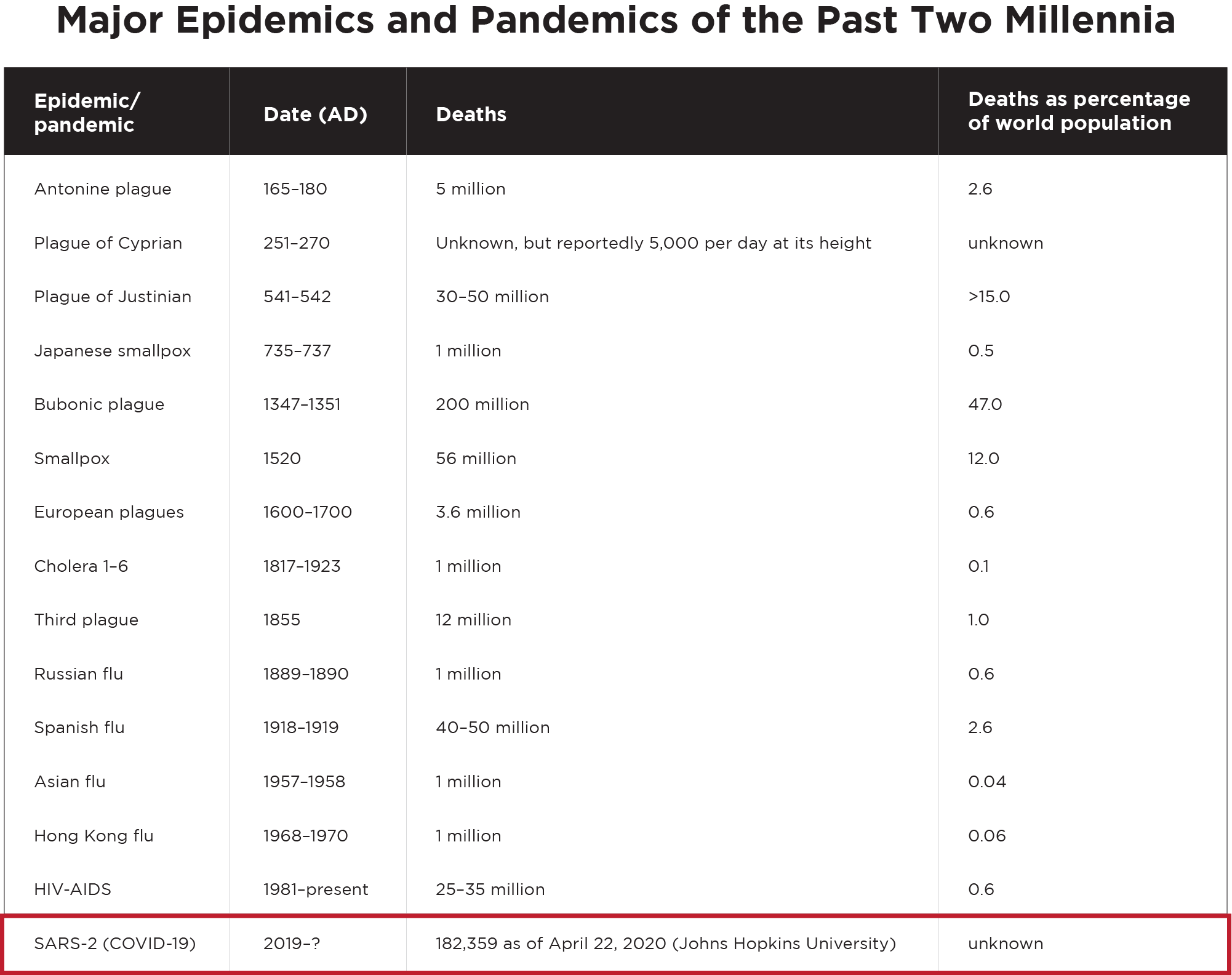
Since the second century AD, reasonably accurate records of pandemics have been kept. The following table shows the names, dates, and death tolls of the major pandemics of the past 2,000 years.


blog__inline--covid-19-prompts-focus-on-protective-action

Table: Major Epidemics and Pandemics of the Past Two Millennia
adapted from Nicholas LePan, “Visualizing the History of Pandemics,” March 14, 2020, https://www.visualcapitalist.com/history-of-pandemics-deadliest/.

Diseases leading to a million or more deaths occur nearly once every century, if not more frequently. Given their relatively regular frequency, they should not catch us totally off guard. Although our advancing medical knowledge and technology have been able to reduce the death toll as a percentage of the global population, they are yet unable to prevent pandemics.

Preparing for Pandemics
During the past century, researchers have become adept at identifying the sources of pandemic outbreaks. The more recent epidemics and pandemics have most often originated from animal-to-human transmission. For example, the Russian flu arose from bird-human contact, the Spanish flu from pig-human contact, HIV-AIDS from chimpanzee-human contact, and SARS-CoV-2 (COVID-19) apparently from live animal markets in Wuhan.

This research implies that one way many pandemics can be prevented, or at least mitigated, is to ban live animal markets. If and where such markets are deemed necessary, they can at least be moved outside of crowded cities and the animals given appropriate space. The severe crowding of animals, which has a destructive effect on the animals’ health, runs counter to the Christian ethical principle of treating these creatures with appropriate care and kindness.

The need for less crowding of animals also applies to our human population. The last fifty years has seen an exponential increase in urbanization. Today, for the first time in history, more than half the world’s people live in large metropolitan centers, where population numbers and density are both increasing. This high population density often means people lack appropriate air circulation and independent plumbing. Such conditions present opportunities for bacterial and viral mutations as well as for amplified contagion.

The problem is further exacerbated by increased travel, especially by planes, trains, and buses. These modes of transportation represent extreme examples of human crowding. For all but the wealthier passengers, who can afford to buy extra space, crowding has only increased over time.

Practical Preparation
While these and other challenges seem daunting, they are not insurmountable. Much can be done both to prepare for and to mitigate the impact of future epidemics and pandemics. For example, since the fourteenth century, some form of quarantine has consistently proven to help limit pandemic death tolls. How much more is it needed now that humanity has become increasingly urbanized? By preparing to test, isolate, and track contacts of infected individuals, outbreaks can be effectively contained. This approach has proven effective.

By stockpiling essential supplies—test kits, masks, gloves, hospital equipment—and motivating manufacturers to pivot rapidly toward production of such supplies, we would save countless lives. We can encourage construction companies to equip condominiums and apartments with individualized ventilation and plumbing systems for each unit.

We can explore ways to equip airports and other transportation terminals, as well as planes, trains, buses, and subways, with air circulation systems that ensure passengers and workers are breathing clean, not infected, air. We can reconfigure modes of transport to make them sufficiently spacious to ensure healthier social distancing.

Ethical Preparation
Preparation for inevitable disasters—including viral and bacterial outbreaks, climate change, and all the catastrophes both history and science have shown us—may seem utterly infeasible, from an economic standpoint, but we must ask ourselves what makes it so. What if, for example, our government at all levels were to manage budgets in such a way as to maintain a healthy surplus (a disaster relief and recovery fund), rather than a hefty deficit? Such a scenario may seem impossible, but it has been done, and it can be done again if we turn to God for the wisdom to turn things around, step by step.

The job our Creator assigned to us to manage Earth’s resources for our benefit and the benefit of all other life can be done, but only as we turn to him for the insight, creativity, and fortitude to take the steps he reveals. We can know they come from him if they are morally and ethically sound and economically beneficial for all, especially for the poorest among us.

About Reasons to Believe

RTB’s mission is to spread the Christian Gospel by demonstrating that sound reason and scientific research—including the very latest discoveries—consistently support, rather than erode, confidence in the truth of the Bible and faith in the personal, transcendent God revealed in both Scripture and nature. Learn More »

Support Reasons to Believe

Your support helps more people find Christ through sharing how the latest scientific discoveries affirm our faith in the God of the Bible.

DONATE NOW


U.S. Mailing Address
818 S. Oak Park Rd.
Covina, CA 91724
  • P (855) 732-7667
  • P (626) 335-1480
  • Fax (626) 852-0178
Posted in Uncategorized | 1 Comment

Is Kepler 1649c the Long-Sought Earth Twin?

BY HUGH ROSS – MAY 11, 2020

Ever since 1995, when the first planet outside the solar system orbiting a hydrogen-burning star was discovered,1 astronomers have been on a holy grail search to find a planet sufficiently like Earth that it could possibly host life. A quarter of a century and 4,255 discovered exoplanets2 later, some people think scientists have found an Earth twin. A team of twelve astronomers led by Andrew Vanderburg published a paper in Astrophysical Journal Letters in which they announced their discovery of an Earth-sized planet, called Kepler 1649c, orbiting its star in the “habitable zone.”3

What Earth-Like Means
This paper caught the attention of science journalists around the world. Writing for USA Today, Doyle Rice quoted a NASA spokesperson, stating “This world is most similar to Earth both in size and estimated temperature.”4 The Financial Express wrote about Kepler 1649c’s “proximity to the life conditions on the Earth”5 and that “there is no exoplanet that is closer to Earth in size and temperature and which also lies in the habitable zone”6

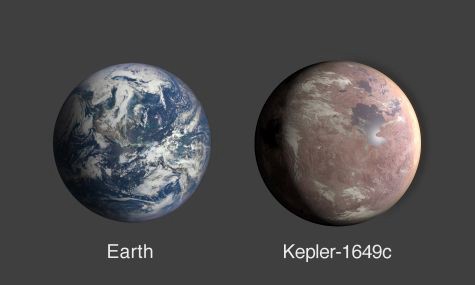
As typically occurs with discoveries of this nature, the peer-reviewed paper on which the popular web articles were based was much more subdued and qualified in its claims. It is true that Kepler 1649c is the most Earth-like discovered to date. The planet is only 6% larger in diameter than Earth (see figure 1) and the amount of light and heat it receives from its host star is 74% of what Earth receives from the Sun. Thus, Kepler 1649c could be in the habitable zone—the distance range from its host star where liquid water could conceivably reside on its surface.

blog__inline--is-kepler-1649c-the-long-sought-earth-twin-1

Figure 1: Artist’s Rendition Comparing Kepler 1649c to Earth. Image credit: NASA/Ames Research Center/Daniel Rutter

Receiving 74% of the light and heat Earth receives from the Sun implies that its average surface temperature with no heat-trapping atmosphere (no greenhouse gases) would be -39°C (-38°F). This temperature compares with -18°C (0°F) for Earth without a heat-trapping atmosphere. The 21°C (38°F) difference means that Kepler 1649c would need an atmosphere loaded up with much more carbon dioxide and/or methane than Earth. The extra greenhouse gases needed would not necessarily rule out microbial life, but they would rule out high-metabolism terrestrial animals like us.7

Planets Need More Than a Water Zone
Something not noticed in most popular web articles on this discovery is that Kepler 1649c orbits a star with only 20 and 0.5% the mass and brightness of the Sun, respectively. Such characteristics for the planet’s host star put Kepler 1649c squarely outside of the ultraviolet habitable zone. (I wrote about this zone in my book Improbable Planet8 and in an article I wrote in 2016.9) For a planet to be truly habitable for any kind of life, it must simultaneously reside in both the liquid water habitable zone and the ultraviolet habitable zone. Kepler 1649c does not.

Vanderburg and his team acknowledged that Kepler 1649c experiences “a very different environment (an extended era of ultraviolet (UV) irradiation, tidal locking, etc.) from planets in our own solar system.”10 Indeed, planets orbiting their host stars as closely as Kepler 1649c orbits Kepler 1649 (the star) will be tidally locked. Tidal locking means that one hemisphere of Kepler 1649c will permanently face its star, much like one hemisphere of our Moon permanently faces Earth. Tidal locking implies that one hemisphere of Kepler 1649c will be blisteringly hot while the other hemisphere will be extremely cold. Furthermore, it implies that any surface water on Kepler 1649c will be transported to its cold hemisphere where it will remain permanently frozen.

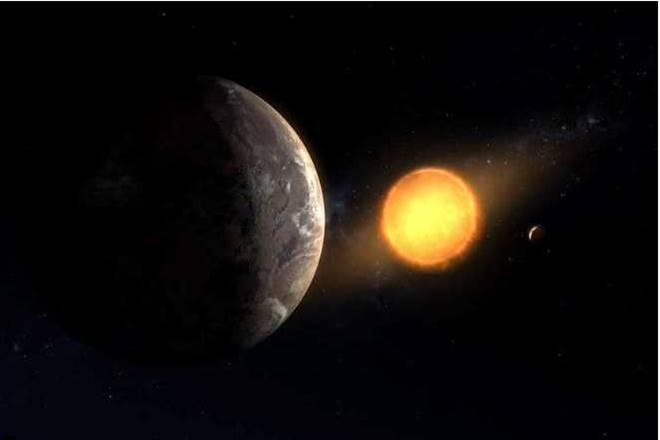
The dozen astronomers also acknowledged that Kepler 1649c may suffer orbital disruptions (catastrophic to advanced life) from mean-motion resonances resulting from other planets known to exist and likely to exist in the same planetary system. Figure 2 shows an artist’s rendition of the Kepler 1649 planetary system.

blog__inline--is-kepler-1649c-the-long-sought-earth-twin-2

Figure 2: Artist’s Rendition of the Kepler 1649 Planetary System. Image credit: NASA/Ames Research Center/Daniel Rutter

Another problem for habitability is that stars like Kepler 1649 are highly variable in their luminosity. Life would be exposed to intolerable temperature changes. Stars like Kepler 1649 also frequently emit deadly superflares. For this and several other reasons, planets orbiting stars as small as or smaller than Kepler 1649 are not habitable planets.

To date, astronomers have discovered thirteen distinct planetary habitable zones. I describe and list these zones in two previous blogs.11 So far, astronomers have discovered only one planet that simultaneously resides in more than two of these planetary habitable zones, the same planet that simultaneously resides in all thirteen. It seems no accident of nature but rather purpose from nature’s Creator that we live and thrive on this favored planet.

Featured image: Artist’s Conception of Kepler 1649c’s Surface, Assuming It Possesses Water. Image credit: NASA/Ames Research Center/Daniel Rutter

Endnotes
  1. Michel Mayor and Didier Queloz, “A Jupiter-Mass Companion to a Solar-Type Star,” Nature 378, issue 6555 (November 23, 1995): 355–59, doi:10.1038/378355a0.
  2. Exoplanet TEAM, The Extrasolar Planets Encyclopaedia, The Catalog (April 24, 2020), http://exoplanet.eu/catalog/.
  3. Andrew Vanderburg et al., “A Habitable-Zone Earth-Sized Planet Rescued from False Positive Status,” Astrophysical Journal Letters 893, no. 1 (April 10, 2020): L27, doi:10.3847/2041-8213/ab84c5.
  4. Doyle Rice, “Has NASA Discovered Another Earth? Perhaps” USA Today (April 16, 2020), https://www.usatoday.com/story/news/nation/2020/04/15/has-nasa-discovered-another-earth/5139773002/.
  5. “New ‘Earth-Like’ Exoplanet Kepler 1649c Found! Scientists Analyze If It Can Sustain Life,” Financial Express (April 17, 2020), https://www.financialexpress.com/lifestyle/science/new-earth-like-exoplanet-kepler-1649c-found-scientists-analyze-if-it-can-sustain-life/1931902/.
  6. “New ‘Earth-Like’ Exoplanet.”
  7. Hugh Ross, “Complex Life’s Narrow Requirements for Atmospheric Gases,” Today’s New Reason to Believe (blog), July 1, 2019, https://reasons.org/explore/blogs/todays-new-reason-to-believe/read/todays-new-reason-to-believe/2019/07/01/complex-life-s-narrow-requirements-for-atmospheric-gases.
  8. Hugh Ross, Improbable Planet: How Earth Became Humanity’s Home (Grand Rapids, MI: Baker, 2016), 84–85, https://shop.reasons.org/product/283/improbable-planet.
  9. Hugh Ross, “Overlap of Habitable Zones Gets Much Smaller,” Today’s New Reason to Believe (blog), December 27, 2016, https://reasons.org/explore/blogs/todays-new-reason-to-believe/read/todays-new-reason-to-believe/2016/12/27/overlap-of-habitable-zones-gets-much-smaller.
  10. Vanderburg et al., 5.
  11. Hugh Ross, “Tiny Habitable Zones for Complex Life,” Today’s New Reason to Believe (blog), March 4, 2019, https://reasons.org/explore/blogs/todays-new-reason-to-believe/read/todays-new-reason-to-believe/2019/03/04/tiny-habitable-zones-for-complex-life; Hugh Ross, “Complex Life’s Narrow Requirements.”

About Reasons to Believe

RTB’s mission is to spread the Christian Gospel by demonstrating that sound reason and scientific research—including the very latest discoveries—consistently support, rather than erode, confidence in the truth of the Bible and faith in the personal, transcendent God revealed in both Scripture and nature. Learn More »

Support Reasons to Believe

Your support helps more people find Christ through sharing how the latest scientific discoveries affirm our faith in the God of the Bible.

DONATE NOW


U.S. Mailing Address
818 S. Oak Park Rd.
Covina, CA 91724
  • P (855) 732-7667
  • P (626) 335-1480
  • Fax (626) 852-0178
Posted in Uncategorized | Leave a comment

Life after the Pandemic

BY HUGH ROSS – MAY 4, 2020

The SARS-2 virus, responsible for COVID-19, has turned life upside down in nations all over the world. As I write, regions of the United States have been hit as hard as any other nation. This historic event makes everyone wonder, “Will life ever be the same?”

I am confident that the answer is no. Just like previous major disasters of the past century unalterably changed the way everyone lives, so will the COVID-19 pandemic. Consider, for example, World War I, the Great Depression, World War II, and 9/11. These catastrophic events changed the way governments, societies, cultures, and individuals operated.

As a recent example, the terror attacks of September 11, 2001, changed the way we all live. The aftermath of that fateful day changed air travel so dramatically that it not only impacted air travelers, it altered the world economy.

The degree to which the current viral outbreak will change the way we live and how the world operates depends on how much longer the pandemic lasts, how many people it kills, and how many of those who recover from COVID-19 have lasting physical consequences, such as lung damage and damage to other internal organs. Perhaps even more consequential for the millions who have been asymptomatic yet economically impacted, is how long until or even whether they can resume their livelihoods. Many others will be vulnerable to illnesses, mental health challenges, and addictions. At the date on which I completed this writing answers to these questions were still speculative. Nevertheless, certain changes to the way we live seem inevitable no matter how the pandemic ends.

Lifestyle Changes
Some are claiming that the social practices of physical touch such as handshakes, kissing, and hugging will disappear. Humans are social creatures. It is unrealistic to say that all forms of physical touch with people outside of our families will vanish. Can you imagine two business people closing a multi-million dollar deal with an elbow bump where their elbows are covered by two layers of clothing?

What is realistic is the proliferation of hand sanitizer dispensaries and people carrying personal hand sanitizers in their pockets, purses, and briefcases. Bleach wipes are even more effective against viruses than hand sanitizers. It would not surprise me to see airlines install bleach wipe dispensers in every seat.

Before COVID-19, I never got offended when someone brought out their bottle of hand sanitizer after I shook their hand. However, I saw many other people who did get offended at such an act. I anticipate that the use of a hand sanitizer after a handshake or hug will no longer be considered offensive.

On my past trips to Asian megacities I saw a high percentage of citizens routinely wearing face masks. After this scourge I expect that this practice will no longer be limited to cities like Tokyo, Shanghai, and Hong Kong. Anywhere where strangers are densely packed together I anticipate seeing a lot of face masks.

COVID-19 has taught us how much social interaction we can achieve through virtual meetings. We have a son and daughter-in-law about an hour’s drive away here in Southern California and a son in North Carolina. With the outbreak keeping all of us in our respective dwellings, we organized family get-togethers through Zoom. There we could visually show one another the different projects we were working on. We even got our pets involved. The travel times we saved enabled us to have more meetups.

Kathy and I also have had virtual dinners with friends. They could see the food we were eating and vice versa as we talked. Once the pandemic has passed, I imagine I will return to a busy travel schedule. However, I intend to keep a lot more of my regular social engagements through virtual media technology. I don’t think I will be alone.

Economic Changes
Several pandemics of the past hundred years have had their origin in animal-human contact. After the SARS-1 outbreak two decades ago, wet markets in China were banned from holding, selling, and slaughtering live wild animals for retail customers. After COVID-19 (itself caused by SARS-2), I expect a worldwide ban on city markets holding, selling, and slaughtering live animals of any kind for retail customers.

Long before the current virus struck, we at Reasons to Believe were doing much of our speaking, training, and public interviews through such virtual media as Zoom, Skype, YouTube and Facebook livestreaming, and Google hangout. Such meetings are not as personal as face-to-face events but are much more economical and have the potential to reach much larger audiences.

COVID-19 has caused an evolution in virtual meetings. They have become more personal. For example, my home church, Christ Church Sierra Madre, has been livestreaming my Sunday Paradoxes class for the past eighteen months. Until now, we would take questions through the chat feature. Now, I can see the person who is asking the question and they can see me. Also, I now start the livestreaming a half hour before the class begins and let it run for another half hour after the class ends. Why? Participants wanted the opportunity for fellowship with one another.

The pandemic has taught us all how much transportation time we save through virtual meetings. Long after COVID-19 ceases to pose a risk I anticipate that the ratio of work done at home compared to the office or classroom will increase. Such a transition will enhance the world economy not only through saving workers’ time but also by relieving pressure on our transportation systems. However, since supervisors will no longer be able to closely monitor their employees, people increasingly will be paid by their work output rather than by the hour.

COVID-19 has impacted the clothing industry in an unexpected manner. Clothing stores have seen their sales of tops outstrip their sales of bottoms. Since a virtual workplace usually displays workers only from the waist up, there will be less need to invest in dress slacks, dresses, and skirts. Your fellow workers will not know if you are wearing sweat pants, shorts, or pajamas.

Everyone is expecting air travel to drop as virtual meetings, virtual entertainment events, virtual classrooms, and virtual conferences to some degree replace in-person events. I believe that kind of business travel indeed will drop. However, I anticipate that the cabin fever effect from increased virtual work and meetings will increase the demand for recreational air travel. National and state parks and wilderness areas likely will see an increased number of visitors. Families and social groups will want to get together more frequently.

Biblical Principles
One outcome I am praying will result from the outbreak is that many more people will appreciate and start following biblical principles that are relevant to preventing and mitigating pandemics. Not until the fourteenth century during the greatest pandemic of all time—the Black Death—did the practice of quarantining extend beyond Jews and Christians.

The principle of quarantining the sick to protect the healthy is taught in five books of the Old Testament. The most extensive instruction is in Leviticus 13–15. There we learn that people with symptoms of infectious diseases are to be isolated from the rest of the population until seven days after the disappearance of all symptoms. Furthermore, such people are not permitted to return from isolation until they have bathed and washed their clothes. Leviticus 13–15 also indicates that governing authorities are permitted to enforce quarantining laws.

Numbers 5:1–4 summarizes the quarantining and cleansing laws. Numbers 31:19–24 extends these laws to anyone who has had contact with a dead body. Deuteronomy 23:12–14 commanded the Jews to immediately bury their excrement. Today, we know that flushing a toilet with the lid up can allow microscopic particles to waft up through the immediate area (called toilet plume). Applying the principle taught in Deuteronomy 23 means that it would be wise, sick or not, to close the toilet lid before flushing.

What about animal markets? These passages (Deuteronomy 25:4, Proverbs 12:10, 27:23, Deuteronomy 22:10, and Luke 14:5) exhort us to look out for the welfare of our domesticated animals and to treat them humanely. When we overcrowd domesticated animals and subject them to stressful circumstances, such overcrowding and stress greatly enhance the probability that relatively benign viruses1 will mutate and become deadly. Likewise, when we overcrowd human beings and/or subject them to great stress, hardship, and fatigue, we create a situation where we enhance the mutation rate of viruses. Putting overcrowded and stressed-out humans into contact with overcrowded and stressed out animals increases the risk of viral mutation even more and, of course, the chance of animal to human transmission of deadly viruses.

A modern application of the biblical principle of quarantining might look like this: We would extend the quarantine beyond the infected to include reasonable social distancing, we would wash our hands, bodies, and clothes more frequently, and take steps to prevent fecal particles from getting into the air we breath. These measures would put humans at much less risk from both viral and bacterial pandemics.

To be sure, life after the pandemic will not be the same but it doesn’t necessarily mean life will be unbearable. Humans have always adjusted to changing circumstances—a trait that reminds us we are created in the image of God. By applying biblical wisdom, common sense, and love for our fellow humans, we can make life more than bearable for all. Believers in the God of the Bible can lead such efforts and point others to the ultimate assurance found in relationship with their Creator.

Endnotes
  1. I have written previously about the enormous benefits we gain from viruses. Our existence depends upon them. See Hugh Ross, “Viruses and God’s Good Designs,” Today’s New Reason to Believe (blog), March 20, 2020, https://reasons.org/explore/blogs/todays-new-reason-to-believe/read/todays-new-reason-to-believe/2020/03/30/viruses-and-god-s-good-designs.

About Reasons to Believe

RTB’s mission is to spread the Christian Gospel by demonstrating that sound reason and scientific research—including the very latest discoveries—consistently support, rather than erode, confidence in the truth of the Bible and faith in the personal, transcendent God revealed in both Scripture and nature. Learn More »

Support Reasons to Believe

Your support helps more people find Christ through sharing how the latest scientific discoveries affirm our faith in the God of the Bible.

DONATE NOW


U.S. Mailing Address
818 S. Oak Park Rd.
Covina, CA 91724
  • P (855) 732-7667
  • P (626) 335-1480
  • Fax (626) 852-0178

Reasons to Believe logo

Posted in Uncategorized | 1 Comment

Is the Universe Closed?

BY JEFF ZWEERINK – APRIL 24, 2020

Can our universe come from nothing? At least one prominent physicist, Lawrence Krauss, answers with a resounding “yes.” In fact, he wrote a book titled A Universe from Nothing to articulate his position, which emanates from his worldview that no creator is involved. Krauss wants science to define nothing (instead of agreeing with the definitions of philosophy and theology). One key component of Krauss’s “nothing” hinges on the sum energy budget for the universe being zero and that requires a universe with a flat geometry. It is difficult to picture this geometry because we can’t “see” the universe’s shape, but recent evidence may undermine that key feature and worldview.

A Little Background

For the last two decades, the prevailing cosmological model for the origin of the universe has posited an inflationary big bang picture. After an incredibly brief epoch of hyperfast expansion, known as inflation, the universe continually expands from an initial hot, dense state. As it expands, it cools and forms all the structure we see—stars, planets, galaxies, and clusters of galaxies, etc. Measurements indicate that the energy of the universe is distributed such that normal matter (electrons, protons, neutrons and the like) comprises about 5%, dark matter adds another 25%, and dark energy makes up the balance. When originally proposed, inflation provided a nice answer to a nagging question: Why did our universe have a geometry so close to flat?

The very process of inflation contained the answer. The exponential growth increased the universe’s size by at least a factor of 1026! This incredible expansion would take the original geometry of the universe (whether closed, flat, or open) and drive it exquisitely close to a flat geometry. This was a hallmark prediction of inflation. Regardless of the universe’s original geometry, inflation’s incredible expansion would result in a measurably flat geometry (at least with our current sensitivity).

Why Is a Flat Geometry Important?

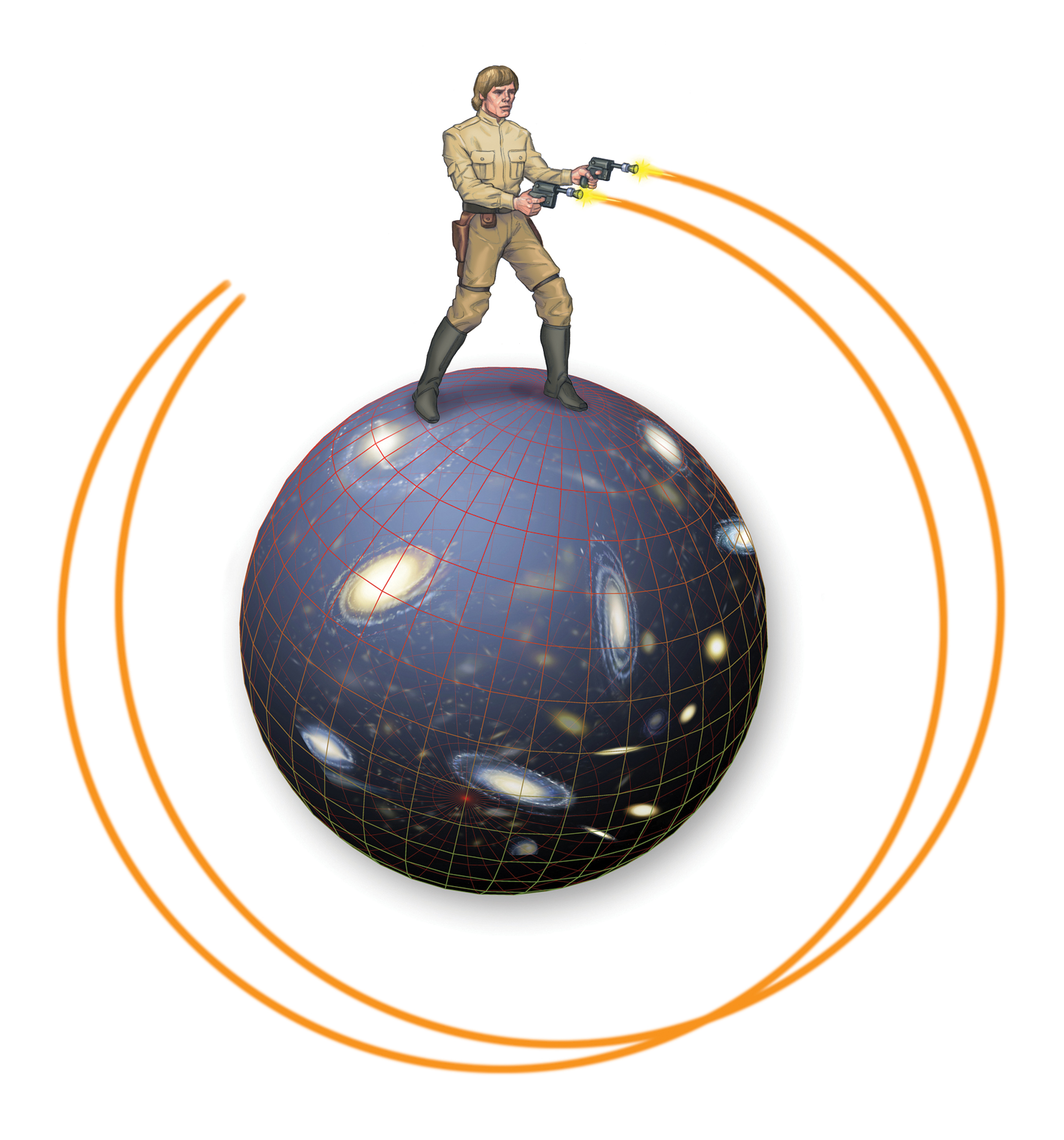
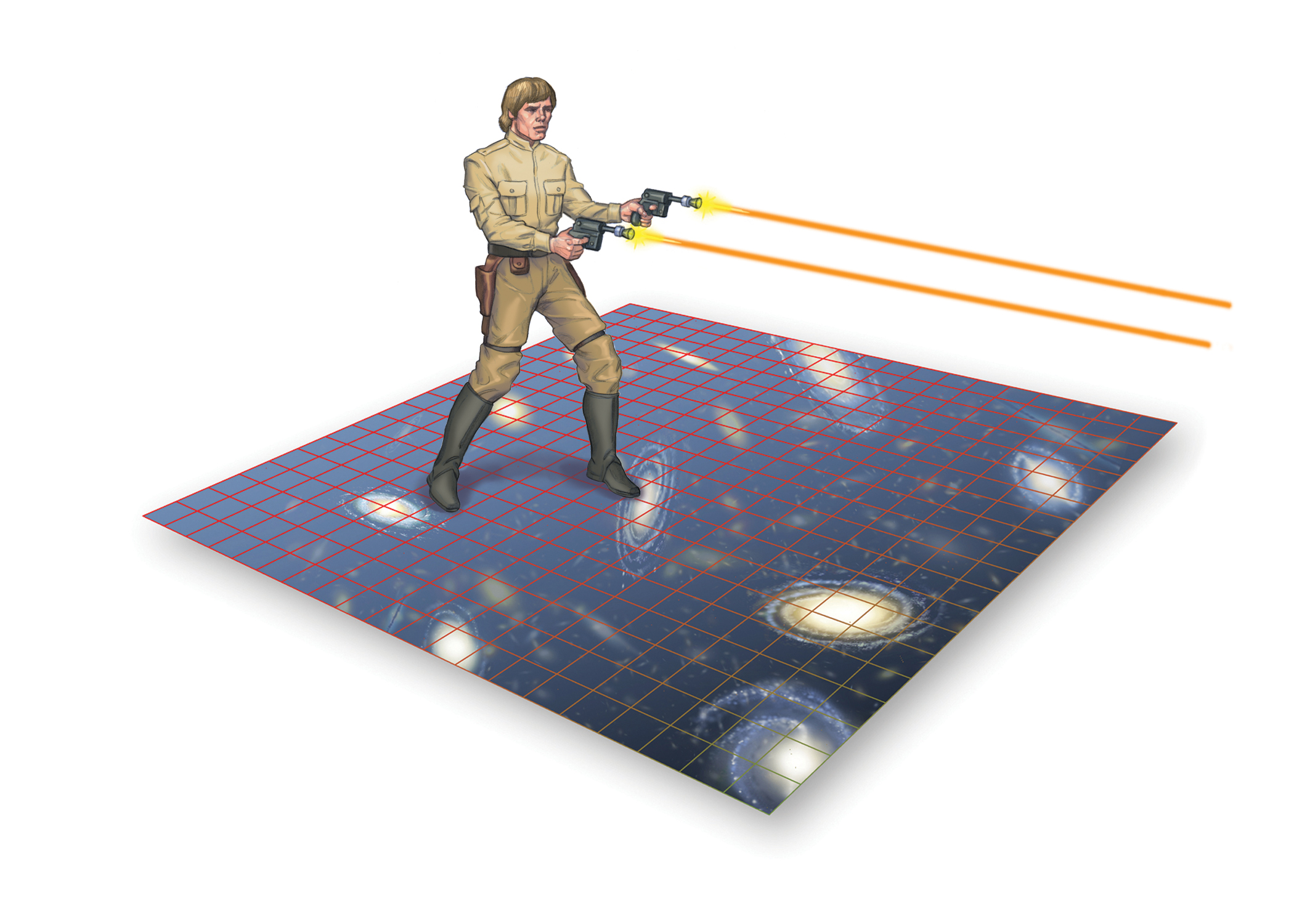
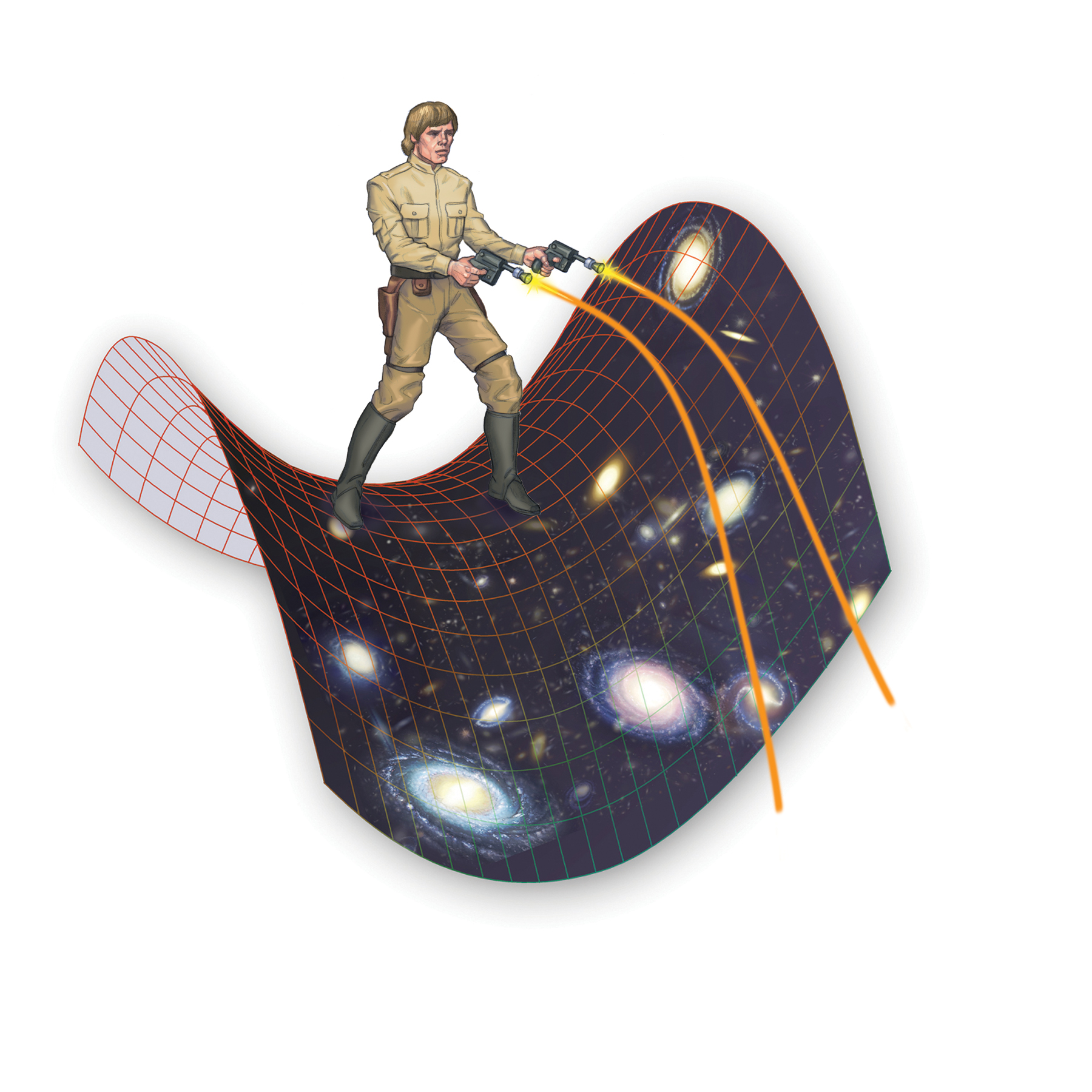
On a basic level, the universe could assume three different geometries: closed, flat, or open—and it has nothing to do with the number of dimensions. The three diagrams below show how parallel lines behave within the different geometries.

blog__inline--is-the-universe-closed-1blog__inline--is-the-universe-closed-2blog__inline--is-the-universe-closed-3


In a closed geometry (left), parallel lines converge and eventually cross. In an open geometry (right) the lines grow farther and farther apart. In a flat geometry (center) the lines always stay the same distance apart. Although scientists cannot step outside the universe to see its geometry, they can measure various quantities like the “clumpiness” of the cosmic microwave background radiation (CMB), which is leftover radiation from an early stage of the universe. That distribution pattern can help reveal the geometry.

Given the nature of our universe (as described above), scientists have derived an interesting feature. If the universe is flat, calculations show that the total energy of the universe is zero!1

Krauss relies on this feature of the universe because he argues that the universe arises from a quantum fluctuation. Only if the universe has zero energy can this quantum fluctuation exist for anything more than the briefest length of time. Consequently, evidence that the universe has an open or closed geometry would undermine Krauss’s entire argument.

Is the Universe Actually Closed?

A recent article published in Nature Astronomy indicates that the universe may actually have a closed geometry.2 Analysis of the Planck Legacy data suggests that the universe exhibits more gravitational lensing than expected. In gravitational lensing, gravity bends the path of light traveling through the expanding universe. Thus, a closed geometry for the universe is the simplest way to account for this variation. Furthermore, analysis of Planck satellite data tends to affirm a closed geometry. However, it’s not a closed case. When integrating the Planck analysis with baryon acoustic oscillations surveys of dark energy and gravitational shear studies, the best fits still point to a flat geometry. (On an interesting note, there are other discrepancies like this, such as the disparate measurements of the Hubble constant using the CMB and Type Ia supernovae.) Unfortunately, current technology and measurements cannot resolve whether the universe is actually closed or if scientists need more analysis.

We must wait for future space missions to provide more definitive data but we can think about the potential implications. The discovery of a closed universe would rule out the possibility of a zero-energy universe. The remaining options fit more comfortably within a theistic framework where the universe begins to exist. These results show that scientific advances can provide evidence to evaluate models for the origin of the universe and the worldviews that give rise to those models.

Endnotes
  1. Marcelo Samula Berman, “On the Zero-Energy Universe,” International Journal of Theoretical Physics 48 (August 25, 2009): 3278–86, doi:10.1007/s10773-009-0125-8.
  2. Eleonora Di Valentino, Alessandro Melchiorri, and Joseph Silk, “Planck Evidence for a Closed Universe and a Possible Crisis in Cosmology,” Nature Astronomy 4 (November 4, 2019): 196–203, doi:10.1038/s41550-019-0906-9.

About Reasons to Believe

RTB’s mission is to spread the Christian Gospel by demonstrating that sound reason and scientific research—including the very latest discoveries—consistently support, rather than erode, confidence in the truth of the Bible and faith in the personal, transcendent God revealed in both Scripture and nature. Learn More »

Support Reasons to Believe

Your support helps more people find Christ through sharing how the latest scientific discoveries affirm our faith in the God of the Bible.

DONATE NOW


U.S. Mailing Address
818 S. Oak Park Rd.
Covina, CA 91724
  • P (855) 732-7667
  • P (626) 335-1480
  • Fax (626) 852-0178
Posted in Uncategorized | Leave a comment

Special Interest Groups (SIG) Attacks Individual

By Will Myers

There is at present a movement by SIG’s snake organization to become a god to each citizen in the nation. The technology now exist to accomplice such goal. The government is spying on each citizen at present. The SIG snake is luring citizens into their den by attempting them to receive info concerning another individual and exposing the targeted person to SIG’s disposition, a molding process, leading to a divide and conquer process. Each private citizen shall wrestle with the snake SIG who is a burden to each citizen; a cancer to our free democracy.

The goal of SIG is hyper-communism whereas the state virtually owns the minds of the citizens; SIG must displace our faith from the nation in order to completely capture our minds. The concept in our free democracy is that there shall be no one between the citizen and his God.

At presence, SIG has the ability to destroy any citizen’s livelihood through public scrutiny. Christianity stands against SIG’s covert movements to undermine our freedoms in which morally convicted citizens who seek the ways of the Lord has always prevailed. This is being challenged more than ever.  Our faith is the only barrier between the forces of SIG and our freedoms.

The SIG organization has the ability to act upon timely medical prognosis about each citizen. If a citizen applies for a job and SIG has anticipated that said citizen is going to contract a severe illness within twenty four months then the citizen shall not get the job. The targeted citizen shall not even know the prognosis about himself; it shall remain a secret between SIG and employers.

The SIG’s snake organization movement is the molding of each citizen’s mind for the efficient functioning of hyper-communism. SIG thrives on conflict and no person shall have peace. We shall be pitted against each other.

2 Chronicles 7:14; “If my people, which are called by my name, shall humble themselves, and pray, and seek my face, and turn from their wicked ways; then will I hear from heaven, and will forgive their sin, and will heal their land.”

Each individual citizen is facing or nearing a challenge that they never dreamed  could happen; a force (SIG) undermining our fundamental rights in which lead toward a free, Liberal democracy as provided in our U.S. Constitution, and has been constantly supported by case law during the history of our nation. Although, we must no longer take these freedoms for granted; instead, we must stand with strong faith.

For we wrestle not against flesh and blood, but against principalities, against powers, against the rulers of the darkness of this world, against spiritual wickedness in high places
>
So in everything, do to others what you would have them do to you, for this sums up the Law and the Prophets.
Posted in Uncategorized | Leave a comment

The End of Cosmic Greatness and the Beginning of Life

BY HUGH ROSS – MARCH 9, 2020

When Wayne Gretzky retired from playing professional hockey, National Hockey League fans referred to his departure as the end of greatness. Nicknamed “The Great One,” he was so great that no hockey fan then or now can imagine that any hockey player coming close to matching Gretzky’s talent.

In an even more dramatic manner the universe displays an end of greatness. However, the end of this greatness—a feature of the early universe’s history—signals the beginning of purpose.

The universe on its largest size-scales (13.5 billion light-years across) appears to be a homogeneous distribution of randomly located superclusters of galaxies (see figure 1). This appearance of homogeneity and uniformity suddenly disappears, however, when one examines the structure of the universe on a somewhat smaller size-scale.

blog__inline--the-end-of-cosmic-greatness-1
Figure 1: Map of the Universe’s Largest-Scale Structure. This map shows the positions of superclusters of galaxies out to the full extent of the observable universe (13.5 billion light-years away). The red dot in the middle shows the position of the local superclusters of galaxies, including the Laniakea galaxy supercluster in which the Milky Way resides. Image credit: Andrew Z. Colvin, Creative Commons Attribution.

Astronomers refer to the sudden appearance of cosmic homogeneity and uniformity (as one observes cosmic structure at greater and greater volumes) as the “End of Greatness.”1 Cosmic volumes defined by spheres with diameters smaller than 840 million light-years depart from homogeneity and uniformity, manifesting magnificent interior designs (“greatness”).2

Elegant Cosmic Webs
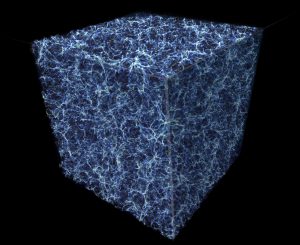
On size-scale diameters of less than 840 million light-years the random, homogeneous, and uniform jumble of superclusters of galaxies gives way to ordered structures of galaxies, galaxy clusters, and gas. These ordered structures are cosmic webs. They look like soap foam bubbles with filaments and sheets of galaxy clusters and gases on the surfaces of the bubbles separated by giant interior voids (see figure 2). You can experience animated fly throughs of different cosmic webs in the following short YouTube videos:

blog__inline--the-end-of-cosmic-greatness-2
Figure 2: 3-D Graphical Portrayal of One of the Universe’s Cosmic Webs. Image credit: NASA/ESA/E. Hallman (University of Colorado, Boulder).

The cosmic webs truly resemble soap foam bubbles. They form when spherical voids where very little matter exists are encapsulated by membranes that contain nearly all the ordinary matter (galaxy clusters, galaxies, dust, and gas) and nearly all the dark matter. Astronomers now understand why, on size-scales of less than 840 million light-years, cosmic structure is manifested as cosmic webs.

Cosmic Structure Formation
The voids formed as a result of baryon acoustic oscillations arising from the big bang creation event. (Baryons refer to the particles that comprise ordinary matter. Protons and neutrons comprise more than 99.9 percent of ordinary matter.) Baryon acoustic oscillations are fluctuations in the density of baryonic matter caused by acoustic density waves in the plasma (ionized matter) of the very early universe.

Tiny anisotropies in the quantum fluctuations of the universe when it was very much less than a trillionth of a second old grew larger as the universe expanded. High-mass density regions collapsed under the influence of gravity much more rapidly than low-mass density regions.

As this ordinary matter clumped together, it created pressure. This pressure was generated from the photons with which ordinary matter strongly interacts. The pressure counteracted gravity, creating ripples that radiated throughout the universe’s spacetime surface. These ripples are the baryon acoustic oscillations.

Dark matter, or exotic matter, interacts very weakly or not at all with photons. Hence, the pressure that causes the ripples (baryon acoustic oscillations) does not affect it. Thus, the dark matter remains at the centers of the ripples. The ordinary matter gets pushed out to form bubbles surrounding the centers of the ripples (see figure 3).

blog__inline--the-end-of-cosmic-greatness-3
Figure 3: Artist’s Depiction of the Bubbles of Ordinary Matter Formed by Baryon Acoustic Oscillations. Image credit: Zosia Rostomian, Lawrence Berkeley National Laboratory.

Some ordinary matter falls into the center of the bubble as a result of the gravitational attraction of the dark matter located there. The result is that most of the ordinary matter resides on the surface of the bubble and nearly all the remaining ordinary matter in the center of the bubble. The distribution of ordinary matter along the bubble surfaces takes the form of sheets of huge, closely packed aggregates of galaxy clusters and gas with filaments of galaxy clusters and gas emanating out from the sheets.

Web Design Leads to Life
The size of the bubbles that make up the cosmic webs are determined by the ratio of the quantity of dark matter to the quantity of ordinary matter, the quantity of each kind of matter, and the cosmic expansion rate. These three features of the universe explain the amazing interior designs of the cosmic webs that make possible the existence of physical life.

The bubble structures of the cosmic webs spread apart the galaxy clusters and the galaxies within the clusters by the just-right distances at the just-right times in the history of the universe to make possible the existence of advanced physical life. (Interested readers can learn much more about these just-right designs in two previous posts on supercluster design [part 1 and part 2]). In a historical context, the end of cosmic greatness is the beginning of greatness. Very early in the history of the universe, homogeneity and uniformity transitioned into magnificently great designs, great designs by the cosmic Creator that made it possible for us humans to exist, to thrive, and to fulfill our purpose and destiny.

Featured image: The Cosmic Web
Credit: Wikimedia Commons

Endnotes
  1. Harvard astronomer Robert Kirshner was the first to use “End of Greatness” to refer to the sudden appearance of cosmic homogeneity and uniformity as one observes at greater and greater cosmological distances. See, Robert P. Kirshner, The Extravagant Universe: Exploding Stars, Dark Energy and the Accelerating Cosmos (Princeton: Princeton University Press, 2002), 71.
  2. Susan Sarkar and Biswajit Pandley, “Unravelling the Cosmic Web: An Analysis of the Sloan Digital Sky Survey Data Release 14 with the Local Dimension,” Monthly Notices of the Royal Astronomical Society 485, no. 4 (June 2019): 4743–53, doi:10.1093/mnras/stz499; Morag I. Scrimgeour et al., “The WiggleZ Dark Energy Survey: The Transition to Large-Scale Cosmic Homogeneity,” Monthly Notices of the Royal Astronomical Society 425, no. 1 (September 2012): 116–34, doi:10.1111/j.1365-2966.2012.21302.x; Felipe Avila et al., “The Angular Scale of Homogeneity in the Local Universe with the SDSS Blue Galaxies,” Monthly Notices of the Royal Astronomical Society 488, no. 1 (September 2019): 1481–87, doi:10.1093/mnras/stz1765.

About Reasons to Believe

RTB’s mission is to spread the Christian Gospel by demonstrating that sound reason and scientific research—including the very latest discoveries—consistently support, rather than erode, confidence in the truth of the Bible and faith in the personal, transcendent God revealed in both Scripture and nature. Learn More »

Support Reasons to Believe

Your support helps more people find Christ through sharing how the latest scientific discoveries affirm our faith in the God of the Bible.

DONATE NOW


U.S. Mailing Address
818 S. Oak Park Rd.
Covina, CA 91724
  • P (855) 732-7667
  • P (626) 335-1480
  • Fax (626) 852-0178
Posted in Uncategorized | Leave a comment

Resolving the Cosmic Expansion Rate Anomaly

BY HUGH ROSS – APRIL 6, 2020

Breakthroughs in astronomy in the early part of the twentieth century were the first of many scientific confirmations of the biblical cosmic creation model. It was the discovery of cosmic expansion that first persuaded astronomers that the universe had a beginning. Detailed measurements of the expansion of the universe throughout its history led to the recognition that space and time were created and that a Causal Agent beyond space, time, matter, and energy created our universe of space, time, matter, and energy.1

Cosmic Expansion Rate Tension
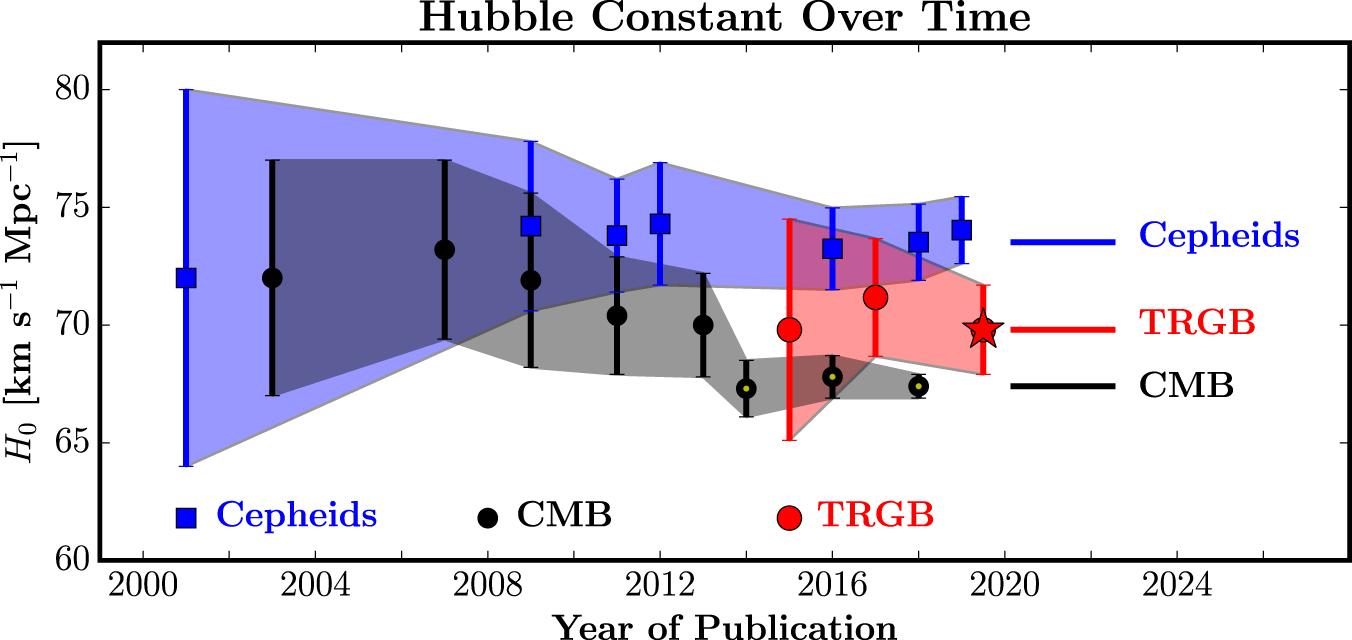
Lately, however, tension has arisen between present-day and very distant (13.8 billion years ago) measurements of the cosmic expansion rate. Last year, a team led by Nobel laureate Adam Riess used Cepheid variable stars to calibrate the distances to local galaxies hosting type Ia supernovae. Based on this calibration, Riess’s team determined that the universe is expanding at a rate of 74.03 ± 1.42 kilometers per second per megaparsec.2 (1 megaparsec = 3.26 million light-years.)

This value differs, however, from the one based on a detailed map of cosmic microwave background radiation (CMBR), a map that reveals the state of the universe when it was only 380,000 years old. The CMBR-based cosmic expansion rate = 67.4 ± 0.5 kilometers per second per megaparsec.3

This difference between local (present-day) and very distant (13.8-billion-years-ago) determinations of the cosmic expansion rate = 6.6 kilometers per second per megaparsec. This difference amounts to a 4.4 standard deviation discrepancy. Such a large discrepancy implies that the difference is unlikely to be a statistical fluke. It is much more likely due to systematic uncertainties (instrumental effects and/or overlooked physical effects that push the measurements either above or below the true value) and/or unforeseen physics (overlooked physical phenomena).

Since the age of the universe is inversely correlated with the cosmic expansion rate, the local cosmic expansion rate measurements imply that the universe is 9 percent younger (1.2 billion years younger) than the 13.8 billion years implied from the CMBR-based cosmic expansion rate. Some young-earth creationist leaders have jumped on this discrepancy to claim “that there is something seriously wrong with the big bang model,”4 that “the big bang model is false,”5 and “Big Bang age estimates often contradict one anther.”6

Resolution of the Tension: Tip of the Red-Giant Branch Stars
About ten months ago, I wrote a blog demonstrating several ways that the tension between the CMBR-based and the Cepheid-supernovae-based measurements for the cosmic expansion rate could be resolved.7 Thanks to new sets of measurements, the means for resolution is now evident.

Astronomers have known for more than a decade that there was a second, independent method for calibrating the distances to type Ia supernovae, the basis for determining the cosmic expansion rate during the universe’s past half history. That method was to use “tip of the red-giant branch” stars.

The tip of the red-giant branch (TRGB) is an astronomical distance indicator. It uses the luminosity of the brightest red-giant branch star in a galaxy as a standard candle to determine the distance to that galaxy. In every galaxy, the brightest red-giant branch star manifests the same intrinsic brightness. Therefore, a measure of such a star’s apparent brightness yields the galaxy’s distance through the inverse square law (the luminosity of a light-emitting object decreases with the square of its distance), given that astronomers possess an accurate geometric distance to a nearby tip of the red-giant branch star.

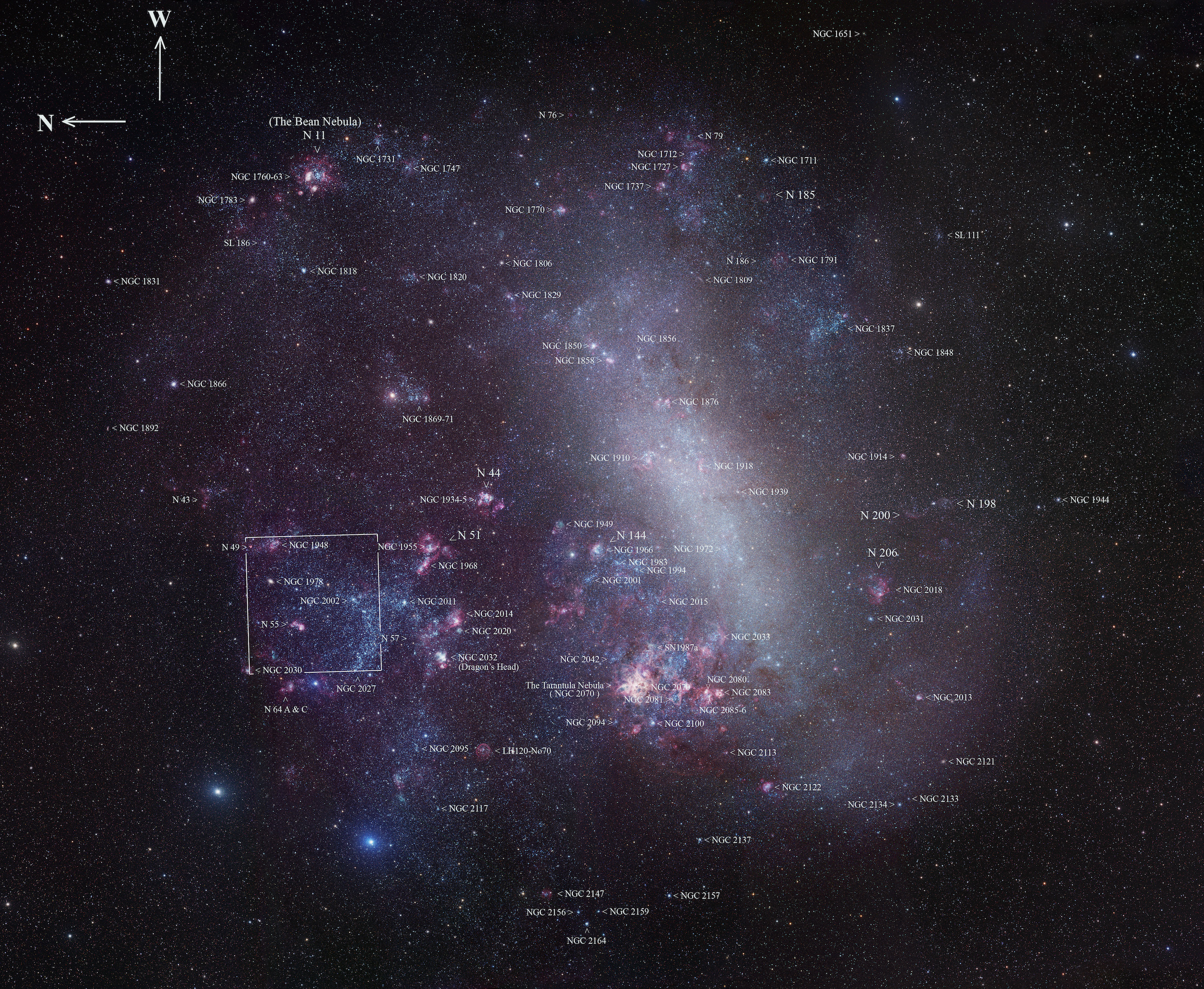
A few months ago, a team of thirteen astronomers led by Wendy Freedman and Barry Madore (a classmate of mine at the University of Toronto), published the most comprehensive determination of the cosmic expansion rate based on TRGB.8 They used 20 eclipsing binary stars in the Large Magellanic Cloud (see figure 1) to determine, by far, the most accurate geometric distance to that galaxy and, hence, to its brightest red-giant branch star. That distance = 162.04 ± 0.30 million light-years.9

blog__inline--resolving-the-cosmic-expansion-rate-anomaly-1

Figure 1: Large Magellanic Cloud, the Closest Galaxy to the Milky Way
Image credit: European Southern Observatory

Based on the new geometric distance to the Large Magellanic Cloud and their observations of TRGB in galaxies hosting type Ia supernovae, the Freedman-Madore team determined that the cosmic expansion rate over the past seven billion years = 69.8 ± 0.8 kilometers per second per megaparsec.10 This value is discordant with the CMBR-based cosmic expansion rate by only 2.4 kilometers per second per megaparsec.

In their paper, Freedman and Madore’s team presents a diagram showing the history of cosmic expansion rate measurements using the three methods described here: CMBR, Cepheid variable stars, and TRGB. Figure 2 below is their diagram.

blog__inline--resolving-the-cosmic-expansion-rate-anomaly-2

Figure 2: Cosmic Expansion Rate Measurements over the Past Two Decades. The shaded portions show the probable measuring errors.
Image credit: Wendy Freedman et al., Astrophysical Journal

Whereas increasing measuring precision has resulted in greater tension between the CMBR and Cepheids determinations, the opposite trend has occurred for the CMBR and TRGB determinations. In fact, the difference between the CMBR and TRGB is now small enough to attribute to the probable measuring errors.

Resolution of the Tension: Dark Energy and the Local Hole
There are other likely reasons for the remaining difference between the CMBR and TRGB determinations. I mentioned one in my June 24, 2019, blog.11 Dark energy, the dominant component of the universe, will more strongly accelerate the cosmic expansion rate when the universe is old and its space surface is larger than when it is young and its space surface is smaller. The latest and best measurements of dark energy imply that the universe should be expanding about one percent faster (about 0.7 kilometers per second per megaparsec faster) now than when it did when the universe was only 380,000 years old.

Another likely reason has been the subject of several recent research papers.12 A local underdensity of galaxies and galaxy clusters would cause an increase in the local value of the cosmic expansion rate. A study based on the CLASSIX galaxy cluster survey revealed a 30 percent underdensity of matter in a local region with a diameter of 330–450 million light-years.13 Inside this underdense region, observations of the cosmic expansion rate will be about 4 kilometers per second per megaparsec greater than for the rest of the observable universe. Distance indicators outside this local underdense region will reduce this enhanced cosmic expansion rate but not to the point of making the enhancement trivial. The local underdense region probably enhances the TRGB determination by 1.0–1.6 kilometers per second per megaparsec.14

The combination of the new TRGB cosmic expansion rate determination, the impact of dark energy, the adjustment arising from the local underdensity, and the range of probable errors in all the measurements now fully resolves the tension in the cosmic expansion rate determinations. The biblically predicted big bang creation model is not in trouble; there is no cosmic age discrepancy. The latest observations demonstrate that the more we learn about the universe the more evidence we accumulate for what the Bible thousands of years ago taught about the origin and history of the universe.


Endnotes
  1. Hugh Ross, The Creator and the Cosmos, 4th ed. (Covina, CA: RTB Press, 2018), 109–39, https://shop.reasons.org/product/599/the-creator-and-the-cosmos-fourth-edition.
  2. Adam G. Riess et al., “Large Magellanic Cloud Cepheid Standards Provide a 1% Foundation for the Determination of the Hubble Constant and Stronger Evidence for Physics Beyond ΛCDM,” Astrophysical Journal 876, no. 85 (May 1, 2019), id. 85, doi:10.3847/1538-4357/ab1422.
  3. Planck Collaboration, “Planck 2018 Results. VI. Cosmological Parameters,” arXiv:1807.06209 (submitted July 2018, accepted for publication in Astronomy and Astrophysics, manuscript no. ms September 24, 2019), https://arxiv.org/pdf/1807.06209.pdf.
  4. Danny R. Faulkner, “The Newest Finding on the Expansion of the Universe,”
    Answers (May 10, 2019), https://answersingenesis.org/astronomy/newest-finding-on-expansion-of-universe/.
  5. Faulkner, “Newest Finding.”
  6. Jake Herbert, “New Estimate: Universe Two Billion Years Younger,” News: Creation Science Update (October 8, 2019), https://www.icr.org/article/estimate-universe-two-billion-years-younger/.
  7. Hugh Ross, “Are Astronomers Confused about the Cosmic Creation Event?”, Today’s New Reason to Believe (blog), June 24, 2019, https://reasons.org/explore/blogs/todays-new-reason-to-believe/read/todays-new-reason-to-believe/2019/06/24/are-astronomers-confused-about-the-cosmic-creation-event.
  8. Wendy L. Freedman et al., “The Carnegie-Chicago Hubble Program. VIII. An Independent Determination of the Hubble Constant Based on the Tip of the Red Giant Branch*,” Astrophysical Journal 882, no. 1 (September 1, 2019): id. 34, doi:10.3847/1538-4357/ab2f73.
  9. Freedman et al., p. 1.
  10. Freedman et al., p. 1.
  11. Ross, “Are Astronomers Confused.”
  12. Hans Böhringer, Gayoung Chon, and Chris A. Collins, “Observational Evidence for a Local Underdensity in the Universe and Its Effect on the Measurement of the Hubble Constant,” Astronomy and Astrophysics 633 (January 2020), id. A19, doi:10.1051/0004-6361/201936400; Gagandeep S. Anand et al., “Peculiar Velocities of Galaxies Just beyond the Local Group,” Astrophysical Journal 880, no. 1 (July 20, 2019): id. 52, doi:10.3847/1538-4357/ab24e5; T. Shanks et al., “Local Hole Revisited: Evidence for Bulk Motions and Self-Consistent Flow,” Monthly Notices of the Royal Astronomical Society 490, no. 4 (December 2019): 4715–20, doi:10.1093/mnras/stz2863.
  13. Böhringer, Chon, and Collins, “Observational Evidence for a Local Underdensity,” id. A19.
  14. Shanks et al., “Local Hole Revisited,” 4715–20.

About Reasons to Believe

RTB’s mission is to spread the Christian Gospel by demonstrating that sound reason and scientific research—including the very latest discoveries—consistently support, rather than erode, confidence in the truth of the Bible and faith in the personal, transcendent God revealed in both Scripture and nature. Learn More »

Support Reasons to Believe

Your support helps more people find Christ through sharing how the latest scientific discoveries affirm our faith in the God of the Bible.

DONATE NOW


U.S. Mailing Address
818 S. Oak Park Rd.
Covina, CA 91724
  • P (855) 732-7667
  • P (626) 335-1480
  • Fax (626) 852-0178

Reasons to Believe logo

Posted in Uncategorized | Leave a comment

Take Up and Read: Knowing God

BY KENNETH R. SAMPLES – SEPTEMBER 25, 2018

I am writing this ongoing blog series on Reflections to encourage Christians to read more vigorously and enrich their lives with Christian classics in such fields as theology, philosophy, and apologetics. Hopefully, a brief introduction to these important Christian texts will motivate today’s believers to, as St. Augustine was called in his dramatic conversion to Christianity, “take up and read” (Latin: Tolle lege) these excellent books.

blog__inline--take-up-and-read-knowing-godThis week’s book, Knowing God by evangelical Protestant theologian J. I. Packer, is a contemporary classic of Christian doctrine. Widely considered one of the most important evangelical theological works of the twentieth century, Packer’s magnum opus (greatest work) has sold more than one million copies in North America alone.

Why Is This Author Notable?

James Innell (better known as J. I.) Packer was born in 1926 in England. He was educated at Oxford University where he studied under C. S. Lewis. Packer is a latter-day Puritan in the Reformed or Calvinistic tradition of the conservative side of the Anglican Church. He has taught for many years and currently serves as Board of Governors’ Professor of Theology at Regent College in Vancouver, British Columbia. Packer is considered one of the most important evangelical theologians of the second half of the twentieth century.

What Is This Book About?

Originally written as a series of articles for a magazine, Knowing God was first published as a book in 1973 and has become a standard evangelical work of doctrine and theology. Consisting of 22 chapters and divided into three parts, the work explores the knowledge and attributes of God and the enjoyment that Christians derive from knowing him intimately.

Part 1 is entitled “Know the Lord” and explains just how and why the believer knows the triune God of historic Christianity who is revealed in the incarnate person of Jesus Christ. Part 2 is titled “Behold Your God” and unpacks many of God’s attributes, such as his majesty, wisdom, goodness, and justice. Part 3 carries the title “If God Be for Us” and reveals the joy of knowing God in personal relationship through Christ.

Packer’s book takes doctrine and devotion seriously as he provides practical guidance to the reader both as a theologian and as a pastor. This influential book provides evidence that reading theology can be inspirational and enjoyable. Packer is well-known for saying that the believer should “turn theology into doxology.”1 In other words, the believer in Christ should turn the study of God into the praise of God.

In Knowing God, Packer warns of the dangers that can result when a person avoids the study of theology:

Disregard the study of God, and you sentence yourself to stumble and blunder through life blindfold, as it were, with no sense of direction and no understanding of what surrounds you. This way you can waste your life and lose your soul.2

Why Is This Book Worth Reading?

Knowing God is widely considered a contemporary masterpiece of evangelical theology and devotion. In 2006, Christianity Today magazine ranked the book number five on their list of “The Top 50 Books That Have Shaped Evangelicals.”3 This is a book that many Christians can read and study over and over throughout their lives.

Resources

Knowing God by J. I. Packer (book)

Endnotes
  1. John G. Stackhouse Jr., “Doctrine That Actually Delights,” Christianity Today, December 9, 2013, http://www.christianitytoday.com/ct/2013/december-web-only/knowing-god-turns-40.html.
  2. “The Top 50 Books That Have Shaped Evangelicals,” Christianity Today, October 6, 2006, http://www.christianitytoday.com/ct/2006/october/23.51.html.
  3. Wikipedia, s.v. “Knowing God,” last modified November 29, 2017, https://en.wikipedia.org/wiki/Knowing_God.

About Reasons to Believe

RTB’s mission is to spread the Christian Gospel by demonstrating that sound reason and scientific research—including the very latest discoveries—consistently support, rather than erode, confidence in the truth of the Bible and faith in the personal, transcendent God revealed in both Scripture and nature. Learn More »

Support Reasons to Believe

Your support helps more people find Christ through sharing how the latest scientific discoveries affirm our faith in the God of the Bible.

DONATE NOW


U.S. Mailing Address
818 S. Oak Park Rd.
Covina, CA 91724
  • P (855) 732-7667
  • P (626) 335-1480
  • Fax (626) 852-0178

Reasons to Believe logo

Posted in Uncategorized | Leave a comment

Why Would a Loving God Punish Us?

BY STEPHEN MCANDREW – MARCH 27, 2020

When I was five years old, Postman Pat was my favorite TV show. So, when I misbehaved my punishment included missing the show. I suffered, as only a five-year-old can, knowing that my siblings were watching while I was banished to my room.

Punishment involves suffering, be it big or small. Humans intuitively recognize that it is wrong to inflict suffering on someone, thus it follows that it is wrong to punish someone. So, why would an all-loving, all-good God make someone suffer by punishing them? Why would God send some people to suffer in hell as punishment?


Responsibility and Punishment

To address these questions, we will consider free will and how society rewards or punishes choices people make. In human society, we generally accept that it is morally justified to punish criminal behavior. When society punishes someone for committing a crime, it holds that person responsible for a free choice made. Likewise, when society praises someone for making a commendable choice, it holds that person responsible for praiseworthy behavior.

When society punishes a criminal, they are blaming that person appropriately for freely choosing to commit the crime. None of this is to say that there are not cases in the criminal justice system where we find that someone who committed a criminal act should not be held responsible because they suffer from a cognitive limitation. In these cases, we hold that the individual was not responsible for the act as they did not fully understand their actions.

Are We Humans or Animals?

Nevertheless, respecting free choice treats people as individuals who are rational and capable of exercising moral judgment. Yet some, like philosopher and political activist Bertrand Russell, have argued that we should not punish criminals, but treat their criminal actions as symptoms of a disease.1 These groups often advocate for what they believe are more “compassionate” treatments. But a world that absolves criminals of responsibility for those crimes would be highly problematic. Christian writer and intellectual C. S. Lewis wrote:

To be “cured” against one’s will and cured of states which we may not regard as disease is to be put on a level with those who have not yet reached the age of reason…and domestic animals. But to be punished, however severely, because we have deserved it, because we “ought to have known better,” is to be treated as a human person made in God’s image.2

I agree with Lewis. If we don’t punish people for wrong actions they chose to do, then we are really treating them like animals. Animals are not morally responsible for their actions. If my dog relieves himself on the carpet, I work to train my dog not to do that in the future. However, if a person commits a crime, we do not merely train them not to do it again. They cannot be trained, like an animal, not to do certain things; rather they must freely choose not to do those things in the future. We cannot override their free will through training. And most people have a deep sense that it is inappropriate to treat a person in the same way we would treat an animal.

Philosopher Herbert Morris pointed out further problems with no-punishment treatments. He argued that a world that treats criminals as suffering from a disease would permit preventive detention before any offense is committed, if someone is believed to have dangerous tendencies. He wrote:

In the punishment system, because we are dealing with deprivations, it is understandable that we should forbear from imposing them until we are quite sure of guilt. In the therapy system, dealing as it does with benefits, there is less reason for forbearance from treatment at an early stage.3

It would also not allow offenders to pay back their debt to society. If you did not earn a punishment, then how can you earn back the respect of society? Morris wrote:

Infliction of the prescribed punishment carries the implication…that one has “paid one’s debt” to society, for the punishment is the taking from the person of something commonly recognized as valuable…What is clear is that the conceptions of “paying a debt” or “having a debt forgiven” or pardoning have no place in a system of therapy.4

Respect and Mercy

Punishment respects our free choices and respects us as persons capable of making moral decisions. If God holds us responsible for our moral actions, then he treats us like rational people who are responsible for our choices. In punishing those who do wrong God is not being unfair or mean, but is treating us with respect. This is the same way the criminal justice system, when properly applied, respects offenders as persons by punishing them rather than treating their offenses as something they had no control over.

The good news is that God extends mercy—even though we deserve divine punishment due to our free choices to do moral wrongs. This is not to say that God takes our moral wrongs lightly and dismisses them easily. Rather, Jesus took the punishment that we deserved by suffering and dying in our place. His righteousness (moral goodness) is imputed to us if we choose to follow and obey Him. Moreover, as Morris and Lewis pointed out, mercy only makes sense if someone deserves to be punished and punishment is not carried out. Lewis wrote: “If crime is only a disease which needs cure, not sin which deserves punishment, it cannot be pardoned. How can you pardon a man for having a humboil or a club foot?”5 Therefore, in order to be merciful, God must hold us responsible, and mercy is clearly an exercise of a loving God.6


Endnotes
  1. Bertrand Russell, Proposed Roads to Freedom (New York: Henry Holt and Company, 1919), 125.
  2. S. Lewis, “The Humanitarian Theory of Punishment,” in God in the Dock: Essays on Theology and Ethics, ed. Walter Hooper (Grand Rapids: William B. Eerdmans, 2014), 287–301.
  3. Herbert Morris, “Persons and Punishment,” The Monist 52, no. 4 (October 1, 1968): 475–501, https://doi.org/10.5840/monist196852436.
  4. Herbert Morris, “Persons and Punishment,” 484.
  5. Lewis, “Punishment,” 294.
  6. This is not to say that those to whom God extends mercy will not suffer in life, as suffering can develop character (Romans 5:5). Rather, believers in Christ will not suffer the eternal punishment they deserve for sin.

About Reasons to Believe

RTB’s mission is to spread the Christian Gospel by demonstrating that sound reason and scientific research—including the very latest discoveries—consistently support, rather than erode, confidence in the truth of the Bible and faith in the personal, transcendent God revealed in both Scripture and nature. Learn More »

Support Reasons to Believe

Your support helps more people find Christ through sharing how the latest scientific discoveries affirm our faith in the God of the Bible.

DONATE NOW


U.S. Mailing Address
818 S. Oak Park Rd.
Covina, CA 91724
  • P (855) 732-7667
  • P (626) 335-1480
  • Fax (626) 852-0178
Posted in Uncategorized | Leave a comment