God’s Existence Best Explains Life’s Most Profound Realities

BY KENNETH R. SAMPLES

     – DECEMBER 25, 2018

Can we justify concepts like logic, moral values, and universals from a naturalistic, atheistic perspective? Or do we need a transcendent grounding like historic Christianity’s explanation for these meaningful realities?

Using a type of abductive logical reasoning (referred to as an inference to the best explanation), I’ll illustrate how five profound realities are plausibly explained by Christian theism.

Accounting for Five Meaningful Realities

1. The existence of the God of the Bible provides a rationally plausible explanation for the reality of abstract, nonphysical entities.

Some of the most wondrous realities of life are things that cannot be observed by the human senses. These abstract, intangible realities are conceptual in nature and include such entities as numbers, propositions, sets, properties, the laws of logic, moral values, and universals. Many people consider these conceptual realities to be objective, universal, and, of course, invisible.

On atheism, it is difficult to ground these conceptual realities. However, the Christian theistic worldview grounds them in the mind of an infinite, eternal, and personal spiritual being. God is the Creator of both the visible and the invisible, the source of both the sensible and the intelligible.

2. The existence of the God of the Bible provides a rationally plausible explanation for the reality of objective moral values.

Moral values are a fundamental part of human life, every bit as real as the law of gravity. And people are generally intuitively cognizant of their moral obligations. In their hearts, people experience the pull of moral duty. This sense of moral oughtness is prescriptive (how things should be) not descriptive (how things are) in nature, and it transcends mere subjective feelings.

Unlike secular attempts to account for morality, the ethics of Christian theism are grounded in the morally perfect nature of God who has revealed his will to humankind in the Judeo-Christian Scriptures. God’s existence and nature provide a source and foundation for objective moral values.

3. The existence of the God of the Bible provides a rationally plausible explanation for the purpose and significance that human beings yearn for in their lives.

If God doesn’t exist and the universe is merely the product of blind, purposeless, natural processes, then from a logical standpoint there can be no objective meaning to life. Given a nontheistic perspective, the fact that people exist becomes simply an improbable accident of evolution.

Humanity’s deep sense of, and need for, meaning comports well with the Christian truth claim that God created human beings in his image (Genesis 1:26–27) and that humanity’s greatest needs are to be reconciled to God and to enjoy fellowship with him forever. The Christian theistic worldview, with its unique gospel of gracious redemption in Christ, offers genuine meaning, purpose, and significance to sinners estranged from God and from their destiny.

4. The existence of the God of the Bible provides a rationally plausible explanation for the enigma of human nature.

One of the chief realities a belief system must explain before gaining acceptance involves the enigmatic nature of human beings. Human nature poses a paradox. Humans are capable of greatness in mathematics, science, technology, philosophy, the arts, compassion, and generosity. Yet humans are equally capable of such shameful and evil acts as racism, robbery, rape, slavery, murder, and genocide. Explaining human nature apart from the reality of God represents an extraordinary philosophical, psychological, and spiritual feat.

The Bible seems to hold the secret to unraveling the enigma of human nature. The Christian theistic worldview asserts that humans’ greatness is a direct result of the imago Dei. As creatures made in the image and likeness of God, humans reflect the glory of their Maker. Human wretchedness, on the other hand, can be traced to the first human beings’ fall into sin. Thus humans are simultaneously great and wretched.

5. The existence of the God of the Bible provides a rationally plausible explanation for the extraordinary life, death, and resurrection of Jesus Christ.

According to the historically reliable documents of the New Testament, Jesus of Nazareth made unparalleled claims to divine authority during his public ministry. Jesus fulfilled dozens of very specific Old Testament prophecies concerning the identity, mission, and message of the coming Messiah. These prophecies, which give precise details about the birth, heritage, life, and death of the long-awaited Messiah, were amazingly fulfilled by Jesus.

Jesus was a prolific miracle worker. He healed incurable diseases, restored sight to the blind, multiplied small amounts of food to feed thousands of people, calmed a storm, walked on water, and even raised the dead.

Jesus exhibited a matchless moral character during his three-year public ministry that changed the world. Not only did his teachings contain incredible ethical insight, but he also perfectly fulfilled his lofty moral ideals.

Jesus’s resurrection from the dead is supported by at least seven lines of evidence. These include: (1) his empty tomb, (2) his many postcrucifixion appearances, (3) the transformation of the disciples from cowards to apostles and martyrs, (4) the dramatic conversion of Saul of Tarsus into the apostle Paul, (5) the historical emergence of the Christian church, (6) the change in the official day of worship to Sunday to commemorate the day of Jesus’s resurrection, and (7) the fact that all alternative naturalistic explanations for the resurrection fail miserably.

Historical Christianity has both profound explanatory power and a considerable depth of explanatory scope when it comes to life’s most meaningful realities. Christians can use this explanation with confidence when engaging skeptics about the realities of life.

Resources:

About Reasons to Believe

RTB’s mission is to spread the Christian Gospel by demonstrating that sound reason and scientific research—including the very latest discoveries—consistently support, rather than erode, confidence in the truth of the Bible and faith in the personal, transcendent God revealed in both Scripture and nature. Learn More »

Support Reasons to Believe

Your support helps more people find Christ through sharing how the latest scientific discoveries affirm our faith in the God of the Bible.

DONATE NOW


U.S. Mailing Address
818 S. Oak Park Rd.
Covina, CA 91724
  • P (855) 732-7667
  • P (626) 335-1480
  • Fax (626) 852-0178

Reasons to Believe logo

Posted in Uncategorized | Leave a comment

When Did Modern Human Brains—and the Image of God—Appear?

BY FAZALE RANA – NOVEMBER 14, 2018

When I was a kid, I enjoyed reading Ripley’s Believe It or Not! I couldn’t get enough of the bizarre facts described in the pages of this comic.

I was especially drawn to the panels depicting people who had oddly shaped heads. I found it fascinating to learn about people whose skulls were purposely forced into unnatural shapes by a practice known as intentional cranial deformation.

For the most part, this practice is a thing of the past. It is rarely performed today (though there are still a few people groups who carry out this procedure). But for much of human history, cultures all over the world have artificially deformed people’s crania (often for reasons yet to be fully understood). They accomplished this feat by binding the heads of infants, which distorts the normal growth of the skull. Through this practice, the shape of the human head can be readily altered to be abnormally flat, elongated, rounded, or conical.

blog__inline--when-did-modern-human-brains-and-the-image-of-god-appear-1

Figure 1: Deformed ancient Peruvian skull. Image credit: Shutterstock.

It is remarkable that the human skull is so malleable. Believe it, or not!

blog__inline--when-did-modern-human-brains-and-the-image-of-god-appear-2

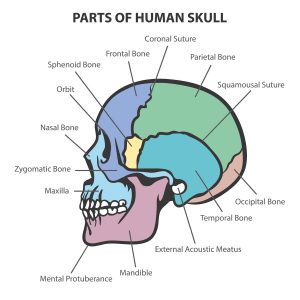
Figure 2: Parts of the human skull. Image credit: Shutterstock.

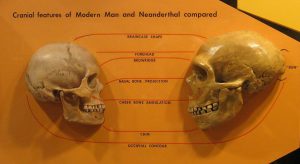
For physical anthropologists, the normal shape of the modern human skull is just as bizarre as the conical-shaped skulls found among the remains of the Nazca culture of Peru. Compared to other hominins (such as Neanderthals and Homo erectus), modern humans have oddly shaped skulls. The skull shape of the hominins was elongated along the anterior-posterior axis. But the skull shape of modern humans is globular, with bulging and enlarged parietal and cerebral areas. The modern human skull also has another distinctive feature: the face is retracted and relatively small.

blog__inline--when-did-modern-human-brains-and-the-image-of-god-appear-3

Figure 3: Comparison of modern human and Neanderthal skulls. Image credit: Wikipedia.

Anthropologists believe that the difference in skull shape (and hence, brain shape) has profound significance and helps explain the advanced cognitive abilities of modern humans. The parietal lobe of the brain is responsible for:

  • Perception of stimuli
  • Sensorimotor transformation (which plays a role in planning)
  • Visuospatial integration (which provides hand-eye coordination needed for throwing spears and making art)
  • Imagery
  • Self-awareness
  • Working and long-term memory

Human beings seem to uniquely possess these capabilities. They make us exceptional compared to other hominins. Thus, for paleoanthropologists, two key questions are: when and how did the globular human skull appear?

Recently, a team of researchers from the Max Planck Institute for Evolutionary Anthropology in Leipzig, Germany, addressed these questions. And their answers add evidence for human exceptionalism while unwittingly providing support for the RTB human origins model.1

The Appearance of the Modern Human Brain

To characterize the mode and tempo for the origin of the unusual morphology (shape) of the modern human skull, the German researchers generated and analyzed the CT scans of 20 fossil specimens representing three windows of time: (1) 300,000 to 200,000 years ago; (2) 130,000 to 100,000 years ago; and (3) 35,000 to 10,000 years ago. They also included 89 cranially diverse skulls from present-day modern humans, 8 Neanderthal skulls, and 8 from Homo erectus in their analysis.

The first group consisted of three specimens: (1) Jebel Irhoud 1 (dating to 315,000 years in age); (2) Jebel Irhoud 2 (also dating to 315,000 years in age); and (3) Omo Kibish (dating to 195,000 years in age). The specimens that comprise this group are variously referred to as near anatomically modern humans or archaic Homo sapiens.

The second group consisted of four specimens: (1) LH 18 (dating to 120,000 years in age); (2) Skhul (dating to 115,000 years in age); (3) Qafzeh 6; and (4) Qafzeh 9 (both dating to about 115,000 years in age. This group consists of specimens typically considered to be anatomically modern humans. The third group consisted of thirteen specimens that are all considered to be anatomically and behaviorally modern humans.

Researchers discovered that the group one specimens had facial features like that of modern humans. They also had brain sizes that were similar to Neanderthals and modern humans. But their endocranial shape was unlike that of modern humans and appeared to be intermediate between H. erectus and Neanderthals.

On the other hand, the specimens from group two displayed endocranial shapes that clustered with the group three specimens and the present-day samples. In short, modern human skull morphology (and brain shape) appeared between 130,000 to 100,000 years ago.

Confluence of Evidence Locates Humanity’s Origin

This result aligns with several recent archaeological finds that place the origin of symbolism in the same window of time represented by the group two specimens. (See the Resources section for articles detailing some of these finds.) Symbolism—the capacity to represent the world and abstract ideas with symbols—appears to be an ability that is unique to modern humans and is most likely a manifestation of the modern human brain shape, specifically an enlarged parietal lobe.

Likewise, this result coheres with the most recent dates for mitochondrial Eve and Y-chromosomal Adam around 120,000 to 150,000 years ago. (Again, see the Resources section for articles detailing some of these finds.) In other words, the confluence of evidence (anatomical, behavioral, and genetic) pinpoints the origin of modern humans (us) between 150,000 to 100,000 years ago, with the appearance of modern human anatomy coinciding with the appearance of modern human behavior.

What Does This Finding Mean for the RTB Human Origins Model?

To be clear, the researchers carrying out this work interpret their results within the confines of the evolutionary framework. Therefore, they conclude that the globular skulls—characteristic of modern humans—evolved recently, only after the modern human facial structure had already appeared in archaic Homo sapiens around 300,000 years ago. They also conclude that the globular skull of modern humans had fully emerged by the time humans began to migrate around the world (around 40,000 to 50,000 years ago).

Yet, the fossil evidence doesn’t show the gradual emergence of skull globularity. Instead, modern human specimens form a distinct cluster isolated from the distinct clusters formed by H. erectus, Neanderthals, and archaic H. sapiens. There are no intermediate globular specimens between archaic and modern humans, as would be expected if this trait evolved. Alternatively, the distinct clusters are exactly as expected if modern humans were created.

It appears that the globularity of our skull distinguishes modern humans from H. erectus, Neanderthals, and archaic Homo sapiens (near anatomically modern humans). This globularity of the modern human skull has implications for when modern human behavior and advanced cognitive abilities emerged.

For this reason, I see this work as offering support for the RTB human origins creation model (and, consequently, the biblical account of human origins and the biblical conception of human nature). RTB’s model (1) views human beings as cognitively superior and distinct from other hominins, and (2) posits that human beings uniquely possess a quality called the image of God that I believe manifests as human exceptionalism.

This work supports both predictions by highlighting the uniqueness and exceptional qualities of modern humans compared to H. erectus, Neanderthals, and archaic H. sapiens, calling specific attention to our unusual skull and brain morphology. As noted, anthropologists believe that this unusual brain morphology supports our advanced cognitive capabilities—abilities that I believe reflect the image of God. Because archaic H. sapiens, Neanderthals, and H. erectus did not possess this brain morphology, it makes it unlikely that these creatures had the sophisticated cognitive capacity displayed by modern humans.

In light of RTB’s model, it is gratifying to learn that the origin of anatomically modern humans coincides with the origin of modern human behavior.

Believe it or not, our oddly shaped head is part of the scientific case that can be made for the image of God.

Resources

Endnotes
  1. Simon Neubauer, Jean-Jacques Hublin, and Philipp Gunz, “The Evolution of Modern Human Brain Shape,” Science Advances 4 (January 24, 2018): eaao596, doi:10.1126/sciadv.aao5961.

About Reasons to Believe

RTB’s mission is to spread the Christian Gospel by demonstrating that sound reason and scientific research—including the very latest discoveries—consistently support, rather than erode, confidence in the truth of the Bible and faith in the personal, transcendent God revealed in both Scripture and nature. Learn More »

Support Reasons to Believe

Your support helps more people find Christ through sharing how the latest scientific discoveries affirm our faith in the God of the Bible.

DONATE NOW


U.S. Mailing Address
818 S. Oak Park Rd.
Covina, CA 91724
  • P (855) 732-7667
  • P (626) 335-1480
  • Fax (626) 852-0178

Reasons to Believe logo

Posted in Uncategorized | Leave a comment

Stoke the Faith Flame: Overcoming Spiritual Weariness

BY KENNETH R. SAMPLES – MAY 8, 2018

Over the years, I’ve had numerous people express to me that they have experienced a weariness concerning their faith journey. This is actually a pretty common phenomenon for Christians to encounter in life. I’ve also experienced such a weariness at times in my Christian life. Life’s pressures of job, family, ministry, etc. can weigh heavily on us at times. Sometimes, we can feel adrift without sensing a clear direction from the Lord.

Amazingly, C. S. Lewis felt that way at times, even in his remarkable life. Here’s a quote I recently uncovered from him: “Nothing about us except our neediness is, in this life, permanent.”As surprising as it sounds, a recent biography reveals that near the end of Lewis’s life, he felt he had been something of a failure when it came to his apologetics ministry.2 Spiritual and intellectual weariness and discouragement seem to hit even the best of us.

Daily Spiritual Practices: Joyful, Prayerful, Thankful (JPT)

There’s a section of Scripture that has come to mean a great deal to me—especially during times of spiritual dryness. It reminds me of the importance of daily spiritual practice, particularly when we feel fatigued in faith.

In the passage, the apostle Paul succinctly states what are virtually his talking points to the first-century Christian churches that were going through challenging times. He declares:

Rejoice always, pray continually, give thanks in all circumstances; for this is God’s will for you in Christ Jesus.

–1 Thessalonians 5:16–18

It is possible to be joyful in Christ even if you are not very happy. You can also pray even if you don’t feel like it. And there is always something we can be thankful to God for in life.

Stoking the Faith Flame

One’s faith is like a fire. It has to be stoked in order to burn brightly and give off light and heat. C. S. Lewis reminds us that a spiritual life must be fed:

That is why daily praying and religious reading and churchgoing are necessary parts of the Christian life. We have to be continually reminded of what we believe. Neither this belief nor any other will automatically remain alive in the mind. It must be fed.3

According to the apostle Paul, faith is uniquely energized through God’s inspired Word. He writes: “Consequently, faith comes from hearing the message, and the message is heard through the word about Christ” (Romans 10:17).

Hearing the message comes through participating in church services and liturgy where God’s Word is read and recited, by devotionally reading Scripture, and by studying biblically derived Christian doctrine.

So, stoke the faith flame! Remind yourself of what you believe as a Christian, and keep practicing the basics of the Christian spiritual life. Call upon the triune God to grant you the theological virtues of faith, hope, and love (1 Corinthians 13:13).

And finally, recognize that you are not alone in facing spiritual struggles. All believers experience weariness. God is using even these trials to develop your faith and character in his Son, Jesus Christ.

Reflections: Your Turn

Have you experienced weariness in the Christian life? What helped you to pull out of it? Visit Reflections on WordPress to comment with your response.

Resources

Endnotes
  1. C. S. Lewis, The Four Loves (New York: Harcourt, 1960), 33.
  2. See Alister McGrath, C. S. Lewis—A Life: Eccentric Genius, Reluctant Prophet (Carol Stream, IL: Tyndale House, 2013).
  3. C. S. Lewis, Mere Christianity (New York: Simon & Schuster, 1996), 125.

About Reasons to Believe

RTB’s mission is to spread the Christian Gospel by demonstrating that sound reason and scientific research—including the very latest discoveries—consistently support, rather than erode, confidence in the truth of the Bible and faith in the personal, transcendent God revealed in both Scripture and nature. Learn More »

Support Reasons to Believe

Your support helps more people find Christ through sharing how the latest scientific discoveries affirm our faith in the God of the Bible.

DONATE NOW


U.S. Mailing Address
818 S. Oak Park Rd.
Covina, CA 91724
  • P (855) 732-7667
  • P (626) 335-1480
  • Fax (626) 852-0178

Reasons to Believe logo

Posted in Uncategorized | Leave a comment

Acknowledging Our Leaders; Political And Apologetics For 2019

I am an apologetic writer and have been working my website “Intelligent Design And Biblical Scripture” for several years. Attached is an article that expresses the reason that I write to the public:

Bernie Sanders

Jane and I want to take this opportunity to wish you and yours a very healthy and happy new year.

It goes without saying that 2019 will be a pivotal and momentous time for our country and the entire planet. As you know, there is a monumental clash now taking place between two very different political visions. Not to get you too nervous, but the future of our country and the world is dependent upon which side wins that struggle.

The bad news is that in the United States and other parts of the world, the foundations of democracy are under severe attack as demagogues, supported by billionaire oligarchs, work to establish authoritarian type regimes. That is true in Russia. That is true in Saudi Arabia. That is true in the United States. While the very rich get much richer these demagogues seek to move us toward tribalism and set one group against another, deflecting attention from the real crises we face.

The good news is that, all across this country, people are getting politically involved and are fighting back. They are standing up for economic, political, social and racial justice.

In the last year we saw courageous teachers, in some of the most conservative states in the country, win strikes as they fought for adequate funding for education.

We saw low paid workers at Amazon, Disney and elsewhere undertake successful struggles to raise their wages to a living wage – at least $15 an hour.

We saw incredibly courageous young people, who experienced a mass shooting in their school, lead successful efforts for commonsense gun safety legislation.

We saw diverse communities stand together in the fight against mass incarceration and for real criminal justice reform.

We saw tens of thousands of Americans, from every walk of life, take to the streets and demand that politicians respond to the global crisis of climate change.

As we enter 2019, it seems to me that we must mount a two-pronged offensive. First, we must vigorously take on the lies, bigotry and kleptocratic behavior of the most irresponsible president in the modern history of our country. In every way possible, we must stand up to the racism, sexism, homophobia, xenophobia and religious intolerance of the Trump administration.

But fighting Trump is not enough.

The truth is that despite relatively low unemployment, tens of millions of Americans struggle daily to keep their heads above water economically as the middle class continues to shrink.

While the rich get richer, 40 million live in poverty, millions of workers are forced to work two or three jobs to pay the bills, 30 million have no health insurance, one in five cannot afford their prescription drugs, almost half of older workers have nothing saved for retirement, young people cannot afford college or leave school deeply in debt, affordable housing is increasingly scarce, and many seniors cut back on basic needs as they live on inadequate Social Security checks.

Our job, therefore, is not only to oppose Trump but to bring forth a progressive and popular agenda that speaks to the real needs of working people. We must tell Wall Street, the insurance companies, the drug companies, the fossil fuel industry, the military-industrial complex, the National Rifle Association and the other powerful special interests that we will not continue to allow their greed to destroy this country and our planet.

Politics in a democracy should not be complicated. Government must work for all of the people, not just the wealthy and the powerful. As a new House and Senate convene next week, it is imperative that the American people stand up and demand real solutions to the major economic, social, racial and environmental crises that we face. In the richest country in the history of the world, here are some (far from all) of the issues that I will be focusing on this year. What do you think? How can we best work together?

Protect American democracy: Repeal Citizens United, move to public funding of elections and end voter suppression and gerrymandering. Our goal must be to establish a political system that has the highest voter turnout in the world and is governed by the democratic principle of one person – one vote.

Take on the billionaire class: End oligarchy and the growth of massive income and wealth inequality by demanding that the wealthy start paying their fair share of taxes. We must rescind Trump’s tax breaks for billionaires and close corporate tax loopholes.

Increase Wages: Raise the minimum wage to $15 an hour, establish pay equity for women and revitalize the trade union movement. In the United States, if you work 40 hours a week, you should not live in poverty.

Make health care a right: Guarantee health care for everyone through a Medicare-for-all program. We cannot continue a dysfunctional healthcare system which costs us about twice as much per capita as any other major country and leaves 30 million uninsured.

Transform our energy system: Combat the global crisis of climate change which is already causing massive damage to our planet. In the process, we can create millions of good paying jobs as we transform our energy system away from fossil fuel and into energy efficiency and sustainable energy.

Rebuild America: Pass a $1 trillion infrastructure plan. In the United States we must not continue to have roads, bridges, water systems, rail transport, and airports in disrepair.

Jobs for All: There is an enormous amount of work to be done throughout our country – from building affordable housing and schools to caring for our children and the elderly. 75 years ago, FDR talked about the need to guarantee every able-bodied person in this country a good job as a fundamental right. That was true in 1944. It is true today.

Quality Education: Make public colleges and universities tuition free, lower student debt, adequately fund public education and move to universal childcare. Not so many years ago, the United States had the best education system in the world. We much regain that status again.

Retirement Security: Expand Social Security so that every American can retire with dignity and everyone with a disability can live with security. Too many of our elderly, disabled and veterans are living on inadequate incomes. We must do better for those who built this country.

Women’s rights: It is a woman, not the government, who should control her own body. We must oppose all efforts to overturn Roe v. Wade, protect Planned Parenthood and oppose restrictive state laws on abortion.

Justice for All: End mass incarceration and pass serious criminal justice reform. We must no longer spend $80 billion a year locking up more people than any other country. We must invest in education and jobs, not jails and incarceration.

Comprehensive immigration reform: It is absurd and inhumane that millions of hardworking people, many of whom have lived in this country for decades, are fearful of deportation. We must provide legal status to those who are in the DACA program, and a path to citizenship for the undocumented.

Social Justice: End discrimination based on race, gender, religion, place of birth or sexual orientation. Trump cannot be allowed to succeed by dividing us up. We must stand together as one people.

A new foreign policy: Let us create a foreign policy based on peace, democracy and human rights. At a time when we spend more on the military than the next ten countries combined, we need to take a serious look at reforming the bloated and wasteful $716 billion annual Pentagon budget.

In the New Year, let us resolve to fight like we have never fought before for a government, a society and an economy that works for all of us, not just those on top.

Wishing you a wonderful new year,

Bernie Sanders


I must acknowledge our apologetic leader, Dr. Hugh Ross, and his team who has works posted throughout this website. Our Champions for the people is clearly seen by the works of Senator Bernie Sanders and Dr. Hugh Ross. They both work to save the youth in our nation. Senator Sanders’ article above speaks for itself. Our Dr. Ross works to regain the youth from the secular humanist who has claimed science to trick the youth away from our faith.

***Will Myers


Posted in Uncategorized | Leave a comment

Faith In God; Our Protector

By Will Myers

We are facing an encroachment upon our freedoms and liberties of a free democracy. The threatening force is the collecting and distributing information targeting private citizens, any citizen of the working class especially. This social machinery of special interest groups (SIG) has moved within eye-shot of any citizen in America. The American Oligarchy finances this social machinery (SIG) in order to achieve maximum control of the working class. Our faith is a buffer between the individual citizen and the masses, and SIG. Without God being involved in a very influential manner the individual can be enslaved by the people (SIG) or the government; the individual would have no grounds to have standings. This is why there has been a movement against Christianity and all other religions who worship God in recent times.

Our human rights and freedoms afforded us in the U.S. Constitution need the spirit of Christianity in order for an individual to stand for their rights against the harassing public, and against unwarranted public scrutiny. The Constitution is so general that a person can live their entire life without being aware of their constitutional rights when in essence we teach and learn not to offend a person on the elementary schoolyard. Christianity engages all wrong suffered by a person while our Constitution is non-engaging at the everyday encounters for most mental devastating incidences. The law is always late when concerning individuals; they have to suffer a great loss for the constitutional rights to be engaging. The police appear after the person has been victimized.

We have a prominent example now; it’s the encroaching social machinery that collects and peddle (SIG) private information targeting private citizens. In America, SIG can destroy any one’s life without fear of retribution. Only the Spirit Of Christianity who is Jesus Christ can give standing as to what is wrong that you are suffering from the public. One example is that the Constitution helps one when the mountain falls on you, but Christianity says that the mountain should not fall on you and keeps the mountain from falling on you in most cases. The Spirit of Christianity is in the first good words understood by the toddler from their parents. What is instilled in a person in the beginning usually remain.

The Son of God, Christ Jesus, is our Savior in all ways, form, and manners. He is the way, the life, and the truth. Many scientists who study the physical world is witnessing that the universe has a purpose. Many are witnessing that the Spirit of the physical laws are giving testimony that the purpose of the universe is to instill in each the facts that motivate us unto accepting Jesus who has God’s Spirit.

Our arms are too short to box with the Supreme Court who Lord over all of our laws. From 5 to 80 years of our lives we can pray to Jesus and He shall reply; just listen patiently.

The SIG snake organization is Anti-Democracy of freedoms and liberties and above all Anti-Christian and all other religions. SIG works to enslave the minds of the citizenry who serves the controlling oligarchy.

Ephesians 6:12 King James Version (KJV)

12 For we wrestle not against flesh and blood, but against principalities, against powers, against the rulers of the darkness of this world, against spiritual wickedness in high places.

13 Wherefore take unto you the whole armour of God, that ye may be able to withstand in the evil day, and having done all, to stand.

14 Stand therefore, having your loins girt about with truth, and having on the breastplate of righteousness;

15 And your feet shod with the preparation of the gospel of peace;

16 Above all, taking the shield of faith, wherewith ye shall be able to quench all the fiery darts of the wicked.

17 And take the helmet of salvation, and the sword of the Spirit, which is the word of God:

18 Praying always with all prayer and supplication in the Spirit, and watching thereunto with all perseverance and supplication for all saints;

19 And for me, that utterance may be given unto me, that I may open my mouth boldly, to make known the mystery of the gospel,

20 For which I am an ambassador in bonds: that therein I may speak boldly, as I ought to speak.

Posted in Uncategorized | Leave a comment

How Does Science Show That God Is a Personal Being?

BY HUGH ROSS – OCTOBER 11, 2018

The following question was posted on my Facebook page several days ago:

I understand that the fine-tuning evidence for God’s existence is overwhelming. But how do we know that this God is a personal Being? I know it myself from the indwelling of the Holy Spirit, but how do I explain it to a skeptic?

I answer this question at length in my book The Creator and the Cosmos.1 Here, I will provide a much briefer answer.

The experimental and observational evidence that the universe has a beginning in finite time establishes that the universe must have some kind of Beginner. Space-time theorems provide additional evidence that some kind of causal Agent beyond space and time created our universe of matter, energy, space, and time. I describe and document in much detail the experimental, observational, and theoretical evidence for this causal Agent in The Creator and the Cosmos.2

While this evidence for a cosmic causal Agent establishes deism (the existence of an uncaused Agent that created the universe but does not interfere directly with the created universe), it does not necessarily establish theism (the existence of a Supreme Being who not only creates the universe but also directly intervenes in shaping the created universe to achieve specific purposes and goals). Deists reject either that God is a personal Being or that the personal Being who created the universe intervenes in any way at any point in the history of the universe beyond the cosmic creation event. Theists, on the other hand, assert that God is a personal Being and that he has demonstrated his personality by directly intervening throughout cosmic history to achieve his personal goals and purposes for the universe.

Christians frequently cite the fine-tuning of the universe, Milky Way Galaxy, solar system, Earth, and Earth’s life to make possible the existence of human beings and human civilization as indisputable evidence that God is a personal Being. I explain why this evidence is so powerful in chapters 5, 6, and 14­–17 of The Creator and the Cosmos.3

In many cases, the level of fine-tuning of the universe and the laws of physics to make possible the existence of human beings, or their functional equivalent, measures far beyond the best examples of fine-tuning achieved by us humans. Some examples would be the needed fine-tuning of dark energy, dark matter, the force of gravity, and the force of electromagnetism. That this fine-tuning far exceeds our best human achievements implies that the causal Agent—who designed these features for the existence and benefit of human beings—is, at minimum, many orders of magnitude more intelligent, knowledgeable, inventive, creative, and powerful than we humans. Since intellect, knowledge, inventiveness, creativity, and power are attributes that only a personal being can possess, the causal Agent who created the universe must be a personal Being.

Fine-tuning evidence for the existence and benefit of human beings, and high-technology human civilization in particular, is not limited to the laws of physics and the gross features of the universe. This evidence for fine-tuning is ubiquitous. It exists on all size scales.

As I show in The Creator and the Cosmos, for humans to possibly exist in the universe, not only must the laws of physics and the universe as a whole be exquisitely designed, but also the cluster of galaxies, the galaxy, the host star, the planetary system, the host planet, and the host planet’s moon in which the humans reside.4 Furthermore, as I show in my book Improbable Planet, the physical, chemical, and biological history of the humans’ planet must also be exquisitely fine-tuned.5 The required fine-tuning extends all the way down in size scales to molecules, atoms, and fundamental particles.

No matter where in the realm of nature human investigators look, they will find overwhelming scientific evidence for the existence of God and for the personal attributes of God. A quick look at the four past editions of The Creator and the Cosmos will affirm that the more we learn about nature, the more evidence we gain for the existence of an all-knowing, all-powerful, all-loving personal God and for what Paul declared in Romans 1:20 (Christian Standard Bible),

For his [God’s] invisible attributes, that is, his eternal power and divine nature, have been clearly seen since the creation of the world, being understood through what he has made.

Endnotes
  1. Hugh Ross, The Creator and the Cosmos: How the Latest Scientific Discoveries Reveal God, 4th ed.(Covina, CA: RTB Press, 2018), 45–266.
  2. Ross, Creator and the Cosmos, 33–158.
  3. Ross, Creator and the Cosmos, 45–76, 159–222.
  4. Ross, Creator and the Cosmos, 159–222, 243–66.
  5. Hugh Ross, Improbable Planet: How Earth Became Humanity’s Home(Grand Rapids, MI: Baker, 2016), 28–219.

About Reasons to Believe

RTB’s mission is to spread the Christian Gospel by demonstrating that sound reason and scientific research—including the very latest discoveries—consistently support, rather than erode, confidence in the truth of the Bible and faith in the personal, transcendent God revealed in both Scripture and nature. Learn More »

Support Reasons to Believe

Your support helps more people find Christ through sharing how the latest scientific discoveries affirm our faith in the God of the Bible.

DONATE NOW


U.S. Mailing Address
818 S. Oak Park Rd.
Covina, CA 91724
  • P (855) 732-7667
  • P (626) 335-1480
  • Fax (626) 852-0178

Reasons to Believe logo

Posted in Uncategorized | Leave a comment

Discovery of Missing Atomic Matter Boosts Cosmic Creation Model

BY HUGH ROSS – NOVEMBER 12, 2018

During my graduate school days at the University of Toronto I had the privilege of taking a short course from Princeton University astronomer and cosmologist Jeremiah Ostriker. In that course Ostriker spoke about the missing mass of the universe. The mass he was referring to was not the dark matter (aka cold dark matter; exotic dark matter) that is comprised of particles that do not interact or that interact very weakly with photons. Rather, he was concerned about atomic matter, matter comprised of protons, neutrons, and electrons that has the property of interacting strongly with photons. Detection of such matter carries significant implications for the reliability of big bang models for the beginning of the universe.

Electrons contribute a trivial amount to the total mass of the universe’s atomic matter. Hence, astronomers refer to the missing atomic matter problem as the “missing baryons” problem, where baryons refer to both protons and neutrons (essentially, all matter that we experience in everyday life).

Back in the 1970s the missing baryons was a big problem because the big bang creation model predicted that there should be many more baryons in the universe—nearly ten times as many—as what astronomers at that time had inventoried. This dilemma led to lingering doubts about the validity of the biblically predicted big bang model1 for the universe.

In the 1970s Ostriker stated that many of these missing baryons likely lurked in the hot diffuse gas in the otherwise empty voids between galaxies. He also pointed out that these baryons would be extremely difficult to detect.

Absorption Spectra Detection of the Missing Baryons
In 1999 Ostriker and his Princeton colleague Renyue Cen published computer simulations they had run on gas movements in and between galaxies.2 They concluded that hot gas accumulates along filaments between galaxies. These filaments, they calculated, likely contained the missing baryons of the universe. They determined that this hot gas would be detectable in the absorption spectra (see figure 1) of quasars at X-ray wavelengths by the new generation of X-ray telescopes that were planned or scheduled for launch into Earth orbit.

blog__inline--discovery-of-missing-atomic-matter-1
Figure 1: Absorption Spectrum for Hydrogen. Hydrogen gas between the light source and the observer absorbs light at the spectral lines of hydrogen. The absorption lines from right to left are Hα, Hβ, Hγ, and HδImage credit: Hugh Ross

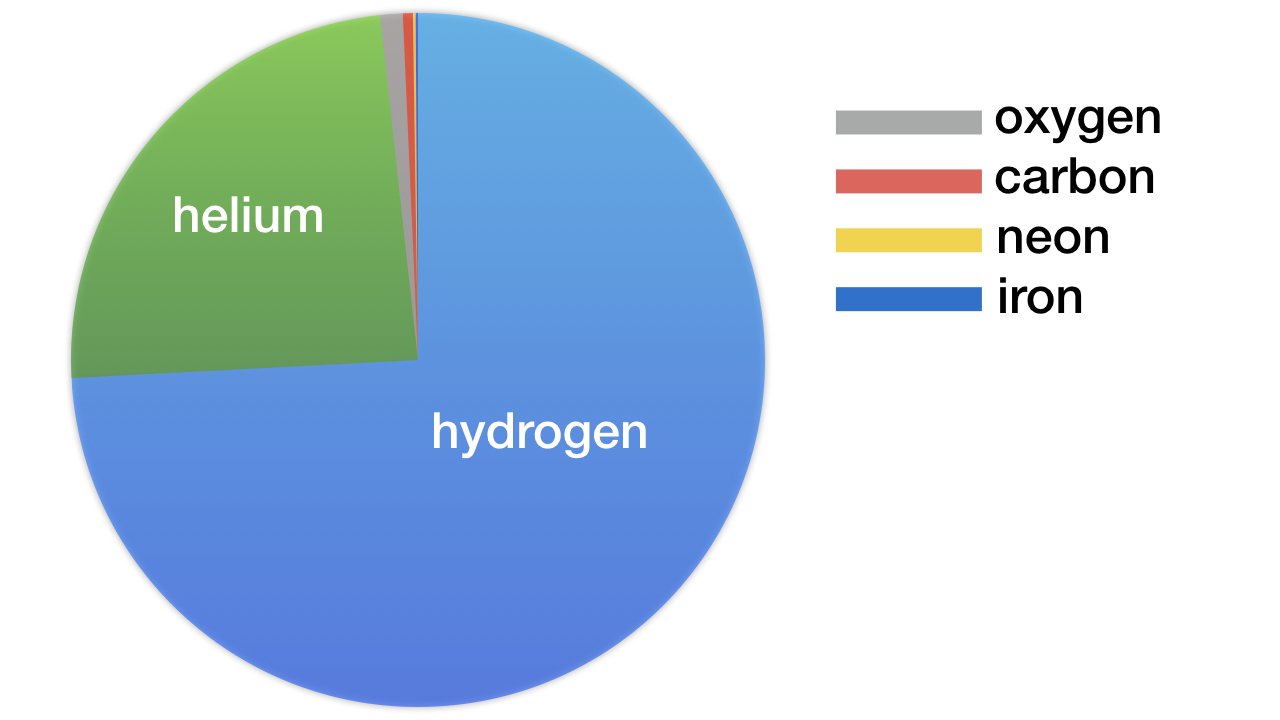
The gas between us and a bright quasar or galaxy will absorb some of the light of the quasar or galaxy if that gas is not too hot. Typically, astronomers determine the mass of the gas by measuring the absorption spectra of the two most abundant elements comprising intergalactic gas, namely, hydrogen and helium. (Hydrogen and helium make up 98–99 percent of the baryons in intergalactic gas.) This option, however, is out. The intergalactic gas is so extremely hot that it completely strips away all the electrons normally attached to hydrogen and helium nuclei. The resulting plasma of free electrons and hydrogen and helium nuclei do not absorb any light.

After hydrogen and helium, oxygen is the third most abundant element in the universe (see figure 2).3 Oxygen atoms have eight electrons compared to two for helium and one for hydrogen. It takes a lot more heat to strip away all electrons of oxygen than it does for helium or hydrogen. Ostriker and Cen calculated that the heat of intergalactic gas would be able to strip away only five, six, or seven of oxygen’s eight electrons. Therefore, the remaining electrons would produce an absorption spectrum that would permit a determination of the mass of the intergalactic mass.

blog__inline--discovery-of-missing-atomic-matter-2

Figure 2: Relative Mass Fractions of the Elements in the Universe. Hydrogen and helium comprise more than 98 percent of the universe’s element abundance. Image credit: Hugh Ross

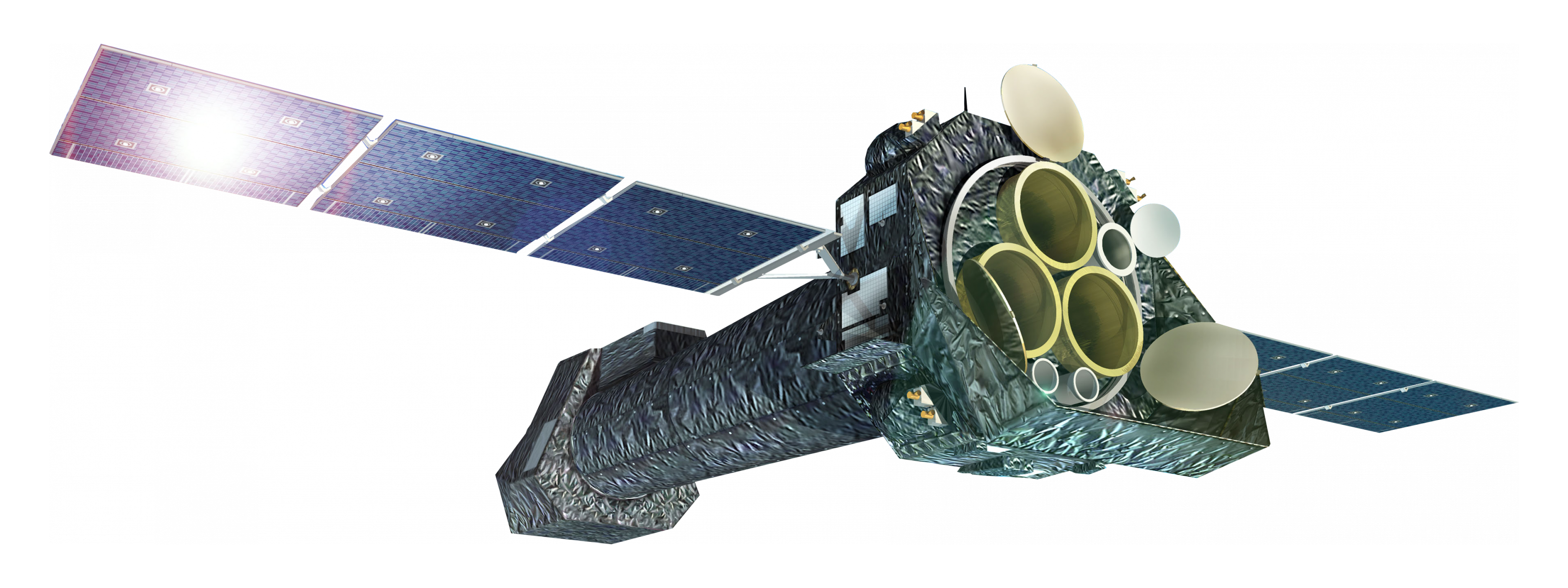
Not until this year did astronomers gain the necessary instrumentation and observing time to detect (more than marginally) the oxygen absorption spectra of hot intergalactic gas. A team of 21 astronomers led by Fabrizio Nicastro performed a very long duration observation on the brightest known X-ray blazer, IES 1553+1334, with the X-ray multi-mirror Newton telescope(see figure 3).5 They detected the absorption spectrum of OVII, oxygen atoms with six of their eight electrons stripped away by the hot intergalactic gas. Thanks to their long observing time, Nicastro’s team achieved a high enough signal-to-noise ratio in their absorption spectra measurements to conclude that they had found all of the missing baryons.

blog__inline--discovery-of-missing-atomic-matter-3

Figure 3: The XMM-Newton X-Ray Telescope and Spacecraft. Image credit: NASA/ESA

The conclusion by Nicastro’s team, however, was based on a single object. The possibility remained that the density of the hot intergalactic medium might vary slightly from location to location. To be certain that they had found all the missing baryons, astronomers needed confirmation based on at least one other bright extragalactic source and preferably accomplished with a different X-ray telescope.

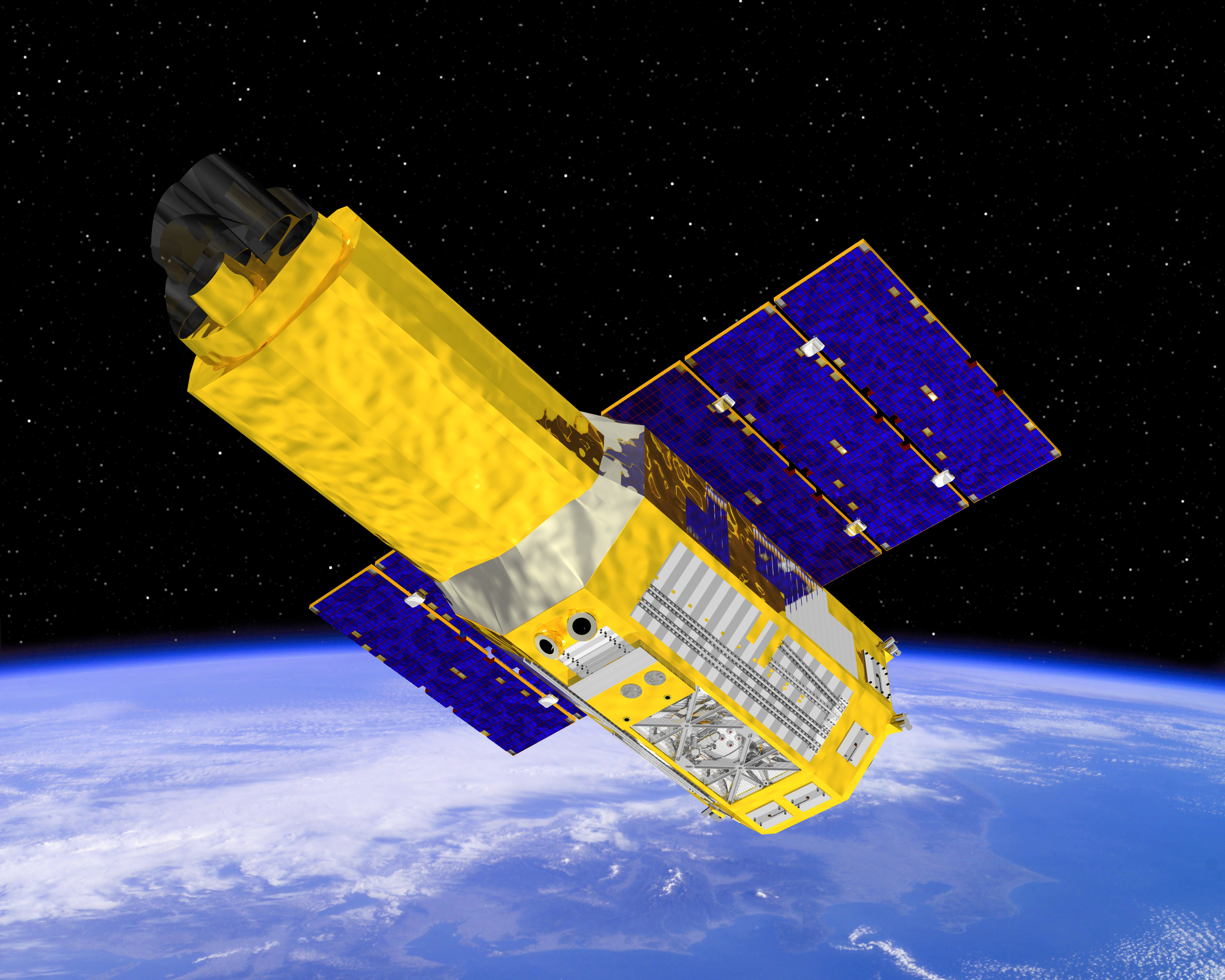
In a recent submission to the Astrophysical Journal, a team of six astronomers led by Sanskriti Das reported that they had achieved OVII absorption line measurements on the spiral galaxy NGC 3221 (see figure 4) using the Suzaku X-ray telescope (see figure 5).6 Though the signal-to-noise ratio of their measurements was not as good as that realized by Nicastro’s team, the Das team’s measurements were consistent with the conclusion that they found all the missing baryons.

blog__inline--discovery-of-missing-atomic-matter-4Figure 4: Spiral Galaxy NGC 3221. Image credit: Sloan Digital Sky Survey
blog__inline--discovery-of-missing-atomic-matter-5

Figure 5: Suzaku X-Ray Telescope and Spacecraft. Image credit: NASA

Sunyaev-Zel’dovitch Effect on Detection of the Missing Baryons
At the same time that Nicastro’s and Das’s teams of astronomers were finding the universe’s missing baryons through the X-ray absorption spectra method, two other teams of astronomers found the missing baryons using a completely different method. They looked for subtle distortions in the spectrum of the cosmic microwave background radiation, the radiation left over from the cosmic creation event.

As the radiation from the very early history of the universe streams across the cosmos, it can be slightly distorted by the regions of gas that it passes through. The electrons in the hot intergalactic gas will interact with photons from the cosmic microwave background radiation in a manner that imparts a little extra energy to those photons. Thus, astronomers should be able to see subtle distortions in their maps of the cosmic microwave background radiation.

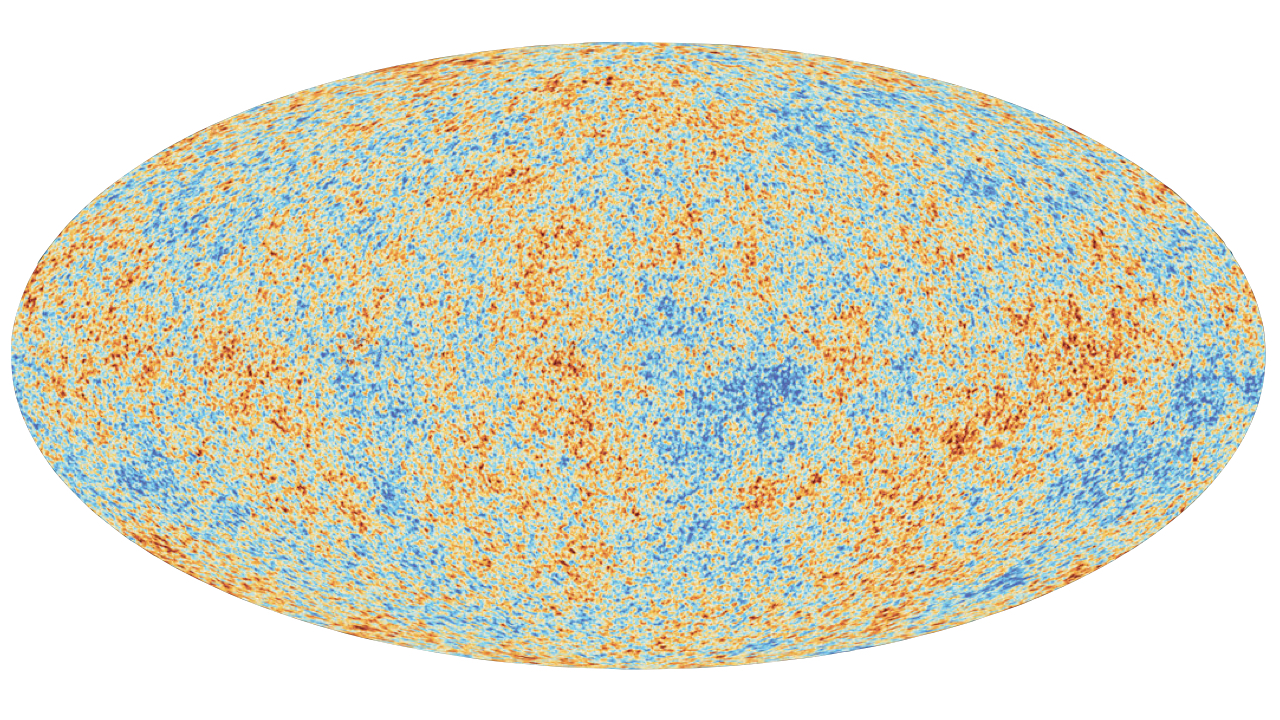
The Planck spacecraft yielded the most detailed map of the cosmic microwave background radiation (see figure 6). However, for even this most detailed map, the distortions from the electrons in the hot intergalactic gas were too subtle to see.

blog__inline--discovery-of-missing-atomic-matter-6

Figure 6: Planck Spacecraft Map of the Cosmic Microwave Background Radiation. The colors indicate tiny temperature fluctuations, with red regions warmer and blue regions colder by about 0.0002 degrees. Image credit: ESA/Planck Collaboration

While the Planck spacecraft was not able to detect the effect of intergalactic hot gas existing between any single pair of galaxies, astronomers found a way to enhance the signal by stacking images of different galaxy pairs on top of one another. First, they searched published galaxy catalogs and selected pairs of galaxies that were massive enough and the appropriate distance apart from one another that the astronomers expected there would be a dense web of hot intergalactic gas between them. Second, they went to the Planck map of the cosmic microwave background radiation and precisely identified the location for each galaxy pair. Third, they used digital scissors to clip the region for each galaxy pair from the Planck map. Fourth, they stacked all the clipped regions on top of one another so that all the pairs of galaxies were aligned in the same exact position. Fifth, they subtracted out the light from all the gas associated with the galaxy pairs from the stacked images, leaving just the signal from the intervening intergalactic gas. What had not been possible to detect based on a single pair of galaxies became visible when integrated over many, many pairs of galaxies.

In another research effort, a team of four astronomers led by University of Edinburgh’s Anna de Graaff stacked Planck map image pieces of a million pairs of galaxies on top of one another.7 The remaining signal after the subtraction of the signal from all the gas associated with the one million galaxy pairs was strong enough to enable de Graaff’s team to determine the mass of the hot intergalactic gas. That mass added up to the missing baryons.

Finally, an independent team of nine astronomers led by University of British Columbia’s Hideki Tanimura used 260,000 pairs of luminous red galaxies taken from the Sloan Digital Sky Survey Data Release 12 and stacked their Planck map image pieces on top of one another.8Their measured mass of the hot intergalactic gas also added up to the missing baryons.

All together, astronomers have four independently achieved measurements of the mass of the hot intergalactic medium based on two completely distinct methods and using different telescopes and different databases of galaxies and quasars. That all four measurements add up to the missing baryons gives astronomers confidence that they really have found the missing baryons of the universe. The missing baryons problem of big bang cosmology has now been solved. Hence, the scientific case for the validity of the biblically predicted big bang creation model is more firmly established than ever before.9 Thus, we can all be assured that the God of the Bible personally created and designed the universe for the express benefit of human beings.

Featured image: Computer Simulation Showing Distribution of the Warm-Hot Intergalactic Gas in the Universe
Image credit: Princeton University

Endnotes
  1. Hugh Ross and John Rea, “Big Bang—The Bible Taught It First!” Facts For Faith (Quarter 3, 2000): 26–32, https://www.reasons.org/explore/publications/rtb-101/read/rtb-101/2000/06/30/big-bang-the-bible-taught-it-first.
  2. Renyue Cen and Jeremiah Ostriker, “Where Are the Baryons?” Astrophysical Journal 514 (March 20, 1999): 1–6, doi:10.1086/306949.
  3. Wikipedia, s.v. “Abundance of the Chemical Elements,” https://en.wikipedia.org/wiki/Abundance_of_the_chemical_elements.
  4. M. Raiteri et al., “Synchrotron Emission from the Blazar PG 1553+133. An Analysis of Its Flux and Polarization Variability,” Monthly Notices of the Royal Astronomical Society 466 (April 21, 2017): 3762–74, doi:10.1093/mnras/stw3333.
  5. Fabrizio Nicastro et al., “Observations of the Missing Baryons in the Warm-Hot Intergalactic Medium,” Nature558 (June 21, 2018): 406–9, doi:10.1038/s41586-018-0204-1.
  6. Sanskriti Das et al., “Discovery of Massive Warm-Hot Circumgalactic Medium around NGC 3221,” arXiv:1810.12454v1 [astro-ph.GA], October 31, 2018, submitted to the Astrophysical Journalhttps://arxiv.org/pdf/1810.12454.pdf.
  7. Anna de Graaff et al., “Missing Baryons in the Cosmic Web Revealed by the Sunyaev-Zel’dovich Effect,” arXiv:1709.10378v2 [astro-ph.CO], October 5, 2017, https://arxiv.org/pdf/1709.10378v1.pdf.
  8. Hideki Tanimura et al., “A Search for Warm/Hot Gas Filaments between Pairs of SDSS Luminous Red Galaxies,” arXiv:1709.05024v2 [astro-ph.CO], October 5, 2018, submitted and accepted by Monthly Notices of the Royal Astronomical Societyhttps://arxiv.org/pdf/1709.05024.pdf.
  9. Ross and Rea, “Big Bang.”

About Reasons to Believe

RTB’s mission is to spread the Christian Gospel by demonstrating that sound reason and scientific research—including the very latest discoveries—consistently support, rather than erode, confidence in the truth of the Bible and faith in the personal, transcendent God revealed in both Scripture and nature. Learn More »

Support Reasons to Believe

Your support helps more people find Christ through sharing how the latest scientific discoveries affirm our faith in the God of the Bible.

DONATE NOW


U.S. Mailing Address
818 S. Oak Park Rd.
Covina, CA 91724
  • P (855) 732-7667
  • P (626) 335-1480
  • Fax (626) 852-0178

Reasons to Believe logo

Posted in Uncategorized | Leave a comment

Take Up and Read: C.S. Lewis’ Case for the Christian Faith


BY KENNETH R. SAMPLES – NOVEMBER 13, 2018

I am writing this ongoing blog series on Reflections to encourage Christians to read more vigorously and enrich their lives with Christian classics in such fields as theology, philosophy, and apologetics. Hopefully, a brief introduction to these Christian texts will motivate today’s believers to, as St. Augustine was called in his dramatic conversion to Christianity, “take up and read” (Latin: Tolle lege) these excellent books.

blog__inline--take-up-and-read-cs-lewis-case-for-christian-faithThis week’s book is C. S. Lewis’ Case for the Christian Faith by Catholic philosopher Richard Purtill. It is one of the best books for helping people—both those who are new to Lewis and those who know his writings well—to understand Lewis’s basic case for the truth of Christianity. A reliable guide, Purtill explains Lewis’s apologetics thinking with powerful insights.

Why Is This Author Notable?

Richard Purtill (1931–2016) taught philosophy at Western Washington University for many years. A prolific author, Purtill wrote many academic works on philosophy, religion, ethics, and the study of logic. But he was also a popular author of fantasy and science fiction novels. A Roman Catholic by theological conviction and a lover of imaginative literature, Purtill wrote books on the thoughts of both J. R. R. Tolkien and Lewis.

What Is This Book About?

Using his broad knowledge of Lewis’s writings of fiction and nonfiction, Purtill presents, in 10 chapters, Lewis’s basic apologetics approach for the truth of the Christian faith. Purtill’s book introduces Lewis’s thinking on such critical topics as God’s existence, the nature and attributes of God, the person of Christ, miracles, faith and reason, rivals of Christianity, Christian living and prayer, and death and the hereafter.

Purtill systematically presents Lewis’s theological and apologetics ideas with clarity. He also organizes Lewis’s thoughts and provides a basic philosophical framework for seeing Lewis’s case in terms of a logically based worldview. Purtill’s work helps readers to think through and understand the bigger picture. It also encourages people to reread Lewis’s writings with fresh understanding and with a greater overall perspective on Lewis’s apologetics model.

Here, Purtill offers a brief explanation for Lewis’s enormous success and influence as a Christian thinker and author:

The explanation for Lewis’ success is to be found in all the aspects of Lewis as a man and a writer, in his imaginative and moral qualities as well as his intellectual capacities.1

Why Is This Book Worth Reading?

C. S. Lewis is arguably the most influential Christian apologist of the twentieth century. But his books sell better today than when he was living, more than 50 years ago. Anyone who wants to gain a greater understanding of Lewis’s thinking will benefit significantly from reading Purtill’s fine introduction. Read Purtill and then reread Lewis’s masterful apologetics works.

Resources

Endnotes
  1. Richard Purtill, S. Lewis’ Case for the Christian Faith (San Francisco: Ignatius, 2004), 14.

About Reasons to Believe

RTB’s mission is to spread the Christian Gospel by demonstrating that sound reason and scientific research—including the very latest discoveries—consistently support, rather than erode, confidence in the truth of the Bible and faith in the personal, transcendent God revealed in both Scripture and nature. Learn More »

Support Reasons to Believe

Your support helps more people find Christ through sharing how the latest scientific discoveries affirm our faith in the God of the Bible.

DONATE NOW


U.S. Mailing Address
818 S. Oak Park Rd.
Covina, CA 91724
  • P (855) 732-7667
  • P (626) 335-1480
  • Fax (626) 852-0178

Reasons to Believe logo

Posted in Uncategorized | Leave a comment

Learning about Christian Creeds, Part 1

BY KENNETH R. SAMPLES – AUGUST 14, 2018

Have you ever recited the Apostles’ Creed?

It is widely used in Western Christendom, both in the Roman Catholic Church and in various Protestant churches (Lutheran, Reformed, Presbyterian, Anglican, Methodist, Congregational, among others). In fact, most evangelical churches have creedal statements that serve as something like the Apostles’ Creed. Some nondenominational churches even sing the creed in their worship services.

Christian historian Jaroslav Pelikan says this about creeds and their use in Christendom:

Every Sunday all over the world, millions and millions of Christians recite or sing (or, at any rate, hear) one or another creed, and most of them have had a creed spoken over them, or by them, at their baptism.1

Let’s take some time to read through the Apostles’ Creed, and then we’ll learn more about Christian creeds in general:

Apostles’ Creed

I believe in God, the Father almighty,
creator of heaven and earth.

I believe in Jesus Christ, his only Son, our Lord,
who was conceived by the Holy Spirit
and born of the virgin Mary.
He suffered under Pontius Pilate,
was crucified, died, and was buried;
he descended to hell.
The third day he rose again from the dead.
He ascended to heaven
and is seated at the right hand of God the Father almighty.
From there he will come to judge the living and the dead.

I believe in the Holy Spirit,
the holy Catholic church,
the communion of saints,
the forgiveness of sins,
the resurrection of the body,
and the life everlasting. Amen.

Five Important Points about Christian Creeds

Creeds have been an important part of historic Christianity from the very beginning. Christians recite creeds to confess or profess their faith publicly. The creeds serve as authoritative pronouncements that set forth in summary form the central beliefs of the Christian faith.

Let’s consider five points you may not know about creeds:

1. The term “creed” comes from the Latin credo, meaning “I believe.” The opening line of the Apostles’ Creed in Latin reads Credo in Deum—“I believe in God.” In the ancient world, the name of documents often came from the first words that were used in the statement.

2. There are creedal or protocreedal statements even in the Bible. The most often cited Old Testament passage serves as a creed and is called the Shema (Hebrew for “Hear”). This comes from Deuteronomy 6:4, which reads, “Hear, O Israel: The LORD our God, the LORD is one.”The New Testament contains a number of ancient Christian creeds (1 Corinthians 8:615:3–4), with possibly the earliest creed being the statement “Jesus is Lord!” from Romans 10:9 and Philippians 2:11 (Greek: κύριος Ἰησοῦς, kyrios Iesous). So creeds have a clear biblical basis.

3. Christian creeds serve to both formulate and affirm essential Christian doctrine. For example, the Apostles’ Creed focuses upon a fully formed Trinitarian theology by having the three stanzas of the creed address the three distinct persons of the Trinity (Father, Son, Holy Spirit).

4. The creeds can and do play a helpful role in catechetical instruction in Christian doctrine and theology. At a time when doctrine is often undervalued, the creeds can aid believers in developing an organized, precise, and correct understanding of the Christian faith.

5. The creeds have direct theological and apologetic importance. All of Christendom’s formal creeds were written to specifically combat heresies that had arisen in the early centuries of the Christian church (such as the influential Christological heresy known as “Arianism”).

So why do historic Christians continually recite their creeds? Theologian Luke Timothy Johnson has a very good response:

Some truths are so critical that they must be repeated over and over again.2

Join me next week for the second installment of this series in which we’ll examine the creeds further.

Resources

Endnotes
  1. Jaroslav Pelikan, Credo (New Haven, CT: Yale University Press, 2003), 1.
  2. Luke Timothy Johnson, The Creed (New York: Doubleday, 2004), 40.

About Reasons to Believe

RTB’s mission is to spread the Christian Gospel by demonstrating that sound reason and scientific research—including the very latest discoveries—consistently support, rather than erode, confidence in the truth of the Bible and faith in the personal, transcendent God revealed in both Scripture and nature. Learn More »

Support Reasons to Believe

Your support helps more people find Christ through sharing how the latest scientific discoveries affirm our faith in the God of the Bible.

DONATE NOW


U.S. Mailing Address
818 S. Oak Park Rd.
Covina, CA 91724
  • P (855) 732-7667
  • P (626) 335-1480
  • Fax (626) 852-0178

Reasons to Believe logo

Posted in Uncategorized | Leave a comment

Why Did God Kill All the Men, Women, and Children in Sodom?

BY HUGH ROSS – AUGUST 8, 2018

The way I typically hear this question is, why did God kill every man, woman, and child living in Sodom and Gomorrah? This question is frequently asked by Christians and non-Christians alike, and it’s commonly used as a basis for people to reject the existence of the God of the Bible. Such individuals presume that an all-loving God would never do such a thing.

Societal Reprobation
The full description given in Genesis of the behavior and morality of the people living in Sodom and Gomorrah makes it indisputably clear that Sodom and Gomorrah are examples of societal reprobation. Reprobation is a term used in the Bible to describe an individual who is irretrievably evil. It describes an individual whose every thought and action is evil all the time. Such individuals believe that what normal human beings consider as evil acts are actually good, and what normal human beings consider as good acts are actually evil. Such human beings not only are continually intent on evil, but also work tirelessly to morally corrupt others; to persuade, and if possible force, others to join them in their evil thinking and behavior.

Societal reprobation describes a town, city, set of cities, or a nation where every man, woman, and child in that town, city, set of cities, or nation is reprobate. Societal reprobation has always been rare. In fact, since the day of Pentecost described in Acts 2, when Jewish Christians for the first time were permanently indwelled by the Holy Spirit, the equivalent of the day of Pentecost for Samaritan Christians described in Acts 8, and the equivalent of the day of Pentecost for gentile Christians described in Acts 10, it has been nonexistent. That permanent indwelling made the followers of Jesus Christ “the salt of the earth.” Such spiritual salt acts as a preservative that prevents the outbreak of societal reprobation.

The possibility of societal reprobation during Old Testament times and its impossibility since the days of Pentecost explains why many skeptics conclude that the God of the Old Testament contradicts the God of the New Testament. Such skeptics err—God has not changed. It is people who have changed.

Evidence of Societal Reprobation in Sodom and Gomorrah
Three different Bible texts affirm that Sodom and Gomorrah indeed are examples of societal reprobation. One text, Genesis 19:1–9, describes a test performed by two of God’s righteous angels. These angels visited Sodom to determine if its inhabitants were as evil as the reports they had heard. They decided to spend the night in the city square so as to observe the behavior of the Sodomites for themselves. Lot, the only man in the city who had not yet succumbed to reprobation, insisted that they not spend the night in the city square. Evidently, he knew how dangerous that would be for them. He implored them to stay under the protection of his house. Shortly thereafter, Lot’s house became surrounded by every man, young and old, from every part of the city Sodom. The phrase “young and old” implies that the men surrounding Lot’s house included young boys and elderly men. The men demanded that Lot send his two guests outside so that they could all subject his two guests to homosexual rape.

There was no stopping the assembled mob. Desperate to protect his two guests, Lot even offered to send his two virgin daughters out to the mob to do with them as they wished, if only they would leave his guests alone. The mob turned down the offer, moved forward to break down the door to Lot’s house, and threatened to do to Lot much worse than what they were intent on doing to his two guests.

Lot’s offer testifies to the degree of reprobation in Sodom. This offer shows that the reprobation was so persuasive that even Lot, a righteous man, was in grave danger of succumbing to the spiritual cancer that surrounded him. 2 Peter 2:7–8 describes how the Sodomites distressed and tormented Lot.

The second Bible text, Genesis 18:16–33, describes a conversation between God and Abraham where Abraham, on behalf of his nephew Lot, begs God to save Sodom and Gomorrah from destruction. Abraham first asks if fifty people in Sodom are found to be righteous, would not God save all the inhabitants of Sodom on behalf of those fifty? God says he would. Abraham then bargains God all the way down to just ten righteous people in the city. Every time, God says “yes.” At that point, Abraham realizes that the only righteous people left in Sodom are Lot and his family. Knowing that God has promised to rescue Lot and his family before destroying Sodom and Gomorrah, Abraham stops his begging. He now recognizes that all the inhabitants of the Sodomite plain are reprobate except for Lot and his family.

The third Bible text affirming societal reprobation in Sodom and Gomorrah is Genesis 15:12–16. In this text God says to Abraham that while the Amorites living in the hills with him are evil, their evil “has not yet reached its full measure.” God explained to Abraham that it would take another four hundred years for the Amorites to degrade into societal reprobation. Only at that time would God act to remove the Amorites from the land of Canaan.

Why Not Isolation? 
A remaining question is, why does God not simply isolate reprobate societies and let them die natural deaths? The answer is to protect the future generations of those societies and to protect the inhabitants of their neighboring societies.

Once all the inhabitants of a city become completely reprobate, there is no hope for the children born in that city. As Paul points out in Romans 1:32, reprobation is malignant. Children born in a city where all the inhabitants are reprobates will be surrounded by the malignant spiritual cancer of reprobation. For them, there is no escape. As with metastasized stage 4 cancer, they will be infected and completely overcome. To prevent that from happening, God surgically removes a reprobate society as soon as its reprobation becomes pervasive.

Another reason God surgically intervenes is to prevent the spiritual cancer from spreading to communities adjoining the reprobate society. Societies do not and cannot operate in isolation. Cities must be maintained by trade with adjoining communities. If God had not acted in the manner that he did, the spiritual malignancy in Sodom and Gomorrah inevitably would have spread.

God’s destruction of Sodom and Gomorrah was a profound act of mercy and love. As I explain in my book Beyond the Cosmos, from the perspective of eternity it was even a profound act of mercy and love to the reprobates themselves.1

Endnotes
  1. Hugh Ross, Beyond the Cosmos: The Transdimensionality of God, 3rd ed. (Covina, CA: RTB Press, 2017), 177–84.

About Reasons to Believe

RTB’s mission is to spread the Christian Gospel by demonstrating that sound reason and scientific research—including the very latest discoveries—consistently support, rather than erode, confidence in the truth of the Bible and faith in the personal, transcendent God revealed in both Scripture and nature. Learn More »

Support Reasons to Believe

Your support helps more people find Christ through sharing how the latest scientific discoveries affirm our faith in the God of the Bible.

DONATE NOW


U.S. Mailing Address
818 S. Oak Park Rd.
Covina, CA 91724
  • P (855) 732-7667
  • P (626) 335-1480
  • Fax (626) 852-0178

Reasons to Believe logo

Posted in Uncategorized | Leave a comment